
Tight Purse Strings
Henry VII was well-known for his miserliness. “The popular tradition respecting his avarice, which has descended to us, seems only too well founded. It is quite the characteristic of a usurer to have a fondness for gold. We are informed that whenever a gold coin entered the chest of Henry it never found its way out again” ( Bergenroth 69).
Don Pedro de Ayala, envoy to Ferdinand and Isabella of Spain, revealed that although Henry had many qualities that would have rendered him great, “he had but one characteristic which spoilt all the rest, his love of money” (Bergenroth 53).
It was claimed that when he was not with his council or in public he was “writing accounts of his expenses with his own hand” (Tremlett 95). “He also handled the cash himself. In his own handwriting, he itemised the moneys delivered in one day to … the treasurer of his chamber…all amounting to several thousands of pounds” (Hutchinson 41).
Ledger initialed by Henry VII from 1492 Accounts written in Henry’s handwriting


The king collected money from taxation, plus the obligations and fines he placed on his subjects (rich and poor). Out of the “sixty-two families in the English peerage that survived the butchery of the War of the Roses, forty-seven were at the king’s mercy, either by living under attainder or forfeiting substantial sums to the crown to guarantee their good behavior” (Hutchinson 42). These recognisances were imposed and collected by the able administrators, Sir Richard Empson and Edmund Dudley. The activities of these two men were known throughout the Court as Don Pedro de Ayala reported to Ferdinand and Isabella that Henry’s servants had “a wonderful dexterity in getting hold of other people’s money” (Bergenroth 207).
Henry VII’s priorities were revealed in the power and prestige granted to these two trusted advisors. The policies they implemented, in the king’s name, generated as much hatred and distrust as they did revenue. Although not everyone felt that way, courtiers who profited from Henry VII’s fiscal policies did worry when Henry VIII came to the throne that he would reverse “his father’s tight-fistedness…” (Jones 222), most resented Henry VII and his administration. In fact, one of Henry VIII’s first acts as king was the arrest of these two men, “greate counsaylers to the late kyng, were attached and brought to the Tower, not to the litle rejoysyng of many persones, whiche by them wer greved, whiche, attachement was thought to bee procured by malice of theim, that with their aucthoritie, in the late kynges daies wer offended, or els to shifte the noyse, of the straight execucion of penall statutes in the late kynges daies, by punishement of those persones, and other promoters, for to satisfie and appeace the people” (Hall).
For a discussion of the land revenues and prerogative feudal rights which Henry VII took advantage of to generate income, see Stanley Bertram Chrimes’ Henry VII. It is enough here to understand that Henry VII found a source of revenue which he pursued “with a zeal and relentless application which earned him and his agents an unpopularity and a measure of odium which became marked towards the end of the reign…” (Chrimes 209). Although other sovereigns had used these methods, none had “taken such a close personal part in wielding the whips and scorpions of financial pressures to attain their ends” (Chrimes 214). No wonder Henry VII emerges in the pages of history as miserly and avaricious. A study of the Calendar of Close Rolls for 1500-1509 by K. B. McFarlane led him to declare that by the end of his reign Henry VII “governed by recognizance” (Chrimes 214). It has been estimated that Henry extorted (hard to use any other word) close to £495 million in present-day monetary values from his subjects (Hutchinson 43).
Henry “made rebellions, like wars, pay their own expenses, and even yield him a mine of treasure, which was a source, in its turn, of stability to the country, giving him more ample power to put down future outbreaks. For the great majority of insurgents he had no other punishment than fines…. Violation, even of laws which were antiquated, was visited with fines which went to the king’s coffers” (Gairdner 215).
Despite the general belief that Henry had amassed a large surplus early in his reign (Chrimes 217), the Spanish envoy, Don Pedro de Ayala, remarked, “The King of England is less rich than generally said. He likes to be thought very rich because such a belief is advantageous to him in many respects. The King himself said to me that it is his intention to keep his subjects low, because riches would only make them haughty…” (Hutchinson 41). The viewpoint that Henry’s miserliness was a political rather than an avaricious motive is taken up further by Polydore Vergil. Writing under the patronage of the Tudors, Vergil did not ignore the fact that Henry VII gained money in dubious ways although he does offer explanations.
…id quod argumentum non dubium erat eum, sicut ipse aiebat, studio coercendi ferocem populi inter factiones nutriti animum, non item cupiditate cogendae pecuniae, ea coepisse uti severitate, quemadmodum supra demonstravimus, quanquam saucii ista non tam severitatis quam avaritiae tela esse clamabant. Sane modestus princeps non emungebat suos fortunis immodice qui regnum rebus omnibus longe locupletissimum reddidit reliquitque, quod planum praeter caetera fecit immanis auri pariter atque argenti copia quae in annos singulos in insulam importata est a mercatoribus ultro citroque commeantibus, quos ille saepenumero pecunia ad tempus data gratuito iuvabat, ut mercatura ars una omnium cunctis aeque mortalibus cum commoda, tum necessaria, in suo regno copiosior esset.
This was a sure sign that, just as he himself said, he resorted to this severity for the sake of curbing the fierce spirits of a people brought up amidst factionalism, not out of a lust for money-making, as I have shown above, although those who were wounded in this way exclaimed these were the darts of greed, not severity. Indeed, this modest sovereign did not despoil his subjects of their fortunes immoderately, for he left behind him a kingdom most wealthy in all respects. This is made plain, among other things, by the immense amount of gold and silver annually brought into the island by merchants plying to and fro, whom he very frequently helped with interest-free loans, so that the flow of commerce, both useful and necessary for all men, would be more abundant in his realm.
Thomas Penn brings forth the idea that Henry VII’s obsession with money was not the actions “of a miser, but of a sophisticated financial mind…” (Penn 156). This is an interesting point of view and one that was not held by many others, although Josephine Ross does admire Henry and his policies. She commented that Henry “…was a born accountant, who loved to spend hours closeted with lists of figures signing every entry with his own hand, those accounts revealed some attractive aspects of his personality” (Ross 22). His financial records do show expenditures to charitable causes, music, a variety of entertainments, architecture, sporting events, and gambling (Ross, Penn, and Chrimes). According to Ross, “There was nothing miserly about Henry VII; he was intensely careful with money, but he recognized the importance of spending freely to keep up a regal image” (Ross 22). This incongruity between miserliness and extravagance is something which was held in common between Henry VII and his granddaughter, Elizabeth Regina.
Elizabeth had inherited “…the financial prudence of her grandfather” (Neale 294) and the depleted coffers of her father. “A sense of economy was inbred as well as inborn in Elizabeth” (Neale 296). Prior to her accession her income had been small even after she received her inheritance from her father and acquired Hatfield. Elizabeth had learned to be careful with her monies. “Her financial affairs, which had been in a precarious state since her father’s death, assumed a more healthy aspect when she took over the book-keeping herself, maintaining meticulous records of her expenditure and personally signing each page of the accounts” (Somerset 28).
Even as Queen she was watchful and her “stringent economies effected soon after her accession…” plus her “prudent financial management” allowed her to escape true money worries while maintaining her Court (Somerset 281). What she managed to achieve with the limited resources available is astounding. It is “that financial sense of Elizabeth’s, her resolute, irritating parsimony that the secret of greatness lay” (Neale 101).
She was a penny-pincher, but she knew, like her grandfather, where and when to spend money for political reasons. “Balancing the books was to be her life-long preoccupation as Queen” and she understood there had to be revenue (Starkey 221). Elizabeth realized that, as money got tighter, she had to extract money at any possible source beyond the ordinary income from taxes, rates, etc.
It is well-known that privateering brought in some revenue for the Crown but never as much as hoped. Elizabeth had exclaimed that “she had known from the very first that everyone would make a fortune out of the business except herself” (Strachey 112).
One revenue source came from the requirement that Bishops give 10% of their revenue to the Crown and at their appointment the equivalent of a year’s income. Although it was claimed she did not exploit this, it was common knowledge that later in her reign, Elizabeth was able to tap into this income by moving her Bishops between dioceses (Somerset 86). She believed, by using “this judicious redistribution of the national wealth she was preserving her kingdom’s stability” (Somerset 88).
When the economy started to slip, she responded by selling some property, appropriating new funds and further reducing government expenditure. Yet, like her grandfather, Elizabeth had virtuous reasons for her miserliness. When England was at war late in her reign, she “practiced eternal vigilance over her own expenses, to the disgust of the greedy cormorants about her, everlastingly grumbling and gibing at her parsimony…” (Neale 346).
“Parsimony is not a popular virtue” (Neale 296). Elizabeth instituted “stringent economies that were often unpopular, but these measures kept England solvent at a time when most European countries were virtually bankrupt” (Weir 225). Keeping her debt to a minimum and balancing her expenditures with her ordinary income required her to never relax the tight purse strings. She performed wonders in keeping her creditors satisfied and shouldering most of the burden without “impairing the efficiency of government or casting the gloom of poverty over the Court, the splendor of which was the nation’s pride and the monarch’s dignity” (Neale 296).
To further complicate money issues was this paradox: Elizabeth was miserly for reasons of political capital and she was extravagant for the same purpose. Although careful with her money, Elizabeth never stinted on outward show. She knew that to attract the upper classes to her Court she had to impress the whole country with the visual aspects of power. Perception is reality. The queen wore costly gowns (she had over three thousand –a topic for a future blog) and owned a magnificent collection of jewelry knowing full-well the role she played. “Princes, you know, stand upon stages so that their actions are viewed and beheld of all men…” (Marcus, 189).
Therefore, clothing, court ceremonial, entertainments, even furnishings were extravagant with the intent to show majesty and impress all who came to the Court.
Many costs of these items could be defrayed by what would become a large, unavoidable expense for the noblemen–a lavish gift for the queen. She enjoyed receiving costly gifts throughout her reign. A contemporary explained that “She was very rich in jewels, which had been given her by her subjects; for in times of progress there was no person that entertained her in his house but (besides his extraordinary charge in feasting her and her train) he bestowed a jewel upon her; a custom in former times begun by some of her especial favorites that (having in great measure tasted of her bounty) did give her only of her own; though otherwise that kind of giving was not so pleasing to gentlemen of meaner quality” (Robinson 192). The Spanish envoy Count de Feria commented soon after her coronation that Elizabeth “is very fond of having things given to her” (Erickson 174).
Ship Pendant given to Elizabeth Gloves given to Elizabeth
by Sir Francis Drake by the University of Oxford
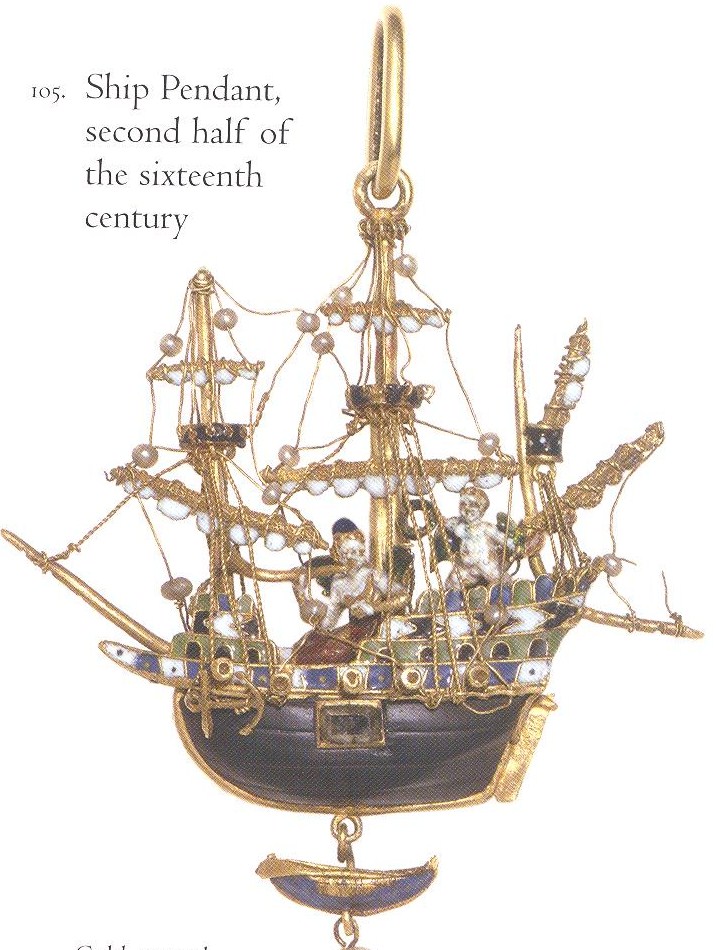

Elizabeth’s yearly progresses were another way to subsidize the living costs of Court. Being housed at others’ expense during her lengthy progresses was a sure way for her to be seen by her people, in all her majesty, and allow her to graciously accept the hospitality of many and not cost the Exchequer any money (Ridley 180).
As the decades progressed and expenses mounted, Elizabeth was less apt to reward her courtiers as in earlier days as she was led to “tightening up in the distribution of patronage” (Somerset 547). She reduced government expenditure, rewarding her administrators so sparingly with titles, lands and monopolies, especially monopolies, that corruption was inevitable as nobles tried to find ways to generate funds.
Corruption became rampant and she scolded Parliamentary members by exclaiming “…if these fellows were well answered and paid with lawful coin, there would be fewer counterfeits among them” (Perry Word of a Prince 199). She was genuinely surprised when courtiers seemed less than satisfied with the patronage that was handed out. She had learned “that neither gifts nor pensions were the foundation of loyalty” (Neale 101).
Through it all, the welfare of her people and her duty to them, was foremost in her mind. Addressing her people late in her reign, the Queen said that “though God hath raised me high, yet this I count the glory of my crown: that I have reigned with your loves” (Marcus 337).
Works Cited
Bergenroth, G. A., and, Pascual De. Gayangos. Calendar of Letters,
Dispatches and State Papers, Relating to the Negotiations between England and Spain, Preserved in the Archives at Simancas and Elsewhere: Published by the Authority of the Lords Commissioners of Her Majesty’s Treasury under theDirection of the Master of the Rolls. Henry VII 1485 – 1509. ed. Vol. 1. London:
Longman, Green, Longman and Roberts, 1862. Google Books. Web. 26 Nov.
2012.
Chrimes, S. B. Henry VII. Berkeley: University of California, 1972. Google Books. Web. 31 Dec. 2012.
Erickson, Carolly. The First Elizabeth. New York: Summit Books. 1983. Print.
Gairdner, James. Henry the Seventh,. London: Macmillan, 1889. Google Books. Web. 26 Nov. 2012.
Hall, Edward, and Charles Whibley. Henry VIII,. Vol. I. London: T.C. & E.C. Jack, 1904. Google Books. Web. 1 Dec. 2012.
Hutchinson, Robert. Young Henry: The Rise of Henry VIII. London: Weidenfeld & Nicolson, 2011. Google Books. Web. 02 Dec. 2012.
Jones, Michael K. and Malcolm G. Underwood. The King’s Mother: Lady Margaret
Beaufort, Countess of Richmond and Derby. New York: Cambridge University Press, 1992. Print.
Marcus, Leah S. et al., eds. Elizabeth I: The Collected Works. Chicago: University of Chicago Press, 2002. Print.
Neale, J. E. Queen Elizabeth I. Garden City, NY: Doubleday, 1957. Print.
Penn, Thomas. Winter King; the Dawn of Tudor England. New York: Penguin Books, 2012. Print.
Perry, Maria. The Word of a Prince: A Life of Elizabeth from Contemporary
Documents. Woodbridge, Suffolk: The Boydell Press, 1990. Print.
Ridley, Jasper. Elizabeth I: The Shrewdness of Virtue. New York: Fromm International Publishing Corporation, 1989. Print.
Robinson, James Harvey. Readings in European History: A Collection of Extracts from the Sources Chosen with the Purpose of Illustrating the Progress of Culture in Western Europe since the German Invasions,. Vol. II. Boston: Ginn &, 1904. Google Books. Web. 19 Jan. 2013.
Ross, Josephine. The Tudors, England’s Golden Age. London: Artus, 1994. Print.
Somerset, Anne. Elizabeth I. New York: Alfred A. Knopf, 1991. Print.
Starkey, David, ed. Rivals in Power. New York: Grove Weidenfeld, 1990. Print.
Strachey, Lytton. Elizabeth and Essex: A Tragic History. New York: Harcourt Brace & Company, 1969. Print.
Tremlett, Giles. Catherine of Aragon: Henry’s Spanish Queen. London: Faber and Faber, 2010. Print.
Weir, Alison. The Life of Elizabeth I. New York: Ballatine Books, 1998. Print.
Vergil, Polydore. Polydore Vergil, Anglica Historia (1555 Version). Ed. Dana F. Sutton.
Irvine: University of California, 2005. Polydore Vergil, Anglica Historia (1555 Version). The Philological Museum, 04 Aug. 2005. Web. 02 Jan. 2013.


 elizregina