Words to the Wise

Words to the Wise

What is wisdom?  If we followed Aristotle’s idea of the practicality of wisdom not only would a person choose the best means to the ends or goals they may have, but also the ‘correct’ ends.  Now the discussion takes on another dimension involving ethical choices.  And where do we insert experiences, knowledge, perceptions, logic?  Regardless of the definition of wisdom, is it applied differently depending on the person and their role in life, such as a ruler?  If a head of state is expected to make decisions wisely, how do we judge the wisdom of the decisions?  Is it simply because we agree with her or his choices?

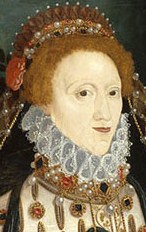
We have much evidence that Henry VII and Elizabeth Regina were wise given the profuse use of the word to describe them both.  With Henry we are assured that this “King, to speak of him in terms equal to his deserving, was one of the best sort of wonders, a wonder for wise men” (Bacon and Lumby 211).  Praise indeed.

henry 7          elizagheer2

Henry VII                                      Elizabeth Regina

Both Polydore Vergil, an Italian priest who arrived in Britain in the year 1502 and was commissioned by King Henry VII to write a history of Britain, and Edward Hall, a Henrican contemporary, commented on Henry’s wisdom, shrewdness, prudence and resoluteness especially in moments of danger.  “Kyng Henry being made wyse and expert with troubles and myschiefes before” in the time of his exile (Hall 435).  Vergil and Hall also observed how the people respected his abilities and “no one dared to get the better of him through deceit or guile” (Vergil 144).

polydore vergil  Edward Hall

Polydore Vergil                                                  Edward Hall

John Fisher, the Bishop of Rochester spoke glowingly of Henry.  Below are the text and the modern script of his oratory about Henry:

Fisher sermon   john fisher


John Fisher

All be it he had as much of them                                             
as was possible in manner for any king to have, his
politic wisdom in governance it was singular, his
wit always quick and ready, his reason pithy and
substantial, his memory fresh and holding, his
experience notable, his counsels fortunate and taken
by wise deliberation, his speech gracious in divers
languages … his dealing in time
of perils and dangers was cold and sober with great
hardiness.

Francis Bacon also reported that Henry’s “wit increased upon the occasion; and so much the more, if the occasion were sharpened by danger.  Again, whether it were the shortness of his foresight, or the strength of his will, or the dazzling of his suspicions…” (Bacon and Lumby 219).

Henry’s suspicions made him guarded in his dealings with others, in his plans and his strategies.  Perhaps it was this guarded behavior that led to the many chroniclers referring to him as shrewd.  He was “undoubtedly shrewd, calculating, and long-headed; he seems never to have been overcome by passion” (Elton 16).

He was so shrewd he could make good use of what little advantages he had and in turn he was not a man of whom people could take advantage.  Henry was very prudent in his selection of advisors.  He “cogregated together the sage councelers of his realme, in which coiisail like a prince of just faith and true of promes… (Hall 423).

Men wanted to serve him but they could not tell what was on Henry’s mind.  As a “wise Prince, it was but keeping of distance, which indeed he did towards all; not admitting any near or full approach, either to his power, or to his secrets: for he was governed by none” (Bacon and Lumby 215).

“Few indeed were the councillors that shared his confidence, but the wise men, competent to form an estimate of his statesmanship, had but one opinion of his consummate wisdom” (Gairdner 209).

Henry could not be called a learned man yet he was a lover of learning and gave his children an excellent education (Gairdner 217).  Famously in 1498-99 Erasmus met with the then future Henry VIII when he was eight in 1498-1499 and still in the royal nursery at Eltham in Kent.  Henry appreciated the humanist movement and ensured his sons were grounded in a classical education. Henry VII supported universities as well as his wife’s and mother’s patronage of colleges.  He purchased books and acquired a library.  “He was rather studious than learned; read most books that were of any worth, in the French tongue, yet he understood the Latin, as appeareth in that cardinal Adrian and Others, who could very well have written French, did use to write to him in Latin” (Bacon and Lumby 218). John Fisher spoke of Henry knowing many languages, the “fruit of his long exile” (Fisher).  Perhaps the best ‘education’ he had was the exposure to various governmental methods while in exile and visiting other Courts in Brittany and France.

eltham exterior                 Eltham_palace_GreatHall

Exterior and Interior of Eltham Palace

Henry brought with him the experiences and knowledge of the cultures of France, Burgundy and Brittany with the secular classical themes. “This trend had already been apparent at Edward IV’s court, but Henry was an important influence in encouraging trends which were to lead to the flowering of Renaissance culture at the Tudor court in the 16th century” (Loades 71). He made “princely use of his wealth, encouraged scholarship and music as well as architecture, and dazzled the eyes of foreign ambassadors with the spendour of his receptions” (Gairdner 9).

Ambassadors were astonished not only with his Court but with the depth of knowledge he displayed of the situations in their own countries and “that they did write ever to their superiors in high terms, considering his wisdom and art of rule:  nay, when they were returned, they did commonly maintain intelligence with him” (Bacon and Lumby 216)

Henry’s prudent policies, circumspect behaviors and political wisdom earned him high praise from contemporaries and historians.  “He was of an high mind and loved his own will and his own way, as one that revered himself and would reign…” with triumph as he excelled at so many things (Bacon 793).  He was successful.  He was prudent.  He was wise. He was emulated by his granddaughter, Elizabeth Regina.

Events in Elizabeth’s childhood taught her not to speak or act unwisely; her very life depended upon deliberate, cautious actions. These early lessons contributed to her wisdom and, along with her characteristics of intelligence, tenacity, compromise, and subtlety, she became well-respected.  Even after centuries, most historians and chroniclers explain “even her errors of taste and judgment as superlative examples of political skill” (Elton 262).

Author Jasper Ridley is one of the few dissenters.  He proposed that the truth was that “Elizabeth was an emotional woman, and often acted on impulse, and not from cunning political calculation” (Ridley 41).  Her successes were not by good policy and planning, “but by luck, by muddling through…” (Ridley 335).

As much as one respects the interpretation of Ridley, overwhelming examples, even if disregarding sycophantic inclinations of contemporaries, show her intelligence and wisdom.

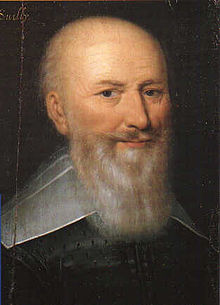
Maximilien de Bethune, Baron de Rosny, ambassador from France, exclaimed “this great Queen merited the whole of that great reputation she had throughout Europe” concerning her grasp for the political situation in Europe (Hibbert 115).  Even as she aged, diplomats were still astounded at her grasp of affairs of state.  Andre de Maisse, the French ambassador, thought her shrewd, calculating, statesmanlike and well-informed.

baron de rosny                             demassie

Baron de Rosny                                Andre de Maisse

Her Clerk of the Council, Robert Beale, believed that she was a “princess of great wisdom, learning and experience” and Sir John Harington wrote how Elizabeth would pass her judgment on matters and knew how to “cunningly commit the good issue to her own honour and understanding…” (Sitwell 87). Harington also observed that he “never did find greater show of understanding and learning than she was blessed with” (Hibbert 114).
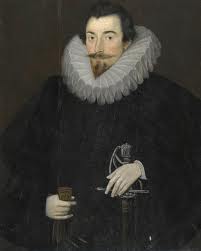
johnharington

Sir John Harington

The success of Elizabeth’s education is well-known and documented.  Her preference for Roger Ascham as her tutor showed early on her judgment in men.  He was an excellent choice and provided her not only a thorough education but a life-time love of learning. Even as queen, Elizabeth continued her studies as it was well-known she spent a part of her day reading and at study “by a wise distribution of her time” (Bohun 346).  Ascham had nothing but praise for the quick mind and abilities of his pupil.  Below, reproduced in its entirety is a letter Ascham wrote to his friend, Johannes Sturm, German scholar concerning Elizabeth:

“It is difficult to say, whether the gifts of nature or of fortune are most to be admired in my distinguished mistress.  The praise which Aristotle gives, wholly centres in her; beauty, stature, prudence, and industry.  She has just passed her sixteenth birthday and shows such dignity and gentleness as are wonderful at her age and in her rank.  Her study of true religion and learning is most eager.  Her mind has no womanly weakness, her perseverance is equal to that of a man, and her memory long keeps what it quickly picks up.  She talks French and Italian as well as she does English, and has often talked to me readily and well in Latin, moderately in Greek.  When she writes Greek and Latin, nothing is more beautiful than her handwriting” (Neale 14 – 15).

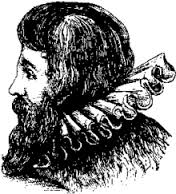
      aschamengraving2                                           roger asham

Princess Elizabeth and                                     Sketch of Roger Ascham
Roger Ascham

Like her grandfather Henry VII, her skill in many languages allowed her to take a prominent role in the diplomacy of her country as she could meet with ambassadors herself.  Her intellect allowed her to match the professional diplomats in subtlety and the language of diplomacy itself.

Elizabeth’s skills in government did not come from specific training as an apprentice but from her formal, classical and humanist education and her practical, political education of survival during her brother’s and sister’s reigns.

Without going into great detail, the young Elizabeth’s handling of the Thomas Seymour issue shows the intelligence, courage and composure she displayed while detained and questioned by Sir Robert Tyrwhitt.  Tyrwhitt wrote the Lord Protector “I do assure your grace, she hath a very good wit, and nothing is gotten of her, but by great policy” (Erickson 88).

Another early example comes during her sister Mary’s reign.  While under suspicion as part of the Wyatt Rebellion, Elizabeth negotiated with the councilors sent to arrest her to write a letter to Mary. Using her talents and education, Elizabeth not only composed a brilliant note, she also managed to utilize enough time that the tide had altered deflecting her move to the Tower for one more day.  On the letter itself, she made diagonal marks at the end of the second page to ensure no one would tamper with the document.
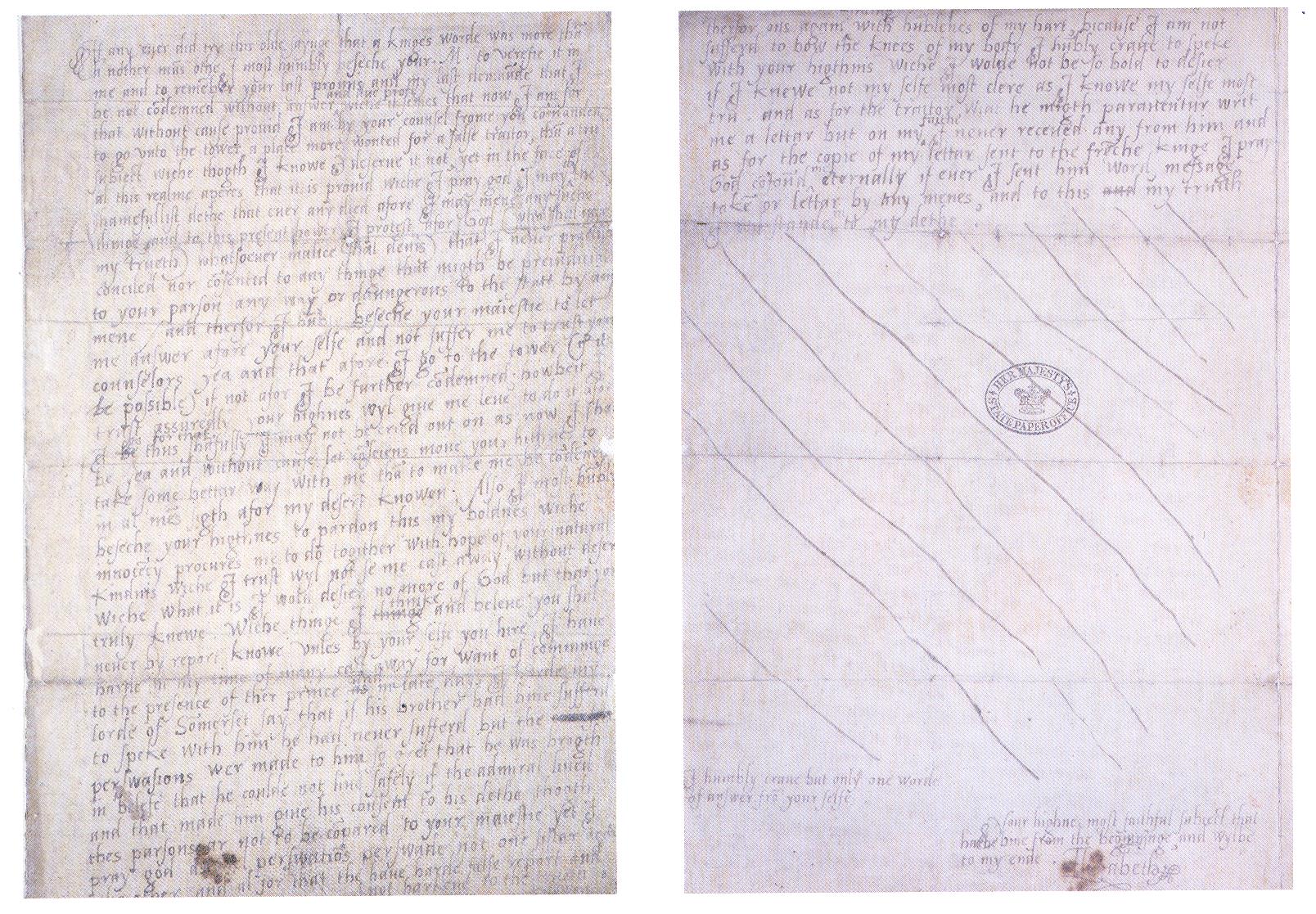
diagonal letters 001

Letter to Mary with diagonal lines across second page

As a mature and seasoned sovereign, Elizabeth continually dealt with complicated and life-threatening situations.  Would all decisions be exact?  Of course they would not.  Yet, most historians agree with her contemporary John Hayward’s exclamation concerning her character that she was “in purpose, just; of spirit, above credit … as well for depth of judgment…” (Hayward 8).  Maybe her wisdom came from knowing that her success came from serving England and her peoples and from making decisions that rested on the good of the kingdom.  Or maybe it was simply she had a brain in her head and she used it:

There is small disproportion betwixt a fool who
useth not wit because he hath it not and him
that useth it not when it should avail him
Queen Elizabeth

References 

Bacon, Francis.  The Works of Lord Bacon:  Philosophical Works.  Longman and Co. 1858-1859.  Google Books. Web. 11 Apr. 2013.

Bacon, Francis, and J. Rawson Lumby. Bacon’s History of the Reign of King Henry VII,. Cambridge: University, 1902. Internet Archive. Web. 22 Jan. 2013.

Bohun, Edmund. The Character of Queen Elizabeth, Or, A Full and Clear Account of Her Policies and the Methods of Her Government Both in Church and State, Her Virtues and Defects Together with the Characters of Her Principal Ministers of State … London: Printed for Ric. Chiswell at the Rose and Crown in St. Paul’s Church-Yard(IS), 1693. Google Books. Web. 26 Jan. 2013.

Commynes, Philippe de.  The memoirs of Philip de Commines, Lord of Argenton: containing the histories of Louis XI and Charles VIII. Kings of France and of Charles the Bold, Duke of Burgundy. To which is added, The scandalous chronicle, or Secret history of Louis XI  London:  H. G. Bohn, 1855.  Internet Archive. Web. 10 Feb. 2013.

Elton, G. R. England Under the Tudors. Third ed. London:  Routledge, 1991. Print.

Fisher, John, and John E. B. Mayor. The English Works of John Fisher, Bishop of Rochester. London: N. Trübner for the Early English Text Society, 1876. Google Books. Web. 12 Feb. 2013.

Erickson, Carolly. The First Elizabeth. New York: Summit Books. 1983. Print.

Griffiths, Ralph A. and Roger S. Thomas.  The Making of the Tudor Dynasty.  New York: St. Martin’s Press, 1985. Print.

Hall, Edward, Henry Ellis, and Richard Grafton. Hall’s Chronicle; Containing the History of England, during the Reign of Henry the Fourth, and the Succeeding Monarchs, to the End of the Reign of Henry the Eighth, in Which Are Particularly Described the Manners and Customs of Those Periods. London: Printed for J. Johnson and J. Rivington; T. Payne; Wilkie and Robinson; Longman, Hurst, Rees and Orme; Cadell and Davies; and J. Mawman, 1809. Archive.org. Web. 2 Jan. 2013.

Hayward, John, and John Bruce. Annals of the First Four Years of the Reign of Queen Elizabeth. London: Printed for the Camden Society by J.B. Nichols and Son, 1840. Google Books. Web. 19 Jan. 2013.

Hibbert, Christopher.  The Virgin Queen: Elizabeth I, Genius of the Golden Age.  New York: Addison-Wesley Publishing Company, Inc., 1991.  Print.

Jones, Michael K. and Malcolm G. Underwood.  The King’s Mother: Lady Margaret

Beaufort, Countess of Richmond and Derby. New York: Cambridge University Press, 1992. Print.

Loades, David, ed. The Tudor Chronicles: The Kings.  New York: Grove Weidenfeld, 1990.  Print.

Neale, J. E. Queen Elizabeth I. Garden City, NY: Doubleday, 1957. Print.

Norton, Elizabeth.  Margaret Beaufort: Mother of the Tudor Dynasty.  Stroud: Amberley, 2010. Print.

Okerlund, Arlene Naylor.  Elizabeth of York.  New York: Palgrave Macmillan, 2009. Print.

Penn, Thomas.  Winter King; the Dawn of Tudor England.  New York: Penguin Books, 2012. Print.

Pollard, Albert Frederick, ed. The Reign of Henry VII: From Contemporary Sources.[S.l.]: Longmans Green and, Co. 1913. Google Books. Web. 1 Apr. 2013. 

Ridley, Jasper. Elizabeth I: The Shrewdness of Virtue.  New York: Fromm International Publishing Corporation, 1989.  Print.

Ross, Josephine.  The Tudors, England’s Golden Age.  London: Artus, 1994.  Print. 

Sitwell, Edith.  The Queens and the Hive.  Harmondsworth: Penguin Books, 1966. Print.

Somerset, Anne. Elizabeth I.  New York: Alfred A. Knopf, 1991. Print.

Vergil, Polydore, The Anglica Historia of Polydore Vergil, A.D. 1485-1537 (translated by Denys Hay), London: Office of the Royal Historical Society, Camden Series, 1950. Web. 29 Mar. 2013.

Weir, Alison.  The Life of Elizabeth I.  New York: Ballatine Books, 1998. Print.

Tight Purse Strings

Tight Purse Strings

Henry VII was well-known for his miserliness. “The popular tradition respecting his avarice, which has descended to us, seems only too well founded. It is quite the characteristic of a usurer to have a fondness for gold. We are informed that whenever a gold coin entered the chest of Henry it never found its way out again” ( Bergenroth 69).

Don Pedro de Ayala, envoy to Ferdinand and Isabella of Spain, revealed that although Henry had many qualities that would have rendered him great, “he had but one characteristic which spoilt all the rest, his love of money” (Bergenroth 53).

It was claimed that when he was not with his council or in public he was “writing accounts of his expenses with his own hand” (Tremlett 95). “He also handled the cash himself. In his own handwriting, he itemised the moneys delivered in one day to … the treasurer of his chamber…all amounting to several thousands of pounds” (Hutchinson 41).

Ledger initialed by Henry VII from 1492       Accounts written in Henry’s handwriting

 ledger         account

The king collected money from taxation, plus the obligations and fines he placed on his subjects (rich and poor). Out of the “sixty-two families in the English peerage that survived the butchery of the War of the Roses, forty-seven were at the king’s mercy, either by living under attainder or forfeiting substantial sums to the crown to guarantee their good behavior” (Hutchinson 42). These recognisances were imposed and collected by the able administrators, Sir Richard Empson and Edmund Dudley. The activities of these two men were known throughout the Court as Don Pedro de Ayala reported to Ferdinand and Isabella that Henry’s servants had “a wonderful dexterity in getting hold of other people’s money” (Bergenroth 207).

Henry VII’s priorities were revealed in the power and prestige granted to these two trusted advisors. The policies they implemented, in the king’s name, generated as much hatred and distrust as they did revenue. Although not everyone felt that way, courtiers who profited from Henry VII’s fiscal policies did worry when Henry VIII came to the throne that he would reverse “his father’s tight-fistedness…” (Jones 222), most resented Henry VII and his administration. In fact, one of Henry VIII’s first acts as king was the arrest of these two men, “greate counsaylers to the late kyng, were attached and brought to the Tower, not to the litle rejoysyng of many persones, whiche by them wer greved, whiche, attachement was thought to bee procured by malice of theim, that with their aucthoritie, in the late kynges daies wer offended, or els to shifte the noyse, of the straight execucion of penall statutes in the late kynges daies, by punishement of those persones, and other promoters, for to satisfie and appeace the people” (Hall).

For a discussion of the land revenues and prerogative feudal rights which Henry VII took advantage of to generate income, see Stanley Bertram Chrimes’ Henry VII. It is enough here to understand that Henry VII found a source of revenue which he pursued “with a zeal and relentless application which earned him and his agents an unpopularity and a measure of odium which became marked towards the end of the reign…” (Chrimes 209). Although other sovereigns had used these methods, none had “taken such a close personal part in wielding the whips and scorpions of financial pressures to attain their ends” (Chrimes 214). No wonder Henry VII emerges in the pages of history as miserly and avaricious. A study of the Calendar of Close Rolls for 1500-1509 by K. B. McFarlane led him to declare that by the end of his reign Henry VII “governed by recognizance” (Chrimes 214). It has been estimated that Henry extorted (hard to use any other word) close to £495 million in present-day monetary values from his subjects (Hutchinson 43).

Henry “made rebellions, like wars, pay their own expenses, and even yield him a mine of treasure, which was a source, in its turn, of stability to the country, giving him more ample power to put down future outbreaks. For the great majority of insurgents he had no other punishment than fines…. Violation, even of laws which were antiquated, was visited with fines which went to the king’s coffers” (Gairdner 215).

Despite the general belief that Henry had amassed a large surplus early in his reign (Chrimes 217), the Spanish envoy, Don Pedro de Ayala, remarked, “The King of England is less rich than generally said. He likes to be thought very rich because such a belief is advantageous to him in many respects. The King himself said to me that it is his intention to keep his subjects low, because riches would only make them haughty…” (Hutchinson 41). The viewpoint that Henry’s miserliness was a political rather than an avaricious motive is taken up further by Polydore Vergil. Writing under the patronage of the Tudors, Vergil did not ignore the fact that Henry VII gained money in dubious ways although he does offer explanations.

…id quod argumentum non dubium erat eum, sicut ipse aiebat, studio coercendi ferocem populi inter factiones nutriti animum, non item cupiditate cogendae pecuniae, ea coepisse uti severitate, quemadmodum supra demonstravimus, quanquam saucii ista non tam severitatis quam avaritiae tela esse clamabant. Sane modestus princeps non emungebat suos fortunis immodice qui regnum rebus omnibus longe locupletissimum reddidit reliquitque, quod planum praeter caetera fecit immanis auri pariter atque argenti copia quae in annos singulos in insulam importata est a mercatoribus ultro citroque commeantibus, quos ille saepenumero pecunia ad tempus data gratuito iuvabat, ut mercatura ars una omnium cunctis aeque mortalibus cum commoda, tum necessaria, in suo regno copiosior esset.

This was a sure sign that, just as he himself said, he resorted to this severity for the sake of curbing the fierce spirits of a people brought up amidst factionalism, not out of a lust for money-making, as I have shown above, although those who were wounded in this way exclaimed these were the darts of greed, not severity. Indeed, this modest sovereign did not despoil his subjects of their fortunes immoderately, for he left behind him a kingdom most wealthy in all respects. This is made plain, among other things, by the immense amount of gold and silver annually brought into the island by merchants plying to and fro, whom he very frequently helped with interest-free loans, so that the flow of commerce, both useful and necessary for all men, would be more abundant in his realm.

Thomas Penn brings forth the idea that Henry VII’s obsession with money was not the actions “of a miser, but of a sophisticated financial mind…” (Penn 156). This is an interesting point of view and one that was not held by many others, although Josephine Ross does admire Henry and his policies. She commented that Henry “…was a born accountant, who loved to spend hours closeted with lists of figures signing every entry with his own hand, those accounts revealed some attractive aspects of his personality” (Ross 22). His financial records do show expenditures to charitable causes, music, a variety of entertainments, architecture, sporting events, and gambling (Ross, Penn, and Chrimes). According to Ross, “There was nothing miserly about Henry VII; he was intensely careful with money, but he recognized the importance of spending freely to keep up a regal image” (Ross 22). This incongruity between miserliness and extravagance is something which was held in common between Henry VII and his granddaughter, Elizabeth Regina.

Elizabeth had inherited “…the financial prudence of her grandfather” (Neale 294) and the depleted coffers of her father. “A sense of economy was inbred as well as inborn in Elizabeth” (Neale 296). Prior to her accession her income had been small even after she received her inheritance from her father and acquired Hatfield.  Elizabeth had learned to be careful with her monies. “Her financial affairs, which had been in a precarious state since her father’s death, assumed a more healthy aspect when she took over the book-keeping herself, maintaining meticulous records of her expenditure and personally signing each page of the accounts” (Somerset 28).

Even as Queen she was watchful and her “stringent economies effected soon after her accession…” plus her “prudent financial management” allowed her to escape true money worries while maintaining her Court (Somerset 281).  What she managed to achieve with the limited resources available is astounding.  It is “that financial sense of Elizabeth’s, her resolute, irritating parsimony that the secret of greatness lay” (Neale 101).

She was a penny-pincher, but she knew, like her grandfather, where and when to spend money for political reasons. “Balancing the books was to be her life-long preoccupation as Queen” and she understood there had to be revenue (Starkey 221).  Elizabeth realized that, as money got tighter, she had to extract money at any possible source beyond the ordinary income from taxes, rates, etc.

It is well-known that privateering brought in some revenue for the Crown but never as much as hoped. Elizabeth had exclaimed that “she had known from the very first that everyone would make a fortune out of the business except herself” (Strachey 112).

One revenue source came from the requirement that Bishops give 10% of their revenue to the Crown and at their appointment the equivalent of a year’s income.  Although it was claimed she did not exploit this, it was common knowledge that later in her reign, Elizabeth was able to tap into this income by moving her Bishops between dioceses (Somerset 86).  She believed, by using “this judicious redistribution of the national wealth she was preserving her kingdom’s stability” (Somerset 88).

When the economy started to slip, she responded by selling some property, appropriating new funds and further reducing government expenditure. Yet, like her grandfather, Elizabeth had virtuous reasons for her miserliness.  When England was at war late in her reign, she “practiced eternal vigilance over her own expenses, to the disgust of the greedy cormorants about her, everlastingly grumbling and gibing at her parsimony…” (Neale 346).

“Parsimony is not a popular virtue” (Neale 296).  Elizabeth instituted “stringent economies that were often unpopular, but these measures kept England solvent at a time when most European countries were virtually bankrupt” (Weir 225).  Keeping her debt to a minimum and balancing her expenditures with her ordinary income required her to never relax the tight purse strings. She performed wonders in keeping her creditors satisfied and shouldering most of the burden without “impairing the efficiency of government or casting the gloom of poverty over the Court, the splendor of which was the nation’s pride and the monarch’s dignity” (Neale 296).

To further complicate money issues was this paradox: Elizabeth was miserly for reasons of political capital and she was extravagant for the same purpose.  Although careful with her money, Elizabeth never stinted on outward show.  She knew that to attract the upper classes to her Court she had to impress the whole country with the visual aspects of power. Perception is reality. The queen wore costly gowns (she had over three thousand –a topic for a future blog) and owned a magnificent collection of jewelry knowing full-well the role she played. “Princes, you know, stand upon stages so that their actions are viewed and beheld of all men…” (Marcus, 189).

Therefore, clothing, court ceremonial, entertainments, even furnishings were extravagant with the intent to show majesty and impress all who came to the Court.
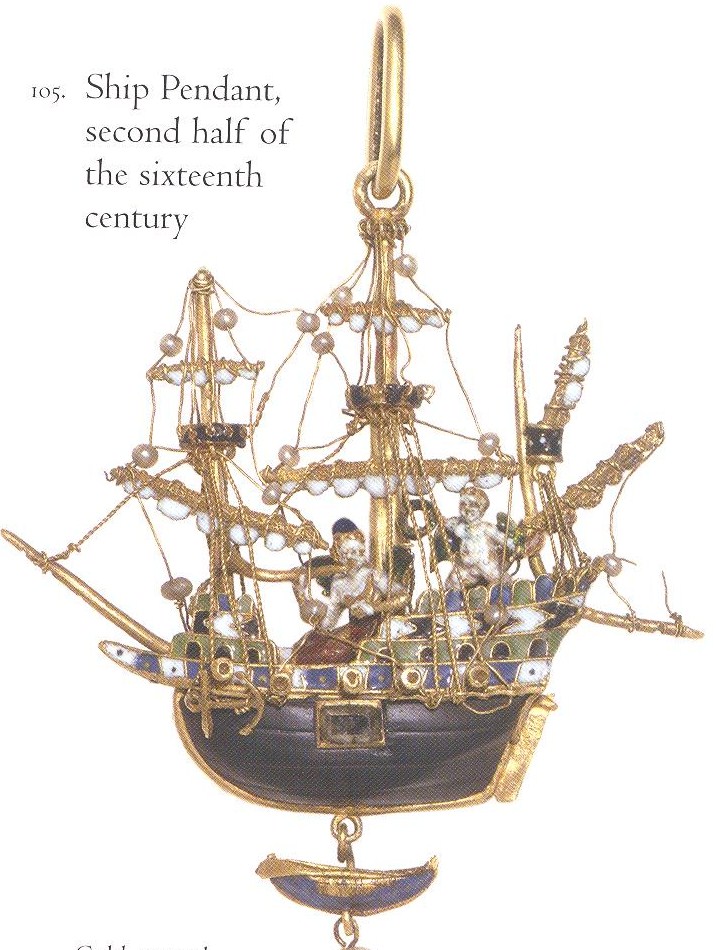
Many costs of these items could be defrayed by what would become a large, unavoidable expense for the noblemen–a lavish gift for the queen.  She enjoyed receiving costly gifts throughout her reign.  A contemporary explained that “She was very rich in jewels, which had been given her by her subjects; for in times of progress there was no person that entertained her in his house but (besides his extraordinary charge in feasting her and her train) he bestowed a jewel upon her; a custom in former times begun by some of her especial favorites that (having in great measure tasted of her bounty) did give her only of her own; though otherwise that kind of giving was not so pleasing to gentlemen of meaner quality” (Robinson 192).  The Spanish envoy Count de Feria commented soon after her coronation that Elizabeth “is very fond of having things given to her” (Erickson 174).

Ship Pendant given to Elizabeth                Gloves given to Elizabeth
by Sir Francis Drake                                     by the University of Oxford
  ship pendant 001                                     gloves1

Elizabeth’s yearly progresses were another way to subsidize the living costs of Court. Being housed at others’ expense during her lengthy progresses was a sure way for her to be seen by her people, in all her majesty, and allow her to graciously accept the hospitality of many and not cost the Exchequer any money (Ridley 180).

As the decades progressed and expenses mounted, Elizabeth was less apt to reward her courtiers as in earlier days as she was led to “tightening up in the distribution of patronage” (Somerset 547).  She reduced government expenditure, rewarding her administrators so sparingly with titles, lands and monopolies, especially monopolies, that corruption was inevitable as nobles tried to find ways to generate funds.

Corruption became rampant and she scolded Parliamentary members by exclaiming “…if these fellows were well answered and paid with lawful coin, there would be fewer counterfeits among them” (Perry Word of a Prince 199).  She was genuinely surprised when courtiers seemed less than satisfied with the patronage that was handed out. She had learned “that neither gifts nor pensions were the foundation of loyalty” (Neale 101).

Through it all, the welfare of her people and her duty to them, was foremost in her mind.  Addressing her people late in her reign, the Queen said that “though God hath raised me high, yet this I count the glory of my crown: that I have reigned with your loves” (Marcus 337).

Works Cited

Bergenroth, G. A., and, Pascual De. Gayangos. Calendar of Letters,
Dispatches and State Papers, Relating to the Negotiations between England and Spain, Preserved in the Archives at Simancas and Elsewhere: Published by the Authority of the Lords Commissioners of Her Majesty’s Treasury under theDirection of the Master of the Rolls. Henry VII 1485 – 1509. ed. Vol. 1. London:

Longman, Green, Longman and Roberts, 1862. Google Books. Web. 26 Nov.
2012.

Chrimes, S. B. Henry VII. Berkeley: University of California, 1972. Google Books. Web. 31 Dec. 2012.

Erickson, Carolly. The First Elizabeth. New York: Summit Books. 1983. Print.

Gairdner, James. Henry the Seventh,. London: Macmillan, 1889. Google Books. Web. 26 Nov. 2012.

Hall, Edward, and Charles Whibley. Henry VIII,. Vol. I. London: T.C. & E.C. Jack, 1904. Google Books. Web. 1 Dec. 2012.

Hutchinson, Robert. Young Henry: The Rise of Henry VIII. London: Weidenfeld & Nicolson, 2011. Google Books. Web. 02 Dec. 2012.

Jones, Michael K. and Malcolm G. Underwood.  The King’s Mother: Lady Margaret
Beaufort, Countess of Richmond and Derby. New York: Cambridge University Press, 1992. Print.

Marcus, Leah S. et al., eds. Elizabeth I: The Collected Works. Chicago: University of Chicago Press, 2002. Print.

Neale, J. E. Queen Elizabeth I. Garden City, NY: Doubleday, 1957. Print.

Penn, Thomas.  Winter King; the Dawn of Tudor England.  New York: Penguin Books, 2012. Print.

Perry, Maria.  The Word of a Prince: A Life of Elizabeth from Contemporary
Documents.  Woodbridge, Suffolk: The Boydell Press, 1990.  Print.

Ridley, Jasper. Elizabeth I: The Shrewdness of Virtue.  New York: Fromm International Publishing Corporation, 1989.  Print.

Robinson, James Harvey. Readings in European History: A Collection of Extracts from the Sources Chosen with the Purpose of Illustrating the Progress of Culture in Western Europe since the German Invasions,. Vol. II. Boston: Ginn &, 1904. Google Books. Web. 19 Jan. 2013.

Ross, Josephine.  The Tudors, England’s Golden Age.  London: Artus, 1994.  Print. 

Somerset, Anne. Elizabeth I.  New York: Alfred A. Knopf, 1991. Print.

Starkey, David, ed. Rivals in Power. New York: Grove Weidenfeld, 1990. Print.

Strachey, Lytton.  Elizabeth and Essex: A Tragic History.  New York: Harcourt Brace & Company, 1969. Print.

Tremlett, Giles.  Catherine of Aragon: Henry’s Spanish Queen.  London: Faber and Faber, 2010. Print.

Weir, Alison.  The Life of Elizabeth I.  New York: Ballatine Books, 1998. Print.

Vergil, Polydore. Polydore Vergil, Anglica Historia (1555 Version). Ed. Dana F. Sutton.

Irvine: University of California, 2005. Polydore Vergil, Anglica Historia (1555             Version). The Philological Museum, 04 Aug. 2005. Web. 02 Jan. 2013.

In the Stars

In the Stars

Many believed Henry VII’s well-known interest in prophesy could have stemmed from his Welsh background as the Welsh “follow prophecies, affirming that they are true” (Tremlett 100) and have a “prophetic tradition” (Thornton 15). As discussed in a previous blog, King Henry VI, upon meeting the young Henry, Earl of Richmond, gave a prophecy that he would become king (Bacon, Vergil).

Henry VII did not have a formal Royal Astrologer but Gulielmus Parronus Placentinus, an Italian known in England as William Parron, came close.  Parron is credited, according to an expert at the British Library, with bringing to England the practice of creating astrological almanacs for the nation (Pickup).  Astrology almanacs were compilations of astrological data that was considered useful for physicians and other medical professionals as well as for the general public (Parker).  Evidence shows that Parron received payments from the king, possibly for an early almanac, as seen in the king’s account books from 6 March 1499: “To Master William Paromis an astronymyre £1” (Macalister 301). After making several successful prognostications, Parron presented to Henry, De astrorum succincte vi fatali, (The Fateful Meaning of the Stars) completed on 15 October 1499. In this work Parron ingratiated himself by giving justifications for Henry’s actions on many fronts especially his treatment of Perkin Warbeck and the Earl of Warwick saying that people born under bad stars must die before infecting the country.  A “satisfyingly closed logic, and it satisfied Henry’s conscience” (Penn 38).

Parron’s last known compilation for the Tudor family was a horoscope in late 1502 titled, Liber de Optimo fato Henrici Eboraci ducis et optimorum ipsius parentum, (The Book of the Excellent Fortunes of Henry Duke of York and his Parents). This was less than successful and perhaps why he disappears from official sources.  It is supposed he left England in disgrace after predicting that Queen Elizabeth, Henry VII’s wife, would live until she was 80.  She died shortly thereafter at the age of 37.  As an aside, he also foretold that Prince Henry, the future Henry VIII would have a happy marriage and many sons (Carlin, Penn, Tucker).

The following illustrations are from Parron’s 1502 horoscope and almanac including the cover page, his dedication page and the illustration of Henry VII –note the Tudor roses in the border.

Parron 1503 Almanac  Royal 12 B vi  1v  Royal 12 B vi  2r

Parron was not the only astrologer and scientist to whom Henry offered his patronage.  Dr. Janina Ramirez explained that “Henry VII saw himself as a patron of science and scholarship and in Tudor times astrology was held in high esteem” (Ridgway).  At court was Lewis of Caerleon, physician to Margaret Beaufort, who was valued for his “astronomical and astrological skills, and he received considerable remuneration and generous favours from the monarch” (Pahta 50).  Added to the list of astrologers were John Argentine who “assembled an extensive collection of astrological and astronomical treatises” and was “appointed physician and chaplain” to Prince Arthur, son of Henry VII (Pahta 50); and John Killingworth “perhaps the most important of fifteenth-century English astrologers” (Pahta 51).  Killingworth’s scientific manuscript of planetary data and prophecies was written for Henry VII in 1490.  Another example of Henry’s patronage was the sculptures on the ceilings at Merton College where Bishop Richard Fitzwilliam’s “astrological symbols were next to the royal arms of Henry VII, showing that Henry was ruling not just England but the cosmos. Astrology was the science of the day and was seen as important” (Ridgway).

The strong influence prophecy and astrology held over Henry VII did not diminish throughout the Tudor time-period and was as prominent with his granddaughter, Elizabeth Regina.   Enter John Dee, astrologer, astronomer, mathematician, alchemist, and rumored neocromancer who found time “to dabble in the mysteries of the occult” (Brimacombe 143).  He was a Fellow of Trinity College, Cambridge; an acquaintance to Continental academics, Abraham Ortelius, Gemma Frisius—Court Astrologer to Charles V— and Geradus Mercator; and, a friend to influential people— Roger Ascham, Robert Dudley and Lord Pembroke.  In fact, Dudley and Pembroke introduced him to the 25-year old Elizabeth when she needed to set the date for her coronation.  This auspicious occasion could not just be any day. It would be the birth date of the Elizabethan Age and had to be considered carefully (Bassnett, Brimacombe, Somerset, Watkins).

John Dee      

                                          johndee

John Dee would become an influential member of Elizabeth’s circle (he was a cousin to Blanche Parry, Elizabeth’s gentlewoman, and had been a member of the Duke of Northumberland’s household when Robert Dudley was a youth). By 1564 when he had returned from the Emperor’s Court, Dee was “appointed Royal Adviser in mystic secrets” (Bassnett 63), another way of saying Court Astrologer.  Elizabeth offered him apartments at Court (something most people vied for their entire lives) and he turned her down fearing it would interfere with his studies. Supposedly he “applied himself to his studies with such diligence that he allowed only four hours for sleep, and two for his meals and recreation”  (Nichols 414). He appreciated Elizabeth’s support and acknowledged it:  “Whereupon her Majestie had a little perusion of the same with me, and then in most heroicall and princely wise did comfort and encourage me in my studies philosophicall and mathematicall” (Dee Autobiographical 19).

“In the sixteenth century, the borderline between science and sorcery was often perilously narrow” (Brimacombe 144). The role of natural magic cannot be ignored in the rise of experimental science .  This reminds me of some experiments that science teachers demonstrated when I was in school.  The exploding volcano bordered on magic!  Some authors suspect “Sir Walter Ralegh and his circle of friends practiced sorcery at this infamous ‘School of the Night’ at his home at Sherborne in Dorset” (Brimacmbe 144) and others that it was a gathering to discuss all topics of learning especially religion (Marlowe Society). Dee was very much aware of the links between religious thoughts and the sciences “which fruite and gaine if I attaine unto, it shall encourage me hereafter, in such like sort to translate, and set abroad some other good authors, both pertaining to religion (as partly I have already done) and also pertaining to the Mathematicall Artes” (Dee Mathmatical iii).

Elizabeth, a highly educated, intelligent woman, frequently consulted Dee be it for explanations for comets, a toothache, diet and medicines, navigation (he is reported to have coined the term British Empire) and the dangers to be apprehended from a waxen image of her with a pin struck through its breast, which had been found in Lincoln’s Inn Fields.  Her faith in his abilities also earned him the role as a foreign spy “reporting, in code, to both the Queen and William Cecil on intrigues abroad.  His coded letters were signed using the numerals 007” (Watkins 39).

When Dee was in England, she visited him at his home in Mortlake, Surrey, where he was reputed to have one of the largest private libraries in Europe along with his famous laboratories (Brimacombe, Hibbert, Lipscomb, Watkins). Although it was suggested in some readings that Dee built an astrolabe for Elizabeth, the only evidence found was one made for her by the Flemish instrument maker Thomas Gemini.

Astrolabe known to belong to Elizabeth with enlargement of the inscription.

astrolobe     Astrolabe closeup

Today we would call the Elizabethans superstitious*, not understanding the seriousness in which they took elements of magic, the occult and alchemy.  In fact, I get the impression that many modern writers try to ‘excuse’ Elizabeth’s reliance on Dee by down-playing her interest or referring to her as impressionable. Elizabeth was in good company as there are letters that William Cecil wrote to Edward Kelley, Dee’s colleague for many years when they lived in Europe conducting experiments, to encourage him to return to England with his “powder that could transform base metals into gold” (Bassnett 63).  Even the Archbishop of Canterbury responded to Elizabeth’s fears of assassination and assured her that no harm would come to her so long as her “birth sign, Virgo, was in the ascendant” (Hibbert 72).

Ironically, despite Elizabeth’s beliefs and interests, when it was predicted in 1572 there would be a series of catastrophes after the appearance of a comet, it was reported that “with a courage answerable to the greatness of her state, she caused the window to be set open and cast out this word, jacta est alea, the dice are thrown” (Malcolm 355). Added to this account was the following when there were prophecies circulating about the countryside.  Elizabeth sent out a proclamation in which she “warns all not to be moved by murmurers and spreaders of rumours, the dissemination of which is to be punished as the spreading of sedition (Pollen 340).

Thus is another paradox of Elizabeth Regina:  her pragmatic response to threats to her realm and her embracing prophecies.  When in January 1603 John Dee cast her horoscope and warned her to “beware of Whitehall” (Sitwell 454) she moved to Richmond.  She did so seeing it as a realistic response.  Ironically, it was at Richmond that she died about two months later. Thus the tradition of the Tudors’ consultation with and acceptance of astrologer’s predictions was maintained.

*A consultation with an astrologer in the time of Queen Elizabeth was reported to last about “15 minutes and cost 2s. 6d” (Emerson 264).

Works Cited

Bacon, Francis, and J. Rawson Lumby. Bacon’s History of the Reign of King Henry VII,. Cambridge: University, 1902. Internet Archive. Web. 22 Jan. 2013.

Bassnett, Susan.  Elizabeth I: a Feminist Perspective.  Oxford: Berg Publishers, 1997. Print.

Brimacombe, Peter.  All the Queen’s Men: the World of Elizabeth I.  Stroud: Sutton Publishing, 2000.  Print.

Carlin, Martha. “Parron, William.” Oxford DNB. Oxford University Press, Jan. 2013. Web. 02 Feb. 2013.

Dee, John. Autobiographical Tracts of Dr. John Dee … Ed. James Crossley. [Manchester]: Printed for the Chetham Society, 1851. Google Books. Web. 31 Jan. 2013.

Dee, John. Mathematicall Praeface to Elements of Geometrie of Euclid of Megara. [S.l.]: General, 13 Jul 2007. Project Gutenburg. Web. 31 Jan. 2013.

Emerson, Kathy L. The Writer’s Guide to Everyday Life in Renaissance England : from 1485-1649. Cincinnati, Ohio: Writer’s Digest Books, 1996. Print.

Hibbert, Christopher.  The Virgin Queen: Elizabeth I, Genius of the Golden Age.  New York: Addison-Wesley Publishing Company, Inc., 1991.  Print.

Lipscomb, Suzannah.  A Visitor’s Companion to Tudor England. London : Ebury Press, 2012. Print.

Macalister, J. Y. W., and Alfred W. Pollard, eds. New Series. The Library; a Quarterly Review of Bibliography and Library Lore, Etc. Dec. 1899-Oct. 1909. Vol. IV. London: Alexander Moring, 1913. Third Series. Internet Archive. Web. 4 Feb. 2013.

Malcolm, James Peller. Anecdotes of the Manners and Customs of London from the Roman Invasion to the Year 1700: Including the Origin of British Society, Customs and Manners, with a General Sketch of the State of Religion, Superstition, Dresses, and Amusements of the Citizens of London, during That Period: To Which Are Added, Illustrations of the Changes in Our Language, Literary Customs, and Gradual Improvement in Style and Versification, and Various Particulars concerning Public and Private Libraries. London: Longman, Hurst, Rees, Orme, and Brown, 1811. Google Books. Web. 3 Feb. 2013.

Marlowe Society. “The Free-Thinkers.”: Marlowe & The School of Night. The Marlowe Society, 2012. Web. 01 Feb. 2013.

Nichols, John. The Progresses and Public Processions of Queen Elizabeth. Among Which Are Interspersed Other Solemnities, Public Expenditures, and Remarkable Events during the Reign of That Illustrious Princess. Collected from Original MSS., Scarce Pamphlets, Corporation Records, Parochial Registers, &c., &c.: Illustrated with Historical Notes. New York: B. Franklin, 1823. Google Books. Web. 19 Jan. 2013.

Pahta, Päivi, and Andreas H. Jucker. Communicating Early English Manuscripts. Cambridge: Cambridge UP, 2010. Google Books. Web. 4 Feb. 2013.

Parker, Derek. “Skyscript: The Rise and Fall of the Astrological Almanac by Derek Parker. The Traditional Astrologer Magazine, Dec. 2004. Web. 04 Feb. 2013.

Penn, Thomas.  Winter King; the Dawn of Tudor England.  New York: Penguin Books, 2012. Print.

Pickup, Oliver. “It’s Nostra-dumbass! Astrologer Predicted Henry VIII Would Marry Well and Take Care of the Church.” Mail Online. Daily Mail, 26 Aug. 2011. Web. 03 Feb. 2013.

Pollen, John Hungerford. The English Catholics in the Reign of Queen Elizabeth: A Study of Their Politics, Civil Life, and Government : From the Fall of the Old Church to the Advent of the Counter-Reformation. London: Longmans, Green, 1920. Internet Archive. Web. 30 Jan. 2013.

Ridgway, Claire. “Illuminations: The Private Lives of Kings – Libraries Gave Us Power.” The Anne Boleyn Files RSS. N.p., 24 Jan. 2012. Web. 05 Feb. 2013.

Sitwell, Edith.  The Queens and the Hive.  Harmondsworth: Penguin Books, 1966. Print.

Somerset, Anne. Elizabeth I.  New York: Alfred A. Knopf, 1991. Print.

Thornton, Tim. Prophecy, Politics and the People in Early Modern England. Woodbridge: Boydell, 2006. Google Books. Web. 2 Feb. 2013.

Tremlett, Giles.  Catherine of Aragon: Henry’s Spanish Queen.  London: Faber and             Faber, 2010. Print.

Tucker, M. J. “Life at Henry VII’s Court.” History Today. History Today.com, n.d. Web. 4 Feb. 2013.

Vergil, Polydore. “Full Text of “Three Books of Polydore Vergil’s English History,             Comprising the Reigns of Henry VI., Edward IV., and Richard III. from an Early            Translation, Preserved among the Mss. of the Old Royal Library in the British             Museum”” Full Text of “Three Books of Polydore Vergil’s English History,             Comprising the Reigns of Henry VI., Edward IV., and Richard III. from an Early             Translation, Preserved among the Mss. of the Old Royal Library in the British             Museum” Internet Archive, n.d. Web. 27 Oct. 2012.

Watkins, Susan, and Mark Fiennes. The Public and Private Worlds of Elizabeth I. New York, NY: Thames and Hudson, 1998. Print.