The Path to St. Peter ad Vincula: Part III

The Path to St. Peter ad Vincula –Part III

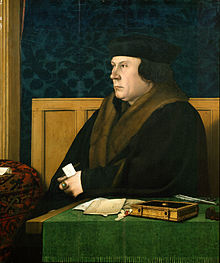
Anne’s possession of banned texts came to the attention of Thomas Wolsey, Lord Chancellor of England, Archbishop of York and Cardinal in the Catholic Church.  Wolsey as a conservative was against reformists from the start and loyal to the cause of Katherine of Aragon.

The relationship between Thomas Wolsey and Anne Boleyn will always be in the forefront of a discussion of the ‘King’s Great Matter’—dissolving his marriage to Katherine of Aragon.  Wolsey was not moving as quickly and assuredly towards obtaining the divorce as Anne, and Henry for that matter, would have liked.  “Anne Boleyn and her friends were not friends of the Cardinal, and the Cardinal had none; the duke of Norfolk, her uncle, hated him, and others were then about the court ready to strike him if they had but the opportunity…” (Sander lxxxi).

Anne remained cordial up until late 1528 but by October 1529 her hostility combined with the pro-Katherine faction at Court forced Henry to deprive Wolsey of his government offices (Wolsey retained the position of Archbishop of York).  Henry made no further move and when Wolsey was taken ill he sent him good wishes.wolseyseal
Cardinal Wolsey surrendering the Great Seal (1529) from Cavendish’s Life of Wolsey Roll 214.5.  The Bodleian Library, Oxford. http://www.luminarium.org/encyclopedia/wolseyseal.jpg

Spanish Ambassador Eustace Chapuys represented the international take on the events in a letter to his Emperor in February of 1530.  “The Cardinal has been ill, and some say feigned illness, in the hope that the King might visit him. He has not done so, but sent him instead a promise of pardon, on the news of which the Cardinal recovered. He will receive his patent today, retain the archbishopric of York, and a pension of 3,000 angels on the see of Winchester, for which he is to resign all other benefices. Besides 10,000 angels the King has given him tapestry and plate for five rooms. All the rest the King retains. His house in town has been taken by the King, who gives another in place to the see of York. Russell told me that in consequence of some words he had spoken to the King in favor of the Cardinal the lady had been very angry, and refused to speak with him. Norfolk told him of her displeasure, and that she was irritated against himself, because he had not done as much against him as he might” (Brewer IV 6199).

part B
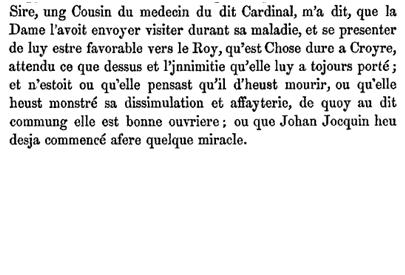
A transcription of the letter Chapuys sent to Charles V explaining Henry’s maneuvering over Wolsey.  

Not to be outdone in the realm of subterfuge, Anne, according to Chapuys, tried to hoodwink Wolsey.  “A cousin of the Cardinal’s physician told me that the lady had sent to visit him during his sickness, and represented herself as favoring him with the King. This is difficult to be believed, considering the hatred she has always borne him. She must have thought he was dying, or shown her dissimulation and love of intrigue, of which she is an accomplished mistress” (Brewer IV 6199).

partc
A transcription of the letter Chapuys sent to Charles V explaining Anne’s treatment of Wolsey.  

Chapuys’ information was not too far off the mark as seen in a letter Anne wrote to Wolsey in late 1529 or early 1530.  She appeared very accommodating as she in her “most humblyst wyse… do thanke your grace for your kind letter, and for yourer rych and goodly present, the whyche I shall never be able to deserve wyth owt your gret helpe” (Cavendish II 254).  She went on to assure the Cardinal that for all the days of her life there was no one “next to the kyngs grace to love and serve your grace, of the whyche I besyche you never to dowte that ever I shalle vary frome this thought as long as only brethe is in my body” (Cavendish II 254).

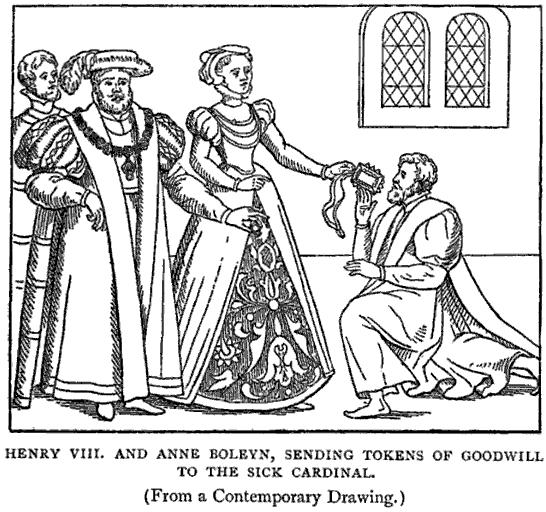
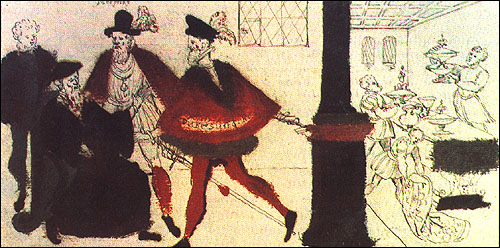
henry anne wolsey
Henry VIII and Anne Boleyn, sending tokens of goodwill to the sick Cardinal Wolsey from a contemporary drawing.  http://www.luminarium.org/encyclopedia/wolseybio.htm

After discussing her thankfulness that Wolsey recovered from his latest sickness “Not doughthyng bot that God has preservyd you…for grete caswsys knwnen allonly to his high wysdome,” Anne approached what must be the main purpose of the letter.  She comments on the arrival in England of the Papal legate letting Wolsey know that “as for the commyng of the legate I desyer that moche; and if it be Goddis pleasor I pray him to send this matter shortly to a goode ende” (Cavendish II 254 – 255).

Anne stressed her good will toward Wolsey and sent him wishes for a “longe lyfe with continewance in honor” signing off with the statement that she had “written wyth the hande of her that is most bound to be Your humble and obedient servant” (Cavendish II 255).  Even the most dedicated champion of Anne Boleyn has to agree to Chapuys’ assessment that she had ‘shown her dissimulation and love of intrigue.’

Yet, this type of deception was typical of Henry. After making a move against his enemy, he then attempted a reconciliation.  Wolsey was pardoned on February 12, 1530, with the following proclamation:  General pardon for Thos. cardinal of York, bishop of Winchester, and perpetual commendatory of the exempt monastery of St. Alban’s, alias late bishop of Bath and Wells, alias late bishop of Durham, alias late chancellor of England and legate de latere of the Apostolic See, alias sometime bishop of Lincoln (Brewer IV 6213).

Wolsey credited the hand of Thomas Cromwell, Chief Minister, and thanked him for his handling of the pardon with the “Kyng in allottyng and appoynttyng of my p[ardon] … yf he lyste. No man can do me more goode and yo[u] … your sylf referre that hys oppynyon was that I shuld [have no] lesse then 4,000l. yeerly to lyve with, wych myn … degre consyderyd ys with the lest, I cowde nat forbere [putting him] in remembrance hereof, remyttyng the betteryng ther[eof to your wisdom] and good handelyng” (Brewer IV 6204). Wolsey assured Cromwell that “Myn only comfort, at the reverens of God leve me not nowe, for yf ye do I shal nat longe lyve in thys wrechyd world. Ye woll nat beleve how I am alteryd, for that I have herd nothing from yow of your procedyngs and expeditions in my maters” (Brewer IV 6203).

Cromwell, the man who would shortly conduct the inventory of goods Wolsey must forfeit to the King, received another letter from Wolsey in which the Cardinal stated that his “comfort & relief I wold have your good sad, syscret advyse & counsell” knowing that Cromwell was working on “sertyng thyngs requyryng expedicion…on my behalf to be solycytyd” (Cavendish II 255-256).  Wolsey wrote to Secretary Stephen Gardiner about the assistance he expected from “my trustyng frend, Thomas Cromwel” (Cavendish II 264). This was trust misplaced, as the pragmatic Cromwell knew where his loyalties lay–with Henry VIII and Anne Boleyn.

Moving quickly, Cromwell acquired the chattel goods of the former Lord Chancellor.  Issuing a decree that Wolsey “having been convicted of various offences against the Crown and the statute of provisors 16 Ric. II., whereby all his property was forfeited. Also grant of all sums of money and goods” (Brewer IV 6214).  Below is the very thorough patent for the recall of Wolsey’s property.

“The money, goods, and chattels given by the King’s grace to the lord Cardinal, whereof mention is made in the King’s letters patent hereunto annexed. First, in ready money, 3,000l. Item, in plate, 9,565¾ oz., at 3s. 8d. the oz., amounteth to 1,753l. 3s. 7½d. Item, divers apparel of household, as hangings, bedding, napry, and other things, as appeareth by the inventory of the same, amounting in value by estimation 800l. Item, in horses and geldings, 80, with their apparel, valued by estimation 150l. Item, in mules for the saddle, four, with [their] apparel, valued by estimation 60l. Item, in mules for carriage, six, with their apparel, valued by estimation 40l. Item, in lynges, 1,000, valued by estimation 50l. Item, in cod and haberdynes, 800, valued by estimation 40l. Item, in salt, 8 way, valued by estimation 10l. Item, in implements of the kitchen, as pots, pans, spits, pewter vessel, and other things necessary for the same, valued by estimation 80l. Item, 52 oxen, valued by estimation 80l. Item, in muttons, 70, valued by estimation 12l. Item, the apparel for his body, valued by estimation 300l.—Sum total, 6,374l. 3s. 7½d.” (Brewer IV 6214).

Again, Spanish Ambassador Eustace Chapuys reported the turn of events to his King.  “One object … was to reinstate the Cardinal in the King’s favor, and, but for the lady, this would be easy, for it is thought the King has no ill-will to the Cardinal. His only wish is for the Cardinal’s goods; and he is not very far wrong, for the Cardinal has spent very large sums of money, and said all he accumulated was for the King; and to take administration of it before the time was not much offence; considering also that the Cardinal, since he began to suspect his fall, and since his destruction, has always said that the King could not do him any greater good than help himself to all that he had. As a proof of the King’s having no ill-will, I am told the King did not wish the Cardinal’s case to be determined by Parliament, as, if it had been decided against him, the King could not have pardoned him” (Brewer IV 6199).
Part a
A transcription of the letter Chapuys sent to Charles V explaining how Anne influenced Henry’s dealings with Wolsey.  

Characteristically of Henry VIII’s Court, the pardon, the apparent reconciliation and Wolsey’s action of handing over his goods and even his residences of Hampton Court and York Place (which became known as the Palace of Whitehall) were not enough to save him.  Previously Henry had trusted Wolsey completely as observed by the Venetian Ambassador Lodovico Falier “he was made Bishop and Cardinal, with papal power. Having achieved so high a position, the King and kingdom were in his sole hands, and he disposed of everything in his own fashion as King and Pope. Very great respect was therefore shown him by all the Powers, whose affairs were always negotiated with his right reverend lordship” (Brown IV 694).  Regardless of his previous powers to regulate the affairs of England, Wolsey was arrested in November 1530 for treason on the grounds that he was communicating with the Pope and the French against the policies of Henry VIII.

On his journey from Yorkshire to face the charges against him, Wolsey had “waxed so sicke” (Cavendish I 311)  when he reached as far as Leicester Abbey he proclaimed, “Father Abbot, I am come heither to leave my bones among you” (Cavendish I 313).

wolsey3
Cardinal Thomas Wolsey, Archbishop of York

Wolsey did die while at the Abbey and the words he spoke on his deathbed showed the regret for the life he had led and the loyalties he had kept, “if I had served God as diligently as I have done the king, he would not have given me over in my grey hairs” (Cavendish I 320).

For references, please refer to the blog entry, Path to St. Peter ad Vincula-Part I

Elizabeth Regina: Her Mother’s Memory

Elizabeth:  Her Mother’s Memory

Elizabeth at the age of two years and eight months upon the death of her mother, probably never had concrete recollections of her mother Anne Boleyn.  There is no evidence that Anne Boleyn was mentioned by any of Elizabeth’s household members during her childhood.  It is pure speculation as to which adults told the youngster about her mother and when she would have possibly learned about Anne’s execution and the scandalous reasons for it.  There are plenty of assumptions that Henry had placed a moratorium on the subject of Anne Boleyn which would not be implausible, but what is conjecture is based on the fact that Elizabeth was confined to her estate because Henry could not bear the sight of her and wanted no remembrance of her or her mother.  We know Sir John Shelton assured Cromwell on Wednesday 16 August 1536 from Hunsdon that he would ensure “the King’s pleasure that my lady Elizabeth shall keep her chamber and not come abroad, and that I shall provide for her as I did for my lady Mary when she kept her chamber” (Gairdner XI 312).  We know Elizabeth remained secluded at Hunsdon; we just do not know why—it could have been Henry trying to protect her from court gossip.

thomas cromwell
Thomas Cromwell

Lady Bryan, in August 1536, had already questioned Cromwell on the status of her charge.  “Now, as my lady Elizabeth is put for that degree she was in, and what degree she is at now, I know not but by hearsay, I know not how to order her or myself, or her women or grooms” (Gairdner XI 203).  Obviously, there was some confusion in her household.  Even Elizabeth was confused; when a gentleman of her household, often identified as either Sir John Shelton or Sir Thomas Bryan, referred to her by the demoted title of Lady Elizabeth, she responded “how haps it, Governor, yesterday my Lady Princess, and today but my Lady Elizabeth?” (Hibbert 20).  An astute child such as this would have understood the danger of asking questions about her mother or even mentioning her.

There are only two recorded times when Elizabeth mentioned her mother in public.  One was when she was 20 and hinted to the Spanish ambassador that she was disliked by Mary because of the distress her mother had caused. The second was when she informed the Venetian ambassador that her mother would never have cohabitated with the king without the ties of matrimony (Weir The Children of Henry VIII 7).  Is this anemic display evidence that she did not have any feelings for her mother or that she did not want to be associated with Anne?  Probably not.  It would not have been politically wise for Elizabeth to be linked too often and too closely with Anne Boleyn so one can understand the lack of mention by an aware and intelligent child.  This did not mean complete elimination of connections and when she was more secure as queen, several examples are in evidence of her identification with her mother although the earliest example comes when she was about ten.

elizabeth 1 by scrouts
Princess Elizabeth 

This early example was when she wore the ‘A’ necklace in the painting,The Family of Henry VIII.”  Supposedly this was “one of Anne Boleyn’s initial pendants” that was inherited from Elizabeth’s mother (Weir Lady in the Tower 306).

Jewelry was one way that Elizabeth showed her relationship with her mother.
Anne Boleyn was said to have three pendants of initials; an “A”, a “B”, and an “AB”. The “B” necklace is the most famous and is in portraits displayed at the National Portrait Gallery and Hever Castle more readily validated as representative of Anne. The “AB” is perhaps in a less famous painting; one not completely authenticated as Anne, and is referred to as the Nidd Hall portrait.

Anne Boleyn B necklace
Anne Boleyn, National Portrait Gallery

Anne Boleyn Hever
Anne Boleyn, ‘Hever Castle Portrait’ a copy of the lost original painted in 1534
AnneBoleynAB
Anne Boleyn, ‘Nidd Hall Portrait’ with the pendent of ‘AB’ hanging upon her gown
It is claimed that Elizabeth was wearing the “A” necklace in “The Family of Henry VIII” painting that hung in Hampton Court. (Weir Henry VIII: The King and His Court 187).  This blogger must disagree with some reports that she was wearing the necklace in defiance of her father.  He had full control of all of his public imagery.  I cannot imagine the artist risking his life, quite literally, by painting in the “A” if it was not sanctioned by Henry.   It is hard to imagine that Elizabeth would so blatantly wear this piece of jewelry without Henry’s permission.  This blogger could start an unsupported theory that this could be the cause of Elizabeth’s exile from 1543 to 1544 (see blog entry “The Fourth Step-Mother of Elizabeth, Katherine Parr” at https://elizregina.com/2013/06/04/the-fourth-step-mother-of-elizabeth-katherine-parr/).  This is clearly on a weak foundation considering the painting, according to Roy Strong, was completed between 1543 -1547. If Henry became incensed enough to banish his daughter for wearing an inherited item of jewelry from her disgraced mother, surely he would have ordered it painted out of the completed picture.  Perhaps allowing Elizabeth to display this necklace was a kind gesture on the king’s part or it was a tactic wanting everyone to associate the girl with her mother and her illegitimacy, in contrast to the legitimate heir next to him.
H8 Family
The Family of Henry VIII
BLow up M and E try this one
An enlargement obtained by Flickr of the princesses 

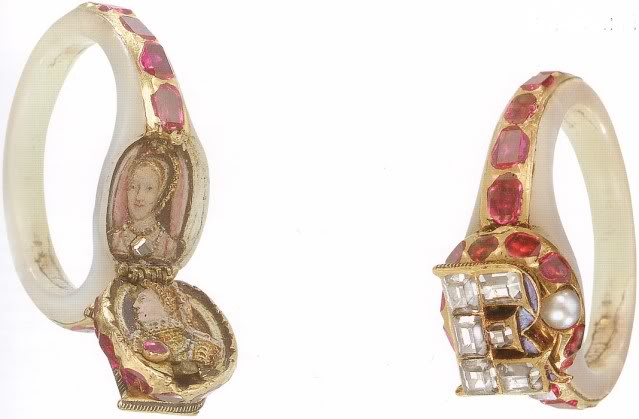
Apart from the wearing of one of Anne Boleyn’s necklaces, another piece of jewelry associated with Elizabeth and her mother is the Chequers ring.  Dated to around 1575 the Chequers Ring, thus named as it is now in the possession of that estate, clearly has a diamond encrusted ‘E’ and ‘R’ on the face. The locket opens to reveal a portrait of Elizabeth and an unidentified woman, usually and logically identified as Anne Boleyn; although, speculation ranges from it being a younger Elizabeth to Katherine Parr.  The history of the ring is too sketchy for this blogger to comfortably say that Elizabeth commissioned it as opposed to a courtier.  It is also difficult to agree with Weir, and many other writers who claim the ring “was only removed from her finger at her death, when it was taken to her successor, James VI of Scotland, as proof of her demise” (Weir Lady in the Tower 306). There is no definitive proof that Elizabeth constantly wore the ring or that it was the particular jewel taken to Scotland by Robert Carey.

Chequers ring to use
Chequers ring–this blogger was fortunate to see this locket ring at “Elizabeth:  The Exhibition at the National Maritime Museum” in Greenwich on August 8, 2003.

Another way Elizabeth linked to her mother was the use of her mother’s heraldic badge the crowned falcon upon a tree stump, surrounded by Tudor roses.  Although this was not implemented consistently as Elizabeth’s badge, there are several places it is displayed and on several items such as her virginal. The spinet “bears the royal coat of arms and the falcon holding a scepter, the private emblem of her mother, Anne Boleyn” (“The Queen Elizabeth Virginal”).  It is also speculated that Elizabeth adopted one of Anne’s mottoes, Semper eadem.  This is discussed on the blog “Said it, Believed it, Lived it” at https://elizregina.com/2013/06/25/said-it-believed-it-lived-it/.

virginals w falcon
Virginal of Elizabeth I, the Boleyn badge is on the left.

Elizabeth continued her links with her mother by promoting members of Anne’s household staff, Matthew Parker as Archbishop of Canterbury and relatives; notably the Careys, Knollyse, Sackvilles and even Howards until their alliance to Catholicism made it politically impossible.  Anne was also commemorated in a biography by William Latymer and in an unfinished treatise by George Wyatt (Weir, The Lady in the Tower 307-308).

A way in which Elizabeth kept her mother’s influence alive was in her understanding of the benefits and necessity of display. “Between Anne and Elizabeth there was an uncanny similarity of attitude towards the projection of monarchy, and of themselves as chosen by God to rule” (Ives 218).  It is estimated Anne spent £40* a month mostly on clothes for herself and Elizabeth (Ives 217).  Had Anne lived, her wardrobe would have “rivalled the 2000 costumes which tradition assigns to that most fashion-conscious of monarchs, her daughter Elizabeth” (Ives 253).  Catholic chronicler, Nicholas Sander, no friend of Anne’s, conceded that she “was always well dressed, and every day made some change in the fashion of her garments” (Sander 25).

Anne has been criticized for having such an active interest in her daughter’s wardrobe; one wonders if this was an area in which she could direct her wishes and so she did.  Taking an inordinate amount of care in the purchase of materials and the ordering of garments for her child was perhaps the method of bestowing attention that was socially and politically acceptable for Anne.

We have a dispatch that Sir William Loke, mercer and merchant adventurer who supplied the king with clothes of gold, silver and other luxurious fabrics and performed diplomatic missions on his buying trips abroad, wrote personally to the king in February 1534:  “The sale of cloths by your subjects has been good, but money is scarce.  I trust I have done my best to provide such things as the Queen gave me commission for” (Gairdner VIII 197). Loke kept extensive account records (published in the text, An Account of Materials Furnished for Use of Queen Anne Boleyn and the Princess Elizabeth, by William Loke ‘the King’s Mercer’ Between the 20th January 1535 [27th year of Henry VIII], and the 27th April 1536.  Communicated by J. B. Heath) which reveal clothing being sent to the princess.  It was  obvious that the “king’s heir, who was not yet three years old, was quite properly to be dressed in fashionable and expensive clothing”  (Warnicke 170).

armada
An example of elaborate clothing worn by Elizabeth in the ‘Armada Portrait’.

In Anne’s account books of May 19, 1536, are entries for payment for “boat-hire form Greenwich to London and back to take measure of caps for my lady Princess, and again to fetch the Princess’s purple satin cap to mend it.”  Anne, apparently, was especially fussy about her daughter’s caps: this particular one required at least three journeys to Greenwich to get it right” (Ives 253). Included in the accounts was “an ell of ‘tuke’ and crimson fringe for the Princess’s cradle head.”  Added to this finery was “a fringe of Venice gold and silver for the little bed.” Included were more assorted caps, white, crimson, purple and a “cap of taffeta covered with a caul of damask gold for the Princess” (Gairdner X 913).

Queen Anne Boleyn never had a full say in her child’s upbringing. That was the business of the king and his council. Famously, when it came to decide if Elizabeth should be weaned, her governess wrote to Thomas Cromwell for permission (Warnicke 170).  We do know from William Latymer, chaplain to Anne Boleyn who wrote Chronickille of Anne Bulleyne during the reign of Elizabeth, reported that Anne “had wanted her child, as her elder half-sister had been, trained in classical languages” (Warnicke 171).  When Anne realized that she was in serious danger of losing her life she gave unto Matthew Parker, her devoted chaplain and later Archbishop of Canterbury during the reign of Elizabeth, the care of her child.  This move can be seen as her wish for Elizabeth to have not only a classical education but also a more evangelical religious upbringing.

Matthew_Parker
Matthew Parker, Archbishop of Canterbury during the reign of Elizabeth 

Besides directing Elizabeth’s wardrobe and directing her education, how else did Anne bestow attention on her daughter?  This is impossible to know. Following standards of the day, Elizabeth was removed from her parents’ household when she was three months old.  She was sent to her own residence, Hatfield, with a wet-nurse and her governess, Margaret Bourchier, Lady Bryan.  “Here and at Hunsdon in Hertfordshire the princess spent much of her childhood although, like her parents, she traveled from house to house, staying in such places as Richmond, Eltham, Langley,and the More” (Warnicke 170).  Contemporary records indicate that Anne did visit regularly as we see from a letter written by Sir William Kyngston, courtier and Constable of the Tower of London, to Lord Lisle, Arthur Plantagenet on 18 April 1534.  “To day the King and Queen were at Eltham, and saw my lady Princess, as goodly a child as hath been seen and her grace is much in the King’s favour as goodly child should be, God save her”  (Gairdner VII 509).

The visits were not always private, as we would assume between a mother and her child as Eustace Chapuys mentions in a dispatch to Charles V on 24 October 1534. “On Thursday, the day before yesterday, being at Richmond with the little lass (garce) the Lady came to see her said daughter, accompanied by the dukes of Norfolk and Suffolk and others, including some of the ladies, which was a novelty” (Gairdner VII 1297).  Besides these visits, Anne was in contact with Lady Bryan through letters concerning the care of Elizabeth (Ives 256).  A response to a request from Elizabeth’s household officers to the Council was sent in a packet with “letters to them, and one from the Queen to lady Brian” (Gairdner IX 568).

Richmond 1562
Richmond Palace, 1562

Speculation is futile regarding the feelings both mother and daughter felt for each other; no written records exist.  Anne, following the social dictates and court etiquette of the day, rarely saw her daughter.  Not only was Elizabeth reared by people other than her parents, she was physically removed from them, as was her siblings so some people placing emphasis on the fact she was taken to Hatfield at the age of three months was proof her mother was as disappointed as her father in her birth.  Henry’s treasured heir, Edward, was also reared in a separate household.  Evaluation of those persons surrounding the infant Elizabeth does lend itself to assume a strong influence of Anne.  Many had Boleyn connections: Lady Margaret Bryan was not only Princess Mary’s former governess but related to Anne as they shared a maternal grandmother; Lady Shelton, also from Princess Mary’s household and given charge of the combined establishment of Mary and Elizabeth was Anne’s Aunt; and Kat Ashley nee Champernowne was married to Anne’s cousin. After Anne Boleyn’s execution, Henry did not alter the positions of these people closest to Elizabeth.  He too must have trusted them and was not worried about how Anne would be portrayed to their daughter by ‘Boleyn’ servants.  Elizabeth would later comment that “we are more bound to them that bringeth us up well than to our parents… our bringers-up are a cause to make us live well in [the world]” (Marcus 34).

*£40 from 1535 would be £19,000.00 using the retail price index or£266,000.00 using average earnings based on calcualtions from the “Measuring Worth” website.

References:

Brewer, J. S. (editor). “Henry VIII: November 1517.” Letters and Papers, Foreign and Domestic, Henry VIII, Volume 2: 1515-1518 (1864): 1183-1198. British History Online. Web. 29 June 2013.

Burnet, Gilbert. The History of the Reformation of the Church of England. Vol.I Part I. London:  W. Baynes and Son, 1825.  Google Books.  Web.  3 July 2013.

Gairdner, James. (editor). “Henry VIII: April 1534, 16-20.” Letters and Papers, Foreign and Domestic, Henry VIII, Volume 7: 1534 (1883): 199-210. British History Online. Web. 29 June 2013. 

Gairdner, James (editor). “Henry VIII: February 1535, 11-20.” Letters and Papers, Foreign and Domestic, Henry VIII, Volume 8: January-July 1535 (1885): 75-98. British History Online. Web. 29 June 2013.

Gairdner, James (editor). “Henry VIII: October 1535, 6-10.” Letters and Papers, Foreign and Domestic, Henry VIII, Volume 9: August-December 1535 (1886): 181-195. British History Online. Web. 29 June 2013.

Gairdner, James (editor). “Henry VIII: February 1536, 1-5.” Letters and Papers, Foreign and Domestic, Henry VIII, Volume 10: January-June 1536 (1887): 82-98. British History Online. Web. 01 July 2013.

Gairdner, James (editor). “Henry VIII: August 1536, 16-20.” Letters and Papers, Foreign and Domestic, Henry VIII, Volume 11: July-December 1536 (1888): 130-138. British History Online. Web. 28 June 2013.

Hibbert, Christopher.  The Virgin Queen: Elizabeth I, Genius of the Golden Age.  New York: Addison-Wesley Publishing Company, Inc., 1991.  Print.

Ives, Eric.  The Life and Death of Anne Boleyn: The Most Happy. Oxford: Blackwell Publishing, 2004. Print.

Marcus, Leah S. et al., eds. Elizabeth I: The Collected Works. Chicago: University of Chicago Press, 2002. Print.

“The Queen Elizabeth Virginal.” V&A Images Collection. Victoria and Albert Museum, n.d. Web. 03 July 2013.

Ridgway, Claire.  The Fall of Anne Boleyn:  A Countdown.  UK:  MadeGlobal Publishing, 2012. Print.

Sander, Nicholas, and Edward Rishton. Rise and Growth of the Anglican Schism. Trans. David Lewis. London: Burns & Oates, 1877. Google Books. Web. 28 June 2013.

Somerset, Anne. Elizabeth I.  New York: Alfred A. Knopf, 1991. Print.

Warnicke, Retha.  The Rise and Fall of Anne Boleyn: Family Politics at the Court of Henry VIII. Cambridge:  Cambridge University Press, 1989.  Print.

Weir, Alison. The Children of Henry VIII.  New York:  Ballantine Books, 1996. Print

Weir, Alison.  Henry VIII:  The King and His Court.  New York:  Ballatine Books, 2001. Google Books. Web. 30 June 2013.

Weir, Alison.  The Lady in the Tower:  The Fall of Anne Boleyn.  London:  Jonathan Cape, 2009.  Print.

Lady Bryan: An Iron Hand in a Velvet Glove

Lady Bryan:  An Iron Hand in a Velvet Glove

Margaret, Lady Bryan, governess to the royal children of King Henry VIII, was born about 1468 in Benningborough, Yorkshire, England.  Her parents were Sir Humphrey Bourchier–who was killed fighting for Edward VI at the battle of Barnet (Wagner 180) and Elizabeth Tilney–related through the Plantagent line to Edward III.  Elizabeth Tilney remarried upon the death of Sir Humphrey to Thomas Howard, 2nd Duke of Norfolk.  She went on to have more children, notably the 3rd Duke who played a very prominent role in Tudor politics and Elizabeth Boleyn, mother to Queen Anne, thus making Margaret Bourchier a half-sister to Anne Boleyn’s mother.

Elizabeth_tylney
Detail of a stained glass window at Holy Trinity Church, Long Melford, Suffolk depicting Elizabeth Tilney

The pre-contract that had been arranged with John Sands in November of 1478, did not impede her marriage to Sir Thomas Bryan in 1487.  It is known the couple had four children of which, most sources agree, two reached adulthood, Sir Francis Bryan and Elizabeth.

Francis Bryan did not care for Anne Boleyn and would take a role in her downfall.  He was referred to as the ‘Vicar of Hell’ by both King Henry and Thomas Cromwell for his lack of principles.  He had a “reputation for liking rich clothing and for gambling.  He was a popular courtier, skilled hunter and ouster, and lost an eye in a joust in 1526” (Ridgway xv).  Sir Francis was a very close friend to King Henry VIII and held positions on the Privy Council until eventually he became Lord Chief Justice of Ireland where he died in 1550.

Elizabeth Bryan married Sir Nicholas Carew.  The King did not forget his obligation to his loyal servants’ daughter. Accounts record a dowry, “Receipt 7 Nov. 6 Hen. VIII., from Sir John Daunce, by Dame Margaret Bryan, wife of Sir Thomas Bryan, on behalf of Mistress Elizabeth Bryan, their daughter, of 550/. Given ‘to her marriage, which by God’s grace shall be espoused and wedded to Nicholas Carewe, son and heir apparent to Sir Richard Carewe, knight, before the feast of the Purification of Our Blessed Lady the Virgin” (Brewer I 3419). Nicholas Carew was in high favor with the king and on May 3, 1516, a further wedding gift was recorded : “For NICH. CARUE. squire of the Body, son and heir of Sir Ric, and for ELIZ his wife, daughter of Tho. Bryan, vice-chamberlain to Queen Katherine. Writ to the Barons of the Exchequer, to make over lands …to the annual value of 40 mks., in part payment of 50 mrks. as a marriage portion” (Brewer II 1850).
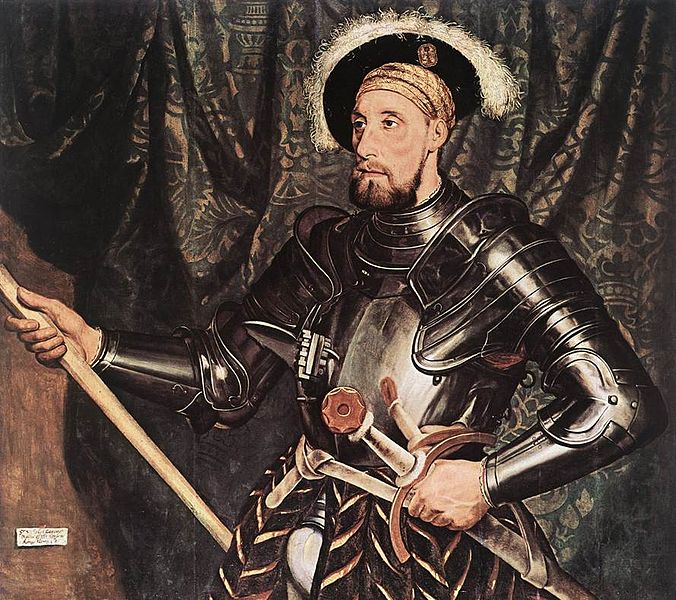
n carew
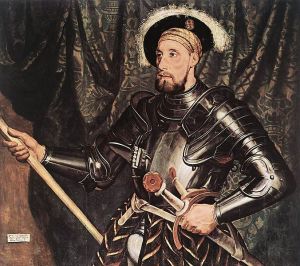
Sir Nicholas Carew by Hans Holbein, 1533

Sir Nicholas Carew, Master of the Horse, was very close to the king.  He had “at first been one of Anne’s partisans – they were cousins–but by 1532 she had alienated and angered him not only by her overbearing ways and her abuse of her position, but also by her unjust treatment of his friend, Charles Brandon, Duke of Suffolk, and his brother-in-law, Sir Henry Guildford” (Weir Lady in the Tower 33).  Carew was executed in 1539 for treasonous actions.  Because his assets and property were confiscated, he left his widow and children destitute. Obviously, her mother intervened and wrote from Hunsdon an imploring letter to Thomas Cromwell in 1539:  “My lord, I most humbly thank your good lordship for the great goodness you shew upon my poor daughter Carew, which bindeth me to owe you my true heart and faithful service while I live.  She sendeth me word that it is the king’s pleasure she shall have lands in Sussex, which is to the value of six score pounds, and somewhat above, which I heartily thank his grace and your lordship for” (Wood 112).  It appears that the land did not have a house so Lady Bryan was requesting more suitable property for the widow and “her heirs males” upon which receipt it would “comfort two troubled hearts; for, my lord, unfeignedly you have, and shall have our true prayers and hearty service during our lives.”  Lady Bryan wanted to assure Cromwell that she knew that putting her trust in him and the King was the best she could do for her daughter who is “so kind a child to me as she hath been, I cannot for pity do no less” (Wood 113-114).
ladycarew2_medium (1)
Tomb of Elizabeth Bryan Carew

Margaret Bryan had been a lady-in-waiting to Catherine of Aragon from the time she married Henry VIII in 1509; she also attended Catherine at her coronation and was later listed as a chamber woman (Brewer I 82).  Sir Thomas was a vice chamberlain to the Queen Catherine’s household until his death sometime before 1517. Perhaps her widowhood is the reason for the king’s taking measures to assist this loyal servant.  A ledger entry for November 19, 1517, was not very comforting to a servant named Elizabeth Denton, but it certainly was for Margaret Bryan. “Marg. Brian, lady mistress to the King’s daughter, the Princess states: Annuity of 40 marks for services to the Princess, during the life of Eliz. Denton, widow, who has the fee of lady mistress to the Princess, and on whose death Brian is to have her office and fee” (Brewer II 3802).

Well-placed, Lady Margaret became governess to Princess Mary and was rewarded by Henry with her own title when she was made Baroness Bryan suo jure.  It is known that she stayed with Mary for almost six years and prior to being relieved of her duties was given a pension.  On July 7, 1519, “Margaret Bryan, widow of Sir Thomas Bryan, and now wife of David Soche, annuity of 50/, for services to the King and queen Katharine, and one tun of Gascon wine; yearly, out of the wine received for the King’s use” (Brewer III 361). Still known as Lady Bryan, Margaret had married her final husband David Zouche sometime before July 1519.

margaret_bourchier
Lady Bryan, Margaret Bourchier

David Zouche is all but lost to history.  Some believe he died in 1526, others in 1536 shortly after Anne Boleyn was executed. Certainly, someone important to her died in the summer of 1536 as revealed in the beginning sentence of a letter Margaret wrote to Cromwell: “I beseech you to be good lord to me now in the greatest need that ever [was], for it hath pleased God to take from me hem (them) that was my most com[fort] in this world, to my great heaviness, Jesu have mercy on his soul, a[nd] I am succourless and as a redeless creature but for my great trust in the King and your good lordship” (Gairdner XI  203).

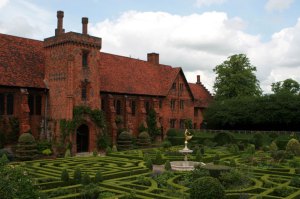
Lady Margaret’s exact role is not clear after she left Princess Mary.  Some speculate that she looked after Henry Fitzroy, the king’s illegitimate son.  She was granted a gift of plate in 1532 even though the Royal household may not have directly employed her at that time (Gairdner V 1711). When she was called upon to care for Elizabeth, Lady Bryan was over the age of 60.  Margaret took charge of Elizabeth at her birth and went on to setup her household at Hatfield three months later. On 2 December 1533, “The king’s highness hath appointed that the lady princess Elizabeth (almost three months old) shall be taken from hence towards Hatfield to remain with such household as the king’s highness has established for the same” (Strickland VI 6).  At Hatfield and Hunsdon is where the princess “spent much of her childhood although, like her parents, she traveled from house to house, staying in such places as Richmond, Eltham, Langley,and the More” (Warnicke 170).
Hatfield_House_Old_Palace
 Hatfield

Much of what we know from the childhoods of Elizabeth and Edward come from the correspondence from Lady Bryan to Thomas Cromwell concerning the households of the children.  In a much quoted letter to Thomas Cromwell soon after Anne’s execution, Lady Bryan lays forth the difficulties of the child’s household with her change of status, her lack of clothing and her method of eating, all to be discussed further.

Held in such esteem by King Henry VIII when his treasured male heir was born in October of 1537, Lady Bryan was installed as his governess and Kat Ashley nee Champernowne took charge as Elizabeth’s. As conscientious with the Prince as she was with Elizabeth, Lady Bryan wrote to Cromwell appraising him of her charge.  A letter survives from 11 March 1539 in which young Edward is praised and touted; “Pleaseth your lordship to understand that, blessed be Jesu, my lord prince’s grace is in good health and merry, as would to God the king’s grace and your lordship had seen him yesternight; for his grace was marvelous pleasantly disposed.  The minstrels played, and his grace danced and played so wantonly that he could not stand still, and was as full of pretty toys as ever I saw a child in my life; as Master Chamberlain and my lady his wife can shew your lordship when they speak with you, whom I assure your lordship giveth as good and diligent attendance as is possible” (Wood 112).

It is unclear if Margaret relinquished her duties prior to Edward’s becoming king.  She was not forgotten as there is a mention of an annuity to her in January 1545. A ledger entry reads for “Lady Margaret Bryane, the King’s servant.  Annuity of 20/ from the Annunciation of Our Lady last.  Greenwich, 16 Jan. 36 Hen. VIII” (Gairdner XX 125).  Once Edward succeeded to the throne, Lady Bryan maintained her title, but lived away from court at her estates in Essex, “where she enjoyed a generous annuity of £70 per year” (Wagner 180).
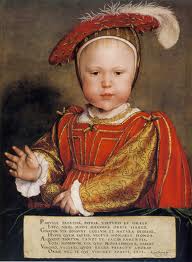
edward 6
Prince Edward by Hans Holbein, 1538

We do know Lady Bryan died in Leyton, a village in Essex; the year is a bit more elusive.  Various sources list her possible years of death as 1551, 1552, and 1554. One source confidently declared that Margaret “died in 1552, shortly before the proving of her will on 21 June” (Wagner 180).

When Anne Boleyn gave birth to Elizabeth in 1533, Margaret transferred her duties to become the governess of the newest royal baby.  Margaret held this post until Edward was born in 1537 when she moved to his household and Katherine Ashley took over duties with Princess Elizabeth.  Anne did not have much say in her child’s upbringing—that was for Henry and his council. When Lady Bryan thought Elizabeth should be weaned, she contacted Lord Cromwell and then he submitted the request to the Privy Council.

A response from Sir William Paulet, onetime Comptroller of the Royal Household and  Lord Chamberlain to Henry VIII,  to Thomas Cromwell on 9 October 1535 addressed the issue of Elizabeth’s weaning.  “The King having considered the letter to Cromwell from lady Brian and other of the Princess’s officers, has determined that she shall be weaned with all diligence” (Gairdner IX 568). Agnes Strickland gives us some sardonic imagery when she tells us that in order for Elizabeth to be weaned “the preliminaries for this important business were arranged between the officers of her household and the cabinet ministers of her august sire, with as much solemnity as if the fate of empires had been involved in the matter” (Strickland Life of Elizabeth 6).
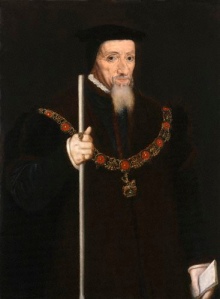
NPG 65,William Paulet, 1st Marquess of Winchester,by Unknown artist
Sir William Paulet

Having the charge of the royal children meant teaching them etiquette and proper manners—and displaying the children in the majesty expected. “Lady Bryan, who had brought Mary up until she was six, had been accustomed to treat her as the heiress to the throne for seventeen years. She must have been profoundly embarrassed when the girl was sent to share Elizabeth’s household with orders to ride behind the baby’s litter on progress and to cede the seat of honour even when the infant was still in the care of a wet-nurse” (Perry 19).  But as a stickler to her duty, it can be assumed she ensured the King’s wishes were fulfilled.

Chapuys, no friend of Elizabeth, shared with Charles V a meeting that took place on the Tuesday following Easter of 1534 between the French Ambassadors, La Pommeraye and Catillion and Elizabeth.  This visit was orchestrated to present Elizabeth as a fitting bride for a French prince and full-credit for its success went to Lady Bryan.  The Ambassadors “went to visit the King’s bastard daughter, who was brought out to them splendidly accoutred and dressed, and in princely state, with all the ceremonial her governess could think of”  (Gayangos V 40).

That Lady Bryan took this portion of her duties seriously was again shown in her letter to Cromwell.  It is speculated this letter was written in response to Lord Chancellor Thomas Audeley’s proposed visit to baby Prince Edward in 1537.  Lady Bryan wrote:

“My lord,
After my most bounden duty I humbly recommend me unto your good lordship; and shall accomplish it to the best of my power…. The best coat my lord prince’s grace hath is tinsel, and that he shall have on at that time; he hath never a good jewel to set on  his cap; howbeit I shall order all things for my lord’s honour the best I can, so as I trust the king’s grace shall be contented withal” (Wood 68-69).

Her affection seemed sincere for her royal charges and her pride in them too. She could not help but brag on Prince Edward, informing Cromwell, “I thank Jesu my lord prince’s grace is in good health and merry, and his grace hath four teeth; three full out, and the fourth appeareth” (Wood 69).
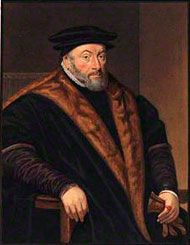
thomasaudley2
 Lord Chancellor, Thomas Audeley

“Much of the future greatness of Elizabeth may reasonably be attributed to the judicious training of her sensible and conscientious governess, combined with the salutary adversity, which deprived her of the pernicious pomp and luxury that had surrounded her cradle while she was treated as heiress of England” (Strickland VI 12).  Elizabeth was brought up calmly in the way that Lady Bryan thought best, shielded from the gossip and temptations of the adult world.  Lady Bryan no doubt shielded Princess Elizabeth as much as she could from the gossip surrounding her mother and the inevitable slander that began shortly after Anne’s death concerning the paternity of her daughter (Weir, The Lady in the Tower 316-317).

The king’s order for Elizabeth to remain in seclusion could have been his attempt to protect her as much as the theory that it was his unwillingness to face the child.  To read further on this topic visit the blog entry “Elizabeth:  Her Mother’s Memory” @elizregina.com.  This blogger believes that Agnes Strickland judged the Tudor Era with the mores of her own time period when she exclaimed that when “Elizabeth was branded with the stigma of illegitimacy; she was for a time exposed to the sort of neglect and contempt which is too often the lot of children to whom that reproach applies” (Strickland VI 9).  Henry VIII did not neglect his recognized illegitimate son, Henry FitzRoy, and perhaps he did not purposefully neglect Elizabeth in the summer of 1536.  He was embarking on a new life with his third wife, Jane Seymour, and was traveling the country.  We have seen how the final word of the organization of the children’s households rested with Henry.  His thoughts were on her to some degree so it could not be his indifference that led to the ‘crisis’ of her wardrobe and her household but perhaps more of benign neglect—administrative oversight.  That her position was diminished was obvious. “On 25 June 1536, an order reconstituted the households of Mary and Elizabeth.  It was certainly no coincidence, in that age when the number of servants in a household was a great status symbol, that Mary was given fourty-two servants, and Elizabeth thirty-two” (Ridley 26).  Below reprinted in chart form is the information from the 10th volume of Letters and Papers of Henry VIII concerning the structural changes made to the two households.

Personages appointed to attend on the lady Mary:—
Gentlewomen. Anne Morgan, Mrs. Finche, Frances Jerningham, Elizabeth Sydney.
Chamberers: Systile (Cecil ?) Barnes, Lucretia the Tumbler.
Gentlemen Ushers and Waiters: Richard Wilbraham, Robt. Chichester, Sir Ric. Baldwin, Walter Bridges, Thos. Burrows.
Wardrobe of Robes: Thos. Palmer, Nic. Newes.
Footman: Chas. Morley.
Laundress: Deachryche (Beatrice) Ap Rice.
Woodbearer: John Layton.
Keeper of Greyhounds: Christopher Bradley.
The Stable: Thos. Jene, yeoman; Ric. Hogg, Nic. Twydall, and Thos. Crabtree, grooms.
The names of persons attending upon lady Mary and lady Elizabeth:— i. On lady Mary:—
Gentlewomen: Susan Clarencyus, Frances Elmer, Mary Baynton Frances Baynan. “Chamberes:” Knyght, Syssele. Physician: Dr. Mychell. Gentlemen: Ant. Cotton, Wm. Chechester, Ric. Wylbram, Randale Dod, Sym Borton. Chaplain: Bauldewen. Yeoman: Geo. Mounge, David à Pryce, Chr. Wryght, John Conwey, Gray. Grooms of the Chamber: Thos. Borow, Walter Brydges, Thos. Palmer, Nic. Newes. Footman: Chas. Morley. Stable: Thos. Gent, yeoman; Thos. Bell, John Smith, and John Hyges, grooms. Laundress: Beatrice a Pryce. Woodbearer: William. Total, 42.
On lady Elizabeth:—
Ladies and gentlewomen: Lady Troy, Mrs. Chambrum, lady Garet, Eliz. Candysche, Mary Norice. “Chamberes:” Alys Huntercum, Jane Bradbelt. Gentlemen: Thos. Torrell, Robt. Porter, Ric. Sandes.Chaplain: Sir Rauffe. Grooms of the Chamber: Ric. Foster, Wm. Russell. Yeomen: David Morgan, Gabryell Tenant. Laundress: Agnes Hylton. Woodbearer: Christopher. Total, 32.
Personages appointed to attend on the lady Elizabethe, the Kinges doughter.”
Gentlewomen: Kateryne Chambernowne, Elizabethe Garret, Mary Hyll, Blanche ap Harrye.
Chamberers: Alice Huntercombe, Jane Bradbelt.
Gentlemen Ushers and Gentlemen Waiters: Rychard Sandes, Robert Power.
Chaplain: Sr Raffe Taylour.
Gromes of the Chambre: Willm. Man, John Acton.
Wardrobe of Robes: John Goughe, yeoman.
Lawndresse: Anne Hilton.
Woodberer: John Wyllycke
(Gairdner X 1187)

Lady Bryan’s letter to Thomas Cromwell in the summer of 1536, which was referred to earlier and has been recreated in full below, can be seen as a way to restore the prestige of and attention on Elizabeth’s household which was at Hunsdon. Cromwell’s response has not survived but Mistress Bryan’s concerns must have been addressed as there appears to be no further pleas on her part.  Her initial issue involved the altered status Elizabeth held.  Lady Bryan was searching for guidance when she wrote, “Now, as my lady Elizabeth is put from that degree she was in, and what degree she is at now I know not but by hearsay, I know not how to order her or myself, or her women or grooms” (Gairdner XI  203).
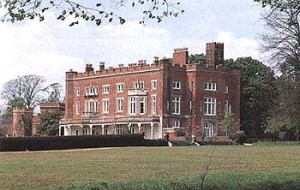
hunsdon
Hunsdon

Next up was the issue of Elizabeth’s wardrobe. It was up to “the lady mistress to make certain Elizabeth looked and acted like a king’s daughter, and proper clothes were essential to the role” (Erickson 37).  Margaret was beside herself as she begged Cromwell “to be good lord to her and hers, and that she may have raiment, for she has neither gown nor kirtle nor petticoat, nor linen foresmocks, nor kerchiefs, rails (night dresses), bodystychets (corsets), handkerchiefs, sleeves, mufflers, nor begins (night-caps).  All thys her Graces must take I have dreven off as long as I can, that, be my trothe, I cannot drive it no lenger. Besseeching you, my lord, that ye will see that her grace may have that which is needful for her, as my trust is that ye will do” (Gairdner XI  203).

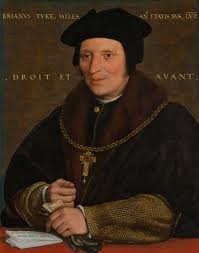
The condition of Elizabeth’s wardrobe “reflected the general penury of the household” (Erickson 38).  Money must have been tight as the final concern that Lady Bryan has mixes the role of the steward, John Shelton, with the need for economy.  Shelton, who was responsible for keeping up the supplies of food, drink and other items necessary for the household, wrote to Cromwell shortly after Lady Bryan did to complain that he was “running short of money and ‘could not continue’ without more.”  This may not have been easy to acquire as the king’s Secretary Brian Tuke “had made it clear only a week earlier that he hoped Mr. Shelton would not be appealing for additional funds, as he had little or nothing to give him” (Erickson 38).
tuke
Sir Brian Tuke by Hans Holbein, 1527

Lady Bryan’s tactic was to explain the poor judgment on Shelton’s part– who, she lets us know, “saith he is master of this house. ‘What fashion that shal be I cannot tel, for I have not seen it afore.’” (Gairdner XI  203)–and offer a solution.  Apparently, Shelton “would have my lady Elizabeth to dine and sup every day at the board of estate.”  Margaret explains that this is not good for a child and “she will see divers meats, fruits, and wine, that it will be hard for me to refrain her from. ‘Ye know, my lord, there is no place of correction there; and she is too young to correct greatly.’ I beg she may have a good mess of meat to her own lodging, with a good dish or two” which would be enough to feed 11 of her personal attendants which in turn would be more economical as less people would have to be fed in the great hall (Gairdner XI  203).

One theory for Mr. Shelton,  a relative of Anne Boleyn, actions could be that he “wished to keep regal state as long as possible round the descendant of the Boleyns” and with “perhaps an eye to ingratiate himself with the infant, by indulging her by the gratification of her palate with mischievous dainties” (Strickland VI 11).  Or, as this blogger wonders, could it be a way for him and his associates to be served elaborate meals at the King’s expense.
elizabeth 1 by scrouts
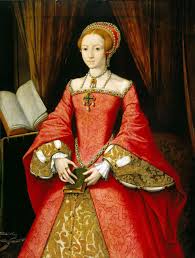
Princess Elizabeth

This letter, which gives us a peek into the politics of the household, ends with Margaret expressing sympathy for Elizabeth’s teething.  The governess realizes that witnessing the pain the child is in, “makes me give her her own way more than I would” yet excuses herself by assuring Cromwell that “she is as toward a child and as gentle of conditions as ever I knew any in my life….” Determined in her duties, Lady Bryan wanted to ensure that when the time came for Elizabeth to be “set abroad, I trust so to endeavour me that she shall so do as shall be to the King’s honour and hers…”(Gairdner XI  203).

Letter from Lady Margaret Bryan to Thomas Cromwell, June 1536
I beseech you to be good lord to me now in the greatest need that ever [was], for it hath pleased God to take from me hem (them) that was my most com[fort] in this world, to my great heaviness, Jesu have mercy on his soul, a[nd] I am succourless and as a redeless creature but for my great trust in the King and your good lordship. When your lordship was last here you bade me not mistrust the King or you, which gave me great comfort, and encourages me now to show you my poor mind. When my lady Mary was born the King appointed me lady Mistress, and made me a baroness; ‘And so I have been a governess to the children his Grace have had since.’

Now, as my lady Elizabeth is put from that degree she was in, and what degree she is at now I know not but by hearsay, I know not how to order her or myself, or her women or grooms. I beg you to be good lord to her and hers, and that she may have raiment, for she has neither gown nor kirtle nor petticoat, nor linen foresmocks, nor kerchiefs, rails (night dresses), bodystychets (corsets), handkerchiefs, sleeves, mufflers, nor begins (night-caps).  All thys her Graces must take I have dreven off as long as I can, that, be my trothe, I cannot drive it no lenger. Besseeching you, my lord, that ye will see that her grace may have that which is needful for her, as my trust is that ye will do.  Beseeching ye, mine own good lord, that I may know from you, by writing, how I shall order myself, and what is the king’s grace’s pleasure and yours; and that I shall do in everything?  And whatsomever it shall please the king’s grace or your lordship to command me at all time, I shall fulfil it to the best of my power.

Mr. Shelton saith he is master of this house. ‘What fashion that shal be I cannot tel, for I have not seen it afore.’ I trust to your lordship, who, as every man reports, loveth honour, to see this house honourably ordered,’ howsom ever it hath been aforetime.’ If the head of [the same] know what honor meaneth it will be the better ordered; if not, it will be hard to bring it to pass.

Mr. Shelton would have my lady Elizabeth to dine and sup every day at the board of estate. It is not meet for a child of her age to keep such rule. If she do, I dare not take it upon me to keep her Grace in health; for she will see divers meats, fruits, and wine, that it will be hard for me to refrain her from. ‘Ye know, my lord, there is no place of correction there; and she is too young to correct greatly.’  I know well and she be there, I shall neither bring her up t the king’s grace’s honour, nor hers, nor to her health, nor to my poor honesty.

I beg she may have a good mess of meat to her own lodging, with a good dish or two meet for her to eat of; and the reversion of the mess shall satisfy her women, a gentleman usher, and a groom; ‘which been eleven persons on her side.’ This will also be more economical.

God knoweth my lady hath great pain with her teeth, which come very slowly. This makes me give her her own way more than I would. ‘I trust to God and her teeth were well graft to have her Grace after another fashion than she is yet; so, as I trust, the King’s Grace shall have great comfort in her Grace. For she is as toward a child and as gentle of conditions as ever I knew any in my life, Jesu preserve her Grace. As for a day or two at a hey time or whansomever it shall please the King’s Grace to have her set abroad, I trust so to endeavour me that she shall so do as shall be to the King’s honour and hers; and then after to take her ease again. I think Mr. Shelton will not be content with this. He may not know it is my desire, but that it is the King’s pleasure and yours it should be so.’ From Hunsdon with the evil hand of your daily bede woman.
Apologies for her boldness in writing thus” (Gairdner XI  203).

References

Brewer, J. S. (editor). “Henry VIII: November 1514, 2-10.” Letters and Papers, Foreign and Domestic, Henry VIII, Volume 1: 1509-1514 (1920): 1431-1444. British History Online. Web. 06 July 2013.

Brewer, J. S. (editor). “Henry VIII: November 1517.” Letters and Papers, Foreign and Domestic, Henry VIII, Volume 2: 1515-1518 (1864): 1183-1198. British History Online. Web. 29 June 2013.

Brewer, J. S. (editor). “Henry VIII: July 1519, 1-15.” Letters and Papers, Foreign and Domestic, Henry VIII, Volume 3: 1519-1523 (1867): 121-136. British History Online. Web. 30 June 2013.

Erickson, Carolly. The First Elizabeth. New York: Summit Books. 1983. Print.

Gairdner, James. (editor). “Henry VIII: April 1534, 16-20.” Letters and Papers, Foreign and Domestic, Henry VIII, Volume 7: 1534 (1883): 199-210. British History Online. Web. 29 June 2013.

Gairdner, James (editor). “Henry VIII: February 1535, 11-20.” Letters and Papers, Foreign and Domestic, Henry VIII, Volume 8: January-July 1535 (1885): 75-98. British History Online. Web. 29 June 2013.

Gairdner, James (editor). “Henry VIII: October 1535, 6-10.” Letters and Papers, Foreign and Domestic, Henry VIII, Volume 9: August-December 1535 (1886): 181-195. British History Online. Web. 29 June 2013.

Gairdner, James (editor). “Henry VIII: Miscellaneous, 1536.” Letters and Papers, Foreign and Domestic, Henry VIII, Volume 10: January-June 1536 (1887): 531-537. British History Online. Web. 06 July 2013.

Gairdner, James (editor). “Henry VIII: August 1536, 16-20.” Letters and Papers, Foreign and Domestic, Henry VIII, Volume 11: July-December 1536 (1888): 130-138. British History Online. Web. 28 June 2013.

Gairdner, James (editor). “Henry VIII: June 1538, 26-30.” Letters and Papers, Foreign and Domestic, Henry VIII, Volume 13 Part 1: January-July 1538 (1892): 464-491. British History Online. Web. 06 July 2013. <

Gairdner, James and R. H. Brodie (editors). “Appendix.” Letters and Papers, Foreign and Domestic, Henry VIII, Volume 14 Part 2: August-December 1539 (1895): 359-372. British History Online. Web. 06 July 2013.

Gairdner, James and R. H. Brodie (editors). “Henry VIII: January 1545, 26-31.” Letters and Papers, Foreign and Domestic, Henry VIII, Volume 20 Part 1: January-July 1545 (1905): 38-59. British History Online. Web. 30 June 2013.

Gayangos, de Pascual (editor). “Spain: April 1534, 11-20.” Calendar of State Papers, Spain, Volume 5 Part 1: 1534-1535 (1886): 110-124. British History Online. Web. 07 July 2013.

Gristwood, Sarah.  Elizabeth & Leicester:  Power, Passion, Politics. New York:  Viking, 2007. Print.

Hibbert, Christopher.  The Virgin Queen: Elizabeth I, Genius of the Golden Age.  New York: Addison-Wesley Publishing Company, Inc., 1991.  Print.

Ives, Eric.  The Life and Death of Anne Boleyn: The Most Happy. Oxford: Blackwell Publishing, 2004. Print.

Neale, J. E. Queen Elizabeth I. Garden City, NY: Doubleday, 1957. Print.

Perry, Maria.  The Word of a Prince: A Life of Elizabeth from Contemporary Documents.  Woodbridge, Suffolk: The Boydell Press, 1990.  Print.

Ridgway, Claire.  The Fall of Anne Boleyn:  A Countdown.  UK:  MadeGlobal Publishing, 2012. Print.

Ridley, Jasper. Elizabeth I: The Shrewdness of Virtue.  New York: Fromm International Publishing Corporation, 1989.  Print.

Sander, Nicholas, and Edward Rishton. Rise and Growth of the Anglican Schism. Trans. David Lewis. London: Burns & Oates, 1877. Google Books. Web. 28 June 2013.

Somerset, Anne. Elizabeth I.  New York: Alfred A. Knopf, 1991. Print.

Starkey, David.  Elizabeth:  The Struggle for the Throne. New York:  HarperCollins Publishers. 2001. Print

Strickland, Agnes. The Life of Queen Elizabeth. London: J.M. Dent &, 1906. Google Books. Web. 3 June 2013.

Strickland, Agnes, Elisabeth Strickland, and Rosalie Kaufman. The Queens of England, Vol VI.  Chicago: Werner, 1895. Internet Archive. Web. 4 May 2013.

Wagner, John and Susan Walters Schmid. Encyclopedia of Tudor England. Santa Barbara, California: ABC-CLIO, 2012. Google Books. Web 29 June 2013.

Warnicke, Retha.  The Rise and Fall of Anne Boleyn: Family Politics at the Court of Henry VIII. Cambridge:  Cambridge University Press, 1989.  Print.

Weir, Alison. The Children of Henry VIII.  New York:  Ballantine Books, 1996. Print

Weir, Alison.  Henry VIII:  The King and His Court.  New York:  Ballatine Books, 2001. Google Books. Web. 30 June 2013.

Weir, Alison.  The Lady in the Tower:  The Fall of Anne Boleyn.  London:  Jonathan Cape, 2009.  Print.

Wood, Mary Anne Everett. Letters of Royal and Illustrious Ladies of Great Britain: From the Commencement of the Twelfth Century to the Close of the Reign of Queen Mary : Edited, Chiefly from the Originals in the State Paper Office, the Tower of London, the British Museum and Other State Archives. Vol. III. London: Henry. Colburn, 1846. Google Books. Web. 5 July 2013.

POST THIS ONE AFTER THE ELIZATH AND HER MOTHER SINCE NEED TO GET THE BLOG ADDRESS TO ADD IN HERE
Friend, Cousin, Brother? Part I

Henry Carey, Lord Hunsdon Part I

Henry Carey, Lord Hunsdon was born 4 March 1526 to Mary Boleyn and William Carey who married on 4 February 1520.  Mary was the eldest daughter of Thomas Boleyn, 1st Earl of Wiltshire and Lady Elizabeth Howard, eldest daughter of Thomas Howard, 2nd Duke of Norfolk. Mary was the sister to Anne Boleyn, second wife to Henry VIII.

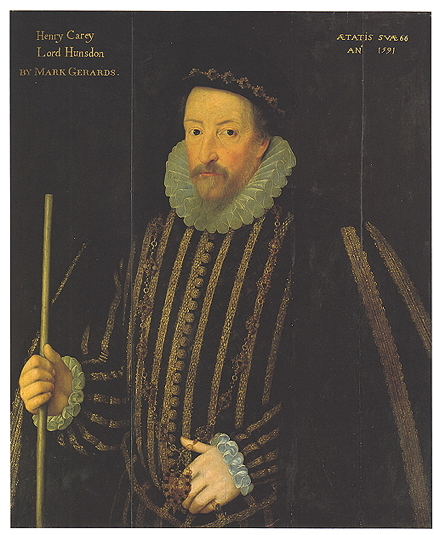
henry carey
 Henry Carey, Lord Hunsdon

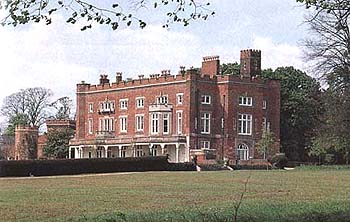
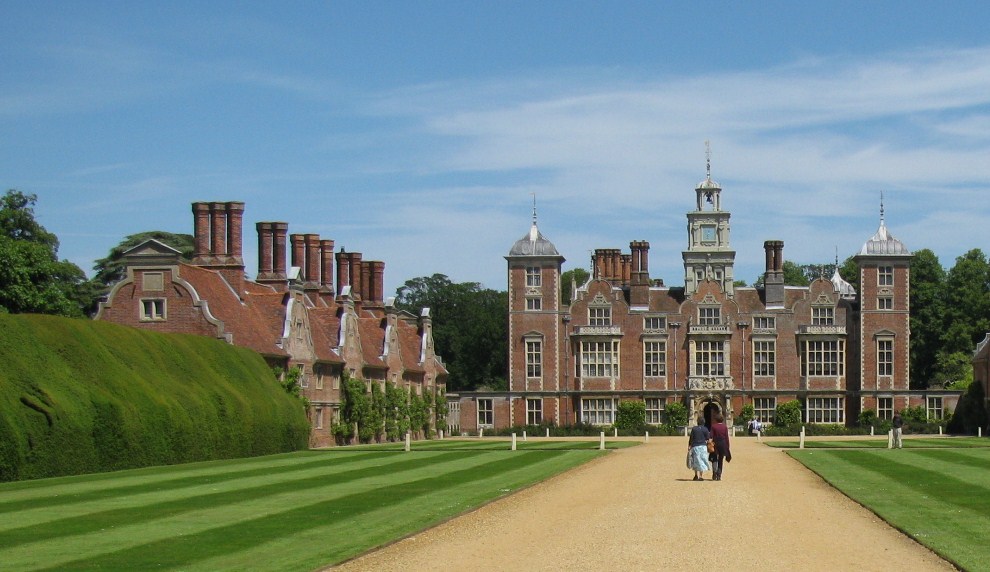
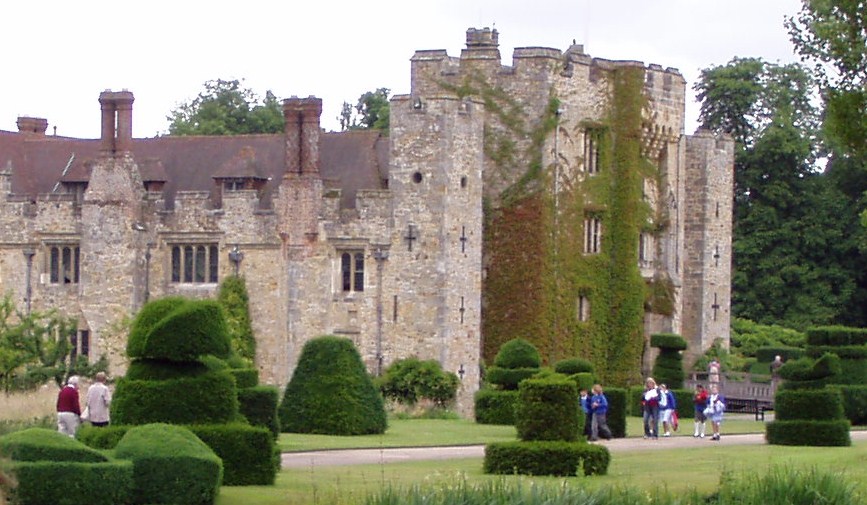
Mary Boleyn, was born most likely at Blickling Hall and reared at Hever Castle; with no evidence of an exact date for her birth most historians place it in the year 1499. Mary, tutored at home along with her siblings George and Anne, received a conventional education until 1514.  Her father arranged for her to become a maid-of-honor to Mary Tudor, sister to Henry VIII, who was soon to become the bride of King Louis XII of France. Mary Tudor was widowed shortly after her wedding and returned home. Mary Boleyn’s reputation through generations has implied affairs with French courtiers and even the new King of France Francis I.  Mary Boleyn became a maid-of-honor to Catherine of Aragon and shortly after wed Sir William Carey.  It was believed that she began an affair with King Henry around this time.  This was not a publicized liaison but the evidence is difficult to shift through.  Was the relationship not well-known at the time or was it suppressed later?  After Henry VIII had discarded Catherine due to the rise in his conscience of marrying the wife of his brother (against scripture Leviticus 20:21), could he have destroyed all evidence of an affair once he became determined to marry Anne?  If he had fathered children by Mary, would he also have repressed those facts? 

213 Welcome to my home
Blickling Hall June 2012

OLYMPUS DIGITAL CAMERA
Hever Castle 2007

Evidence is strong that Henry VIII did have an affair with Mary Boleyn.  Paul Friedmann relays that Dr. Ortiz, the Spanish theologian sent to Rome to assist the cause of Catherine of Aragon, “wrote to the empress, ‘that some time ago he [Henry] sent to ask his holiness for a dispensation to marry her, notwithstanding the affinity between them on account of his having committed adultery with her sister.’ In 1529 Charles V had already heard of the matter. Charles declared that Henry’s conscientious scruples did not seem to be justified, especially ‘if it were true, as his said Majesty had heard (although he himself would not positively affirm it), that the said king had kept company with the sister of her whom he now, it was stated, wanted to marry.’ In 1532, Eustache Chapuis speaks of the former adultery of Henry with Mary Boleyn as a well-known fact of which there can be no doubt. ‘Even if,’ he writes, ‘he could separate from the queen, he could not have her [Anne], for he has had to do with her sister.’ Such, in the main, are the arguments for the opinion that Mary Carey had been the mistress of Henry” (Friedmann 325-327).

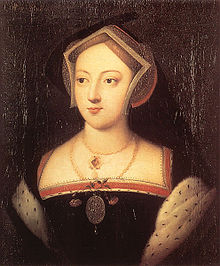
Mary_Boleyn   William_Cary
Mary Boleyn Carey                               William Carey

Of course, there is the famous incident of Sir George Throgmorton speaking to the king of the rumor that Henry had improper relations with Anne’s mother and sister, and “Henry replied, ‘Never with the mother;’ and Cromwell, who was present, added, ‘Nor with the sister either.’” (Friedman 326).  Could even Henry VIII have been such a hypocrite to justify marriage to Anne Boleyn after he had discarded Catherine of Aragon for being the wife of his brother? One must remember, Henry desperately wanted to marry Anne.

Another rumor passed down through the centuries is that Henry Carey was the natural son of Henry VIII.  If this were true, would the king have recognized the boy as such?  After all, Henry had acknowledged Henry FitzRoy, the child he had with Elizabeth Blount, and rewarded him accordingly. The difference is the king did not want to marry Elizabeth Blount’s sister.  Would measures have been taken at the time to suppress the truth?  Even if Henry had acknowledged Mary’s child, would he have disposed of all official records two to three years later when he became infatuated with Anne?

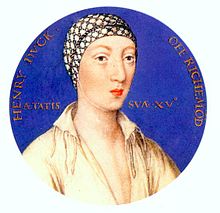
HenryFitzRoy
Henry FitzRoy

Allison Weir is adamant that Henry did not father Mary Boleyn Carey’s child (Weir Lady in the Tower 309-310). This blogger also wonders if Anne would have obligingly taken the wardship of Henry Carey when William Carey died if she thought he could be a threat to her own children as an illegitimate son to the king?  Very few contemporary sources mention this possibility.  John Haile*, vicar of Isleworth, wrote on April 20, 1535, that Morever, Mr. Skydmore dyd show to me yongge Master Care, saying that he was our suffren Lord the Kynge’s son by our suffren Lady the Qwyen’s syster, whom the Qwyen’s grace might not suffer to be yn the Cowrte” (Hoskins).

John_Hale_DSCN5606
John Haile 

Mary’s disgrace came in 1534 when she secretly married a soldier, William Stafford.  As a second son of a modestly wealthy landowner, William’s prospects were not great. Queen Anne was furious and banished her sister from Court.  After her siblings were executed in 1536, her parents died within a short time period.  As sole heir Mary then inherited some family property.  She lived comfortably and quietly until her death in July of 1543. 

thomas boleyn        elboleyn
Thomas Boleyn                          Believed to be Elizabeth Boleyn

When William Carey died of the sweating sickness 23 June 1528, Anne Bolyen was granted Henry’s wardship. He benefited enormously as Anne had him educated by “Nicholas Bourbon, a French humanist and other prominent educators” (Warnicke 148).  This patronage came to an end when Anne was executed in May of 1536; Henry was ten years old. 

Anne Morgan, the daughter of Sir Thomas Morgan and Anne Whitney, was his bride on 21 May 1545.  The couple would eventually have 12 children. In 1547, Henry was elected as a member of Parliament for Buckingham where he served for many years.  During the reign of Edward VI, he received several manors to provide a living for him and his family.  Soon after the accession of Elizabeth Regina, Henry received a knighthood (his wife was appointed as a Lady of the Privy Chamber) and was elevated to the peerage by letters patent, as Baron Hunsdon. Along with the peerage was a grant of the estate of Hunsdon in Hertfordshire and a pension of £4,000 a year “(according to the valuation in that age) in fair desmesnes, parks, and lands lying about it” (Fuller 47). 

anne morgan
Anne Morgan, Lady Hunsdon, portrait is displayed at Hatfield House

*John Haile was one of the first priests to die as a result of the Act of Supremacy (not acknowledging Henry VIII as Head of the Church).  He, along with several others, was hanged, drawn and quartered at Tyburn on 4 May 1535. Haile was beatified by Pope Leo XIII in 1886.

Henry Carey, Lord Hunsdon Part II will follow as the next published blog entry.

The Second Step-Mother to Elizabeth, Anne of Cleves

The Second Step-Mother to Elizabeth, Anne of Cleves

After the death of Jane Seymour, Henry began negotiations with European Royal houses.  Henry was still Catholic in the sense that he did not agree to reforms in the services of worship. In 1539 he had the Act of Six Articles drawn up which kept the traditional church teachings, especially the doctrine of transubstantiation. His advisors such as Cromwell and Cranmer did not relish a Catholic bride and steered Henry toward the Protestant countries and dukedoms.  The Duke of Cleves was a mild Protestant and had two unmarried sisters.  Anne was the ‘lucky’ bride. She was married to Henry in January 1540 and divorced six months later in July.

Cleves henry viii enthronedjpg
Henry VIII illustrated on his Marriage Proclamation to Anne of Cleves, January 5, 1540.

Tradition has passed down that Anne was so disgusting to Henry that he declared after first meeting her that “I like her not”.  Anne gets an unjustified description as ‘The Flanders mare’.  She was not as unattractive (we will not delve into the issue of painting by Hans Hoblein) as Henry’s supporters and biographers make out (for evidence consult the individual biographies referenced below). Their first meeting did not go well and Henry could not overlook her response.  He projected his shortcomings onto her. What had happened was, Henry full of romantic ideas of surprising his bride, entered her presence shortly after her arrival on the shores of England, disguised as a messenger.  Anne spoke few words of English, her ladies in waiting were complete foreigners, and no one advised her about Henry’s preference for masquerades which included coming upon ‘unsuspecting’ Courtiers in disguise. Startled by this muddied, elderly messenger acting very familiarly to her, Anne responded coldly and not with the delighted surprise Henry expected.

cleves holbien
The (in)famous Hans Holbein Painting, 1539

cleves miniture
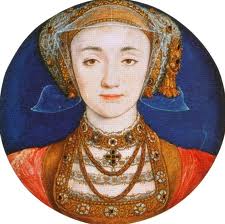
Miniature attributed to Hans Holbein, 1539

Anne of Cleves
Attributed to Barthel Bruyn, 1540s

Not her features but perhaps the whole package was deemed lacking by Henry—a man captivated by the accomplishments Anne Boleyn learned at the Court of France.  Anne of Cleves, on the other hand, was reared to be a practical companion to a man with position and power, her talents of intelligence and common sense lent themselves to being a successful housewife.  Dancing, playing musical instruments, and speaking in foreign languages would not have been part of her upbringing.  Was she unattractive?  That debate we will leave behind.  This blogger believes Anne was probably attractive but “had no accomplishments whatever” that Henry found so necessary (Strickland 410).

14.236
Ceremonial bedhead created for the marriage of Henry and Anne

According to Gregorio Leti, an Italian historian writing in the late 1600s with access to documents that have since disappeared, Elizabeth wrote to her father about this time asking for permission to meet her new step-mother, Anne of Cleves.

I would like to caution us to accept Leti’s work with a touch of reserve. Mary Anne Everett Wood, a later historian, reminds us “the originals have perished, or are no longer accessible” (Wood 14).  Leti would have translated his sources into his native Italian and the only text available of his work is itself a French translation published in Amsterdam in 1694 titled, La Vie d’Elizabeth, reine d’Angleterre. This work was supposedly suppressed in England by royal authority.  The letter, which has no date or signature, written when Elizabeth would have been a little over six years old is below.

Madame,—I am struggling between two contending wishes—one is my impatient desire to see your Majesty, the other that of rendering the obedience, I owe to the commands of the King my father, which prevent me from leaving my house till he has given me full permission to do so.  But I hope that I shall be able shortly to gratify both these desires.  In the meantime, I entreat your Majesty to permit me to show, by this billet, the zeal with which I devote my respect to you as my queen, and my entire obedience to you as to my mother.  I am too young and feeble to have power to do more than to felicitate you with all my heart in this commencement of your marriage.  I hope that your Majesty will have as much good will for me as I have zeal for your service. (Queen Elizabeth I 21)

Anne showed the letter to the king and he would not let Elizabeth come to court.  Henry “took the letter and gave it to Cromwell” ordering him to write a reply.  “Tell her,” he said brutally, “that she had a mother so different from this woman that she ought not to wish to see her” (Weir 408). Whether or not the story is true, Henry did not withhold permission for long as Elizabeth was eventually brought to Court from Hertford Castle to meet Anne.

Leti reports that “Anne of Cleves, when she saw Elizabeth, was charmed by her beauty, wit and …that she conceived the most tender affection for her. Anne claimed that to have had Elizabeth “for her daughter would have been greater happiness to her than being queen” (Strickland Life of Queen Elizabeth I 15). This sentiment should not be diluted by the fact that Anne was queen for only six months.

When Henry could not evade the wedding, he became determined to divorce Anne as soon as he could. According to Martin Hume, when confronted about a previous marriage (a pre-contract to the Duke of Lorraine has been mentioned in many biographies but no marriage so I take this with a grain of salt) Anne replied, “Please your Majesty, it is true I was espoused to him, but when the Duke spoke to me about marrying your Majesty, he told me my husband was dead, and I know nothing more about it” (Hume 93). Hume continues that Henry, angry at the Duke of Cleves for giving him a married woman, called together his Council for advice on what to do.  The Council recommended a divorce and agreed he should make an allowance for Anne to live on after their marriage was dissolved.  “The lady took it pleasantly enough” (Hume 95).

cleves dedication
Rare document with the signature “Anna the Queen”

download
Most signatures are “Anna the Daughter of Cleves”

When the “conditions of her divorce were arranged, she (Anne) requested, as a great favour, that she might be permitted to see her (Elizabeth) sometimes” (Strickland Life of Queen Elizabeth I 15).  Henry agreed as long as Elizabeth addressed her as Lady Anne instead of Queen Anne (Lindsey 156).  Anne’s relationships and status were established by that new title.
Upon her divorce Anne retained a position in the family and Court with the status as the King’s Sister. She gained a sizable income “secured on the Cornish tin mines,” (Hume 95) plus lands and properties granted to her “to the value of £3,000* a year” (Strickland 419). Anne was given Richmond Palace, Hever Castle, Penshurst, Dartford Castle, a London residence, plus other estates such as the land-hold in Lewes.

richmond palace 001
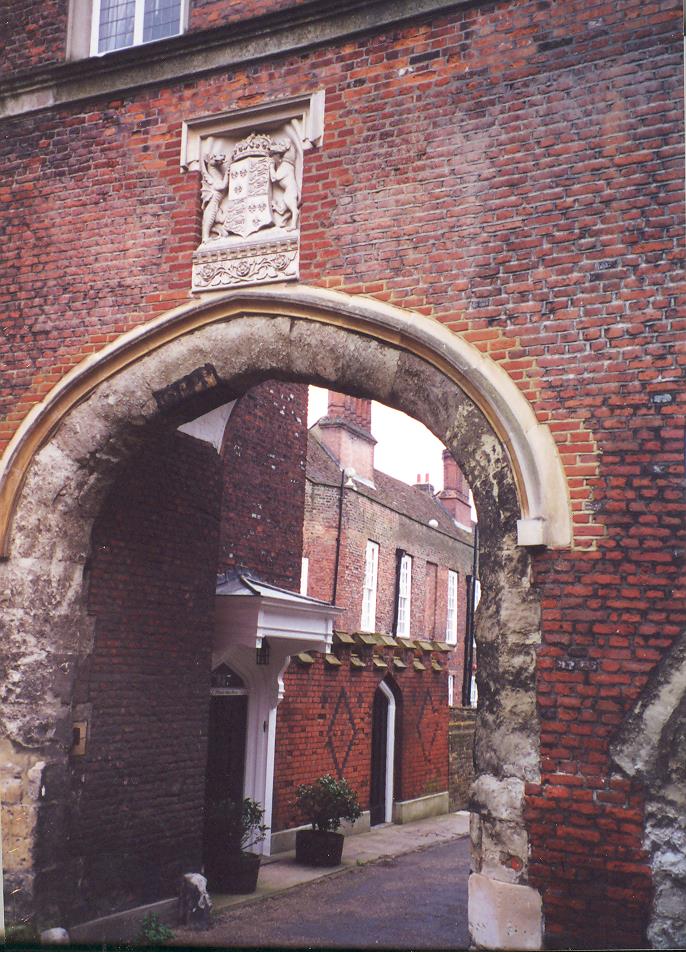
Gate at Richmond Palace   

OLYMPUS DIGITAL CAMERA
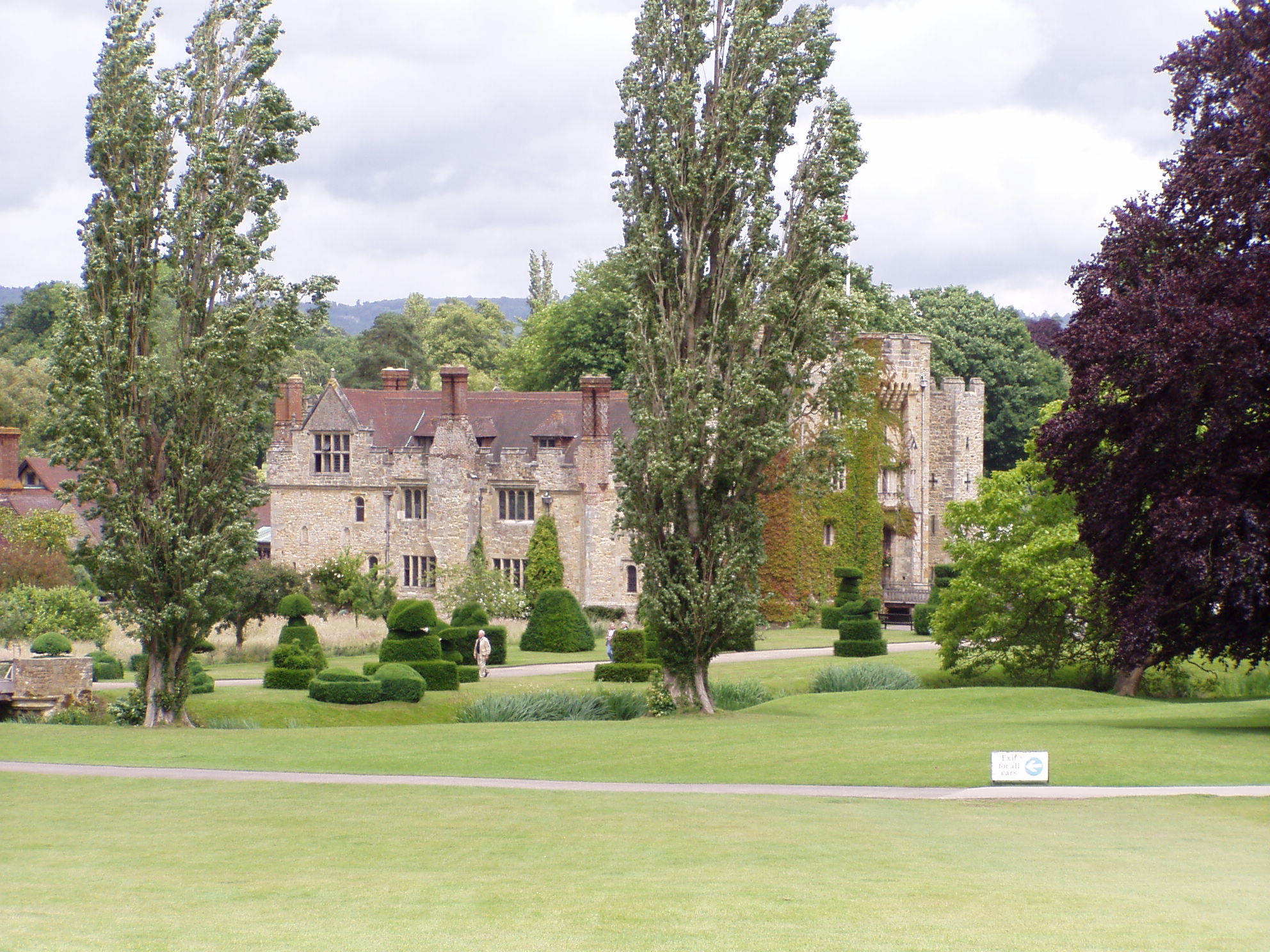
Hever Castle

Anne Cleeves House in Lewes
Anne of Cleves House in Lewes, now a museum

Anne experienced considerable freedom and it appears as if she bore the loss of her husband quite cheerfully. She enjoyed her life in England learning to dance and play music, hunting, dressing in fine clothes and having a pleasant relationship with Henry.

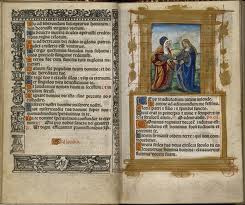
Her amiableness is shown in her dedication to Henry in the Book of Hours, Salisbury 1533 “I beseche your grace huble when ye loke on this rember me. Yor graces assured anne the dowther off cleves” (Anne of Cleves).  In the modern translation: “I beseech your grace humbly when you look on this remember me.  Your grace’s assured Anne the daughter of Cleves.”

cleves book of hours
Dedication in the Book of Hours in Anne’s handwriting.  She gave this to Henry as a gift.  

cleves book of hours pictures
A decorated and illuminated page in the Book of Hours, Salisbury

This daughter of Cleves did have quite a unique status not only in England but in the scene of international politics.  Many could not define if she was free to marry and her brother put out feelers once in a while to consider her return to Cleves or create clarity in her position.  What I found interesting was the diplomatic dispatch, reprinted below, which the French Ambassador, Charles de Marillac, to the English Court sent to his king concerning the inquiry made by the Duke of Cleves after the arrest of Catherine Howard, the fifth wife of Henry VIII.

cleves william
William, Duke of Cleves

December 16, 1541 Marillac to Francis I 
Told by the ambassador of Cleves that, upon letters of credence from his master, he sought to speak with this King about lady Anne, but as the King’s grief did not permit it he yesterday went before the Council and, after declaring his master’s thanks for the King’s liberality to his sister, prayed them [to find] means to reconcile the marriage and restore her to the estate of queen. They answered, on the King’s behalf, that the lady should be graciously entertained and her estate rather increased than diminished, but the separation had been made for such just cause that he prayed the Duke never to make such a request. The ambassador asking to have this repeated, Winchester, with every appearance of anger, said that the King would never take back the said lady and that what was done was founded upon great reason, whatever the world might allege. The ambassador dared not reply, for fear that they might take occasion to treat her worse; but came to tell Marillac, because his master wrote that they would beg Francis to intercede. Thinks there are two courses open, either to intercede so dexterously as not to show that it is done with authority, and thus frighten the English into a league with the Emperor, or else to say nothing about it.  London, 16 Dec. 1541. (Gairdner XVI 678)

After Henry’s death, the financial situation of Anne of Cleves did change and there was talk of her returning to Cleves.  This, of course, came to nothing as she was at Court for Edward and Mary’s rule.

084
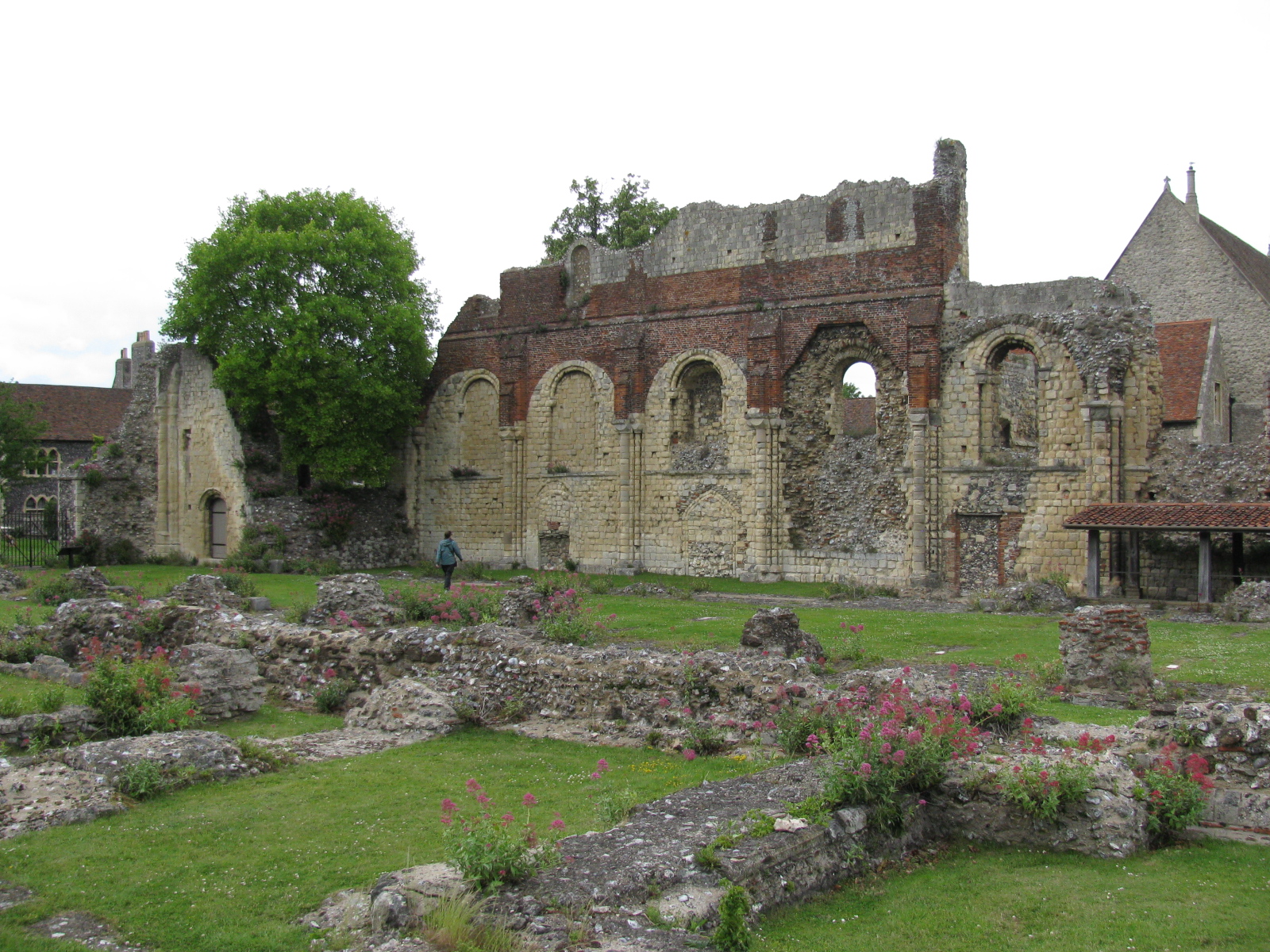
St. Augustine’s Abbey, Canterbury.  Anne and Elizabeth spent a great deal of time here. 

Throughout Mary’s reign, Anne and Elizabeth were often seen together. Starting on 30 September 1553 when they rode in a carriage during Queen Mary’s coronation procession.   They were together at the state banquet later too. “The two of them sat together at the end of the table, Elizabeth now heiress-presumptive to the throne, and Anna of Cleves’ precedence moved up to that of the third lady in the land”  (Fraser 409).

Although “Madam of Cleves always paid great honour to Madam Mary” (Hume 92), Anne did create controversy when she joined Elizabeth in not attending the Catholic Mass during the early part of Mary’s reign.  The Queen had words with Anne and she afterwards did attend services (Ridley 47).  Being so close to the same age, one could imagine how Anne and Mary could get along, but it was with Elizabeth that Anne shared the most affection until the day she died, 16 July 1557 at Chelsea Manor.

cleves tomb
Tomb of Anne of Cleves at Westminster Abbey

Anne’s last will and testament was not as bountiful as commentators would have expected.  She did leave some items to her step-daughters.  To Elizabeth she left some jewels with the hope that one of her ladies-in-waiting, Dorothy Curson, could join the younger woman’s household.

Anne’s influence may have extended further than imagined to the unmarried state of Elizabeth.  Somerset implies that witnessing her father’s distaste and rejection of Anne of Cleves and her brother-in-law Philip’s lack of respect and attraction for Mary, Elizabeth did not want to experience the same thing herself.  So as queen Elizabeth supposedly told Count Feria, the Spanish Ambassador, that she had “taken a vow to marry no man whom she has not seen, and will not trust portrait painters” (Somerset 92).

*The equivalent of £3,000 in 1540 would be worth £1,508,000 in 2010 currency of the retail price index. This was calculated using the website, Measuring Worth.com.

References

“Anne of Cleves’s Book of Hours.” -Folger Shakespeare Library. Folger Shakespeare Library, n.d. Web. 8 May 2013.

Elton, G. R. England Under the Tudors. Third ed. London:  Routledge, 1991. Print

Erickson, Carolly. The First Elizabeth. New York: Summit Books. 1983. Print.

Fraser, Antonia.  The Wives of Henry VIII.  New York:  Alfred A. Knopf, 1992. Print.

Gairdner, James and R. H. Brodie (editors). “Henry VIII: December 1541, 11-20.” Letters and Papers, Foreign and Domestic, Henry VIII, Volume 16: 1540-1541 (1898): 671-681. British History Online. Web. 12 May 2013.

Gairdner, James and R. H. Brodie (editors). “Henry VIII: January 1542, 1-10.” Letters and Papers, Foreign and Domestic, Henry VIII, Volume 17: 1542 (1900): 1-9. British History Online. Web. 12 May 2013.

Lindsey, Karen.  Divorced, Beheaded, Survived:  A Feminist Reinterpretation of the Wives of Henry VIII.  Reading, Massachusetts:  Addison-WESLEY Publishing Company, 1995. Print.

Neale, J. E. Queen Elizabeth I. Garden City, NY: Doubleday, 1957. Print.

Norton, Elizabeth.  Anne of Cleves:  Henry VIII’s Discarded Bride.  Stroud, Gloucestershire: Amberley Publishing, 2010. Print.

Queen Elizabeth I, Frank Mumby, and R. S. Rait. The Girlhood of Queen Elizabeth: A Narrative in Contemporary Letters. Boston: Houghton Mifflin, 1909. Google Books. Web. 9 May 2013.

Ridley, Jasper. Elizabeth I: The Shrewdness of Virtue.  New York: Fromm International Publishing Corporation, 1989.  Print.

Saaler, Mary.  Anne of Cleves:  Fourth Wife of Henry VIII.  London:  The Rubicon Press, 1995. Print.

Starkey, David.  Six Wives: The Queens of Henry VIII.  London:  Chatto & Windus, 2003.  Print.

Strickland, Agnes. Life of Elizabeth, Queen of England, with Anecdotes of Her Court, from Official Records and Other Authentic Documents, Private as Well as Public. New York: Miller, 1903 Internet Archive. Web. 6 May 2013.

Strickland, Agnes, Elisabeth Strickland, and Rosalie Kaufman. The Queens of England, Abridged and Adapted from Strickland’s “Queens of England” Chicago: Werner, 1895. Internet Archive. Web. 4 May 2013.

Weir, Alison.  The Six Wives of Henry VIII.  New York: Grove Weidenfeld, 1991. Print.

Warnicke, Retha. The Marrying of Anne of Cleves:  Royal Protocol in Tudor England. Cambridge: Cambridge University Press, 2000. Print.

Wood, Mary Anne Everett. Letters of Royal and Illustrious Ladies of Great Britain: From the Commencement of the Twelfth Century to the Close of the Reign of Queen Mary : Edited, Chiefly from the Originals in the State Paper Office, the Tower of London, the British Museum and Other State Archives. Vol. II. London: Henry. Colburn, 1846. Google Books. Web. 12 May 2013.