Reigned With Your Loves

Reigned with Your Loves

Connections and service, be they within personal or formal relationships, create loyalty.  Loyalty which can be demonstrated in many ways.  Both Henry VII and Elizabeth Regina developed heightened abilities in sensing gifted allies to serve them.  Perhaps the skills were honed during their times of confinement (Henry in Brittany and Elizabeth at Hatfield) or they were innate.  Regardless, each surrounded themselves with talented, loyal councilors. 

Henry knew that if England was to recover and the throne was to become stable, the War of the Roses would have to end and healing would have to take place.  What was required now was for the king to be resolute and to act with “judicious mercy, the mercy of head not heart.”  Henry VII was to display clemency and firmness by his “reluctance to proceed to extremes and his readiness to accept old enemies into the fold.”  Actions which “display his determination to show that the wars were over” (Elton 16).

Henry not only utilized Lancastrian loyalists, gentry from his native Wales, and fellow exiles, he also incorporated the Yorkist faction in his new government.  He knew he must not further antagonize the opposition.  Therefore, he pardoned men who had fought at Bosworth against him, and allowed them to enter government positions, even granting them property, if they took the oath of allegiance.  He approached the many Woodville Yorkists cautiously as he did not want to be indebted to them nor to give the impression he reigned in any name but his own– meaning he did not want to appear to have need of Elizabeth of York’s family ties to strengthen his claim. “As a new man, Henry had to secure his place.  He did this by a compromsing approach” (Bacon and Weinberger 238).

Henry had little knowledge of England and its government workings as he had been in exile for so many of his formative years.  He was even unprepared for the responsibilities and life of a king. He thus relied heavily on the associates of his youth and those men who had joined him in exile along with many advisors from his mother’s household.

margaret beaufort

Margaret Beaufort

Henry and his mother, Margaret Beaufort, recognized the need for experienced men to provide council.  Therefore, her household became a basis for Henry to draw officials from such as Christopher Urswick and Reginald Bray.  Many of his contemporaries recognized that service his mother could easily lead to a royal appointment.  Henry viewed service to his mother almost as those who served him “during his period of exile, as a debt of honour” (Jones 80).

Needing men of experience also meant he had to appoint those who had been in England and not exiled—people familiar with the ways of England.  Therefore, a mix of noblemen, gentry, lawyers and clerics were used to comprise Henry VII’s Council (Loades 30).  Henry did not want to give too much power to the men with governmental experience. He kept the nobles contained and “chose rather to advance clergymen and lawyers, which were more obsequious to him…” (Bacon and Lumby 217). These men recognized for their talents were more grateful to the king.

Henry was adamant about allegiance and service.  The men he appointed were “loyal and ardent servants of an exacting but worthy master” (Elton 17).  Despite his harshness, “Henry showed himself capable of attracting men to his side and retaining their loyalty…”  (Griffiths 168).

Star Chamber H7 seated

Henry VII, seated in the Star Chamber

“Like all his family he had an uncanny gift for picking men to serve him, and not even the great Elizabeth surrounded herself with a brighter galaxy of first-rate ministers than did her grandfather” (Elton 17). It is not the purpose here to list every member of Henry’s Privy Council, the focus will be on those he relied upon early in his reign.  Below, in chart form, are listed the pertinent advisors and servants.

Councilors Serving Henry VII

Councilor / Servant

Role

Miscellaneous

Jasper Tudor, Duke of Bedford Military advisor and commander paternal uncle to Henry, took him into exile
John de Vere, 13th Earl of Oxford Military advisor and commander shared exile and influntial as nobleman
Sir Giles Daubeney Chancellor shared exile and very influential
Cardinal John Morton—Archbishop of Canterbury Lord Chancellor financial advisor/innovator dare we say exploiter
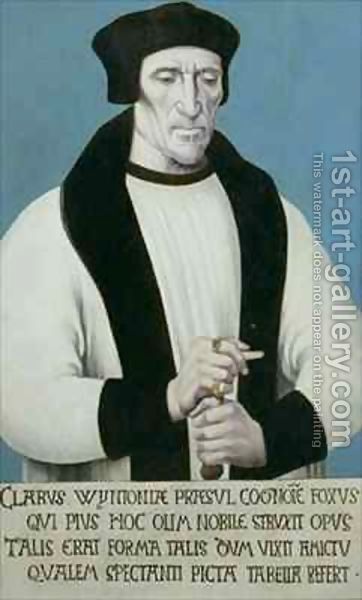
Bishop Richard Fox Lord Privy Seal shared exile, very influencial after Morton’s death
Bishop Peter Courtenay Keeper of the Privy Seal shared exile
Bishop William Warham Master of the Rolls and later Lord Chancellor performed many diplomatic missions
Sir Reginald Bray Courtier acquired from Margaret Beaufort’s advisors,very influential and architect of Henry VII’s Chapel at Westminster Abbey and St. George’s Chapel, Windsor
Christopher Urswick Courtier acquired from Margaret Beaufort’s advisors
Sir John Heron Treasurer of the Chamber shared exile and one of the most trusted advisors
Sir Edward Belknap Surveyor of the King’s Prerogative could confiscate anyone’s land that overtook the King’s prerogative
Richard Empson Carried out Cardinal Morton’s financial policies arrested under Henry VIII for unpopular financial activities
Edmund Dudley Carried out Cardinal Morton’s financial policies executed under Henry VII for unpopular financial activitiesGrandfather to Robert Dudley, Earl of Leicester
Sir Thomas Lovell Treasurer of the Chamber shared exile and one of the most trusted advisors
Sir Richard Guildford Chamberlain of the Receipt shared exile and one of the most trusted advisors
Thomas Rotherham, Archbishop of York Lord Chancellor experience in previous reigns, did not serve Henry very long
John Alcock, Bishop of Worcester Lord Chancellor experience in previous reigns, bridge between Edward IV, Richard III and Henry’s rule
Sir Thomas Stanley, 1st Earl of Derby High Constable of England Henry’s step-father
Sir Edward Woodville Courtier brother to the Queen Dowager, military leader
Sir William Stanley, Lord Chamberlain brother to Henry’s step-father, executed for treason over Perkin Warbeck

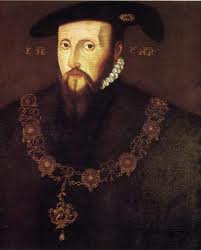
jasper tudor           gilesdubeney

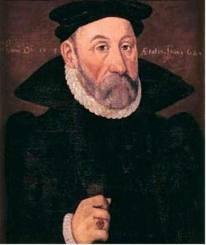
Jasper Tudor                                          Giles Daubeney

Cardinal_John_Morton               Richard Fox       

John Morton                                                           Richard Fox

    Peter Courtenay     williamwarham

                 Peter Couetenay                                William Warham

chrisurswick              thomas lovell

Christopher Urswick                                     Thomas Lovell  ThomasRotherham             John Alcock

Thomas Rotherham                                          John Alcock

Thomas-Stanley

 Thomas Stanley

“Henry became practiced in awarding empty honours and rewards to the deserving, which gratified the receivers and heightened their loyalty to him without increasing their actual strength” (Ross 19). Minor merchants or officials who had helped him in one way or another were rewarded as well—prudently. Henry was not a man to throw money around and, although he was generous, it was not beyond his means or beyond what was suitable. e rewarded people who had served his father and other Welsh followers, had helped his mother and even those who had served his revered uncle, Henry VI. (Griffiths 175). 

Machiavelli wrote that a prince should be feared over loved although it would be ideal to be able to be both. In Henry VII’s case it appears as if he did not manage fear and love.  Down the ages we have Edmund Dudley’s treatise, Tree of the Common Wealth, written in defense of absolute monarchy as applied to Henry VI.  Dudley defended Henry’s actions (and maybe reflecting Henry’s views) by stating that if the King was lenient to his subjects “in all cases let them … psume to take it of theire owne authoritie, for then it will surelie choke them” (Dudley 28). 

Henry did set the path for his administration although Bacon proclaimed that Cardinal Morton and Sir Reginald Bray not only reflected Henry’s views but “did temper them” (Bacon 214).  Whereas Empson and Dudley, middle-ranking servants who rose to prominence by being men who “best content the king” (Penn 33), did not moderate his policies, especially financial, “but shaped his way to those extremities, for which himself was touched with remorse at his death….” (Bacon 214).

It is well-known that many of Henry’s financial practices were disliked by his people.  Bacon proclaimed that ” of the three affections which naturally tie the hearts of the subjects to their sovereigns, love, fear, and reverence; he had the last in height, the second in good measure, and so little of the first, as he was beholden to the other two” (Bacon and Lumby 218). Financial acts were not popular with anyone but the benefits of his stable rule, his courts of law and justice did benefit everyone and they knew it too.

EmpsonHenryDudley

Henry VII, Richard Empson and Edmund Dudley

By implying to the people that civil war would happen if they lost him, Henry maintained stability.  Another method he consciously employed to control his ministers was in the journal he kept of his thoughts. It included notes he wrote while in conversation with ministers, diplomats and advisors about whom to reward and whom to watch—this was similar to his granddaughter.  Elizabeth Regina kept mental notes of conversations and events she engaged in with her ministers to utilize if necessary in future dealings.

Elizabeth “kept her advisers off balance and perpetually astonished them by the range and mutability of her passions.  Beyond this, they came to know that, with Elizabeth, nothing was ever what it seemed.  Beneath her surface emotions were layer upon calculating layer of secondary reactions, ploys and schemes” (Erickson 173). She enjoyed laying traps for her ministers, throwing back at them their own words.  Yet, they were devoted to her, perhaps because of her political, intellectual and interpersonal skills.  An example could be from the way she handled the ex-ministers of Mary’s reign.  Elizabeth greatly reduced the number of advisors and assured those that had served Mary that they were not retained because she wanted a smaller group to make it more manageable and less open to faction, not because of any deficit on their part (Neale 55).

Battles for Court positions were based on “loosely structured groups focusing on family, household, and master-servant connections…” (Warnicke 135).   Some men were ambitious seeking power and money, others were honored to serve.  Or, as Mervyn James has shown, “the ties of blood were liable to assert themselves with a particular power” (James 325). 

As Queen, Elizabeth did not forget those who were still alive and had served her mother, Anne Boleyn. William Barlow was created Bishop of Chichester; William Latymer, became Dean of Peterborough under Elizabeth and author of Chronickle of Anne Bulleyne; and Matthew Parker appointed Archbishop of Canterbury.  Parker had been chaplain to Anne Boleyn.  Although he did not want to take the Archbishopric, he did so based on a promise he had made to Anne shortly before her death to watch out for the spiritual needs of her daughter.

Like her grandfather, Elizabeth kept her beloved servants of her childhood and youth.  She knew the Privy Council, the body that held up the authority of the Crown and was key to forming royal policy, should be conciliatory to the previous reign and diverse.  In respect to the first consideration, Elizabeth retained 10 ministers from Mary’s reign. Taking a page from her grandfather, she kept members of the opposing faction in her council. Whereas his were Lancaster and York, hers were Catholic (Marian) and Protestant (Elizabethan). 

For diversity, as did Henry, she promoted gifted men of the professions, many who had never held high office before, while keeping a balance of nobles and clergy.  Her main criteria appeared to be efficiency, talent and loyalty.  She wanted advisors who would give good counsel and ones she could trust.  

It is not the purpose here to list every member of Elizabeth’s Privy Council, the focus will be on those she relied upon early in her reign.  Below, in chart form, are listed the pertinent advisors and servants.

                                    Councilors Serving Elizabeth Regina 

Councilor / Servant

Role

Miscellaneous

Edward Stanley, 3rd Earl of Derby High Chamberlain served Mary, kept due to prominent role in nobility
Francis Talbot, 5th Earl of Shrewbury Courtier and Privy Council Member served Mary, kept due to prominent role in nobility—died within 2 years, son George famously married Bess of Hardwick and was custodian of Mary, Queen of Scots as 6th Earl
Henry FitzAlan, 19th Earl of Arundel High Constable and Lord Steward served Mary, kept due to prominent role in nobility as relative to Woodvilles and Percys.
Henry Herbert, 2nd Earl of Pembroke Lord Lieutenant served Mary, kept due to prominent role in nobility as husband to Lady Katherine Grey
William Howard, 1st Baron Howard of Effingham Lord Admiral and Lord Chamberlain served Mary, Elizabeth’s great-uncle and defender in Marian court
William Paulet, Marquis of Winchester Treasurer and Speaker of the House served Mary, great administrator
Edward Clinton, later Earl of Lincoln Lord Admiral andAmbassador to France served Mary, he was Lord Admiral and capable
Sir John Mason Diplomat and Chancellor of Oxford University served Mary, was knighted as public servant
Sir William Petre Secretary of State served Mary, lawyer & tutor to George Boleyn rose rapidly and was knighted
Sir Nicholas Wotton Diplomat served Mary, commoner and cleric
Sir Thomas Parry Comptroller of the Household Elizabeth’s steward since childhood, relative to Cecil,  in household at Hatfield and later knighted
Sir Richard Sackville Chancellor of the Exchequer Elizabeth’s relative as his mother was cousin to Anne Boleyn, had experience during Edward’s time
Sir Francis Knollys Vice-Chamberlain of the Royal Household Elizabeth’s relative as he married her cousin the daughter of Mary Boleyn, served Edward and a staunch Protestant
Sir Nicholas Bacon Lord Keeper of the Great Seal an attorney—very capable and had been in Edward’s Court, father to Francis
William Cecil, 1st Baron Burghley Secretary of State later Lord High Treasurer served Elizabeth during Mary’s reign while maintaining a position at CourtBacon’s brother-in-law
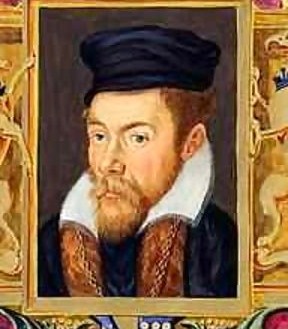
Francis Russell, 2nd Earl of Bedford Diplomat created into Peerage, staunch Protestant and collector—Armada Portrait at Woburn Abbey—godfather to Francis Drake
William Parr,1st Marquis of Northampton Courtier created into Peerage, brother to Katherine Parr
Sir Edward Rogers Comptroller served Edward and was in Elizabeth’s household at Hatfield
Sir Ambrose Cave connection of Cecil’s, and was in Elizabeth’s household at Hatfield
Robert Dudley, Earl of Leicester Master of the Horse later Privy Council Member known to Elizabeth since childhood, held in Tower concurrently, became principle favorite
Henry Carey, Lord Hunsdon Courtier later Privy Council Member Elizabeth’s cousin (son of aunt Mary Boleyn) given many positions
John Ashley Courtier husband of her governess, Kat Ashley
John Fortescue Courtier relative of Thomas Parry
Sir William St. Loe Courtier accused at time of Wyatt rebellion
Sir James Crofts Courtier accused at time of Wyatt rebellion, was a practicing Catholic
Edward de Vere, 17th Earl of Oxford Lord Great Chamberlain at 12 his wardship was handed over to Cecil from Elizabeth, inclined toward Catholicism, some believe he is “Shakespeare”
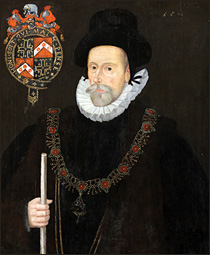
Sir Francis Walsingham Principal Secretary known as ‘spy master,’ loyal, yet very out-spoken
Thomas Radclyffe, 3rd Earl of Sussex Courtier and Lord Lieutenant of Ireland distantly related to Elizabeth, served Mary
Sir Christopher Hatton Courtier later Privy Council Member rose to prominence after Elizabeth saw him dance at Court, called “the Dancing Chancellor”, very devoted
Sir Thomas Wilson Diplomat and Judge later Secretary of State associate of the Dudleys, wrote Arte of Rhetorique which set English style

edstanley          Henry FitzAlan 19thEarlOfArundel

Edward Stanley                                                     Henry FitzAlan

Henry Herbert EarlOfPemboke         HOward of Effingham

Henry Herbert                                              William Howard

NPG 65,William Paulet, 1st Marquess of Winchester,by Unknown artist       edclinton

William Paulet                                               Edward Clinton

WilliamPetre           Nicholas_Wotton

William Petre                                                     Nicholas Wotton

Thomas Parry    francisknollys

Thomas Parry                                              Francis Knollys

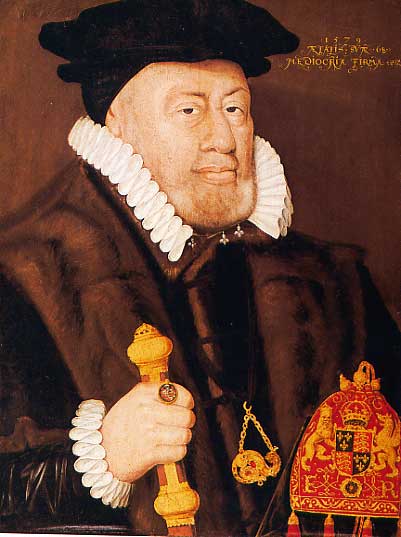
bacon nicoholas     cecil william

Nicholas Bacon                                             William Cecil

Russell,Francis(2EBedford)01       william parr

Francis Russell                                                   William Parr

robertdudley       henrycarey1

Robert Dudley                                                   Henry Carey

johnfortseque          Edward-de-Vere-1575

John Fortesque                                            Edward de Vere

walsingham       Thomas_Radclyffe_Earl_of_Sussex

Francis Walsingham                               Thomas Radclyffe

chrishatton       thomas wilson

Christopher Hatton                                  Thomas Wilson

At the beginning of her reign, Elizabeth proclaimed “I mean to direct all my actions by good advice and counsel” (Marcus 52).  I believe this does not mean she meant to bend to the will of her ministers.  She had received a humanist education similar to many of her advisors and she knew she ruled.  In her speech to her councilors shortly before her Coronation she assured them she would take advice from them and knew what a good team they would all be: “I with my ruling and you with your service may make a good account to almighty God…” (Marcus 52).

Personal relationships between monarchs and their council members were a big part of the appointments more than just political views—thus the factions that could emerge and the debates. Lord Burghley helped set the tone for the Privy Council as reported by Francis Peck: “He would never deliver his opinion in council, but when he might freely debate it” (Peck 43). 

Elizabeth did permit differences of opinion and allowed council members to make comments. She respected independent thought (look at the type of men she appointed).  Her council became more fiery and diverse in later years (especially the final 15 years of her rule as many of the early advisors died) but this conciliatory, initial one proved effective and wise under the leadership of the experienced William Cecil.  While teaching Elizabeth the art of statecraft, Cecil devoted himself to her, England and the Protestant cause. Once when he offered to resign after a disagreement, he requested that he be able to “serve her Majesty elsewhere, be it in kitchen or garden” (Brimacombe 63). 

She did consult her advisors but she also knew her own mind.  One has to give her credit for appointing such able councilors.  Yet, how did she hold their loyalty?  Similarly to her grandfather, she did not give excessive rewards, she was often harsh, she could be unkind, yet they were devoted to her. She had courage, subtlety, intelligence and charisma.  

Elizabeth loved a crowd and performed well in front of one.  She always had a rejoinder for the comments made by the people when she was out in public.  She seemed friendly and approachable while still retaining her dignity. Throughout her entire reign, when she went on progress the countryside filled with people eager to catch a glimpse of her on the road.  This was devotion above and beyond fear of majesty and her relatively tolerant rule. “When she smiles, it was a pure sunshine that everyone did choose to bask in if they could” said Sir John Harington (Hibbert 117).
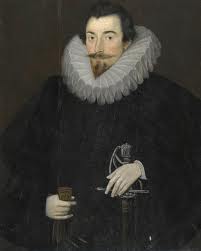
johnharington

John Harington

John Hayward, a contemporary, wrote of her entry into London and her first few weeks as queen that “if ever any persone had eyther the gift or the stile to winne the hearts of people, it was this Queene; and if ever shee did expresse the same, it was at that present, in coupling mildnesse with majesty as shee did, and in stately stouping to the meanest sort” (Hayward 6).

progress1

Elizabeth on Progress

The feeling was mutual.  She commented to a French diplomat late in her reign concerning her people’s affection that “it seems incredible, and I love them no less, and I can say that I would rather die than see any diminution of it on one side or the other” (Sitwell 75).  As she famously exclaimed in her Golden Speech, “…though God hath raised me high, yet this I count the glory of my Crown, that I have reigned with your loves” (Marcus 337).

References

Bacon, Francis. The Works of Francis Bacon, Baron Verulam, Viscount of St. Albans, and Lord High Chancellor of England. Vol. 5. London: Printed for M. Jones, 1818. Google Books. Web. 6 Apr. 2013.

Bacon, Francis, and J. Rawson Lumby. Bacon’s History of the Reign of King Henry VII,. Cambridge: University, 1902. Internet Archive. Web. 22 Jan. 2013.

Brimacombe, Peter.  All the Queen’s Men: the World of Elizabeth I.  Stroud: Sutton Publishing, 2000.  Print.

Cecil, Lord Burghley, William, Sir. Queen Elizabeth and Her Times: A Series of Original Letters Selected from the Inedited Private Correspondence of the Lord Treasurer Burghley, the Earl of Leicester, the Secretaries Walsingham and Smith, Sir Christopher Hatton and Most of the Distinguished Persons of the Period : In Two Volumes. Ed. Thomas Wright. London: Colburn, 1838. Google Books. Web. 10 Mar. 2013.

Doran, Susan and Norman Jones. The Elizabethan World. London: Routledge, 2011. Print.

Doran, Susan.  The Tudor Chronicles 1485-1603.  New York:  Metro Books, 2008. Print.

Dudley, Edmund. The Tree of Common Wealth: A Treatise. Manchester London: C. Simms & Co., 1859. Google Books. Web. 1 Apr. 2013.

Elton, G. R. England Under the Tudors. Third ed. London:  Routledge, 1991. Print.

Griffiths, Ralph A. and Roger S. Thomas.  The Making of the Tudor Dynasty.  New York: St. Martin’s Press, 1985. Print.

Hayward, John, and John Bruce. Annals of the First Four Years of the Reign of Queen Elizabeth. London: Printed for the Camden Society by J.B. Nichols and Son, 1840. Google Books. Web. 19 Jan. 2013.

Hibbert, Christopher.  The Virgin Queen: Elizabeth I, Genius of the Golden Age.  New York: Addison-Wesley Publishing Company, Inc., 1991.  Print.

Hutchinson, Robert. Young Henry: The Rise of Henry VIII. London: Weidenfeld & Nicolson, 2011. Google Books. Web. 02 Dec. 2012.

James, Mervyn. Society, Politics, and Culture: Studies in Early Modern England. Cambridge [Cambridgeshire: Cambridge UP, 1986. Web. 6 Apr. 2013. 

Jones, Michael K. and Malcolm G. Underwood.  The King’s Mother: Lady Margaret Beaufort, Countess of Richmond and Derby. New York: Cambridge University Press, 1992. Print.

Loades, David, ed. The Tudor Chronicles: The Kings.  New York: Grove Weidenfeld,1990.  Print.

MacCaffrey, Wallace. Elizabeth I. London: E. Arnold. 1993. Print.

Neale, J. E. Queen Elizabeth I. Garden City, NY: Doubleday, 1957. Print.

Nichols, John. Gentleman’s Magazine … Vol. 163. London: William Pickering; John Bowyer Nichols and Son, January to June Inclusive,1833. Google Books. Web. 2013.

Norton, Elizabeth.  Margaret Beaufort: Mother of the Tudor Dynasty.  Stroud: Amberley, 2010. Print.

Peck, Francis. Desiderata Curiosa:  Or, a collection of divers scarce and curious pieces relating chiefly to matters of English history; Consisting of Choice Tracts, Memoirs, Letters, Wills, Epitaphs, & Transcribed, Many of them, from the Originals Themselves, and the Rest from Divers Antient MS. Copies, or the MS. Collections of Sundry Famous Antiquaries and other Eminent Persons, both of the Last and Present Age: the whole, as Near as Possible, digested into an Order of Time, and Illustrated with Ample Notes, Contents, Additional Discourses, and a Complete Index.  By Francis Peck, M..A. Rector of Godeby Near Melton in Leicestershire.  Adorned with Cuts.  A new edition, greatly corrected, with some memoirs of the life and writings of Mr. Peck.  Vol. 1. London: Thomas Evans in the Strand, 1732. Google Books. Web. 30 Mar. 2013. 

Penn, Thomas.  Winter King; the Dawn of Tudor England.  New York: Penguin Books, 2012. Print.

Ridley, Jasper. Elizabeth I: The Shrewdness of Virtue.  New York: Fromm International Publishing Corporation, 1989.  Print.

Ross, Josephine.  The Tudors, England’s Golden Age.  London: Artus, 1994.  Print. 

Sitwell, Edith.  The Queens and the Hive.  Harmondsworth: Penguin Books, 1966. Print.

Somerset, Anne. Elizabeth I.  New York: Alfred A. Knopf, 1991. Print.

Warnicke, Retha M. The Rise and Fall of Anne Boleyn.  Cambridge: Cambridge University Press, 1989. Print.

Wilson, A. N.  The Elizabethans.  London: Hutchinson, 2011. Print.

Heir Unapparent

Heir Unapparent
Looked at with a cursory glance, the roads to succession for the heirs to Henry VII and Elizabeth I was without challenge and smooth.  Looked at with greater scrutiny, those roads to succession were troubled with opposition and rough.  Although many other royal houses had issues, the House of Tudor developed unique situations.

The Oxford Dictionary lists the earliest use of the identification of the House of Tudor as the “Tudor Dynasty” to 1779 with it becoming much more prevalent around 1906. According to C. S. L. Davis, the name “Tudor” was not widely used in the sixteenth century. Davis continued to explain that the contemporary publications did not use the surname until 1584, speculating that the monarchs wanted to distance themselves as descendents from non-royal, actually lowly-born, origins.

Until the Yorkist view of legitimacy based on primogeniture, the law of succession was not clear.  The dynastic struggles of the War of the Roses had continued the beliefs that the ruling king was such by divine right (having won the victory to place him there) and was cemented through the oaths of allegiance.  Obviously, legitimacy was not in Henry VII’s favor but it is a doctrine which he embraced once he became king  (Elton 18-19).  Henry had the succession registered in Parliament.  His purpose was to get his dynasty clearly declared.  He had parliament issue forth “that the inheritance of the crown of England, with every right and possession belonging to it, should remain and abide with our now sovereign lord king Henry and his heirs” (Elton 19-20).

Upon his death, Henry VII’s throne did not move automatically to his son.  Power brokers concealed his death for two days while they consolidated their positions.  Henry VIII was proclaimed, but not given full sovereignty under the guise of his being shy of 18 years of age.  Despite this, it cannot be denied that it was a smooth transition with no elaborate power plays.  Henry VII may have thought this impossible at various stages of his reign.

Edward Hall claimed in the title of his history, “The Union of the two Noble and Illustrious Families,” that the children born to Henry VII and Elizabeth of York brought this about.  There were claimants to the throne that had to be dealt with in various degrees of severity.  The remaining daughters of Edward IV were married to supporters. John de la Pole, Earl of Lincoln, was a nephew of Edward IV and had been nominated as successor by Richard III.  His oath of allegiance to Henry VII mitigated his claim.  Edward Plantagenet, Earl of Warwick, was handled less gently by being thrown in jail to dilute his dynastic claims.  Henry realized “There had to be an end to dynastic war before any dynasty could set about rebuilding the kingdom” (Elton 10).

john pole heraldry                                        edward warwick heraldry
Heraldry of John de la Pole,                Heraldry of Edward Plantagenet,
Earl of Lincoln                                            Earl of Warwick

Also early in his reign Henry VII faced dangers to his less-than-stable throne in with not one but two pretenders as Duke of York.  The first, Lambert Simnel, was quickly dealt with while the second, Perkin Warbeck, gained substantial support.  William Stanley, brother to his own step-father, deserted the Tudor cause to support Warbeck as did the Dowager Duchess of Burgundy, Margaret of York.  Her support proved so threatening that Henry was compelled to exclaim, “That stupid brazen woman hates my own family with such bitterness … she remains bent on destroying myself and my children” (Hutchinson 17).

lambertsimnel                 Perkin warbeck

   Lambert Simnel                                       Perkin Warbeck

Once the rebellions were stopped, Henry declared his second son Henry as Duke of York in order to claim the title and cement the succession of Lancaster and York. Preserving the Tudor succession continued to be in the forefront of Henry’s mind.  Henry wanted to leave no inheritance pretenders to endanger his son’s position on the throne of England” (Ross 36).  At the end of his reign he could know that the “threats of the dynasty had faded away; he could pass on a safe inheritance to his son” (Morrill 314).   Although the throne was passed to the second son rather than the eldest (due to the early death of Prince Arthur) Henry VIII was the first sovereign in many years to inherit rather than win it by conquest. The crown that Henry VIII inherited was as strong as the one that James VI succeeded to from Elizabeth Regina.

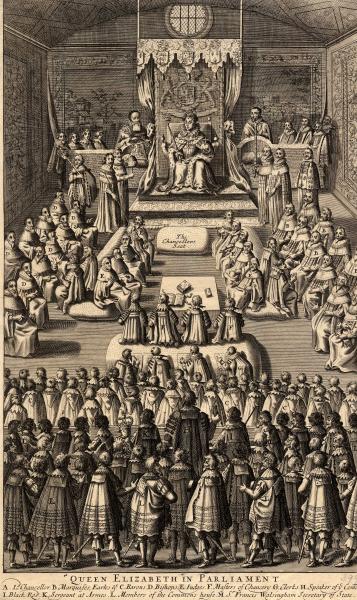
Astoundingly it could be argued that the greatest issues of Elizabeth Regina’s reign, from Parliament’s perspective, were her marriage and the succession.  Once Elizabeth passed the childbearing age, the question of her marriage took care of itself; and, obviously, affected the matter of the succession.

William Cecil tried to convince her that if she did not have children she would be in danger as people of “devilish means might be tempted to desire her end” as they tried to gain the throne and “she would have perpetual torment in life” (Froude 127).

Elizabeth’s perception was that settling the succession would not necessarily bring safety and stability.  “I know that my people have no other cause for regret than that they know me to be but mortal, and therefore they have no certainty of a successor born of me to reign over them”  (Sitwell 269).  Debate would begin immediately, those slighted would be angry and it could still create a struggle for power upon her death. So, with her skill in statecraft, Elizabeth maintained her silence understanding the wisdom of this better than her advisors or her people.

Although in 1559 at her first Parliament Elizabeth assured the members that “the realm shall not remain destitute of an heir” she had no intention of clarifying who that person would be (Perry 100).  She learned during her sister Mary’s reign that a monarch’s heir presumptive automatically becomes the center of dissent.  “I have good experience of myself in my sister’s time, how desirous men were that I should be in place, and earnest to set me up.  And if I would have consented, I know what enterprises would have been attempted to bring it to pass” (Marcus 66).  Every person who had declared for her would have expected rewards when she became queen.  They surely would have been disappointed in what had been meted out and would look around for someone else to put in place who would better reward them.  “No prince’s revenues be so great that they are able to satisfy the insatiable cupidity of men” (Marcus 66).

Throughout her reign, various contenders took their turn leading the short list of possible heirs.  Early on Katherine Grey held the prime spot.  It was well-known that Elizabeth did not care for Katherine and when Katherine married in secret to Somerset’s heir, Elizabeth had no compunction about tossing her in the Tower.  Katherine gave birth to two sons while confined who, despite their lineage, were never true contenders for the throne.  Included in the list early in her reign would be Henry, Lord Hastings and Mary, Queen of Scots, who styled herself as Queen of England much to Elizabeth’s dismay, and never could be discredited as a true heir.  Mary’s role will be discussed later.

Katherine Grey      henry hastings

  Lady Katherine Grey                 Henry, Lord Hastings, Earl of Huntingdon

As Elizabeth grew older the attention focused on the following claimants: Lady Arbella Stuart; Isabella, the Infanta of Spain; Robert Devereux, Earl of Essex; and, James VI of Scotland. She never could escape the political pressures to name an heir although she assured Sir William Maitland, Lord Lethington, a Scottish politician that “When I am dead, they shall succeed that have most right” (Neale 110).

Arbella Stuart                 isabella infanta of spain
 Lady Arbella Stuart                Isabella Clara Eugenia, Infanta of Spain

earl of essex

Robert Devereux, Earl of Essex

King James VI of Scotland
 King James VI of Scotland

Small pox, that feared scourge of the 16th century became even more so when Elizabeth contracted it.  She survived with minimal effects, but the fear instilled in her ministers of the possibility of her dying without an heir did not fade as quickly as her symptoms.  During the 1563 Parliament petitions from both the House and the Lords were presented to her begging her to marry and to name an heir.

The House of Commons saw “the unspeakable miseries of civil wars, the perilous intermeddlings of foreign princes with seditious, ambitious and factious subjects at home, the waste of noble houses, the slaughter of people, subversion of towns … unsurety of all men’s possessions, lives and estates:  if the sovereign were to die without a known heir, and pointed out that “from the Conquest to this present day the realm was never left as now it is without a certain heir, living and known” (Plowden  Marriage with my Kingdom 130).

Elizabeth certainly gave a refined response on January 28, 1563. This short speech gave no concrete answer regarding the succession although she assured her listeners that she understood the gravity of the situation while letting them know that it was her concern for “I know that this matter toucheth me much nearer than it doth you all” (Marcus 71).  She told them that it needed consideration, that she would let them know later and ‘so I assure you all that, though after my death you may have many stepdames, yet shall you never have a more natural mother than I mean to be unto you all” (Marcus 72).

The Lords sent an equally bloodcurdling petition about what would happen when Elizabeth died as they all knew that “upon the death of a prince, the law dieth” (Plowden Marriage with my Kingdom 131).  Elizabeth’s response to the Lords was read out by Nicholas Bacon, Lord Keeper on April 10, 1563.  As with the Commons she recognized that the succession was a grave matter and she would give it close attention.  It was another brilliant example of an “answer, answerless” (Seaward).

1563

1563

Draft of Elizabeth Regina’s Speech Given to Parliament in April 1563

Elizabeth was not pleased when in 1566 members of Parliament brought up her marriage and the succession again.  She told them they could not discuss it and they replied that they had a right to do so.  Once more they received an adamant ‘no’ and a comment that “it is monstrous that the feet should direct the head” (Marcus 98).

Wrapped up very eloquently and fancily, Elizabeth replied to both the Commons and the Lords and, although the style of each response differed, the message was clear: when it was convenient for her to determine a successor she would and not before.

Elizabeth assured the members that she would marry when it was convenient and they were not to be concerned about that.  She explained: “I will never break the word of a prince spoken in public place for my honor sake” (Marcus 95).  As for the succession in no uncertain terms she reminded them that it was her decision and hers alone.  Parliament had no business even discussing it and if the issue was debated it would be useless as “some would speak for their master, some for their mistress and every man for his friend…” (Marcus 97). One can imagine how incensed Elizabeth was as she had spoken that the Parliamentarians did not understand nor concern themselves with the peril she placed herself in by naming an heir.  She believed “nothing was said for my safety, but only for themselves” (Marcus 96).

Next she derisively questioned if the named heirs would be able to go above their own personal interests for the good of the country.  Would they “be of such uprightness and so divine as in them shall be divinity itself.  …they would have such piety in them that they would not seek where they are the second to be the first, and where the third to be the second, and so forth” (Marcus 96). She made it clear that “at this present, it is not convenient, nor never shall be without some peril unto you and certain danger unto me” to name a successor so she would not (Marcus 97).

These admonishments did not silence the members and she had to threaten any Parliamentarian who brought up the issue of the succession with examination by the Privy Council and possible punishment which in turn led Paul Wentworth, on behalf of the House, to assert the right of freedom of speech.

This power struggle did not end there.  Guzman de Silva, the Spanish ambassador whom she liked, learned about Parliament’s attempt to blackmail Elizabeth into naming a successor by placing in the preamble of the subsidy bill the necessity of the Queen to name her heir.  Elizabeth caught this request while reading the draft of the subsidy bill and let it be known via annotations to the document, that she would not have her word questioned by being put into law form.  “Shall my princely consent be turned to strengthen my words that be not themselves substantives?  Say no more at this time; but if these fellows were well answered, and paid with lawful coin, there would be fewer counterfeits among them”  (Mueller 40).

guzman de silva
Guzman de Silva, Spanish Ambassador

In her speech to dissolve Parliament on January 2, 1567, she let the members have it again about the inappropriateness of bringing up the succession question as it was a concern only for her.  She did not cloak her pique with Parliament.  She had replied that “not one of them that ever was a second person, as I have been, and have tasted of the practices against my sister… I stood in danger of my life, my sister was incensed against me. …and I was sought in divers ways.  And so shall never be my successor” (Marcus 96).

1566

1566

Draft of Elizabeth Regina’s Speech Given to Parliament on January 2, 1567

Mary, Queen of Scots plays a dominate role in the succession question under Elizabeth.  At first it was as a thorn in the side of the English Queen because Mary, even when she was the Dauphine of France, styled herself “as heiress-presumptive to the English throne” (Fraser 118). Elizabeth was trying to establish herself as sovereign and Anglicanism as the Church and did not relish such threats to her country’s stability.   Later, Mary conspired to overthrow Elizabeth and take over the crown of England—leading to her execution.

mary as dauphine
Mary, Queen of Scots as Dauphine of France

In between times, where does Mary fit?  Many believed Mary was Elizabeth’s true choice as heir.  It was reported by Sir William Maitland that Elizabeth compared the contenders to her throne alongside Mary.  “You know them all, alas; what power or force has any of them, poor souls? It is true that some of them has made declaration to the world that they are more worthy of it than either she or I…” (Dunn 189).  Yes, indeed.  Elizabeth felt the succession question greatly, was concerned about the pool of contenders, and feared naming any one of them.

william maitland
William Maitland, Lord Lethington

Maitland was certainly given every reason to believe that his Queen could obtain the throne of England as Elizabeth felt Mary had a legitimate right to it (even if she was angry at Mary for her self-declaration as heir and her use of Elizabeth’s arms in her heraldry) but she did couch her consideration in a warning. “For so long as I live there shall be no other queen in England but I, and failing thereof she cannot allege that ever I did anything which may hurt the right she may pretend” (Marcus 62).

Mary’s rights seemed to be overshadowed by all the reasons why she should not be heir:  She was Catholic; Henry VIII’s will had excluded that branch of the family; and Scottish relations could deteriorate if the independent minded Scots felt threatened.

Yet, the greatest deterrent to actually naming Mary would be that as long as she thought she was in the running, she had to toe the line.  Once declared, it would be harder for Elizabeth to control her.  Elizabeth was convinced “it is hard to bind princes by any security where hope is offered of a kingdom” (Marcus 67). The risks of naming a successor were too great. Once Elizabeth gave the succession to someone, it was theirs.  They had a right to keep it and it could not be taken back.  One must see why the granting of it must be weighed so carefully.

The execution of Mary, Queen of Scots does not make this a moot point as the logical successor became Mary’s son, the Protestant James VI. For many years, Elizabeth maintained a correspondence with James which are available and well-worth checking out –one source, Letters of Queen Elizabeth and King James VI of Scotland: Some of Them Printed from Originals… edited by John Bruce.   Historians have interpreted these letters to be in the line of a mentor and mentee.  Obviously, her intentions were for him to succeed although she never would declare that because “to have done otherwise would have been to invite all rivals and enemies to set about forestalling his succession, thus jeopardizing both his rights and her domestic peace” (Neale 403).

Elizabeth astuteness understood the reality as she asserted “I know the inconsistency of the people of England, how they ever mislike the present government and has their eyes fixed upon that person that is next to succeed; and naturally men be so disposed:  ‘Plures adorant solem orientem quam occidentem’ [More do adore the rising than the setting sun]” (Dunn 187 or Marcus 66).

References

Auchter, Dorothy. Dictionary of Literary and Dramatic Censorship in Tudor and Stuart England. Westport, CT: Greenwood, 2001. Google Books. Web. 19 Mar. 2013.

Allen, William. Robert Parsons.  A conference about the next succession to the crown of England: divided into two parts. The first containeth the discourse of a civil lawyer; how, and in what manner propinquity of bloud is to be preferred. The second containeth the speech of a temporal lawyer, about the particular titles of all such as do, or may pretend (within England or without) to the next succession. Whereunto is also added, a new and perfect arbor and genealogy of the descents of all the kings and princes of England, from the Conquest unto this day; whereby each mans pretence is made more plain. London:  R. Doleman, 1594.  Google Books. Web. 19 Mar. 2013.

Bacon, Francis, and J. Rawson Lumby. Bacon’s History of the Reign of King Henry VII,. Cambridge: University, 1902. Internet Archive. Web. 22 Jan. 2013.

Davis, C. S. L. “Tudor:  What’s in a Name?” History Abstract 97.325 (2012): 24-44. Trove. Web.

Elizabeth I, James VI, and John Bruce. Letters of Queen Elizabeth and King James VI of Scotland: Some of Them Printed from Originals in the Possession of the Rev. Edward Ryder, and Others from a Manuscript. Which Formerly Belonged to Sir Peter Thompson, Kt. Vol. 46. [London]: Printed for the Camden Society, 1849. Google Books. Web. 22 Mar. 2013.

Elton, G. R. England Under the Tudors. Third ed. London:  Routledge, 1991 Print
Fraser, Antonio. Mary Queen of Scots.  New York: Delacorte Press, 1969. Print.
Froude, James Anthony. History of England from the Fall of Wolsey to the Defeat of the Spanish Armada. London: Longman, Green, 1908. Google Books. Web. 10 Mar. 2013.

Hall, Edward, Henry Ellis, and Richard Grafton. Hall’s Chronicle; Containing the History of England, during the Reign of Henry the Fourth, and the Succeeding Monarchs, to the End of the Reign of Henry the Eighth, in Which Are Particularly Described the Manners and Customs of Those Periods. London: Printed for J. Johnson and J. Rivington; T. Payne; Wilkie and Robinson; Longman, Hurst, Rees and Orme; Cadell and Davies; and J. Mawman, 1809. Archive.org. Web. 2 Jan. 2013.
[Original Title–The union of the two noble and illustre famelies of Lancaster & Yorke…]

Hibbert, Christopher.  The Virgin Queen: Elizabeth I, Genius of the Golden Age.  New York: Addison-Wesley Publishing Company, Inc., 1991.  Print.
Hutchinson, Robert. Young Henry: The Rise of Henry VIII. London: Weidenfeld &
Nicholson, 2011. Google Books. Web. 02 Dec. 2012.

Griffiths, Ralph A. and Roger S. Thomas.  The Making of the Tudor Dynasty.  New
York: St. Martin’s Press, 1985. Print.

Gristwood, Sarah.  Arbella: England’s Lost Queen.  London:  Bantam Press, 2003.  Print.

Jones, Michael K. and Malcolm G. Underwood.  The King’s Mother: Lady Margaret
Beaufort, Countess of Richmond and Derby. New York: Cambridge University Press, 1992. Print.
MacCaffrey, Wallace. Elizabeth I. London: E. Arnold. 1993. Print.

Marcus, Leah S. et al., eds. Elizabeth I: The Collected Works. Chicago: University of Chicago Press, 2002. Print.

Morrill, John, ed.  The Oxford Illustrated History of Tudor & Stuart Britain.  Oxford:  Oxford University Press, 1996.  Print.

Mueller, Janel, ed.  Elizabeth I:  Autograph Compositions and Foreign Language Originals. Chicago:  The University of Chicago Press, 2003 Print.

Neale, J. E. Queen Elizabeth I. Garden City, NY: Doubleday, 1957. Print.

Norrington, Ruth.  In the Shadow of the Throne:  The Lady Arbella Stuart.  London:  Peter Owen Publishers, 2002. Print.

Norton, Elizabeth.  Margaret Beaufort: Mother of the Tudor Dynasty.  Stroud: Amberley, 2010. Print.

Oxford English Dictionary, Second edition. Oxford: Clarendon Press. 1991. Print

Penn, Thomas.  Winter King; the Dawn of Tudor England.  New York: Penguin Books, 2012. Print.

Perry, Maria.  The Word of a Prince: A Life of Elizabeth from Contemporary Documents.  Woodbridge, Suffolk: The Boydell Press, 1990.  Print.

Plowden, Allison.  Marriage with My Kingdom:  The Courtships of Elizabeth I.  New York:  Stein and Day, 1977. Print.

Plowden, Allison.  Two Queens in One Isle:  The Deadly Relationship Between Elizabeth I and Mary, Queen of Scots.  Stroud, Gloucestershire: Sutton Publishing, 1999. Print

Ridley, Jasper. Elizabeth I: The Shrewdness of Virtue.  New York: Fromm International Publishing Corporation, 1989.  Print.

Roberts, Peter R. “History Today.” History Today Jan. 1986: n. page. History Today. History Today. Web. 12 Dec. 2012.

Seaward, Paul. “History of Parliament Online.” On This Day, 24 November 1586: Parliament’s Intervention against Mary, Queen of Scots. The History of Parliament Trust 1964-2013, n.d. Web. 23 Mar. 2013.

Sitwell, Edith.  The Queens and the HiveHarmondsworth: Penguin Books, 1966. Print.

Somerset, Anne. Elizabeth I.  New York: Alfred A. Knopf, 1991. Print.

Persona Non Grata

Persona Non Grata

As a young man, the Earl of Richmond claimed that “from the time he was five years old he had been always a fugitive or a prisoner (Commynes 396-397). When Henry was just over four years old, Pembroke Castle, where he had lived with his mother and paternal uncle, Jasper Tudor, was overridden by William Herbert during a stage of the War of the Roses.  Henry’s ward-ship was given to Herbert and he was raised along with the Herbert children at Raglan Castle.  In fact, Anne Devereux , Herbert’s wife, held Henry’s affection throughout her life.

When William Herbert died in battle in 1469, following another stage of the War of the Roses and the return of the Lancastrians, Henry and Pembroke Castle were returned to Jasper Tudor. This time of stability was short-lived. By 1470 the Yorkist king, Edward IV, returned to power.  It is not the purpose here to explain the minutiae of this civil war; let it suffice to say that it was expedient for Jasper and Henry to leave the country.

Intended for France, contrary winds blew them to Brittany (Often referred to as Bretagne) where Henry was to begin his 14-year exile as an enforced guest at the court of Francis II, Duke of Brittany  (Griffiths, Hutchinson, Norton, Penn, Roberts, Vergil).

vannes
City of Vannes with the St.Peter Cathedral where Henry VII sent gifts in acknowledgement of his time there.  He also depicted the city’s patron Saint, St. Vincent in his chapel in Westminster Abbey.

Because of the threats on his life and kidnapping plots, and the logistics of maintaining basically a refugee household, Henry was transferred from place to place.  He was never truly settled.  “Dependent on the whims of others, he learned to think like the fugitive he now was:  to watch and assess loyalties, to sift information from rumour and, caught in the wash of European power politics, to understand how they affected his own fortunes” (Penn 4-5).

Tour dd Elven
Chateau Lagoet’s Tour de Elven where Henry was kept between 1474-1476.

chateau of nantes
Chateau Vannes built by Francis II and visited several times by Henry.

His experiences certainly affected him.  “He developed an exile’s patience, inured to a life in which stretches of empty time were punctuated by sudden alerts, moments of danger in which logical clear-headedness meant the difference between life and death” (Penn 5).  He became resourceful, determined and “unabashed and unafraid when faced with adversity.  He was capable of swift and decisive reactions, and yet he also learned the value of careful and detailed planning in order to avoid needless risks” (Griffiths168), all seemingly positive traits learned while under house arrest and exile.  Some historians believe exile also created in Henry “an almost pathological suspicion” (Jones 61).

Regardless, Henry certainly impressed the French diplomat, Philippe Commynes who met him while he was in Brittany and France.  Commynes marveled that Henry “without power, without money, without right … and without any reputation but what his person and deportment excited; for he had suffered much, been in distress all the days of his life, and particularly a prisoner in Bretagne to Duke Francis from the eighteenth year of his age who treated him as kindly as the necessity of his imprisonment would permit…” would emerge strong and noble (Commynes 560).

Vannes h7 excile
In the fifteenth century this gate in Vannes, Brittany was where Henry VII, as Earl of Richmond, passed into the city which protected other English expats.

In 1483 circumstances galvanized Henry to attempt an invasion of England; a pro-Lancastrian conspiracy, headed by the Duke of Buckingham, gained support in England; and Margaret Beaufort, Henry’s mother, began negotiations with the ex-Queen Elizabeth Woodville to marry their children (Henry to Elizabeth of York) to unite the Houses of York and Lancaster.  After extensive preparations, several ships set sail toward Wales where Henry knew support would be the strongest and he could gain an entry point.  After accompanying ships went astray, Henry “learnt the virtue of caution that day” (Griffiths102).  Wisely, Henry returned to Brittany disappointed but not defeated.

About 10 months later, Henry was informed of a different sort of conspiracy which would have Brittany (under the leadership of Pierre Landais, chief advisor to an incapacitated Francis II) hand him over to Richard III.  Henry organized his flight from the town of Vannes to France dressed as a groom with a small group of expats, he escaped across the border.  Later when a recovering Francis II learned what had happened, he gave safe-conduct passage to the remaining retainers of Henry’s who were still in Brittany. This was a relief to Henry, who had a strong sense of obligation to those who shared his exile.  Once in France, Henry obtained men and equipment from Charles VIII to launch an invasion of England in August of 1485 at the age of 28 (Griffiths, Hutchinson, Norton, Penn, Vergil, Roberts).  The rest they say is history.

The impressions made on him from his years of exile affected more than just his personality.  Henry VII was known for his preference for speaking French, his understanding of European politics and his unfamiliarity with English ways.  Nevertheless, he was able to establish one of the most infamous ruling dynasties in England culminating in the rule of his granddaughter, Elizabeth Regina.

Unlike her grandfather, who had his mother and paternal uncle to direct him, Elizabeth had no such guidance and her apprenticeship to the throne was as severe as his had been.  She too spent many years in a form of exile.  She had to learn the art of statecraft and how to assimilate various players’ actions all while in seclusion at country houses with little or no contact with politicians both domestic or foreign.    

She was able to create a strategy and with determination she maintained her course. This is not to say that she was inflexible.  Elizabeth knew when to shift her course of action as her survival demanded it.

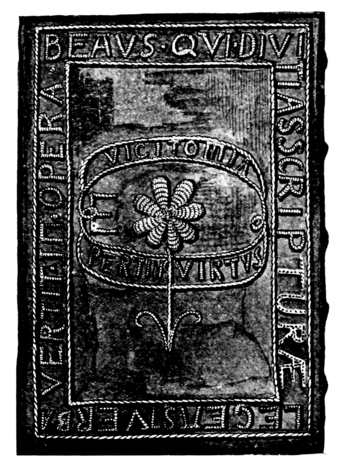
A religious book, The Epistles of St. Paul, owned by Elizabeth during the time that she was imprisoned by Queen Mary, has been preserved in the Bodleian Library.  Amongst the passages she had designed was Vincit omnia pertinax virtus.  E. C. In translation, Tenacious virtue conquers all* Elizabeth the Captive (Marshall 158, Nichols 11).  Beyond her perseverance, her courage, cool headedness, self-reliance and self-possession were cemented during her removal from Court. Also forged during this time were several of her least attractive characteristics: her lack of candor, her ability to conceal her true intentions, her inability to trust, her extreme caution and her vacillation. 

Epistles of st paul
The Epistles of St. Paul preserved by the Bodleian Library showing the above mentioned phrase done in needlework by Elizabeth.

While Henry VII as Earl of Richmond spent 14 years in exile, Elizabeth experienced removal from Court several times.  First was her self-imposed banishment to Hatfield after the Seymour troubles.  She was barely 15 and she had the wisdom to rehabilitate her reputation by concentrating on running the estate, biding her time and minding her behavior.  She led an exemplary life of scholarly pursuits in a decorous manner.  She remained there when the Duke of Northumberland, using Lady Jane Grey as his figurehead, and Mary struggled for the throne.  Once Mary was victorious, Elizabeth journeyed from Hatfield to offer congratulations and support (Erickson, Hibbert, MacCaffrey, Neale, Ridley).

Hatfield_House_Old_Palace Hatfield Old Palace

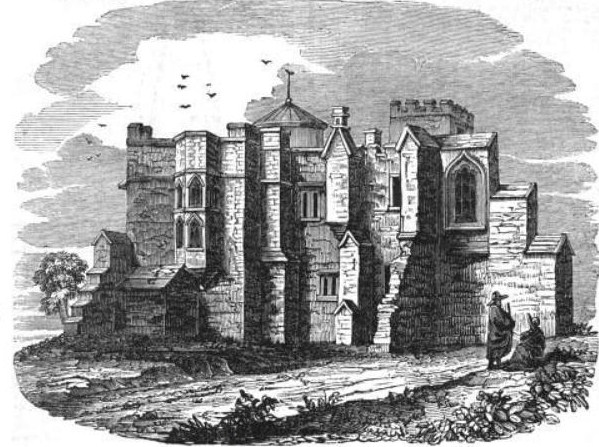
As mentioned above, Elizabeth was detained by Queen Mary at Woodstock after the Wyatt Rebellion.  This captivity, when Elizabeth was 21, was conducted differently from her grandfather’s escape to Brittany.

A letter preserved in the Talbot Papers from Robert Swift, steward to the Earl of Shrewsbury, reported on May 20, 1554,“Of Saterdaye, at one of the cloke at afternone, my Lady Elisabethe was delyv’ed out of Towre by the Lord Tresorer and my Lord Chamb’leyn, and went to Richemonde (on her way to the old Palace of Woodstock, where she remained in confinement till the end of April in the next year,) by water furthewy’er she landyd; wher she shal be attended upon by sundreye of garde, and some officers of ev’y office in the Quen’s howse, but how long she shall co’tinewe there I know not”  (Nichols 8).

woodstock ruins cropped Woodstock Palace drawn in 1714 

Although her custodian, Sir Henry Bedingfield, a Privy Council member under Queen Mary, attempted to spirit her away it was not the case.  People gathered to watch her pass, shouted support, offered her cakes and treats and rang the bells of their churches.  The entire journey saw demonstrations favorable to Elizabeth to such an extent that at one point Bedingfield reminded their hosts along the route that Elizabeth was “a prisoner who had offended against the Queen” (Ridley 62).  Once ensconced in Woodstock, Elizabeth knew her status as in the above reference to herself as ‘captive’ and also in the famous couplet she etched onto a window pane while at Woodstock when she signed herself as prisoner. 

“Much suspected by me,
Nothing proved can be,
Quoth Elizabeth prisoner” (Nichols 9).

After almost a year’s confinement, Elizabeth was summoned to Hampton Court by orders directed to Sir Henry Bedingfeld by Queen Mary: 

Hampton Court, April 17, 1555.

Trusty and well beloved, we greet you well. And forasmuch as we have resolved to have the Lady Elizabeth to repair nearer unto us, we do therefore pray and require you do declare unto her that our pleasure is she shall come to us to Hampton Court in your company with as much speed as you can have things in order for that purpose; wherein you shall not need to make any delay for calling of any other numbers than these, which are yourself and [those that] be now there attendant upon her, And of the time of your setting forward from thence, and by what day you shall think you may be there, we require you to advertise us by your letters with speed. Mary, the Queen (Mumby 187).

bedingfield

Sir Henry Bedingfield

Elizabeth spent time at Hampton Court and other houses from April 1555 until October when she returned to Hatfield.  At Hatfield with her trusted servants, Elizabeth could still not feel safe as Mary had her under continual surveillance (Erickson 153).  Eventually Mary’s suspicions eased, “there was something like a tacit truce between the two sisters.  Elizabeth, withdrawn to country retirement at Hatfield…remained carefully aloof from all political activity. On both sides civility and decorum served to mask underlying unease” (MacCaffrey 25). It was here at Hatfield where Elizabeth learned of her ascension to the throne in November of 1558.

Works Cited

Commynes, Philippe de.  The memoirs of Philip de Commines, Lord of Argenton: containing the histories of Louis XI and Charles VIII. Kings of France and of Charles the Bold, Duke of Burgundy. To which is added, The scandalous chronicle, or Secret history of Louis XI  London:  H. G. Bohn, 1855.  Internet Archive, Web. 10 Feb. 2013. http://archive.org/details/historicalmemoi00comigoog

Erickson, Carolly. The First Elizabeth. New York: Summit Books. 1983. Print.

Griffiths, Ralph A. and Roger S. Thomas.  The Making of the Tudor Dynasty.  New
York: St. Martin’s Press, 1985. Print.

Hibbert, Christopher.  The Virgin Queen: Elizabeth I, Genius of the Golden Age.  New York: Addison-Wesley Publishing Company, Inc., 1991.  Print.

Hutchinson, Robert. Young Henry: The Rise of Henry VIII. London: Weidenfeld &
Nicolson, 2011. Google Books. Web. 02 Dec. 2012.

Jones, Michael K. and Malcolm G. Underwood.  The King’s Mother: Lady Margaret
Beaufort, Countess of Richmond and Derby. New York: Cambridge University Press, 1992. Print.

Marshall, Edward. The Early History of Woodstock Manor and Its Environs, in Bladon, Hensington, New Woodstock, Blenheim; with Later Notices:. Oxford: J. Parker and, 1873. Internet Archive. Web. 18 Feb. 2013.

MacCaffrey, Wallace. Elizabeth I. London: E. Arnold. 1993. Print.

Mumby, Frank  Arthur, and Elizabeth. The Girlhood of Queen Elizabeth, a Narrative in Contemporary Letters, London: Constable, 1909. Internet  Archive. Web. 19 Feb. 2013.

Neale, J. E. Queen Elizabeth I. Garden City, NY: Doubleday, 1957. Print.

Nichols, John. The Progresses and Public Processions of Queen Elizabeth. Among Which Are Interspersed Other Solemnities, Public Expenditures, and Remarkable Events during the Reign of That Illustrious Princess. Collected from Original MSS., Scarce Pamphlets, Corporation Records, Parochial Registers, &c., &c.: Illustrated with Historical Notes. New York: B. Franklin, 1823. Google Books. Web. 19 Jan. 2013.

Norton, Elizabeth.  Margaret Beaufort: Mother of the Tudor Dynasty.  Stroud: Amberley, 2010. Print.

Penn, Thomas.  Winter King; the Dawn of Tudor England.  New York: Penguin Books, 2012. Print.

“Queen Elizabeth, Her Progresses and Processions: Confinement of the Princess Elizabeth in the Tower–Her Removal to Woodstock.” The Saturday Magazine 21 Apr. 1838: 146-47. Google Books. Web. 18 Feb. 2013. <http://books.google.com/books?id=i1YFAAAAQAAJ&pg=PA145&dq=saturday+magazine+372&hl=en&sa=X&ei=yKEiUb_1LfGLyAHc1YCwBA&ved=0CDAQ6AEwAA#v=onepage&q=saturday%20magazine%20372&f=false&gt;.

Ridley, Jasper. Elizabeth I: The Shrewdness of Virtue.  New York: Fromm International Publishing Corporation, 1989.  Print.

Roberts, Peter.  “The Welshness of the Tudors.” History Today. History Today.com, n.d. Web. 11 Feb. 2013.

Vergil, Polydore. Polydore Vergil, Anglica Historia (1555 Version). Ed. Dana F. Sutton. Irvine: University of California, 2005. Polydore Vergil, Anglica Historia (1555 Version). The Philological Museum, 04 Aug. 2005. Web. 02 Jan. 2013.

For a reproduction of Queen Mary’s orders to Sir Henry Bedingfeld on his duties and responsibilities as keeper of the then Lady Elizabeth consult the digitized volume of The Girlhood of Queen Elizabeth: A Narrative in Contemporary Letters pages 135 & 135 at the following address: http://books.google.com/books?id=bpkQAAAAYAAJ&pg=PA134&dq=A+Memorial+given+by+the+Queen’s+Highness++unto+her+trusty+and+right+councillor&hl=en&sa=X&ei=p9ooUYOoC8XHrQGnyIGgDw&ved=0CDAQ6AEwAA#v=onepage&q=A%20Memorial%20given%20by%20the%20Queen’s%20Highness%20%20unto%20her%20trusty%20and%20right%20councillor&f=false

*Special thanks to Jamie, a Latin instructor, for her help with the translation of the quote by Elizabeth I.

Why Do Today…?

Why Do Today…?

Both Henry VII and Elizabeth I have had the word temporise used to describe their behavior.  Will historians ever know positively if their irresolute actions were procrastination due to personal reasons or reluctance due to political reasons; oscillation or genius?  As usual, it depends on who is writing the history. 

“As a new man, Henry had to secure his place.  He did this by a compromising approach:  by marrying Elizabeth, but only belatedly…” (Bacon and Weinberger 238).  In December 1483 he had pledged to marry Elizabeth of York and had obtained the papal dispensation needed.  It was left to Parliament to encourage the marriage on December 10, 1485, by proclamation to the King “that he would please take the noble Lady Elizabeth, daughter of King Edward the IV, as his wife and consort” (Bacon and Lumby 239).

parl to use
Parliamentary Directive for King Henry to marry Elizabeth of York, in Latin

On January 18, 1486, the greatly anticipated marriage took place to great joy on the part of the peoples of England.  Henry had to realize that the ceremony “was thought by some to have been too long delayed, and historians have declaimed against Henry on this account” (Bacon and Lumby 239).

According to Jerry Weinberger, many of Henry’s early troubles stemmed from the fact that he slighted Elizabeth and the House of York. He postponed their marriage and delayed her coronation.  The coronation occurred most likely, as with other things, because events forced his hand.  Henry learned that by not crowning Elizabeth and “vouchsafing her the honour of a matrimonial crown” (Bacon and Lumby 22) it “did rankle and fester the affections of his people” and therefore, “he resolved at last to proceed” (Bacon and Lumby 39).

eyork
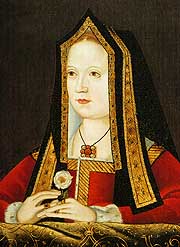
Elizabeth of York

When he returned to London after traveling north, “the Queen was with great solemnity crowned at Westminster, the twenty-fifth of November, in the third year of his reign, which was about two years after the marriage…” (Bacon and Vickers 37).  His “strange and unusual distance of time made it subject to every man’s note, that it was an act against his stomach, and put upon him by necessity and reason of state” (Bacon and Lumby 40).

francis bacon
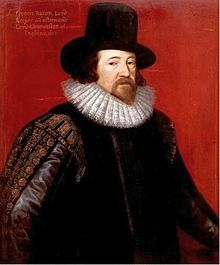
Francis Bacon

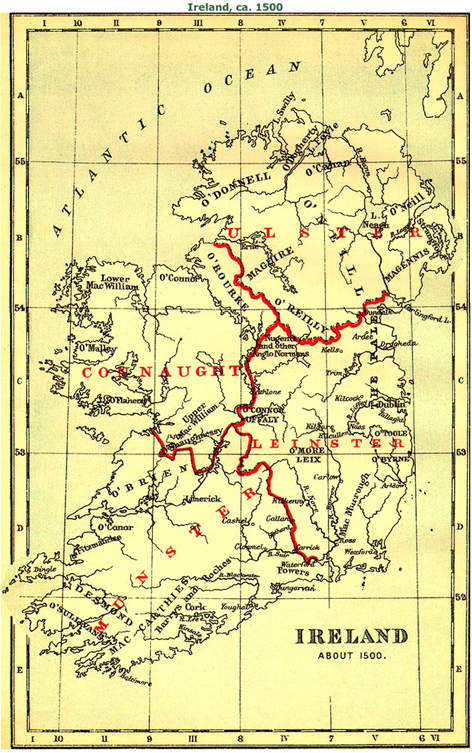
Although it is not the purpose here to relay the history of the country of Ireland, suffice to say that the issues were complicated and Henry was “obliged to temporize.  After long hesitation …” the king instituted his policy in Ireland (Morris 24).

Irelandca1500
Map of Ireland in 1500

Other international situations, such as in France, “precipitated the kind of decision which Henry had striven to avoid since his accession…” (Griffiths 172).  When dealing with Ferdinand of Aragon, the Hapsburg Empire and Burgundy “Henry hesitated, drew back…” (Mattingly 77).  Likewise, it appears to be déjà vu all over again with his actions concerning events in Flanders where the “the King was obliged to temporise” (Fletcher 61). At least he was consistent as Raimondo di Soncino, the Milanese envoy to Ludirio Sforza, Duke of Milan, reported of Henry VII that “he well knows how to temproise…” (Pollard 160).

Was it personality?  Was it policy?

Ten years into his reign, it was thought that policies and events that unfolded positively we accredited to his foresight and skill.  The King would “cunningly put off…” decisions and revelations of his plans until favorable conditions arose (Bacon and Vickers 37).  Amazingly, while Henry VII appears skillful in his vacillating, Elizabeth Regina was scoffed at as displaying womanly indecision.  Historians, I believe, have not been able to remove the sexism of her time period in their interpretations.  Understandably, the evidence which is left is the letters between her advisors or dispatches between diplomats and their home countries–written by men in that traditional time period.  Can Elizabeth not be credited for having the wisdom to allow events to unfold, to await natural solutions and to weigh possible options?

In general Elizabeth had her secretaries “fuming by her time-wasting ploys” (Somerset 279).  Once she had ordered letters to be written, she often would not sign them or allow the letters to be sent until she had thought things over some more.  Sir Thomas Smith writing to Lord Burghley said, “I had somewhat ado to get to the Queene, and more to get anything signed” (Wright 448) and “the letter already signed, which your Lordship knoweth, permitted to be sent away, but day by day, and hour by hour, deferred till anoe, sone, and to-morrow” (Cecil 1).

thomas smith                      cecil william
Sir Thomas Smith                                            William Cecil, Lord Burghley

The letters between these two men displayed “her peculiarities, her caution, her love of procrastination…her fondness for reiterated considerations of matters which every one thought to have been determined upon…” (Sylvanus 346).  Elizabeth did temporize and she was notorious for ignoring decisions.  Often these courses of action (or inaction) worked in her favor, as it did for her grandfather, because events would unfold and either resolve themselves or reveal a clearer path.  Nevertheless, while Henry VII is touted as exuding cunning, she is condemned as exuding “weakness” (Carruthers).

“Her hesitation, indecision, petulance, emotionalism and petty-mindedness are vices which men throughout the ages have been pleased to regard as typically feminine” (Ridley 335).  Yet, in 1569 the failure of the northern Earls’ rebellion was “due to the cautious and temporising policy for which Elizabeth has been so severely blamed by heated partisans” (Beesly).

Mary, Queen of Scots, had been a troubling issue for Elizabeth from the moment Mary returned to Scotland.  After many years as a political prisoner in England, Elizabeth was still unsure of how to handle the situation.  Once “proof” (many would interpret the evidence-gathering by Walsingham and his operatives as entrapment) had been collected to prove Mary was plotting with Catholics for the overthrow of Elizabeth, her conviction was a foregone conclusion.

mary scots
Mary, Queen of Scots

Judgment was handed down in October of 1586 yet Elizabeth wavered until February of 1587 before signing the death warrant.  The story is well-known of how William Davison, a privy councilor, bore the brunt of Elizabeth’s wrath once the execution was carried out.  Elizabeth had given him the signed warrant with the intention, so she later said, that it would not be delivered.  The seasoned Davison recognized the dangerous position he was in and “fearing she should lay the Fault upon me…” he had eventually taken the signed warrant to Cecil (The Life and Reign … 243).  Burghley called a meeting of the Privy Council and all agreed to send the warrant off without delay (Froude, Hibbert, MacCaffrey, Neale, Ridley, Somerset).

Her vacillation and unclear directives can be interpreted as genuine indecision of putting a fellow monarch to death or as brilliant political maneuverings to avoid the blame and placate the French and Spanish. If one acknowledges the emotions Elizabeth was experiencing concerning the death of a fellow monarch and family member plus the pressures of domestic and international politics, it is easier to recognize her indecision.

As an interesting aside at his trial for disobeying his sovereign, William Davison testified that “I perceived that she wavered in her Resolution, I asked her whether she had changed her Mind?  She answered, No: but another Course, said she, might have been devised…” (The Life and Reign …244). Like her grandfather, she held out waiting for another means; in this case it was her hope that Mary could be quietly done away with by some other method besides execution.  This came to light when Mary’s custodian at the time, Sir Amyas Paulet, asserted in a letter to Walshingham that he would do much for his Queen but would not “make so foul a shipwreck of my conscience, or leave so great a blot to my poor posterity, to shed blood without law or warrant” (Paulet 362).

amyaspaulet         walsingham
Sir Amyas Paulet                                        Francis Walsingham 

Determining the path to take concerning the Netherlands proved another area of discontent between Elizabeth and her advisors. Sir Thomas Smith wrote to Burghley that “…nothing resolved, and therefor, such number of things unanswered, whereupon her Majestie’s ministers lie still in suspense” (Cecil 1). Many of her councilors sided with Leicester very early to support William of Orange’s rebellion against the Spanish.  Her view was different from her councilors as she did not relish supporting ‘rebels’ against their sovereign; even if in this case the sovereign was her adversary Philip II.  “After long oscillation Elizabeth’s policy finally gravitated towards Philip and peace” (Froude 409).

This was not the policy that was eventually carried out.  As the political situation changed, military intervention on behalf of the Prince of Orange would become the official policy.  Secretary of State Sir Thomas Wilson stated “Temporising hath been thought heretofore good policy.  There was never so dangerous a time as this is, and temporising will no longer serve” (Archer 136).
WilliamOfOrange     philip-ii
William of Orange                                      Philip II

England’s neighbor, Scotland, proved another trouble spot for policy.  Support for rebels against the state was never an easy path for Elizabeth.  She would not give aid even though there were French troops landing on Scottish shores then agreed to do so because of the intervention of Spain.   Was she irresolute or facing realpolitik?

Walsingham boldly wrote in January 1575 to the Queen concerning her procrastination over policy in Scotland, “For the love of God, madam, let not the cure of your diseased state hang any longer on deliberation.  Diseased states are no more cured by consultation, when nothing resolved on is put into execution…” (Halser).  Would he have done this if his sovereign had been Henry VII?  Obviously, that is one of those unanswerable questions.

Elizabeth’s oscillating about marriage is so well-known there is no need to go into great detail.  She changed her mind not only per candidate, but even to marry, many times based on the international situation of the balance of power in Europe and perhaps her thoughts of having a chance at romantic happiness.  “The Queen skittishly shifted her ground, consistent only in her unwillingness to commit herself” (MacCaffrey 208).

Elizabeth came closest to marrying the Duke of Anjou (also referred to as the Duke of Alençon), even becoming ill at one point over her indecision.  The lengthy negotiations could be interpreted solely to “gain time and to keep the peace” (Hibbert 202).  Her purpose was served as she kept England out of the troubled Netherlands for longer, she lead Philip II to believe there was a chance for an Anglo-French alliance, and she dispensed Anjou out of the country on good terms.

dukeanjou

Duke of Anjou

Perhaps diplomatic and romantic reasons were not enough and James Melville, the Scottish diplomat, found the most precise reason for Elizabeth never marrying when he declared “Ye think gene ye wer married, ye wald be bot Quen of England, and now ye ar King and Quen baith; ye may not suffer a commander” (Melville 122).

The hesitations and changes of policy were genuine, and often due to the change in political climates both domestic and international rather than due to a character flaw.  Elizabeth herself wrote to William Cecil, Lord Burghley, on April 11, 1572,  “Methinks that I am more beholding to the hinder part of my head than well dare trust the forwards side of the same …” (Marcus 131).

Throughout her reign, Elizabeth’s goals were consistent –to keep England at peace and prosperous.  One can understand how hard it would be to make these decisions as there would be no way to see all eventualities.

Maybe in modern day parlance it would be that she had a fear of failure.  Elizabeth wanted so much to make the right decisions that she was often incapable of making one.  The issues discussed above were complex even if one did not include the factors of a monarch with obligations to her state and a woman with personal preferences.

Works Cited

Archer, Jayne Elizabeth et. al., ed.  The Progresses, Pageants, & Entertainments of Queen Elizabeth I.  Oxford: Oxford University Press, 2007. Print.

Bacon, Francis, and J. Rawson Lumby. Bacon’s History of the Reign of King Henry VII,. Cambridge: University, 1902. Internet Archive. Web. 22 Jan. 2013.

Bacon, Francis.  The Major Works.  Ed. Brian Vickers. Oxford: Oxford University Press, 2002.  Google Books. Web. 9 Mar. 2013.

Bacon, Francis. The History of the Reign of King Henry the Seventh a New Ed. with Introduction, Annotation and Interpretative Essay. Ed. Jerry Weinberger. Ithaca (N.Y): Cornell UP, 1996. Google Books. Web. 8 Mar. 2013.

Beesly, Edward Spencer. “Chapter V.” Queen Elizabeth. London: Macmillan and Co, 1892. EnglishHistory.net. Web. 3 Mar. 2013.

Campbell, William, ed. Materials for a History of the Reign of Henry VII. From Original Documents Preserved in the Public Record Office. Vol. I. London: Longman &: etc., 1873. Google Books. Web. 6 Mar. 2013.

Cecil, Lord Burghley, William, Sir. Queen Elizabeth and Her Times: A Series of Original Letters Selected from the Inedited Private Correspondence of the Lord Treasurer Burghley, the Earl of Leicester, the Secretaries Walsingham and Smith, Sir Christopher Hatton and Most of the Distinguished Persons of the Period : In Two Volumes. Ed. Thomas Wright. London: Colburn, 1838. Google Books. Web. 10 Mar. 2013.

Carruthers, Robert. “Queen Elizabeth I of England.” Encyclopedia Britannica. 10th ed. Edinburgh: Scotland. Encyclopedia Britannica, 1902. 1902 Encyclopedia Britannica Online. Encyclopedia Britannica, 2005. Web. 17 Mar. 2013.

Fletcher, C. R. L. An Introductory History of England from Henry VII to the Restoration. With Maps. Vol. II. New York: Dutton, 1908. Google Books. Web. 9 Mar. 2013.

Froude, James Anthony. History of England from the Fall of Wolsey to the Defeat of the Spanish Armada. London: Longman, Green, 1908. Google Books. Web. 10 Mar. 2013.

Hasler, P. W. “WALSINGHAM, Francis (c.1532-90), of Scadbury and Foots Cray, Kent; Barn Elms, Surr. and Seething Lane, London.” The History of Parliament: British Political, Social and Local History. The History of Parliament Trust 1964-2013, Web. 10 Mar. 2013. .

Hall, Edward, Henry Ellis, and Richard Grafton. Hall’s Chronicle; Containing the History of England, during the Reign of Henry the Fourth, and the Succeeding Monarchs, to the End of the Reign of Henry the Eighth, in Which Are Particularly Described the Manners and Customs of Those Periods. London: Printed for J. Johnson and J. Rivington; T. Payne; Wilkie and Robinson; Longman, Hurst, Rees and Orme; Cadell and Davies; and J. Mawman, 1809. Archive.org. Web. 2 Jan. 2013. 

Hibbert, Christopher.  The Virgin Queen: Elizabeth I, Genius of the Golden Age.  New York: Addison-Wesley Publishing Company, Inc., 1991.  Print.

The History of the Life and Reign of That Excellent Princess Queen Elizabeth from Her Birth to Her Death: As Also the Trial, Sufferings, and Death of Mary Queen of Scots. With the Whole Proceedings of the Divorce of King Henry VIII. from Queen Catherine; His Marriage with the Lady Anne Bullen, and the Cause of Her Unfortunate Death on the Scaffold. London: Printed, and Sold by the sellers in Town and Country, 1739. Google Books. Web. 9 Mar. 2013.

MacCaffrey, Wallace. Elizabeth I. London: E. Arnold. 1993. Print.

Marcus, Leah S. et al., eds. Elizabeth I: The Collected Works. Chicago: University of Chicago Press, 2002. Print.

Melville, James. Memoirs of His Own Life: M.D.XLIX.-M.D.XCII : From the Original Manuscript. Ed. Thomas Thomson. Glasgow: G. Brookman, 1833. Google Books. Web. 17 Mar. 2013.

Morris, William O’Connor. Ireland, 1494-1868, with Two Introductory Chapters.. Cambridge: University, 1898. Google Books. Web. 9 Mar. 2013.

Neale, J. E. Queen Elizabeth I. Garden City, NY: Doubleday, 1957. Print.

Paulet, Amias Sir.  The Letter Books of Sir Amias Paulet, Keeper of Mary, Queen of Scots. Ed John Morris.  London:  Burns and Gates, 1874.  Internet Archive.  Web 9 March 2013.

Pollard, Albert Frederick. “Full Text of “The Reign of Henry VII from Contemporary Sources”” Full Text of “The Reign of Henry VII from Contemporary Sources “Google Books, 1914. Internet Archive.  Web. 9 Mar. 2013.

Ridley, Jasper. Elizabeth I: The Shrewdness of Virtue.  New York: Fromm International Publishing Corporation, 1989.  Print.

Somerset, Anne. Elizabeth I.  New York: Alfred A. Knopf, 1991. Print.

Sylvanus, Urban, Gent. Gentleman’s Magazine … Vol. IX. London: William Pickering; John Bowyer Nichols and Son, January to June Inclusive 1838. Google Books. Web. 2013. 

Fate is Remarkable

 Fate is Remarkable:

Henry Tudor as Earl of Richmond and Elizabeth Tudor as Lady Elizabeth were each in their time potential heirs to the English throne.  Remarkably, both believed in their chance and right to rule.  They took their fate into their own hands,  ensuring their options remained open as they forged their paths to the throne.

Henry was a young man of around 15 years of age in September of 1471 when he and his paternal uncle, Jasper Tudor, found themselves avoiding the Yorkist threat of Edward IV in England by sailing for France.  As fate would have it, storms blew them off course and they landed in Brittany.  Thus began Henry’s 14-year exile.


Pembroke Castle

Pembroke Castle from which Henry, Earl of Richmond and Jasper Tudor, Earl of Pembroke fled in 1471.

Astoundingly, Henry was able to direct much of his destiny while in Brittany despite being removed from England and under close surveillance as a possible political pawn between France, Brittany and England.

During the majority of his years in exile, Henry honed his leadership skills as the focal point of the expatriates who joined him . He kept informed of the events in England so when conditions seemed favorable to an invasion in 1483 Henry attempted it. Philippe de Commynes diplomat and historian for the Dukes of Burgundy and later the Kings of France, who was often in Brittany, reported that, upon King Edward’s death, Francis II, Duke of Brittany, “supplied the Earl of Richmond liberally both with men and ships …and sent him to land his forces in England; but; meeting with foul weather, he was driven into Dieppe, and from thence went back into Bretagne” (Commynes 313).  The Lancastrians wisely abandoned the invasion.

Henry earnestly began preparations at this time for his ascension to the throne and to legitimize his claim.  It was reported, first by Bernard Andreas, an early biographer of Henry VII, that Henry made a formal pledge while in exile in Britanny at Rennes Cathedral on Christmas Day 1483 that whenever he obtained the crown he would marry Elizabeth of York, the eldest daughter of Edward IV (Andreas 25).  Negotiations had been on-going and culminated in the marriage agreement which would unite the houses of York and Lancaster and eventually give Henry’s children a strong claim to the throne.


Rennes Cath

Rennes Cathderal

Henry realized that it was paramount to secure the support of men in England and Wales.  Having the Yorkist leadership on his side (proof is the marriage agreement between him and Elizabeth) emboldened him to write several letters to supports, especially those in Wales where his base was strongest and from where he planned to march on Richard.  He asked for their aid and promised to remember their good offices.  Not a very hefty guarantee despite his signature as H.R. the regal monogram.  Below is an example of one such correspondence:  (Roberts 403)

H7 Letter Use

Once the invasion was imminent, Henry continued to contact sympathizers promising deliverance from servitude if they marched with him.  In the letter below Henry does not come off as a ‘poor exile’.  Here Henry refers to himself as King and Richard III as a usurper of Henry’s rights.

“By the King
Right trusty and well-beloved, wee greete you well:
And whereas it is soe, that, through the helpe of Almighty
God, the assistance of our loveing and true subjects … in all haste
possible to descend into our realme of England, not only for
the adoption of the Crowne, unto us of right appertaining,
but also for the oppression of the odious tyrant Richard,
late duke of Gloucester, usurper of our said right; and …
moreover to reduce as well our said realme of England into
its ancient estate, honour, and property … and the people of the
same to their dear erst liberties, delivering them of such
miserable servitude as they have piteously long stood in.
We desire and pray you, and upon your allegiance strictly
charge and command you, that immediately upon the sight
hereof with all such power as ye may make, defencibly
arrayed for the warre, ye addresse you towards us, without
any tarrying upon the way, until such time as ye be with
us, … your singular good Lord, and that ye faile not hereof as ye
will avoyd our grievous displeasure, and answere it unto
your peril.  Given under our signet…” (Jones 25).

When Henry learned that Pierre Landais, chief advisor to the Duke of Brittany, was in negotiations with Richard III to extradite Henry to England he knew he had to act.  According to Commynes, there was “some agreement with king Richard, much to his [Henry’s] prejudice and disadvantage… he and his retinue went away privately without taking their leave of the duke” (Commynes 313).  What Henry had done was to orchestrate his own escape to France from the town of Vannes dressed as a groom with a small group of loyal Lancastrians. Once in France, King Charles VIII provided aid in money, men and artillery and after extensive preparations a final and successful invasion was made.   That August of 1485, Henry had to have realized that he was taking his fate into his own hands (Commynes, Griffiths, Hutchinson, Norton, Penn, Roberts and Vergil). 

vannes

Vannes, Brittany

Henry and we will see his granddaughter, Elizabeth, learned patience and persistence as exiles, but also as rulers-in-waiting they recognized the time for decisive action. By taking full advantage of circumstances they achieved their goal—becoming seated on the throne of England as an all-powerful sovereign.

As a young woman of 15, Elizabeth was involved, unwittingly, in the schemes of Thomas Seymour the widower of her last step-mother, Catherine Parr.  His ambition and folly are well-known and to have involved this young person was unconscionable.  It is not the point here to explain the elaborate plan although it must be acknowledged that the affect on Elizabeth was immense. Certainly it took its toll emotionally and physically, and Elizabeth was unwell for some months after. However, as well as affecting her health, it also affected her reputation and this was a great concern to Elizabeth.

  Seymour Thomas       
Thomas Seymour    

Always sensitive about what people thought of her, Elizabeth wanted the rumor that she was pregnant by the Admiral suppressed. She wrote to Edward Seymour, the Lord Protector, demanding a public statement be made disclaiming the rumors and threatening punishment for those who continued spreading the tale.  Here is a remarkable example of Elizabeth taking matters into her own hands when she penned “rumours abroad which be greatly both against my honour and honesty, which, above all other things, I esteem, which be these, that I am in the Tower, and with child by my Lord Admiral.  My lord, these are shameful slanders, for which besides the great desire I have to see the King’s Majesty, I shall most heartily desire your lordship that I may come show myself there as I am.  Written in haste.  Your assured friend to my little power, Elizabeth” (Mumby 45).

Seymour Edward
Edward Seymour

More letters of the same vein were sent, such as this one to the Lord Protector, on February 21, 1549, in which she wrote requesting “unto your lordship and the rest of the Council to send forth a proclamation into the countries that they refrain their tongues, declaring how the tales be but lies, it should make both the people think that you and the Council have great regard that no such rumors should be spread of any of the king’s majesty’s sisters (as I am, though unworthy)” (Marcus 33).

She was successful; a proclamation was eventually issued.  Elizabeth steadfastly professed her innocence to Seymour’s plans to marry her and saying she would never do anything without the Council’s permission.  Elizabeth understood the moral of the experience: she was careful of her lifestyle; she scrupulously avoided any hint of scandal; she became very conservative in her dress—plain, sober colors, little adornment or jewelry–as she presented an image of modesty and decorum; she managed her own bookkeeping; and she applied herself to her studies.  This remarkable young woman knew she needed to gain what she could from this experience and that was to maintain her reputation and secure her servants’ freedom (Erickson, MacCaffrey, Neale, and Ridley).

During the investigation, several members of Elizabeth’s household were detained, most painfully for Elizabeth her governess, Kat Ashley—it would be sometime before they were reunited.  The Lord Protector was subjected to a flurry of letters demanding the return of Kat Ashley to Elizabeth’s service and the dismissal of other ladies appointed to her household.   She continued protestations of innocence that there was ever any intention to marry–Thomas Seymour or anyone– without permission from the King, the Council or the Lord Protector.  “I am not of so simple understanding” (Marcus 33) this 15-year old told seasoned politicians.

Elizabeth was at Hatfield in late November of 1556 when she was summoned by Queen Mary to London.  While there Mary presented to her sister a prospective marriage with Emmanuel Philibert, the Duke of Savoy.  Contemporary Westerners cannot understand the strength of will and purpose it took for Elizabeth to decline.  Society of her time could not fathom a young woman not wanting to marry and even more so, defying the express wishes of her family let alone her sovereign.  Her rationale for declining was that she would not marry anyone.  Having been invited for the Christmas festivities, she abruptly returned to Hatfield on December 3rd after only a short stay in London (Bassnett, Gristwood, Machyn, Plowden, and Somerset).

Em Phil savoy
Emmanuel Philibert, Duke of Savoy

Perhaps she had displeased the Queen over her refusal despite having through her “amiable condescension, obliging address, and agreeable conversation, procured her new interests and attachments, and even engaged the best part of the Lords of the Council in her favor” (Nichols 25).

Leaving London
This is an eye witness account of Elizabeth’s entry and then exit from London on 28 November and 3 December 1556.

During the spring of 1558 when approached by the King of Sweden as a possible bride for his son, Elizabeth would tell Mary’s representative Thomas Pope that what she believed in 1556 was still true: “I assure you upon my truthe and fidelitie, and as God be mercifull unto me, I am not at this tyme otherways mynded, than I have declared unto you; no, though I were offered the greatest Prince in all Europe” (Nichols 24).  This was the response Pope declared “the Ladye Elizabeth hir Graces aunswere made at Hattfield, the xxvi of April 1558, to Sir T. Pope, Knt. Being sent from the Queenes Majestie to understand how hir Grace lyked of the mocyon of marryage made by the Kynge elect of Swethelandes Messenger” (Nichols 25).  Elizabeth had chartered her course of remaining unmarried, and was determined to control that element of her life.

Legend has it that Elizabeth was in the parkland at Hatfield seated beneath an oak tree on November 17, 1558, when news reached her of Mary’s death. She is said to have whispered in Latin what she truly must have felt: “A Domino factum est istud et est mirabile in oculis nostris” –This is the Lord’s doing, and it is marvelous in our eyes.”
Hatfield_House_Old_Palace
Hatfield Old Palace 

Even if Elizabeth did give Divine credit for this awe-inspiring event, she did much to keep herself safe and established in a position for inheriting.  Elizabeth was at twenty-five years old Queen of England. For the first time in her life, her destiny lay completely in her own hands.  Fate is remarkable.

Works Cited

Andreas, Bernardus, and James Gairdner. Historia Regis Henrici Septimi Necnon AliaQuaedam Ad Eundem Regem Spectantia. London: Longman, Brown, Green, Langmans, and Roberts, 1858. Google Books. Web. 2 Mar. 2013.

 Bassnett, Susan.  Elizabeth I: a Feminist Perspective.  Oxford: Berg Publishers, 1997. Print.

Commynes, Philippe de.  The memoirs of Philip de Commines, Lord of Argenton: containing the histories of Louis XI and Charles VIII. Kings of France and of Charles the Bold, Duke of Burgundy. To which is added, The scandalous chronicle, or Secret history of Louis XI  London:  H. G. Bohn, 1855.  Internet Archive, Web. 10 Feb. 2013.

Erickson, Carolly. The First Elizabeth. New York: Summit Books. 1983. Print.

Griffiths, Ralph A. and Roger S. Thomas.  The Making of the Tudor Dynasty.  New
York: St. Martin’s Press, 1985. Print.

Gristwood, Sarah.  Elizabeth & Leicester:  Power, Passion, Politics. New York: Viking Press, 2007.  Print.

Hutchinson, Robert. Young Henry: The Rise of Henry VIII. London: Weidenfeld & Nicolson, 2011. Google Books. Web. 02 Dec. 2012.

Jones, W. Garmon. Welsh Nationalism and Henry Tudor. London: Honourable Society of Cymmrodorion, 1918. Internet Archive. Web. 2 Mar. 2013.

MacCaffrey, Wallace. Elizabeth I. London: E. Arnold. 1993. Print.

Machyn, Henry. The Diary of Henry Machyn, Citizen and Merchant-taylor of London From 1550 to 1563. Ed. John Gough Nichols. London: Camden Society, 1848. Google Books. Web. 24 Feb. 2013.

Marcus, Leah S. et al., eds. Elizabeth I: The Collected Works. Chicago: University of Chicago Press, 2002. Print.

Mumby, Frank  Arthur, and Elizabeth. The Girlhood of Queen Elizabeth, a Narrative in Contemporary Letters, London: Constable, 1909. Internet  Archive. Web. 18 Feb. 2013.

Neale, J. E. Queen Elizabeth I. Garden City, NY: Doubleday, 1957. Print.

Nichols, John. The Progresses and Public Processions of Queen Elizabeth. Among Which Are Interspersed Other Solemnities, Public Expenditures, and Remarkable Events during the Reign of That Illustrious Princess. Collected from Original MSS., Scarce Pamphlets, Corporation Records, Parochial Registers, &c., &c.: Illustrated with Historical Notes. New York: B. Franklin, 1823. Google Books. Web. 19 Jan. 2013.

Norton, Elizabeth.  Margaret Beaufort: Mother of the Tudor Dynasty.  Stroud: Amberley, 2010. Print.

Penn, Thomas.  Winter King; the Dawn of Tudor England.  New York: Penguin Books, 2012. Print.

Plowden, Allison.  Marriage with My Kingdom.  New York: Stein and Day, 1977. Print.

Ridley, Jasper. Elizabeth I: The Shrewdness of Virtue.  New York: Fromm International
Publishing Corporation, 1989.  Print.

Roberts, Emma. Memoirs of the Rival Houses of York and Lancaster: Historical and Biographical, Embracing a Period of Engl. History from the Accession of Richard II. to the Death of Henry VII. ; in Two Volumes. London: Harding & Lepard, 1827. Google Books. Web. 9 Feb. 2013.

Somerset, Anne. Elizabeth I.  New York: Alfred A. Knopf, 1991. Print.

Vergil, Polydore. Polydore Vergil, Anglica Historia (1555 Version). Ed. Dana F. Sutton. Irvine: University of California, 2005. Polydore Vergil, Anglica Historia (1555 Version). The Philological Museum, 04 Aug. 2005. Web. 02 Jan. 2013.

$afe and $ecure

$afe and $ecure

Henry VII saw the need to expand the “crown’s fiscal authority….”  He felt that political problems came “from the crown’s financial weaknesses.  He saw stability resting on a solvent and secure king” (Jones 89).  Perhaps he carried his avariciousness too far but “the very quality, the excess of which became a matter of severe and deserved reproach to him, added, at first, materially to secure him in the possession of the Crown” (Bergenroth 53).

Gaining the throne did not mean security and Henry became “obsessed by the equation of security and money” (Penn 155). He spent time checking accounting entries, acquiring a “conspicuous talent for heaping up wealth” (Perry Sisters 17).  He personally wrote up sources of revenue and oversaw his financial administrators. Penn reveals that this was “…a king with a complex, all-consuming obsession with the control, influence and power that money represented, both at home and abroad” (Penn 156).  Henry’s policies were to ensure that wealth was directed towards the Crown as much as possible.

Jewel Tower, London

jewel tower1

“He valued money only for money’s worth; and to him a large reserve was a great guarantee for peace and security” (Gairdner 209).  It was further reported that close to his death “he recommended his son and successor to pursue the same policy as himself.  By preserving friendship with France and amassing money he told him that he would be best able to preserve his kingdom in peace and break the power of faction if it ever became dangerous” (Gairdner 215).  Henry did pursue peace with France.  He also dealt with faction successfully. As the envoy, Don Pedro de Ayala of Spain, said: “The King of England is less rich than generally said. He likes to be thought very rich because such a belief is advantageous to him in many respects.  The King himself said to me that it is his intention to keep his subjects low, because riches would only make them haughty…” (Hutchinson 41).

Alas, his son did not follow these two policy suggestions as history reveals to us. Henry VIII conducted costly wars with France and rapidly used up the treasury.  It was left to Henry VII’s granddaughter Elizabeth to act upon his advice.

Peace meant a great deal to Elizabeth.  “She had no lust for glory at the cost of her own ruin, commercial and industrial stagnation, and social distress” (Neale 298).  She lamented over the waste of war.  “It is a sieve that spends as it receives to little purpose” (Crawford).  Elizabeth kept finances into account when creating foreign policy.  She knew too well that interventionist and expansionist policies cost too much money.

Elizabeth was notoriously frugal and her “stringent economies effected soon after her accession…” and her “prudent financial management” (Somerset 281) allowed for her to escape true money worries. Her parsimony was even defended by Burghley.  “To spend in time convenient is wisdom; to continue charges without needful cause bringeth repentance” (Perry Words of a Prince 287).

  William Cecil                                      Nicholas Bacon 

cecil william bacon nicoholas

By 1571-72 her finances were in pretty good shape.  Elizabeth was praised by her Lord Keeper Nicholas Bacon who said that in the past there had been money wasted but in the twelve years of Elizabeth’s reign the expenditures were those:

“…that hath not been thought before convenient to be done for the Weal and profit of the Realm; so far her highness is from spending of Treasure in vain matters, and therefore the rather how can a man make any difficulty to contribute according to his Power?”  (D’Ewes 139).

This is true as nothing was done for glory alone.  She did it to preserve the realm.  Any burden was from a policy that showed “an abstemious royal economy in domestic expenditure and a strictly defensive foreign policy” (McCaffrey 384).

 Robert Cecil                                                        Sir Francis Walsingham

(c) National Trust, Hardwick Hall; Supplied by The Public Catalogue Foundation    walsingham

She tried hard to ensure that her people would not “groan under the burden of continual levies and impositions” (Somerset 547).  Yet, near the end of her reign when expenses in defense were creating hardships, Robert Cecil warned a courtier seeking office, “Her majesty’s mind is not so apt to give as before her wars…” (Morrill 346).  It is clear that keeping peace at home and engaging in foreign conflicts was not going to keep the coffers full.  It is not the purpose here to go into the Essex rebellion, yet it can be used as an example of how the money situation had deteriorated so that the fabric of the Court was unraveling.  The discontent was from the retrenchment that was taking place.  Ironically, as Elizabeth was securing the country from external threats, it was internal security which was weakened. Despite [as reported by Philip Sydney] Walsingham’s, complaint that Elizabeth would not increase her expenditure on international intrigue as she “greatly presumeth on fortune which is but a very weak foundation to build upon” both domestically and internationally, Elizabeth prevailed (Worden ).

What Elizabeth achieved in maintaining solvency and concord was extraordinary. Applying the financial judiciousness and preference for peace she had inherited from Henry VII, Elizabeth ensured that England, not a great power with great wealth, was safe and secure.

 Works Cited

Bergenroth, G. A., and, Pascual De. Gayangos. Calendar of Letters,     Dispatches and State Papers, Relating to the Negotiations between England and Spain, Preserved in the Archives at Simancas and Elsewhere: Published by the Authority of the Lords Commissioners of Her Majesty’s Treasury under the Direction of the Master of the Rolls. Henry VII 1485 – 1509. ed. Vol. 1. London: Longman, Green, Longman and Roberts, 1862. Google Books. Web. 26 Nov. 2012.

Crawford Lomas, Sophie, and Allen B. Hinds. Calendar of State Papers Foreign, Elizabeth, Volume 21, Part 2: June 1586-March 1587. N.p.: n.p., 1927.Elizabeth. British History Online. Web. 04 Jan. 2013.

D’Ewes, Simonds, and Paul Bowes. The Journals of All the Parliaments during the Reign of Queen Elizabeth Both of the House of Lords and House of Commons.
London: Printed for John Starkey …, 1682. Google Books. Web. 5 Jan. 2013.

Gairdner, James. Henry the Seventh,. London: Macmillan, 1889. Google Books. Web. 26 Nov. 2012.

Hutchinson, Robert. Young Henry: The Rise of Henry VIII. London: Weidenfeld & Nicolson, 2011. Google Books. Web. 02 Dec. 2012.

Jones, Michael K. and Malcolm G. Underwood.  The King’s Mother: Lady Margaret
Beaufort, Countess of Richmond and Derby. New York: Cambridge University Press, 1992. Print.

MacCaffrey, Wallace. Elizabeth I. London: E. Arnold. 1993. Print.

Morrill, John, ed.  The Oxford Illustrated History of Tudor & Stuart Britain.  Oxford: Oxford University Press, 1996.  Print.

Neale, J. E. Queen Elizabeth I. Garden City, NY: Doubleday, 1957. Print.

Penn, Thomas.  Winter King; the Dawn of Tudor England.  New York: Penguin Books, 2012. Print.

Perry, Maria. The Sisters of Henry VIII.  New York: St. Martin’s Press, 1999. Print.

Perry, Maria.  The Word of a Prince: A Life of Elizabeth from Contemporary
Documents.  Woodbridge, Suffolk: The Boydell Press, 1990.  Print.

Somerset, Anne. Elizabeth I.  New York: Alfred A. Knopf, 1991. Print.

Worden, Blair. The Sound of Virtue: Philip Sidney’s Arcadia and Elizabethan Politics. New Haven: Yale UP, 1996. Google Books. Web. 04 Jan. 2013.

Tight Purse Strings

Tight Purse Strings

Henry VII was well-known for his miserliness. “The popular tradition respecting his avarice, which has descended to us, seems only too well founded. It is quite the characteristic of a usurer to have a fondness for gold. We are informed that whenever a gold coin entered the chest of Henry it never found its way out again” ( Bergenroth 69).

Don Pedro de Ayala, envoy to Ferdinand and Isabella of Spain, revealed that although Henry had many qualities that would have rendered him great, “he had but one characteristic which spoilt all the rest, his love of money” (Bergenroth 53).

It was claimed that when he was not with his council or in public he was “writing accounts of his expenses with his own hand” (Tremlett 95). “He also handled the cash himself. In his own handwriting, he itemised the moneys delivered in one day to … the treasurer of his chamber…all amounting to several thousands of pounds” (Hutchinson 41).

Ledger initialed by Henry VII from 1492       Accounts written in Henry’s handwriting

 ledger         account

The king collected money from taxation, plus the obligations and fines he placed on his subjects (rich and poor). Out of the “sixty-two families in the English peerage that survived the butchery of the War of the Roses, forty-seven were at the king’s mercy, either by living under attainder or forfeiting substantial sums to the crown to guarantee their good behavior” (Hutchinson 42). These recognisances were imposed and collected by the able administrators, Sir Richard Empson and Edmund Dudley. The activities of these two men were known throughout the Court as Don Pedro de Ayala reported to Ferdinand and Isabella that Henry’s servants had “a wonderful dexterity in getting hold of other people’s money” (Bergenroth 207).

Henry VII’s priorities were revealed in the power and prestige granted to these two trusted advisors. The policies they implemented, in the king’s name, generated as much hatred and distrust as they did revenue. Although not everyone felt that way, courtiers who profited from Henry VII’s fiscal policies did worry when Henry VIII came to the throne that he would reverse “his father’s tight-fistedness…” (Jones 222), most resented Henry VII and his administration. In fact, one of Henry VIII’s first acts as king was the arrest of these two men, “greate counsaylers to the late kyng, were attached and brought to the Tower, not to the litle rejoysyng of many persones, whiche by them wer greved, whiche, attachement was thought to bee procured by malice of theim, that with their aucthoritie, in the late kynges daies wer offended, or els to shifte the noyse, of the straight execucion of penall statutes in the late kynges daies, by punishement of those persones, and other promoters, for to satisfie and appeace the people” (Hall).

For a discussion of the land revenues and prerogative feudal rights which Henry VII took advantage of to generate income, see Stanley Bertram Chrimes’ Henry VII. It is enough here to understand that Henry VII found a source of revenue which he pursued “with a zeal and relentless application which earned him and his agents an unpopularity and a measure of odium which became marked towards the end of the reign…” (Chrimes 209). Although other sovereigns had used these methods, none had “taken such a close personal part in wielding the whips and scorpions of financial pressures to attain their ends” (Chrimes 214). No wonder Henry VII emerges in the pages of history as miserly and avaricious. A study of the Calendar of Close Rolls for 1500-1509 by K. B. McFarlane led him to declare that by the end of his reign Henry VII “governed by recognizance” (Chrimes 214). It has been estimated that Henry extorted (hard to use any other word) close to £495 million in present-day monetary values from his subjects (Hutchinson 43).

Henry “made rebellions, like wars, pay their own expenses, and even yield him a mine of treasure, which was a source, in its turn, of stability to the country, giving him more ample power to put down future outbreaks. For the great majority of insurgents he had no other punishment than fines…. Violation, even of laws which were antiquated, was visited with fines which went to the king’s coffers” (Gairdner 215).

Despite the general belief that Henry had amassed a large surplus early in his reign (Chrimes 217), the Spanish envoy, Don Pedro de Ayala, remarked, “The King of England is less rich than generally said. He likes to be thought very rich because such a belief is advantageous to him in many respects. The King himself said to me that it is his intention to keep his subjects low, because riches would only make them haughty…” (Hutchinson 41). The viewpoint that Henry’s miserliness was a political rather than an avaricious motive is taken up further by Polydore Vergil. Writing under the patronage of the Tudors, Vergil did not ignore the fact that Henry VII gained money in dubious ways although he does offer explanations.

…id quod argumentum non dubium erat eum, sicut ipse aiebat, studio coercendi ferocem populi inter factiones nutriti animum, non item cupiditate cogendae pecuniae, ea coepisse uti severitate, quemadmodum supra demonstravimus, quanquam saucii ista non tam severitatis quam avaritiae tela esse clamabant. Sane modestus princeps non emungebat suos fortunis immodice qui regnum rebus omnibus longe locupletissimum reddidit reliquitque, quod planum praeter caetera fecit immanis auri pariter atque argenti copia quae in annos singulos in insulam importata est a mercatoribus ultro citroque commeantibus, quos ille saepenumero pecunia ad tempus data gratuito iuvabat, ut mercatura ars una omnium cunctis aeque mortalibus cum commoda, tum necessaria, in suo regno copiosior esset.

This was a sure sign that, just as he himself said, he resorted to this severity for the sake of curbing the fierce spirits of a people brought up amidst factionalism, not out of a lust for money-making, as I have shown above, although those who were wounded in this way exclaimed these were the darts of greed, not severity. Indeed, this modest sovereign did not despoil his subjects of their fortunes immoderately, for he left behind him a kingdom most wealthy in all respects. This is made plain, among other things, by the immense amount of gold and silver annually brought into the island by merchants plying to and fro, whom he very frequently helped with interest-free loans, so that the flow of commerce, both useful and necessary for all men, would be more abundant in his realm.

Thomas Penn brings forth the idea that Henry VII’s obsession with money was not the actions “of a miser, but of a sophisticated financial mind…” (Penn 156). This is an interesting point of view and one that was not held by many others, although Josephine Ross does admire Henry and his policies. She commented that Henry “…was a born accountant, who loved to spend hours closeted with lists of figures signing every entry with his own hand, those accounts revealed some attractive aspects of his personality” (Ross 22). His financial records do show expenditures to charitable causes, music, a variety of entertainments, architecture, sporting events, and gambling (Ross, Penn, and Chrimes). According to Ross, “There was nothing miserly about Henry VII; he was intensely careful with money, but he recognized the importance of spending freely to keep up a regal image” (Ross 22). This incongruity between miserliness and extravagance is something which was held in common between Henry VII and his granddaughter, Elizabeth Regina.

Elizabeth had inherited “…the financial prudence of her grandfather” (Neale 294) and the depleted coffers of her father. “A sense of economy was inbred as well as inborn in Elizabeth” (Neale 296). Prior to her accession her income had been small even after she received her inheritance from her father and acquired Hatfield.  Elizabeth had learned to be careful with her monies. “Her financial affairs, which had been in a precarious state since her father’s death, assumed a more healthy aspect when she took over the book-keeping herself, maintaining meticulous records of her expenditure and personally signing each page of the accounts” (Somerset 28).

Even as Queen she was watchful and her “stringent economies effected soon after her accession…” plus her “prudent financial management” allowed her to escape true money worries while maintaining her Court (Somerset 281).  What she managed to achieve with the limited resources available is astounding.  It is “that financial sense of Elizabeth’s, her resolute, irritating parsimony that the secret of greatness lay” (Neale 101).

She was a penny-pincher, but she knew, like her grandfather, where and when to spend money for political reasons. “Balancing the books was to be her life-long preoccupation as Queen” and she understood there had to be revenue (Starkey 221).  Elizabeth realized that, as money got tighter, she had to extract money at any possible source beyond the ordinary income from taxes, rates, etc.

It is well-known that privateering brought in some revenue for the Crown but never as much as hoped. Elizabeth had exclaimed that “she had known from the very first that everyone would make a fortune out of the business except herself” (Strachey 112).

One revenue source came from the requirement that Bishops give 10% of their revenue to the Crown and at their appointment the equivalent of a year’s income.  Although it was claimed she did not exploit this, it was common knowledge that later in her reign, Elizabeth was able to tap into this income by moving her Bishops between dioceses (Somerset 86).  She believed, by using “this judicious redistribution of the national wealth she was preserving her kingdom’s stability” (Somerset 88).

When the economy started to slip, she responded by selling some property, appropriating new funds and further reducing government expenditure. Yet, like her grandfather, Elizabeth had virtuous reasons for her miserliness.  When England was at war late in her reign, she “practiced eternal vigilance over her own expenses, to the disgust of the greedy cormorants about her, everlastingly grumbling and gibing at her parsimony…” (Neale 346).

“Parsimony is not a popular virtue” (Neale 296).  Elizabeth instituted “stringent economies that were often unpopular, but these measures kept England solvent at a time when most European countries were virtually bankrupt” (Weir 225).  Keeping her debt to a minimum and balancing her expenditures with her ordinary income required her to never relax the tight purse strings. She performed wonders in keeping her creditors satisfied and shouldering most of the burden without “impairing the efficiency of government or casting the gloom of poverty over the Court, the splendor of which was the nation’s pride and the monarch’s dignity” (Neale 296).

To further complicate money issues was this paradox: Elizabeth was miserly for reasons of political capital and she was extravagant for the same purpose.  Although careful with her money, Elizabeth never stinted on outward show.  She knew that to attract the upper classes to her Court she had to impress the whole country with the visual aspects of power. Perception is reality. The queen wore costly gowns (she had over three thousand –a topic for a future blog) and owned a magnificent collection of jewelry knowing full-well the role she played. “Princes, you know, stand upon stages so that their actions are viewed and beheld of all men…” (Marcus, 189).

Therefore, clothing, court ceremonial, entertainments, even furnishings were extravagant with the intent to show majesty and impress all who came to the Court.
Many costs of these items could be defrayed by what would become a large, unavoidable expense for the noblemen–a lavish gift for the queen.  She enjoyed receiving costly gifts throughout her reign.  A contemporary explained that “She was very rich in jewels, which had been given her by her subjects; for in times of progress there was no person that entertained her in his house but (besides his extraordinary charge in feasting her and her train) he bestowed a jewel upon her; a custom in former times begun by some of her especial favorites that (having in great measure tasted of her bounty) did give her only of her own; though otherwise that kind of giving was not so pleasing to gentlemen of meaner quality” (Robinson 192).  The Spanish envoy Count de Feria commented soon after her coronation that Elizabeth “is very fond of having things given to her” (Erickson 174).

Ship Pendant given to Elizabeth                Gloves given to Elizabeth
by Sir Francis Drake                                     by the University of Oxford
  ship pendant 001                                     gloves1

Elizabeth’s yearly progresses were another way to subsidize the living costs of Court. Being housed at others’ expense during her lengthy progresses was a sure way for her to be seen by her people, in all her majesty, and allow her to graciously accept the hospitality of many and not cost the Exchequer any money (Ridley 180).

As the decades progressed and expenses mounted, Elizabeth was less apt to reward her courtiers as in earlier days as she was led to “tightening up in the distribution of patronage” (Somerset 547).  She reduced government expenditure, rewarding her administrators so sparingly with titles, lands and monopolies, especially monopolies, that corruption was inevitable as nobles tried to find ways to generate funds.

Corruption became rampant and she scolded Parliamentary members by exclaiming “…if these fellows were well answered and paid with lawful coin, there would be fewer counterfeits among them” (Perry Word of a Prince 199).  She was genuinely surprised when courtiers seemed less than satisfied with the patronage that was handed out. She had learned “that neither gifts nor pensions were the foundation of loyalty” (Neale 101).

Through it all, the welfare of her people and her duty to them, was foremost in her mind.  Addressing her people late in her reign, the Queen said that “though God hath raised me high, yet this I count the glory of my crown: that I have reigned with your loves” (Marcus 337).

Works Cited

Bergenroth, G. A., and, Pascual De. Gayangos. Calendar of Letters,
Dispatches and State Papers, Relating to the Negotiations between England and Spain, Preserved in the Archives at Simancas and Elsewhere: Published by the Authority of the Lords Commissioners of Her Majesty’s Treasury under theDirection of the Master of the Rolls. Henry VII 1485 – 1509. ed. Vol. 1. London:

Longman, Green, Longman and Roberts, 1862. Google Books. Web. 26 Nov.
2012.

Chrimes, S. B. Henry VII. Berkeley: University of California, 1972. Google Books. Web. 31 Dec. 2012.

Erickson, Carolly. The First Elizabeth. New York: Summit Books. 1983. Print.

Gairdner, James. Henry the Seventh,. London: Macmillan, 1889. Google Books. Web. 26 Nov. 2012.

Hall, Edward, and Charles Whibley. Henry VIII,. Vol. I. London: T.C. & E.C. Jack, 1904. Google Books. Web. 1 Dec. 2012.

Hutchinson, Robert. Young Henry: The Rise of Henry VIII. London: Weidenfeld & Nicolson, 2011. Google Books. Web. 02 Dec. 2012.

Jones, Michael K. and Malcolm G. Underwood.  The King’s Mother: Lady Margaret
Beaufort, Countess of Richmond and Derby. New York: Cambridge University Press, 1992. Print.

Marcus, Leah S. et al., eds. Elizabeth I: The Collected Works. Chicago: University of Chicago Press, 2002. Print.

Neale, J. E. Queen Elizabeth I. Garden City, NY: Doubleday, 1957. Print.

Penn, Thomas.  Winter King; the Dawn of Tudor England.  New York: Penguin Books, 2012. Print.

Perry, Maria.  The Word of a Prince: A Life of Elizabeth from Contemporary
Documents.  Woodbridge, Suffolk: The Boydell Press, 1990.  Print.

Ridley, Jasper. Elizabeth I: The Shrewdness of Virtue.  New York: Fromm International Publishing Corporation, 1989.  Print.

Robinson, James Harvey. Readings in European History: A Collection of Extracts from the Sources Chosen with the Purpose of Illustrating the Progress of Culture in Western Europe since the German Invasions,. Vol. II. Boston: Ginn &, 1904. Google Books. Web. 19 Jan. 2013.

Ross, Josephine.  The Tudors, England’s Golden Age.  London: Artus, 1994.  Print. 

Somerset, Anne. Elizabeth I.  New York: Alfred A. Knopf, 1991. Print.

Starkey, David, ed. Rivals in Power. New York: Grove Weidenfeld, 1990. Print.

Strachey, Lytton.  Elizabeth and Essex: A Tragic History.  New York: Harcourt Brace & Company, 1969. Print.

Tremlett, Giles.  Catherine of Aragon: Henry’s Spanish Queen.  London: Faber and Faber, 2010. Print.

Weir, Alison.  The Life of Elizabeth I.  New York: Ballatine Books, 1998. Print.

Vergil, Polydore. Polydore Vergil, Anglica Historia (1555 Version). Ed. Dana F. Sutton.

Irvine: University of California, 2005. Polydore Vergil, Anglica Historia (1555             Version). The Philological Museum, 04 Aug. 2005. Web. 02 Jan. 2013.

Holding the Reins

Holding the Reins

Whether or not we can refer to Henry VII and Elizabeth Regina as workaholics or simply people who felt compelled to do the work at hand, both dedicated themselves to running the government. They not only reigned but they also governed.

Henry “ruled through a bureaucracy backed by the direct intervention of the monarch” (Morrill 314). “From first to last his policy was essentially his own; for though he knew well how to choose the ablest councilors, he asked or took their advice only to such an extent as he himself deemed expedient” (Gairdner 210). In 1498 Pedro de Ayala, a Spanish envoy, remarked that Henry was “subject to his Council, but has already shaken off some, and got rid of some part of this subjection” (Bergenroth 178).  It must be understood that at this time, through to the reign of Elizabeth I, that “however well served with councilors, the sovereign was in those days always his own Prime Minister” (Gairdner 210).

Bacon attributed the reign’s successful laws to Henry VII.  He reported that “in that part both of justice and policy … which is the making of good laws, he did excel” (Bacon 213).  It is known that Henry signed all Parliamentary actions “though he sometimes added to them provisos of his own” (Gairdner 212).

Signature of King Henry VII
H7 signature

Henry’s hands-on approach did not diminish even while his health declined: “the energy with which he attended to business seemed hardly diminished by his accumulated infirmities” (Gairdner 208).  “His eyesight began to fail when he was in his forties, which was a source of anxiety to him; he needed clear vision, literally as well as metaphorically, for the business of government, since so much of his time was spent poring over paperwork” (Ross 36).

“Workaholic and overburdened with state affairs” (Penn 51), Henry took several days to write this letter from Greenwich to his mother.  No year was given but it must have been written between 1503 and 1505. In the excerpt that follows, he mentions that his sight is not what it had once been and explains how long he had been working on the letter (Ellis 46).

h7 letter

Henry VII’s dedication was well-known as it was commented that “never a Prince was more wholly given to his affairs, nor in them more of himself” (Bacon 219) –except perhaps one, Elizabeth Regina.

Elizabeth worked tirelessly for the good of England doing the business of government. Perhaps it was Elizabeth’s difficult apprenticeship which prepared her for the “self-control necessary for government” (Dunn 164) or simply her selected life-style. “In her private way of living, she always preferred her necessary affairs and the dispatch of what concerned the government, before and above any pleasures, recreations and conversations” (Bohun 346).  Directly below is the passage from Edmund Bohun.

Bohun 346

We learned from John Nichols that in the December that she became Queen, Elizabeth sat in Council for 15 straight days (Nichols 33).  Granted it was necessary for Elizabeth to appoint her advisors and establish the transfer of power early in her reign, yet this would have been simultaneous with pageants and receptions.  This is an excellent example of her dedication to her duties; although she would not always meet with her council daily, throughout her reign she kept informed of the discussions.

Elizabeth took power at once without hesitation.  She and she alone ruled.  She was not going to hand over power and she was not going to let her councilors unite against her. Her proclamation soon after her accession, “I mean to direct all my actions by good advice and counsel,” was probably meant in good faith but she often did not take their advice.  “…There were numerous occasions when her Council begged her in unison to change course, but could not induce her to do so”  (Somerset 68).

Elizabeth “…had no intention of abandoning her authority to her advisers and letting them rule for and through her.  She meant to play the commanding role in her government…” (Erickson 172). Often she felt ruling the men of her Council “called for sharp tugs on the rein to remind them that she was mistress” (Neale 223).  Sympathetic contemporaries felt “none knew better the hardest art of all others, that is, of commanding men…” (Hayward 9) as seen on February 10, 1559, when Elizabeth gave her first speech to Parliament in response to its members’ request that she marry.  She let them know that, although she was not offended by their petition, she did think it a “very great presumption, being unfitting and altogether unmeet for you to require them that may command, or those to appoint whose parts are to desire, or such to bind and limit whose duties are to obey, or to take upon you to draw my love to your liking or frame my will to your fantasies” (Marcus 57).

When Parliament tried to pull a fast one on Elizabeth by slipping into an act on subsidies a provision that she marry; she caught it.  “After eight years of Cecil’s tuition Elizabeth, who scrutinized government papers with care, was not likely to be fooled” (Perry 199).   Written in her own hand as a draft of her speech to dissolve Parliament January 2, 1567 after this incident, she warned its members “never to tempt too far a prince’s patience” (Marcus 106) making sure though that the revised version, presented officially, had more force “yet beware however you prove your prince’s patience, as you have now done mine” (Marcus 108).

2nd parliament
Depiction of Elizabeth’s 2nd Parliament
12 January to 10 April 1563 (prorogued)
30 September 1566 to 2 January 1567 (dissolved)

Elizabeth and Henry VII both wanted to be involved in the day-to-day business of government.  One wonders if part of it was fear of losing control or concern for losing the throne.  Regardless, unlike Henry VIII who, according to the Venetian Ambassador, Lorenzo Orio in January of 1526, “leaves everything in charge of Cardinal Wolsey…” (Brown Rawdon) the reins of government were held in Henry VII and Elizabeth’s capable hands.  Elizabeth noted to King Henry IV of France  “my experience in government has made me so stubborn as to believe that I am not ignorant of what becomes a king” (Somerset 60).

 Works Cited

 Bacon, Francis, and J. Rawson Lumby. Bacon’s History of the Reign of King Henry VII,. Cambridge: University, 1902. Internet Archive. Web. 22 Jan. 2013.

Bergenroth, G. A., and, Pascual De. Gayangos. Calendar of Letters, Dispatches and State Papers, Relating to the Negotiations between England and Spain, Preserved in the Archives at Simancas and Elsewhere: Published by the Authority of the Lords Commissioners of Her Majesty’s Treasury under the Direction of the Master of the Rolls. Henry VII 1485 – 1509. ed. Vol. 1. London: Longman, Green, Longman and Roberts, 1862. Google Books. Web. 26 Nov. 2012.

Bohun, Edmund. The Character of Queen Elizabeth, Or, A Full and Clear Account of Her Policies and the Methods of Her Government Both in Church and State, Her Virtues and Defects Together with the Characters of Her Principal Ministers of State … London: Printed for Ric. Chiswell at the Rose and Crown in St. Paul’s Church-Yard(IS), 1693. Google Books. Web. 26 Jan. 2013.

Brown, Rawdon (editor). “Venice: January 1526, 1-15.” Calendar of State Papers Relating to English Affairs in the Archives of Venice, Volume 3: 1520-1526 (1869): 517-525. British History Online. Web. 26 January 2013.

Dunn, Jane. Elizabeth and Mary. New York: Alfred A. Knopf, 2004. Print.

Ellis, Henry. Original Letters, Illustrative of English History: Including Numerous Royal Letters, from Autographs in the British Museum, and One or Two Other Collections. London: Harding, Triphook & Lepard, 1825. Google Books. Web. 21 Jan. 2013.

Gairdner, James. Henry the Seventh,. London: Macmillan, 1889. Google Books. Web. 26 Nov. 2012.

Hayward, John, and John Bruce. Annals of the First Four Years of the Reign of Queen Elizabeth. London: Printed for the Camden Society by J.B. Nichols and Son, 1840. Google Books. Web. 19 Jan. 2013.

Marcus, Leah S. et al., eds. Elizabeth I: The Collected Works. Chicago: University of Chicago Press, 2002. Print.

Morrill, John, ed.  The Oxford Illustrated History of Tudor & Stuart Britain.  Oxford: Oxford University Press, 1996.  Print.

Neale, J. E. Queen Elizabeth I. Garden City, NY: Doubleday, 1957. Print.

Nichols, John. The Progresses and Public Processions of Queen Elizabeth. Among Which Are Interspersed Other Solemnities, Public Expenditures, and Remarkable Events during the Reign of That Illustrious Princess. Collected from Original MSS., Scarce Pamphlets, Corporation Records, Parochial Registers, &c., &c.: Illustrated with Historical Notes. New York: B. Franklin, 1823. Google Books. Web. 19 Jan. 2013.

Perry, Maria.  The Word of a Prince: A Life of Elizabeth from Contemporary Documents. Woodbridge, Suffolk: The Boydell Press, 1990.  Print.

Ross, Josephine.  The Tudors, England’s Golden Age.  London: Artus, 1994.  Print. 

Somerset, Anne. Elizabeth I.  New York: Alfred A. Knopf, 1991. Print.

In the Stars

In the Stars

Many believed Henry VII’s well-known interest in prophesy could have stemmed from his Welsh background as the Welsh “follow prophecies, affirming that they are true” (Tremlett 100) and have a “prophetic tradition” (Thornton 15). As discussed in a previous blog, King Henry VI, upon meeting the young Henry, Earl of Richmond, gave a prophecy that he would become king (Bacon, Vergil).

Henry VII did not have a formal Royal Astrologer but Gulielmus Parronus Placentinus, an Italian known in England as William Parron, came close.  Parron is credited, according to an expert at the British Library, with bringing to England the practice of creating astrological almanacs for the nation (Pickup).  Astrology almanacs were compilations of astrological data that was considered useful for physicians and other medical professionals as well as for the general public (Parker).  Evidence shows that Parron received payments from the king, possibly for an early almanac, as seen in the king’s account books from 6 March 1499: “To Master William Paromis an astronymyre £1” (Macalister 301). After making several successful prognostications, Parron presented to Henry, De astrorum succincte vi fatali, (The Fateful Meaning of the Stars) completed on 15 October 1499. In this work Parron ingratiated himself by giving justifications for Henry’s actions on many fronts especially his treatment of Perkin Warbeck and the Earl of Warwick saying that people born under bad stars must die before infecting the country.  A “satisfyingly closed logic, and it satisfied Henry’s conscience” (Penn 38).

Parron’s last known compilation for the Tudor family was a horoscope in late 1502 titled, Liber de Optimo fato Henrici Eboraci ducis et optimorum ipsius parentum, (The Book of the Excellent Fortunes of Henry Duke of York and his Parents). This was less than successful and perhaps why he disappears from official sources.  It is supposed he left England in disgrace after predicting that Queen Elizabeth, Henry VII’s wife, would live until she was 80.  She died shortly thereafter at the age of 37.  As an aside, he also foretold that Prince Henry, the future Henry VIII would have a happy marriage and many sons (Carlin, Penn, Tucker).

The following illustrations are from Parron’s 1502 horoscope and almanac including the cover page, his dedication page and the illustration of Henry VII –note the Tudor roses in the border.

Parron 1503 Almanac  Royal 12 B vi  1v  Royal 12 B vi  2r

Parron was not the only astrologer and scientist to whom Henry offered his patronage.  Dr. Janina Ramirez explained that “Henry VII saw himself as a patron of science and scholarship and in Tudor times astrology was held in high esteem” (Ridgway).  At court was Lewis of Caerleon, physician to Margaret Beaufort, who was valued for his “astronomical and astrological skills, and he received considerable remuneration and generous favours from the monarch” (Pahta 50).  Added to the list of astrologers were John Argentine who “assembled an extensive collection of astrological and astronomical treatises” and was “appointed physician and chaplain” to Prince Arthur, son of Henry VII (Pahta 50); and John Killingworth “perhaps the most important of fifteenth-century English astrologers” (Pahta 51).  Killingworth’s scientific manuscript of planetary data and prophecies was written for Henry VII in 1490.  Another example of Henry’s patronage was the sculptures on the ceilings at Merton College where Bishop Richard Fitzwilliam’s “astrological symbols were next to the royal arms of Henry VII, showing that Henry was ruling not just England but the cosmos. Astrology was the science of the day and was seen as important” (Ridgway).

The strong influence prophecy and astrology held over Henry VII did not diminish throughout the Tudor time-period and was as prominent with his granddaughter, Elizabeth Regina.   Enter John Dee, astrologer, astronomer, mathematician, alchemist, and rumored neocromancer who found time “to dabble in the mysteries of the occult” (Brimacombe 143).  He was a Fellow of Trinity College, Cambridge; an acquaintance to Continental academics, Abraham Ortelius, Gemma Frisius—Court Astrologer to Charles V— and Geradus Mercator; and, a friend to influential people— Roger Ascham, Robert Dudley and Lord Pembroke.  In fact, Dudley and Pembroke introduced him to the 25-year old Elizabeth when she needed to set the date for her coronation.  This auspicious occasion could not just be any day. It would be the birth date of the Elizabethan Age and had to be considered carefully (Bassnett, Brimacombe, Somerset, Watkins).

John Dee      

                                          johndee

John Dee would become an influential member of Elizabeth’s circle (he was a cousin to Blanche Parry, Elizabeth’s gentlewoman, and had been a member of the Duke of Northumberland’s household when Robert Dudley was a youth). By 1564 when he had returned from the Emperor’s Court, Dee was “appointed Royal Adviser in mystic secrets” (Bassnett 63), another way of saying Court Astrologer.  Elizabeth offered him apartments at Court (something most people vied for their entire lives) and he turned her down fearing it would interfere with his studies. Supposedly he “applied himself to his studies with such diligence that he allowed only four hours for sleep, and two for his meals and recreation”  (Nichols 414). He appreciated Elizabeth’s support and acknowledged it:  “Whereupon her Majestie had a little perusion of the same with me, and then in most heroicall and princely wise did comfort and encourage me in my studies philosophicall and mathematicall” (Dee Autobiographical 19).

“In the sixteenth century, the borderline between science and sorcery was often perilously narrow” (Brimacombe 144). The role of natural magic cannot be ignored in the rise of experimental science .  This reminds me of some experiments that science teachers demonstrated when I was in school.  The exploding volcano bordered on magic!  Some authors suspect “Sir Walter Ralegh and his circle of friends practiced sorcery at this infamous ‘School of the Night’ at his home at Sherborne in Dorset” (Brimacmbe 144) and others that it was a gathering to discuss all topics of learning especially religion (Marlowe Society). Dee was very much aware of the links between religious thoughts and the sciences “which fruite and gaine if I attaine unto, it shall encourage me hereafter, in such like sort to translate, and set abroad some other good authors, both pertaining to religion (as partly I have already done) and also pertaining to the Mathematicall Artes” (Dee Mathmatical iii).

Elizabeth, a highly educated, intelligent woman, frequently consulted Dee be it for explanations for comets, a toothache, diet and medicines, navigation (he is reported to have coined the term British Empire) and the dangers to be apprehended from a waxen image of her with a pin struck through its breast, which had been found in Lincoln’s Inn Fields.  Her faith in his abilities also earned him the role as a foreign spy “reporting, in code, to both the Queen and William Cecil on intrigues abroad.  His coded letters were signed using the numerals 007” (Watkins 39).

When Dee was in England, she visited him at his home in Mortlake, Surrey, where he was reputed to have one of the largest private libraries in Europe along with his famous laboratories (Brimacombe, Hibbert, Lipscomb, Watkins). Although it was suggested in some readings that Dee built an astrolabe for Elizabeth, the only evidence found was one made for her by the Flemish instrument maker Thomas Gemini.

Astrolabe known to belong to Elizabeth with enlargement of the inscription.

astrolobe     Astrolabe closeup

Today we would call the Elizabethans superstitious*, not understanding the seriousness in which they took elements of magic, the occult and alchemy.  In fact, I get the impression that many modern writers try to ‘excuse’ Elizabeth’s reliance on Dee by down-playing her interest or referring to her as impressionable. Elizabeth was in good company as there are letters that William Cecil wrote to Edward Kelley, Dee’s colleague for many years when they lived in Europe conducting experiments, to encourage him to return to England with his “powder that could transform base metals into gold” (Bassnett 63).  Even the Archbishop of Canterbury responded to Elizabeth’s fears of assassination and assured her that no harm would come to her so long as her “birth sign, Virgo, was in the ascendant” (Hibbert 72).

Ironically, despite Elizabeth’s beliefs and interests, when it was predicted in 1572 there would be a series of catastrophes after the appearance of a comet, it was reported that “with a courage answerable to the greatness of her state, she caused the window to be set open and cast out this word, jacta est alea, the dice are thrown” (Malcolm 355). Added to this account was the following when there were prophecies circulating about the countryside.  Elizabeth sent out a proclamation in which she “warns all not to be moved by murmurers and spreaders of rumours, the dissemination of which is to be punished as the spreading of sedition (Pollen 340).

Thus is another paradox of Elizabeth Regina:  her pragmatic response to threats to her realm and her embracing prophecies.  When in January 1603 John Dee cast her horoscope and warned her to “beware of Whitehall” (Sitwell 454) she moved to Richmond.  She did so seeing it as a realistic response.  Ironically, it was at Richmond that she died about two months later. Thus the tradition of the Tudors’ consultation with and acceptance of astrologer’s predictions was maintained.

*A consultation with an astrologer in the time of Queen Elizabeth was reported to last about “15 minutes and cost 2s. 6d” (Emerson 264).

Works Cited

Bacon, Francis, and J. Rawson Lumby. Bacon’s History of the Reign of King Henry VII,. Cambridge: University, 1902. Internet Archive. Web. 22 Jan. 2013.

Bassnett, Susan.  Elizabeth I: a Feminist Perspective.  Oxford: Berg Publishers, 1997. Print.

Brimacombe, Peter.  All the Queen’s Men: the World of Elizabeth I.  Stroud: Sutton Publishing, 2000.  Print.

Carlin, Martha. “Parron, William.” Oxford DNB. Oxford University Press, Jan. 2013. Web. 02 Feb. 2013.

Dee, John. Autobiographical Tracts of Dr. John Dee … Ed. James Crossley. [Manchester]: Printed for the Chetham Society, 1851. Google Books. Web. 31 Jan. 2013.

Dee, John. Mathematicall Praeface to Elements of Geometrie of Euclid of Megara. [S.l.]: General, 13 Jul 2007. Project Gutenburg. Web. 31 Jan. 2013.

Emerson, Kathy L. The Writer’s Guide to Everyday Life in Renaissance England : from 1485-1649. Cincinnati, Ohio: Writer’s Digest Books, 1996. Print.

Hibbert, Christopher.  The Virgin Queen: Elizabeth I, Genius of the Golden Age.  New York: Addison-Wesley Publishing Company, Inc., 1991.  Print.

Lipscomb, Suzannah.  A Visitor’s Companion to Tudor England. London : Ebury Press, 2012. Print.

Macalister, J. Y. W., and Alfred W. Pollard, eds. New Series. The Library; a Quarterly Review of Bibliography and Library Lore, Etc. Dec. 1899-Oct. 1909. Vol. IV. London: Alexander Moring, 1913. Third Series. Internet Archive. Web. 4 Feb. 2013.

Malcolm, James Peller. Anecdotes of the Manners and Customs of London from the Roman Invasion to the Year 1700: Including the Origin of British Society, Customs and Manners, with a General Sketch of the State of Religion, Superstition, Dresses, and Amusements of the Citizens of London, during That Period: To Which Are Added, Illustrations of the Changes in Our Language, Literary Customs, and Gradual Improvement in Style and Versification, and Various Particulars concerning Public and Private Libraries. London: Longman, Hurst, Rees, Orme, and Brown, 1811. Google Books. Web. 3 Feb. 2013.

Marlowe Society. “The Free-Thinkers.”: Marlowe & The School of Night. The Marlowe Society, 2012. Web. 01 Feb. 2013.

Nichols, John. The Progresses and Public Processions of Queen Elizabeth. Among Which Are Interspersed Other Solemnities, Public Expenditures, and Remarkable Events during the Reign of That Illustrious Princess. Collected from Original MSS., Scarce Pamphlets, Corporation Records, Parochial Registers, &c., &c.: Illustrated with Historical Notes. New York: B. Franklin, 1823. Google Books. Web. 19 Jan. 2013.

Pahta, Päivi, and Andreas H. Jucker. Communicating Early English Manuscripts. Cambridge: Cambridge UP, 2010. Google Books. Web. 4 Feb. 2013.

Parker, Derek. “Skyscript: The Rise and Fall of the Astrological Almanac by Derek Parker. The Traditional Astrologer Magazine, Dec. 2004. Web. 04 Feb. 2013.

Penn, Thomas.  Winter King; the Dawn of Tudor England.  New York: Penguin Books, 2012. Print.

Pickup, Oliver. “It’s Nostra-dumbass! Astrologer Predicted Henry VIII Would Marry Well and Take Care of the Church.” Mail Online. Daily Mail, 26 Aug. 2011. Web. 03 Feb. 2013.

Pollen, John Hungerford. The English Catholics in the Reign of Queen Elizabeth: A Study of Their Politics, Civil Life, and Government : From the Fall of the Old Church to the Advent of the Counter-Reformation. London: Longmans, Green, 1920. Internet Archive. Web. 30 Jan. 2013.

Ridgway, Claire. “Illuminations: The Private Lives of Kings – Libraries Gave Us Power.” The Anne Boleyn Files RSS. N.p., 24 Jan. 2012. Web. 05 Feb. 2013.

Sitwell, Edith.  The Queens and the Hive.  Harmondsworth: Penguin Books, 1966. Print.

Somerset, Anne. Elizabeth I.  New York: Alfred A. Knopf, 1991. Print.

Thornton, Tim. Prophecy, Politics and the People in Early Modern England. Woodbridge: Boydell, 2006. Google Books. Web. 2 Feb. 2013.

Tremlett, Giles.  Catherine of Aragon: Henry’s Spanish Queen.  London: Faber and             Faber, 2010. Print.

Tucker, M. J. “Life at Henry VII’s Court.” History Today. History Today.com, n.d. Web. 4 Feb. 2013.

Vergil, Polydore. “Full Text of “Three Books of Polydore Vergil’s English History,             Comprising the Reigns of Henry VI., Edward IV., and Richard III. from an Early            Translation, Preserved among the Mss. of the Old Royal Library in the British             Museum”” Full Text of “Three Books of Polydore Vergil’s English History,             Comprising the Reigns of Henry VI., Edward IV., and Richard III. from an Early             Translation, Preserved among the Mss. of the Old Royal Library in the British             Museum” Internet Archive, n.d. Web. 27 Oct. 2012.

Watkins, Susan, and Mark Fiennes. The Public and Private Worlds of Elizabeth I. New York, NY: Thames and Hudson, 1998. Print.

An Adventurer’s Spirit

An Adventurer’s Spirit

Henry VII and Elizabeth I shared an interest in maritime explorers and financially supporting them.  John Cabot and his son, Sebastian, were actively sponsored by Henry VII.  Their voyage located Newfoundland for England in 1497 and paved the way for settlements.  John Cabot was lost at sea. The exact dates are unverified but most agree it was around 1500.  Sebastian followed his example with an expedition to North America in the final years of Henry VII’s reign.

Although Henry VIII appointed Sebastian Cabot as cartographer at Greenwich, he was reluctant to sponsor voyages so Sebastian moved on to Spain and set sail under the Spanish flag.

Cartography by Sebastian Cabot

  sebast cabot map     sebatian cabot mapb              

Elizabeth, as is well-known, subsidized trips made by Sir Francis Drake, Sir Walter Raleigh, Martin Frobisher, John Davis and Humphrey Gilbert.  Not all were successful. However failure did not deter multiple voyages from the same adventurers.

        Sir Francis Drake                                  Sir Walter Raleigh Drake            Ralegh 

While puzzling over why Henry VII and Elizabeth I, both known to be miserly, would support explorers through investments and patents, I came up with the traditional reasons.  They did it to stimulate England’s economy, to rival Spain in land acquisition and to create a niche as a leading power in Europe.

But, I wasn’t satisfied.  If those were the only reasons, why didn’t Henry VIII actively sponsor exploration?  There had to be more and I believe it is this: Henry VII and his granddaughter shared personality traits with explorers.

 Martin Frobisher                                            Humphrey Gilbert       Frobisher              gilbert humphrey

Henry and Elizabeth proved time and time again (even before they took over their respective thrones) that they had courage in abundance, adventurous spirits and confidence to overcome obstacles.  Throw in natural curiosity and ‘gambling’ natures and one can see the multiple facets of their kindred spirits with the explorers.

Henry VII and Elizabeth ensured their place in history by sponsoring these men and allying themselves to the explorers’ outcomes.   Although the consequences may not have been immediately evident, it would emerge that the voyages expanded England’s knowledge of the world; cemented England’s presence on the North American continent and the high seas of the Atlantic; realized England’s role in the valuable fishing industry and established England’s wealth based on the commodities and mineral deposits of the claimed lands.