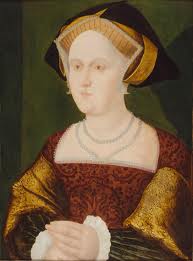
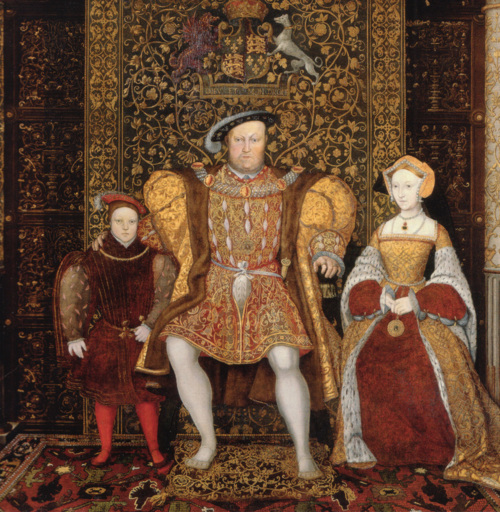
Path to St. Peter ad Vincula-Part VI-A

Path to St. Peter ad Vincula-Part VI-A

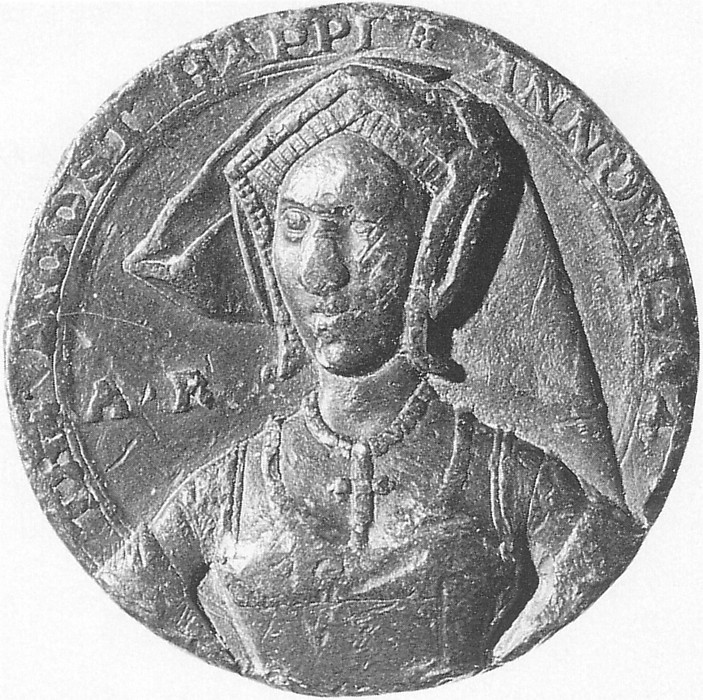
Anne Boleyn had reigned over Henry VIII and his Court as Queen for a relatively short time span considering the many years that built up to her coronation. What was even shorter was her fall. In less than half of a year she not only lost her position, she lost her head. Many factors have been attributed to the reason.
anneboleyn
Anne Boleyn

The international scene had altered. Charles V at the Imperial Court showed an       interest in treating with England thus weakening the traditional French alliance         —an alliance favored by Anne.

Henry blamed Anne for the failed embassy he had sent to Germany –at her             urging. It had cost him a great deal of money, was inconclusive and only                 managed to cause the German princes to doubt his faith (Stevenson 1329 to         1332).

The death of Queen Katherine of Aragon led Henry to consider that marriage to someone where there was no question of legitimacy would settle doubts and perhaps result in the birth of a male child. The King was apprehensive that, if he left no heir, upon his death civil wars would break out and the crown would be transferred again to the family of the White Rose (Stevenson 1303).

Anne had miscarried a son, which weakened her position. Chapuys filled in Charles V on April 29, 1536, on the fact that George Boleyn was disappointed because he had not achieved a Court favor as “the Concubine has not had sufficient influence to get it for her brother” (Gairdner X 752).

Henry was suspicious of Anne’s behavior. Alexander Alesius summarized Anne’s sins: she had danced with others and kissed her brother (like all women of England). The story of Anne dropping her handkerchief out of her window during the jousts at Greenwich so one of her suspected lovers could claim it is most likely false. Anne’s flirtatiousness is without quesiton and Henry came to “look on them as artifices to cover some other criminal affection. Her cheerfulness was not always governed with decency and discretion” (Burnet 109-110).

Henry was attracted to Jane Seymour. In April Ambassador Chapuys explained that advisors “continually counsel Mrs. Semel and other conspirators pour luy faire une venue,” and encouragement was given to the opposite party because “the King was already as sick and tired of the concubine as could be” (Gairdner X 752). As seen with Anne at the time of his marriage to Katherine, so ardent was Henry once he began to form an attachment, there was no let up. Also observed during both of these courtships, the King was “still inclined to pay his court to ladies” (de Gayangos V 43).

Various factions at Court (including the Catholics) were jostling for position. Steven Gunn wrote that the fall of Anne Boleyn “on one side stand the champions of a strong king, for whom the rhythms of politics and government were determined by Henry’s informed choice of ministers and policies. On the other stand the advocates of faction, for whom the king’s choice of policies and executants was determined by the victory of one pressure-group” (Davies 59).
Previously all factions were concerned over the influence Anne had on Henry. Now with the noticeable coldness in Henry’s relationship with her, the divisive groups at Court considered their options. Anne’s opponents, the “enemies of the Gospel, whose intention it was, along with her, to bury true religion in England” would perpetuate negative claims against Anne, who was famed for her pursuit of more evangelical doctrines (Stevenson 1303-15). Many believed the “difficulties abroad…the severity of the new laws and the rigour with which they were enforced, were held to be due altogether to Anne’s ascendency; and it was expected that with her downfall there would be a total change of policy, which would place England once more in a secure and prosperous condition” (Friedmann 256).

Anne was quickly losing support, even among Protestants. The Lancelot poem, written in London on 2 June 1536, expressed that Anne “had her way in all things; she could treat her friends according to her pleasure….” But she could not “secure to her lasting friendships, and the King daily cooled in his affection. Nevertheless she did not leave off her evil conversation, which at length brought her to shame” (Gairdner X 1036). “Having thus so many, so great factions at home and abroad set loose by the distorned favour of the king, and so few to show themselves for her… she and her friends therefore were suddenly sent to the Tower” (Cavendish II 209).

Oyer & Terminer
A divorce was out of the question, as it would imply that Henry’s conscience was aroused only upon convenience. He ended his marriage to Katherine of Aragon citing his breech with the teachings of Leviticus; now if he invoked the issue of consanguinity (based on his previous relationship with Anne’s sister) it would appear as if he entered the holy bonds of marriage carelessly. In addition, a divorced Anne would still be Marchioness of Pembroke— wealthy, influential and evangelical. Anne had to be disposed of in such a way that no one would be able, let alone willing, to defend her nor would she be able to defend herself.

Charles V learned that Henry, as Chapuys had “been for some days informed by good authority, was determined to abandon her; for there were witnesses testifying that a marriage passed nine years before had been made and fully consummated between her and the earl of Northumberland” (Gairdner X 782). The Ambassador’s informants told him that while Katherine of Aragon was alive, Henry “could not separate from the Concubine without tacitly confirming, not only the first marriage, but also, what he most fears, the authority of the Pope” (Gairdner X 782).
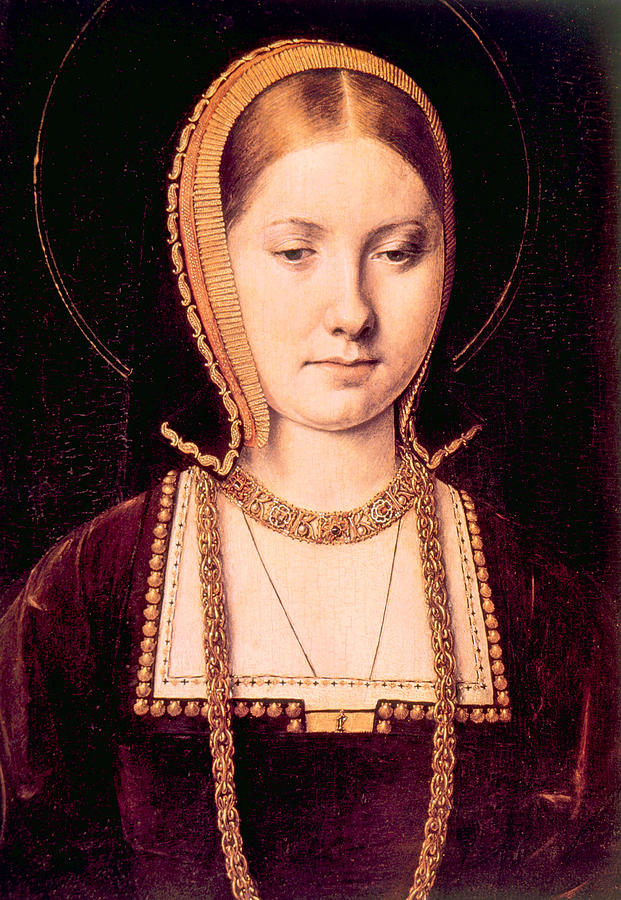
Katherine-of-aragon
Katherine of Aragon

“Thus Cromwell, as he afterwards told Chapuis, resolved to plot for the ruin of Anne” (Friedman 242). He said “it was he who had discovered and followed up the affair of the Concubine, in which he had taken a great deal of trouble… he had set himself to arrange the plot”(Gairdner X 1069). Cromwell was “resolved to destroy her” (Burnet 110). He wanted to get rid of Anne quickly and she needed to “be found guilty of such heinous offences that she would have no opportunity of avenging her wrongs” and the public’s focus on the crimes would take attention away “from the intrigue at the bottom of the scheme” (Friedmann 241-242). “Calamity was to be brought upon her, too, in a way that would satisfy the hatred with which she was regarded by the nation” (Friemann 242).

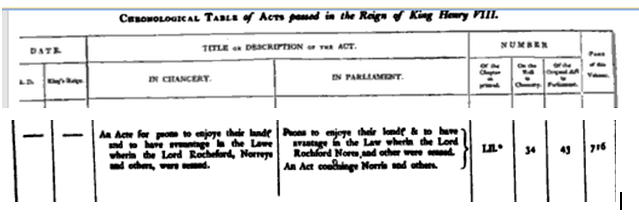
At Cromwell’s urging, while at Greenwich, Henry summoned a ‘commission of oyer and terminer’ April 24, 1536, to investigate treasonous offences committed by persons close to him, including Anne. Probably Henry was “only told by Cromwell that he was menaced by grave dangers, and that it would be necessary to appoint commissioners to hold special sessions at which offenders against him might be tried.” The commission consisted of “the Lord Chancellor Audeley, the Dukes of Norfolk and Suffolk, the Earl of Oxford, lord high chamberlain, the Earl of Westmoreland, the Earl of Wilshire, lord privy seal, the Earl of Sussex, Lord Sandys, chamberlain of the household, Sir Thomas Cromwell, chief secretary, Sir William Fitzwilliam, treasurer, Sir William Paulet, comptroller of the household, and the nine judges.” These men were “empowered to make inquiry as to every kind of treason, by whomsoever committed, and to hold a special session to try the offenders” (Friedmann II 243). Unusually, no specific crime was mentioned when the commission of oyer and terminer was formed.

Statutes of the Realmoyer

An Acte for persons to enjoye their lands and to have avauntage in the Lawe wherin the Lord Rocheford, Norreys and others, were seased.

Persons to enjoye their lands & to have avantage in the Law wherin the Lord Rochford Nores and other were seased. An Act _______conserninge Norris and others.

For references, please refer to the blog entry, Path to St. Peter ad Vincula-Part I

Path to St. Peter ad Vincula: Part V–A

Path to St. Peter ad Vincula:  Part V–A

Anne’s path to St. Peter ad Vincula involved political and religious reasons both on domestic and international levels.  This blog entry will deal with an issue that involved political and religious issues that were of a purely personal nature–her inability to provide Henry with a male heir.

Parliamentary members were obliged in 1533 to swear that the marriage between Henry VIII and Catherine of Aragon was invalid, the marriage of Henry and Anne Boleyn valid and “that Elizabeth was born in lawful wedlock, and heir to the crown” (Sander 110).  Henry was optimistic (and as equally adamant) that this would be a temporary solution.  He would have a legitimate male heir and that would be the responsibility of Anne Boleyn. 

 catherine aragon
Katherine of Aragon

Producing the son Henry required would not prove easy.  Considering the stress she was under, Anne surprisingly conceived soon after Elizabeth’s birth.  In a letter written from his Ambassador, Eustace Chapuys, Charles V heard as early as January 28, 1534,  that “Anne Boleyn is now pregnant and in condition to have more children” (Gairdner VII 114).  A month later on 26 February Chapuys reiterated that, while Henry was ironing out the succession between his daughters, he considered that “there was no other princess except his daughter Elizabeth, until he had a son which he thought would happen soon” (Gairdner VII  232).  George Tayllour [Taylor] wrote to Lady Lisle from Greenwich on 27 April 1534, that the “King and Queen are merry and in good health.  The Queen hath a goodly belly, praying our Lord to send us a prince” (Gairdner VII 556). 

Intriguingly, very little fanfare was made of Anne’s pregnancy in 1534. There are scant formal,diplomatic mentions of it—although on 7 July official instructions to George Boleyn, Lord Rochford, concerning the arrangements of a meeting between Anne and Marguerite, Queen of Navarre (while Henry would have been in France meeting King Francis) had to be “deferred, as the time would be very inconvenient to her….”  Anne would not be able to accompany Henry to France her “reasons are, that being so far gone with child, she could not cross the sea with the King, and she would be deprived of his Highness’s presence when it was most necessary” (Gairdner VII 958).  Later that month Chapuys still believed Anne to be pregnant as he mentioned again that meetings between Henry and Francis would have to be postponed because “those here say the reason is that the lady de Boulans (Anne Boleyn) wishes to be present, which is impossible on account of her condition” (Gairdner VII 1013). Were these references all to the same pregnancy?  January to July would encompass close to a full-term pregnancy yet no mention was made of a child being born and dying afterwards nor of any miscarriage.  Regardless, at least a single pregnancy had to have ended which was kept secret. 
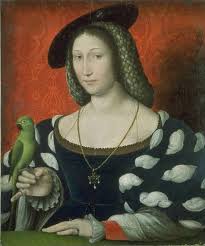
marguerite navarre
Marguerite, Queen of Navarre

What emerges is another comment made by Chapuys in September of 1534 that the King did “doubt whether his lady was enceinte or not” (Gairdner VII 1193). Interesting phraseology as Anne was not in a precarious position at this time.  Certainly, she was vulnerable but there were neither hints of her being replaced nor plots to discard her—until nearly a year and a half later.

On January 7, 1536, Katherine of Aragon died at Kimbolton Castle.  Upon the death of Katherine, “Queen Anne did not carry this so decently as became a happy rival” (Burnet 106).  Anne gave the messenger who brought the news of Katherine’s death to her at Greenwich a substantial reward.  Famously, Henry and Anne put on a show of exuberance dressing in yellow instead of mourning for Katherine’s death and parading Elizabeth triumphantly.  Although as Charles V was apprised by his ambassador in late January, “notwithstanding the joy shown by the concubine at the news of the good Queen’s death… she had frequently wept, fearing that they might do with her as with the good Queen” (Gairdner X 199). 

Anne could see that the international situation was now altered and the domestic scene was less idyllic.  Without Katherine to prompt familial ties in Charles V, he could now concentrate on his Italian campaigns and as seen in a previous blog entry Path to St. Peter ad Vincula-Part IV,  the ties of France and England had lessened. At home, Henry had set his sights on Jane Seymour and it would not have taken much for Anne to wonder if she too would be replaced in the king’s affections. What Anne had in her favor was her latest pregnancy.  Unlike the pregnancy of 1534, there is no prior mention of the one in 1536.  Anne would have been aware that the successful delivery of a male heir would certainly secure her position.  Unfortunately, that was not to be.

While participating in a joust, Henry’s horse took a fall in the tiltyard on January 24, 1536, and the king lost consciousness for several hours.  The entire Court feared for his life and, even though Henry made an astounding recovery, more proved at stake than his recuperation.  Shortly thereafter, on 29 January the day of Katherine’s funeral, “Queene Anne was brought a bedd and delivered of a man chield, as it was said, afore  her tyme, for she said that she had reckoned herself at that tyme but fifteen weekes gonne with chield; it was said she tooke a fright, for the King ranne that tyme at the ring and had a fall from his horse, but he had no hurt; and she tooke such a fright withal that it caused her to fall in travaile, and so was delivered afore her full tyme” (Wriothesley 33).  The “excitement of the last few days had told upon her health, which constant anxiety had been steadily undermining” (Friedmann 199). 

King Henry VIII armor
Armour made for King Henry VIII

Ambassador Chapuys wrote the details as known to him in a dispatch to Charles V on 10 February 1536.  Some discrepancy occurred in the interpretations of the cause but readers should not be alarmed at the term abortion, as it is the 16th century translation of the word miscarriage.

“On the day of the interment [the burial of Katherine of Aragon] the Concubine had an abortion which seemed to be a male child which she had not borne 3½ months, at which the King has shown great distress. The said concubine wished to lay the blame on the duke of Norfolk, whom she hates, saying he frightened her by bringing the news of the fall the King had six days before. But it is well known that is not the cause, for it was told her in a way that she should not be alarmed or attach much importance to it. Some think it was owing to her own incapacity to bear children, others to a fear that the King would treat her like the late Queen, especially considering the treatment shown to a lady of the Court, named Mistress Semel, to whom, as many say, he has lately made great presents.” Henry’s attention to Jane Seymour (Mistress Semel) led many people to “fear the King might take another wife” (Gairdner X 282).

Chapuys continued that Henry VIII divulged to “his most trusted servants …Lord and Lady Exeter” (Friedmann 202-203) that “in great confidence, and as it were in confession, that he had made this marriage, seduced by witchcraft, and for this reason he considered it null; and that this was evident because God did not permit them to have any male issue, and that he believed that he might take another wife, which he gave to understand that he had some wish to do” (Gairdner X 199).   

A couple of weeks later Ambassador Chapuys wrote about Anne’s reasoning for the loss of the child to Charles V.  “The said Concubine attributed the misfortune to two causes: first, the King’s fall; and, secondly, that the love she bore him was far greater than that of the late Queen, so that her heart broke when she saw that he loved others” (Gairdner X 351). A later report, much disputed, claimed that Anne could not keep from scolding Henry and exclaimed “See, how well I must be since the day I caught that abandoned woman Jane sitting on your knees” (Sander 132).
charles v older
Charles V, Holy Roman Emperor

Many at Court, especially the conservative faction considered that with “Queen Catharine being dead, the King might marry another, and be set right again with the Pope and the Emperor: and the issue by any other marriage would never be questioned; whereas, while Queen Anne lived, the ground of the controversy still remained, and her issue would be illegitimated, her marriage being null from the beginning, as they thought” (Burnet 109). Chapuys also believed the “King knew very well that his marriage to Anne could never be held as valid, for many reasons, …from another marriage, more legitimate than his last, the King might possibly have male issue” (de Gayangos V 43).

Continuing the theme of the legitimacy of Henry’s marriage to Anne, Chapuys wrote to Nicholas Granvelle (also known as Grenvelle), Chancellor to Charles V on 25 February 1536: “I am credibly informed that the Concubine, after her abortion, consoled her maids who wept, telling them it was for the best, because she would be the sooner with child again, and that the son she bore would not be doubtful like this one, which had been conceived during the life of the Queen; thereby acknowledging a doubt about the bastardy of her daughter” (Gairdner X 352). 

Would Anne have expressed herself in such a way as to question Elizabeth’s legitimacy?  It is hard to believe. 

One thing is sure, Anne believed she would have another child.  These sentiments were in direct contrast to those Chapuys wrote on 10 February 1536, to Chancellor Granvelle  “there are innumerable persons who consider that the concubine is unable to conceive, and say that the daughter said to be hers and the abortion the other day are supposititious” (Gairdner X 283). Rumors concerning the extremes of Anne’s behavior flew then and were maintained in the 1980s.  While traveling in England my husband and I were regaled with the story that Elizabeth was a changeling.  The story unfolded that the infant daughter that Anne gave birth to had died and fearing Henry’s wrath Anne found a substitute child of comparable age and coloring.  Unfortunately, the infant was a boy—and thus the reason Elizabeth never married.

The absurdity of the above story stands its own test, let alone the cruel irony that Anne desperately wanted a male child.  As Henry’s “new amours” continued toward Jane

“to the intense rage of the concubine” (Gairdner X 495).  ‘Les nouvelles amours de ce roy avec la demoyselle dont ait cydevant escript vont tousiours en avant a la grosse raige de la concubyne’ (Friedmann 202).  Chapuys wrote a fuller description of Jane to Granvelle’s son, Antoine Perronet, that he had no news “except to tell you something of the quality of the King’s new lady, which the Emperor and Granvelle would perhaps like to hear. She is sister of one Edward Semel, of middle stature and no great beauty, so fair that one would call her rather pale than otherwise” (Gairdner X 901).
Antonie Perrenot
Antoine Perronet, son of Chancellor Nicholas Granvelle

Apparently, Henry overlooked that Jane was not “a woman of great wit” and that “she inclines to be proud and haughty” (Gairdner X 901).  He seemed delighted that her temperament was “between the gravity of Queen Catharine, and the pleasantness of Queen Anne” (Burnet 109).  As for Jane’s virtue, it was opinioned by Perrenot that “although Henry necessarily affected to believe in her virtue, she was no better than the other young women of a coarse and dissolute court” (Friedmann 201). Ambassador Chapuys gave the opinion that Henry would make it a condition of the marriage that Jane be a virgin so “when he has a mind to divorce her he will find enough of witnesses” (Gairdner X 901).  Despite the contemporary beliefs of Jane’s uprightness, the King “was as well pleased with a decent appearance of virtue as with virtue itself” (Friedmann 201 – 202). 

Jane’s influence, therefore, increased, and the “whole party of Anne became seriously alarmed” (Friedmann 201 – 202). A gloating Sander reported that Anne faced a serious rival, “for the king began to grow weary of Anne” (Sander 132).  “The poor Queen used all possible arts to reinflame a dying affection; but the King was changed” (Burnet 109).

Not only was Henry growing weary of Anne, his “old conscience began to work again” (Pollard 343).  Contemporaries mentioned that Anne’s “miscarriage was thought to have made an ill impression on the King’s mind, who from thence concluded that this marriage was displeasing to God” (Wriorthesley 33).

Henry’s marked coldness to Anne was remarked upon by many contemporary sources; what varied was the degree of his ill-favor.  Chapuys learned “from several persons of Court” that Henry had “not spoken ten times to the Concubine, and that when she miscarried he scarcely said anything to her, except that he saw clearly that God did not wish to give him male children” (Gairdner X 351).  Henry went to her bedside “bewailing and complaining unto her the loss of his boy,”(Cavendish 208-209) and “gruffly told her that he now saw that God would not give him a son; then, rising to leave, he said harshly that when she recovered he would speak to her” (Friedmann 199).  From the time of the miscarriage “henceforth the harm still more increased, and he was then heard to say to her:  he would have no more boys by her” (Cavendish 209).

It is obvious to see that reports shifted from Henry declaring that God denied him male children to the conviction that he would have no sons by Anne.  These could be the result of translations committed after the fact, as history showed what eventually were Henry’s actions even if, at the end of January 1536, he was not set on the course of repudiating Anne.  Nicholas Sander claims Anne had an inkling as Henry greeted her after her miscarriage “by saying, ‘Be of good cheer, sweetheart, you will have no reason to complain of me again’and went away sorrowing” (Sander 132). The altered demeanor of the king towards Anne was generally remarked upon, and “held to bode no good to her” (Friedmann 203) and “was a great discompfort to all in this realm” (Wriothesley 33).
Anne Boleyn B necklace
Queen Anne Boleyn

The king was frustrated at Anne’s miscarriage and was maddened at her reprimands over his association with Jane Seymour.  That Anne was indiscrete and flirtatious with members of Court could be believed but her biggest mistake was not understanding the strength of Henry’s passion for Jane Seymour.  Years earlier it had been commented about Henry that “rather than miss or want any part of his will or appetite he would put the loss of one half of his kingdom in danger, and that he had often knelled before him the space of an hour or two to persuade him from his will and appetite, but could never bring to pass to dissuade him therefrom” (Cavendish 45).  Henry was used to getting his own way and not encountering much resistance.  Yet, thwarted he was in the incidence with the greatest meaning to him, the birth of a son.  

For References please refer to the blog entry Path to St. Peter ad Vincula–Part I

Path to St. Peter ad Vincula-Part IV

Path to St. Peter ad Vincula-Part IV

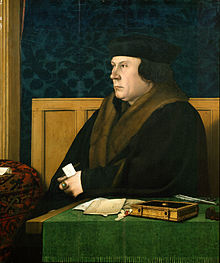
Thomas Cromwell and Thomas Cranmer were more pliable to Anne’s ideas and cause than Cardinal Wolsey.  Cromwell as Chief Minister pushed through Parliament several reform measures including the creation of the King as Head of the Church of England. Cranmer, appointed Archbishop of Canterbury after the death of William Warham, declared the end to Henry and Katherine’s marriage. The age of Wolsey was over.

thomas cromwell
Thomas Cromwell

Anne Boleyn owed a great deal to Thomas Cromwell. He put into effect his plan to frighten the clergy into submission and sever the English Church from Rome– but it was quite a time before it could be implemented. His plan he felt sure “could not of course fail to please Anne, to whom it held out a sure way of obtaining what she desired” (Friedmann 135-136).  At the Convocation of Canterbury in January 1531, under threat the clergy acknowledged Henry as “singular protector, supreme lord and even, so far as the law of Christ allows, supreme head of the English Church and clergy” (Haigh 108).  Added to the brilliance of the plan was the fact that the members of the Privy Council who “generally opposed the measures brought forward by Anne’s friends, willingly assented to a scheme which would weaken the influence of the bishops” (Friedmann 135-136).

Despite the capitulation of the Clergy, all was not smooth sailing for Henry and Anne.  By May 22, 1531, Eustace Chapuys, the Spanish Ambassador, reported to Charles V that “the clergy of York and Durham sent to the King a strong protestation against the supremacy which he pretends to have over them.  The King is greatly displeased, still more because one of his couriers coming from Rome has brought him news that his Ambassadors there are afraid that the Pope will definitively quash the process” (Gairdner 251).  This was “a serious defeat for Anne’s party.”  Legislation to force the clergy and Parliament to submit had to be abandoned as priests protested “against any encroachments on the liberty of the Church or any act derogatory to the authority of the Holy See” (Friedmann 142).  Resistance did not last and in 1534 Henry passed the Acts of Supremacy and of Succession.  Legally he was Head of the Church of England and his marriage to Katherine of Aragon was annulled and that of Anne legitimized along with any children from their union. All seemed to be going well;  Anne was Queen and the Protestant reform movement was gaining momentum.  What happened?

Anne encountered forces stronger than her influence on Henry.  She disagreed with the King over the dissolution of the monasteries, she clashed with Thomas Cromwell over international politics and Anne underestimated Henry’s frustration at not having a male heir, his attraction for Jane Seymour and the Court’s ability to use those domestic issues against her and the evangelical faction.

Henry VIII committed to improving the religious houses in England.  He sent agents out to track adherence to monastic orders’ rules and to account for the wealth of each. He ordered the Commission for the Valuation of Ecclesiastical Benefices stressing his right as Supreme Head of the Church, “Henricus Octavus, Dei gratia Agnlie et Francie Rex, Fidei Defensor, Dominus Hibernie et in terra Supremum Capud Anglicane Ecclesie, Reverendo in Christo patri J[ohanni] Episcopo Exoniensi ac dilectis et fidelbus suis Salutem” (Hall A Formula Book of English Official Historical Documents 63).

Henry VIII
Henry VIII –attributed to the circle of Holbein 1535-1541

Commissioners appointed by King Henry were to “examyn, serche and enquire, by all the ways and meanes that they can by their dyscrections, of and for the true and just hole and entire yerely values of all the manours, londes, tenements, hereditamentes, rentes, tythes, offerings, emoluments and all other profittes, as well spitrituall as temporall, apperteyninge or belonging to any Archebusshopriche, Busshoprich, Abbacye, Monasterie, Priorie, Archdeaconry, Deanry, Hospitall, College, Howse Collegyate … or any other benefice or promocion sprituall within the lymyttes of their Commyssion” (Hall A Formula Book of English Official Historical Documents 62).  Henry also wanted to know “in what manner the revenewes and profitts” were used (Leach ii).

Once the Valor Ecclesiasticus had been presented to Parliament on February 5, 1536, creating the dismay that Henry and Cromwell hoped it would, the Legislature quickly formulated and implemented new policy by mid-March. It certainly was easy to see what Henry’s main purpose was.  He needed money, a lot of it, having gone through the vast fortune his father had left him.  Confiscating the property of religious houses would provide that wealth.

The Act of the Dissolution of the Lesser Monasteries of 1536 (also known as The Suppression of Religious Houses Act), deemed the lesser monastic houses sinful and wasteful.  All the occupants were ordered to transfer to larger monasteries where they would be reformed to live more religiously.  It was proclaimed that Parliament finally revolved “that it is and shall be much more to the pleasure of Almighty God, and for the honour of this his realm, that the possessions of such religious houses, now being spent, spoiled, and wasted for increase maintenance of sin, should be used and converted to better uses.”  Parliament authorized “that his majesty shall have and enjoy to him and to his heirs for ever, all and singular such monasteries, priories, and other religious houses” the land, rent, chapels and all their property “with all their rights, profits, jurisdictions, and commodities, unto the King’s majesty, and to his heirs and assigns for ever, to do and use therewith his and their own wills, to the pleasure of Almighty God, and to honour and profit this realm….”  Not daring to leave anything behind, the Act of Suppression gave the rights for the “…King’s highness shall have and enjoy to his own proper use, all the ornaments, jewels, goods, chattels and debts, which appertained to any of the chief governors of the said monasteries” (“Act for the Dissolution of the Lesser Monasteries”).

Eustace Chapuys, Spanish Ambassador to Charles V wrote “The King and Council are busy setting officers for the provision and exaction of the revenues of the churches which are to be suppressed; which, it is said, will be in number above 300, and are expected to bring in a revenue of 120,000 ducats. The silver plate, chalices, and reliquaries, the church ornaments, bells, lead from the roofs, cattle, and furniture belonging to them, which will come to the King, will be of inestimable amount. All these lords are intent on having farms of the goods of the said churches, and already the dukes of Norfolk and Suffolk are largely provided with them. I am told that although Cromwell promoted in the first instance the demolition of the said churches, that nevertheless, seeing the dangers that might arise from it, he was anxious to prevent them, for which reason the King had been somewhat angry with him” (Gairdner X 601).

chapuys
Eustace Chapuys, Spanish Ambassador to England

The busy Ambassador wrote that same day, March 18, 1536, to his fellow Hapsburg statesman, Cardinal Antoine Perrenot de Granvelle (sometimes referred to as Granville or Grenville): “You will see by the letters I write to his Majesty, the gentle device of this King to extract money on pretext of charity by means of the offerings. If it succeeds, as no doubt it will, he will gain an immense sum of money, for he will impose a tax according to his will which everyone will have to offer, and not engage to do so for once but for all the other innumerable inventions that this King daily puts forward in order to get money, at which the people is terribly grieved and almost desperate, but no man dare complain ” (Gairdner X 495).  Contemporaries discussed Cranmer’s sermon which assured the people that the king would now gain so much treasure “that from that time he should have no need, nor put the people to … any charge for his or the realm’s affairs” (Heal 145).

The monasteries did need some reform. It was not unique to England and it was not so much against the religion as to the laxity that befell many religious houses.  Henry’s and Cromwell’s greed were not the sole motivators.  Local landed gentry also eagerly eyed the wealth of the lands of their neighbors.  Already indebted to each other, the monasteries and noble estates had been intertwined for years. Abbots had long been “giving up part of their revenues, in the form of pensions …to courtiers, in the hope of being allowed to retain the remainder” (Pollard 340).  But Henry had hit upon an enormous source of wealth in his position as Supreme Head of the Church of England. And perhaps, not beyond the one time infusion as Chapuys further opinioned that “the King will greatly increase his revenue” (Gairdner X 494).

Statute 575
 Transcription of the above Statute

“An Acte whereby all Relygeous Houses of Monks, Chanons, and Nonnes whiche may not dyspend Manors Lands  Tenants & Heredytaments above the clere yerly Value of ij C E are geven to the Kings Highness his heirs and Successours for ever.  The Byll for the suppressing of dy__ Places of Relygion” (“The Statutes of the Realm”)

Oddly enough Henry was not made astronomically wealthy–he needed to cover debts and he distributed much of the wealth to his nobles. Thus, the view must be that the dissolution’s intention was not to make Henry wealthy but to bribe the gentry to support Henry’s policies. Chapuys reported to Charles V that “the King will distribute among the gentlemen of the kingdom the greater part of the ecclesiastical revenues to gain their goodwill” (Gairdner VII 1141).  “The dissolution of the monasteries harmonised well with the secular principles of the predominant classes” (Pollard 342).

Whom it did not harmonize well with was Queen Anne Bolyen.

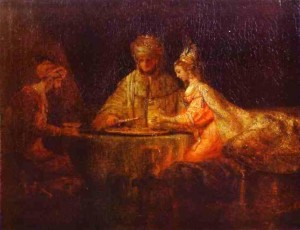
On Passion Sunday, April 2, 1536, John Skip, chaplain to Anne Boleyn, preached a sermon to the entire Court with his target “scarcely disguised” as Thomas Cromwell (Heal 142).  Taking his theme from Biblical text, he asked, Quis ex vobis arguet me de peccato? Which of you convinceth me of sin? (Newcombe).  The message of this incendiary sermon was to encourage Henry’s advisors to cease their greed and do what was right for the people, especially the poor. Skip altered the Esther Biblical story to stress “to courtiers and counselors alike to change the advice they were giving the king and to reject the lure of personal gain” (Ives 309).

Assuerus_Haman_a
Ahasuerus and Haman at the Feast of Esther by Rembrandt

Eric Ives in the text, The Life and Death of Anne Boleyn, supported by other historians, has analyzed Skip’s symbolism-laden sermon and has pointed out the correlation between this sermon and Anne’s disagreement with Cromwell over how the proceeds from the dissolution of the lesser monasteries should be used. Cranmer even ran afoul of Henry later by not consenting “that the king should have all the revenues of the monasteries which were suppressed, to his own sole use” (Dodd 21).  Many understood that Henry could have the lands to do with as he wished but that the wealth should be “bestowed on hospitals, schools, and other pious and charitable foundations” (Dodd 21).  It appeared to be common knowledge that Anne too wanted the money to be “devoted to furthering the cause of reform rather than filling the king’s coffers” (Newcombe).

It must be clarified that Anne was not against the monasteries being suppressed.  She disagreed with the King and Cromwell on how the funds should be distributed. She wanted to follow her inclinations by having the revenues assist the poor and help scholars, causes she was known to patronize.

George Wyatt praised Anne for making shirts and smocks for the poor, and remarking that her charity “passed through the whole land” and she gave “fifteen hundred pounds* at the least, yearly, to be bestowed on the poor” with another fourteen or fifteen thousand pounds** being given in alms and to support scholars (Cavendish II 207).
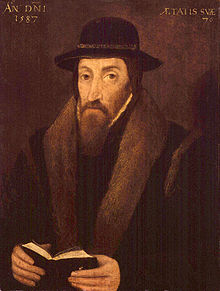
John Foxe commended Anne for “how bountiful she was to the poor, passing not only the common example of other queens, but also the revenues almost of her estate; insomuch that the alms which she gave in three quarters of a year, in distribution, …to the behalf of poor artificers and occupiers” (Foxe 232-234).
John_Foxe
John Foxe

The Scottish cleric, Alexander Alesius, referred to Anne Boleyn as ‘your most holy mother’ when writing to Elizabeth.  He clearly believed that Elizabeth’s “very pious mother” formed many enemies at Court for “her desire to promote the pure doctrine of the Gospel and her kindness to the poor” (Stevenson 1303-15).

Anne more than likely could not imagine that her preferences would be gainsaid. Her influence over Henry was well-known.  Even in the Privy-Council her impact could be felt.  Jean du Bellay, Bishop of Bayonne, the French Ambassador relayed a story that council member, Thomas Boleyn, “allowed everything to be said, and then came and suggested the complete opposite, defending his position without budging, as though he wanted to show me that he was not pleased that anyone should have failed to pay court to the lady [Anne], and also to make me accept that what he had said before is true, that is, that all the rest have no influence except what it pleases the lady to allow them, and that is gospel truth.  And because of this he wanted with words and deeds to beat down their opinions before my eyes” (Ives 126).

Yet, Anne was going to see more and more of her influence slip away. Not only was she not seeing eye-to-eye with Cromwell over the use of the monies gained from the dissolution of the monasteries, international politics also added a level of tension and discord.  Charles V now needed an alliance with England against France.

A long-time ally of Anne’s, Francis, King of France, was being replaced in Henry’s diplomatic play book with Charles V.  What emerged was the famously orchestrated meeting between Chapuys and Anne. On April 18, 1536, George Boleyn greeted the Ambassador who was invited by Henry via message to meet Anne and kiss her hand as she made her way to chapel.  Chapuys excused himself from that honor, as this was a bit much even though he knew that Henry’s move from favoring the French to the Imperial side was vital. Chapuys was in a difficult position as he was personally loyal to the late Queen Katherine and Princess Mary—more so than to the woman he referred to as “the concubine.”

The play unfolded as Anne acknowledged the Ambassador at chapel and he had to bow in return.  She asked after him specifically and made some anti-French remarks.  Henry swung the other way as he wanted his feigned pro-French stance to force the Imperial hand.  It was Cromwell’s turn to be in a bind.  If the Imperial acceptance of her was what negotiations hinged on, he needed to do something.  Cromwell cultivated his relationship with Chapuys.  Knowing that the Ambassador greatly disliked the Queen and would probably believe the words, Cromwell told the Ambassador that Anne “would like to see his [Cromwell’s] head cut off” and Chapuys could not forget this “for the love I bore him; and I could not but wish him a more gracious mistress, and one more grateful for the inestimable services he had done the King, and that he must beware of enraging her” and warned that Cromwell deserved better treatment “than did the Cardinal.” This illusion to Wolsey accompanied Chapuys’ veiled warning that he hoped that Cromwell’s greater “dexterity and prudence” would stand him well in his dealings with Anne (Gairdner X 601).
anneboleyn
Anne Boleyn 

It appeared as if Cromwell was working closely with Chapuys to further the relations between their two countries.  Chapuys wrote in April of 1536 to the Emperor that Cromwell had assured him that he was “very desirous of the preservation and increase of friendship of his master’s with Your Majesty, and is daily doing good offices in that respect—not only pointing out those measures which he considers most fit under the circumstances, but advising also of his own accord, and working for the accomplishment of our mutual wishes” (de Gayangos V 43).  At their meeting, Cromwell “replied five or six times, with great fervour, that it was a good beginning for the matter of the preservation of the amity of which we had so often talked, to which the King was more inclined than ever, and likewise those of his Council … and Cromwell assured me, on his life and honor, that the King had never treated anything in France, Germany, or elsewhere, to the prejudice of the friendship he has with your Majesty” (Gairdner X 601).

Domestically, Cromwell managed to upset both pro-French and pro-Imperial factions in England.  Internationally, events took a more favorable turn.  Charles V continued his overtures of friendship, the Pope became more inclined to treat with England, and Francis I became sidelined—all international events which weakened Anne’s position and nudged Cromwell to act.

Oddly enough, Cromwell’s station, his continued political position and his economic gains were because of Anne’s support.  Her influence over Henry could have swung the king’s favor to another councilor. Perhaps it was this precariousness or the rise of the more evangelical faction led by such young men as George Boleyn and Henry Norris or his own interest in intrigue or, most likely, a combination of reasons which led Cromwell to move against Anne.

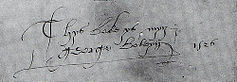
George_Boleyn_signature
George Boleyn’s signature

Cromwell assessed the situation and determined that it would be better if he “took the side of the conservative churchmen against those who had been hitherto considered Anne’s principal supporters” (Friedmann II 226). Cromwell knew that having “identified himself so closely with the measures against the Roman Church, he could not but fear that, if its authority were re-established, he would fare very badly at its hands”  (Friedmann II 55-56).

By March of 1536, Cromwell tried a more moderate approach with success as, surprisingly, those in opposition to Anne, by March of 1536, included fellow Protestants.  The more radical groups believed reform was not moving fast enough and the more moderate thought enough changes had been made.  Cromwell felt his position strengthened and the Secretary most likely saw the way Henry was treating Anne and his interest in Jane Seymour. Chapuys gleefully reported that “the Concubine and Cromwell were on bad terms, and that some new marriage for the King was spoken of” (Gairdner X 601).

In early 1536 Henry was certainly paying attention to Jane Seymour.  Chapuys remarked to his king that the “new amours of this King with the young lady…still go on, to the intense rage of the concubine” (Gairdner X 495).  It was suspected that the King “believed that he might take another wife, which he gave to understand that he had some wish to do” (Gairdner X 199).

jane holbien to use
Jane Seymour by Holbein 

At first it appeared to Chapuys that Henry was going to negotiate with France to obtain a French Princess and “was now thinking of a fresh marriage, that would, no doubt, be the way of preserving him (Cromwell) from many inconveniences, and likewise the best thing for the King to do” (de Gayangos V 43).  Chapuys certainly hoped that a new marriage for Henry would bring “peace, honour, and prosperity to England” and would provide Cromwell “another royal mistress, not out of hatred of Anne Boleyn, for she had never done me any harm, but for his own sake” (de Gayangos V 43).  Regardless of the rumors of a French alliance, Chapuys was assured by Cromwell shortly after he had written about his speculation of a French marriage, “that the King had already fixed on a wife, to wit Jane Semel” (Gairdner X 1069).  Anne Boleyn had less than a month to live.

Cromwell knowing many men of the Privy Chamber such as Nicholas Carew “never accepted the new Queen with any more grace than was needed to avoid their own ruin,” headed the move against Anne (MacCulloch 154). The Spanish Ambassador “monitored these events with increasing excitement, and probably acted as a go-between for the union of Cromwell’s plans and those of the conservatives” (MacCulloch 154). 

n carew
Nicholas Carew

Taking the religious issue to the domestic sphere, the conservatives and Cromwell exploited the King’s interest in Jane Seymour.  Chapuys wrote to the Imperial Court on 1 April 1536, that “certainly it appears to me that if it succeeds, it will be a great thing … to remedy the heresies here, of which the Concubine is the cause and principal nurse, and also to pluck the King from such an abominable and more than incestuous marriage” (Gairdner X 601).  By the middle of April when John Skip gave his sermon on Passion Sunday, it became obvious that rumors of intrigues “were beginning to fly around the Court” (MacCulloch 154). Skip showed great nerve by attacking Henry VIII and Jane Seymour using the analogy of King Solomon who blemished his own reputation by his “sensual and carnal aptitude in taking many wives and concubines” (MacCulloch 154).

Jane protected her own reputation evidenced by the famous story that Chapuys relayed.  Supposedly “some days ago, the King being here in London, and, the young Miss Seymour, to whom he is paying court at Greenwich, he sent her a purse full of sovereigns, together with a letter, and that the young damsel, after respectfully kissing the letter, returned it to the messenger without opening it, and then falling on her knees, begged the royal messenger to entreat the King in her name to consider that she was a well-born damsel, the daughter of good and honourable parents without blame or reproach of any kind; there was no treasure in this world that she valued as much as her honour, and on no account would she lose it, even if she were to die a thousand deaths. That if the King wished to make her a present of money, she requested him to reserve it for such a time as God would be pleased to send her some advantageous marriage” (de Gayangos V 43). 

Evidently, this episode, well-orchestrated by Jane and her advisors, had the following reaction by Henry.  The “King’s love and desire towards the said lady was wonderfully increased, and that he had said she had behaved most virtuously, and to show her that he only loved her honorably, he did not intend henceforth to speak with her except in presence of some of her kin; for which reason the King has caused Cromwell to remove from a chamber to which the King can go by certain galleries without being perceived, and has lodged there the eldest brother of the said lady [Edward Seymour] with his wife, in order to bring thither the same young lady, who has been well taught for the most part by those intimate with the King, who hate the concubine, that she must by no means comply with the King’s wishes except by way of marriage; in which she is quite firm” (Gairdner X 601).

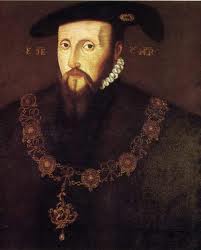
Seymour Edward
Edward Seymour

Intentions of a third marriage were already firmly believed by many at Court as early as January 1536.  A gleeful Chapuys imagined that Henry knew “how much his subjects abominate the marriage contracted with the concubine, and that not one considers it legitimate” (de Gayangos V 43).  Henry stated “in great confidence, and as it were in confession, that he had made this marriage, seduced by witchcraft, and for this reason he considered it null; and that this was evident because God did not permit them to have any male issue, and that he believed that he might take another wife, which he gave to understand that he had some wish to do” (Gairdner X 199).

Henry was very taken with Jane Seymour but realized he could not have a repeat scenario of a living divorced wife.  How actively involved was Henry in eliminating Anne and many of the leading evangelicals?  That is a difficult question to answer although Cromwell, according to Chapuys, took full credit as the person “who had discovered and followed up the affair of the Concubine, in which he had taken a great deal of trouble, and that, … he had set himself to arrange the plot (a fantasier et conspirer led affaire)” to protect the king (Gairdner 1069).  To protect and to please the king?

Surprisingly, Cromwell himself will be put to death by Henry.  Frustrated over the machinations that forced him to marry Anne of Cleeves, Henry was persuaded by Cromwell’s enemies to charge him with treason.  Years later, the Scottish cleric, Alexander Alesius wrote to Elizabeth Regina that Cromwell “was punished by the just judgment of God, because he had loved the King more than God; and that out of deference to his Sovereign he had caused many innocent persons to be put to death, not sparing your most holy mother, nor had he obeyed her directions in promoting the doctrine of the Gospel” (Stevenson I 51).  

Cromwell’s contemporary, Nicholas Shaxton, appointed Bishop of Salisbury at Anne’s urging–one of the clerics “who favoured the purer doctrine of the Gospel, and to whom she [Anne] had intrusted the care of it” (Stevenson I 15), wrote to Cromwell on May 23rd shortly after her death, “I beseech you, Sir, in vis[ceribus] Jesu Christi, that ye will now be no less diligent [in setting] forth the honour of God and his Holy Word, than [when] the late Queen was alive, and often incit[ed you thereto]” (Gairdner X 942). Interesting that a known evangelical saw the need to prod Cromwell to maintain the strides made in the name of reform.  It appears to this blogger that the reformers realized that Henry was too much a conservative at heart to continue the cause of evangelical dogma without the advocacy of Anne.  Cromwell was likely to be swayed in the direction of his king. 
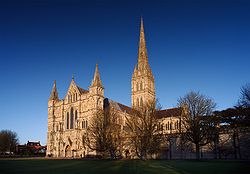
Salisburycathedra
Salisbury Cathedral 

Anne, identified as a “zealous defender of Christ’s gospel” would use her influence so that “her acts… will declare to the world’s end” her theological ideals (Foxe V 232-234).  At the time of her death, it was inconceivable that Anne’s most lasting influence on the Protestant faith would be in the form of her three-year old daughter, Elizabeth. 

Upon her acquisition of the throne, Alesius urged her to “guard herself from the snares of the devil, who were the cause of her mother’s death in consequence of her love for the doctrine of the Gospel while it was in its infancy, and afterwards persecuted those persons whom she appointed to watch over the Church” (Stevenson I 1303).

For References, please refer to the blog entry, Path to St. Peter ad Vincula-Part I

Lady Bryan: An Iron Hand in a Velvet Glove

Lady Bryan:  An Iron Hand in a Velvet Glove

Margaret, Lady Bryan, governess to the royal children of King Henry VIII, was born about 1468 in Benningborough, Yorkshire, England.  Her parents were Sir Humphrey Bourchier–who was killed fighting for Edward VI at the battle of Barnet (Wagner 180) and Elizabeth Tilney–related through the Plantagent line to Edward III.  Elizabeth Tilney remarried upon the death of Sir Humphrey to Thomas Howard, 2nd Duke of Norfolk.  She went on to have more children, notably the 3rd Duke who played a very prominent role in Tudor politics and Elizabeth Boleyn, mother to Queen Anne, thus making Margaret Bourchier a half-sister to Anne Boleyn’s mother.

Elizabeth_tylney
Detail of a stained glass window at Holy Trinity Church, Long Melford, Suffolk depicting Elizabeth Tilney

The pre-contract that had been arranged with John Sands in November of 1478, did not impede her marriage to Sir Thomas Bryan in 1487.  It is known the couple had four children of which, most sources agree, two reached adulthood, Sir Francis Bryan and Elizabeth.

Francis Bryan did not care for Anne Boleyn and would take a role in her downfall.  He was referred to as the ‘Vicar of Hell’ by both King Henry and Thomas Cromwell for his lack of principles.  He had a “reputation for liking rich clothing and for gambling.  He was a popular courtier, skilled hunter and ouster, and lost an eye in a joust in 1526” (Ridgway xv).  Sir Francis was a very close friend to King Henry VIII and held positions on the Privy Council until eventually he became Lord Chief Justice of Ireland where he died in 1550.

Elizabeth Bryan married Sir Nicholas Carew.  The King did not forget his obligation to his loyal servants’ daughter. Accounts record a dowry, “Receipt 7 Nov. 6 Hen. VIII., from Sir John Daunce, by Dame Margaret Bryan, wife of Sir Thomas Bryan, on behalf of Mistress Elizabeth Bryan, their daughter, of 550/. Given ‘to her marriage, which by God’s grace shall be espoused and wedded to Nicholas Carewe, son and heir apparent to Sir Richard Carewe, knight, before the feast of the Purification of Our Blessed Lady the Virgin” (Brewer I 3419). Nicholas Carew was in high favor with the king and on May 3, 1516, a further wedding gift was recorded : “For NICH. CARUE. squire of the Body, son and heir of Sir Ric, and for ELIZ his wife, daughter of Tho. Bryan, vice-chamberlain to Queen Katherine. Writ to the Barons of the Exchequer, to make over lands …to the annual value of 40 mks., in part payment of 50 mrks. as a marriage portion” (Brewer II 1850).
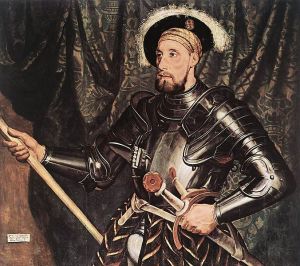
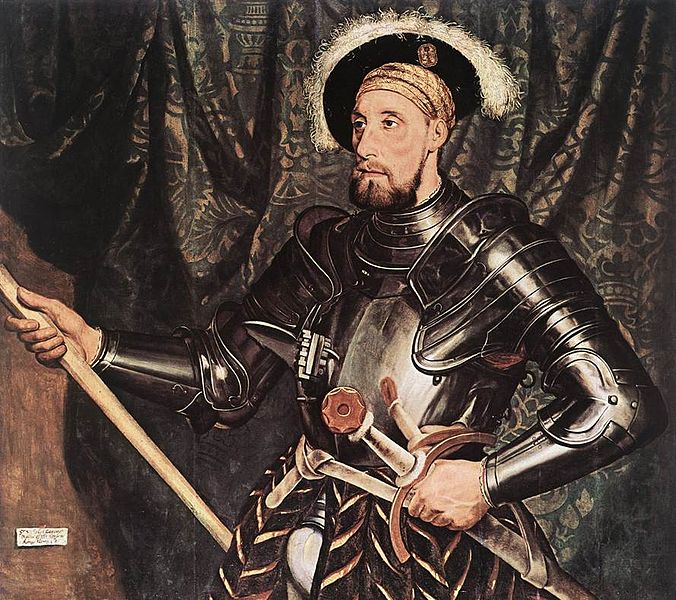
n carew
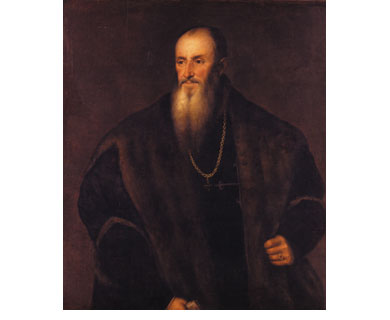
Sir Nicholas Carew by Hans Holbein, 1533

Sir Nicholas Carew, Master of the Horse, was very close to the king.  He had “at first been one of Anne’s partisans – they were cousins–but by 1532 she had alienated and angered him not only by her overbearing ways and her abuse of her position, but also by her unjust treatment of his friend, Charles Brandon, Duke of Suffolk, and his brother-in-law, Sir Henry Guildford” (Weir Lady in the Tower 33).  Carew was executed in 1539 for treasonous actions.  Because his assets and property were confiscated, he left his widow and children destitute. Obviously, her mother intervened and wrote from Hunsdon an imploring letter to Thomas Cromwell in 1539:  “My lord, I most humbly thank your good lordship for the great goodness you shew upon my poor daughter Carew, which bindeth me to owe you my true heart and faithful service while I live.  She sendeth me word that it is the king’s pleasure she shall have lands in Sussex, which is to the value of six score pounds, and somewhat above, which I heartily thank his grace and your lordship for” (Wood 112).  It appears that the land did not have a house so Lady Bryan was requesting more suitable property for the widow and “her heirs males” upon which receipt it would “comfort two troubled hearts; for, my lord, unfeignedly you have, and shall have our true prayers and hearty service during our lives.”  Lady Bryan wanted to assure Cromwell that she knew that putting her trust in him and the King was the best she could do for her daughter who is “so kind a child to me as she hath been, I cannot for pity do no less” (Wood 113-114).

ladycarew2_medium (1)
Tomb of Elizabeth Bryan Carew

Margaret Bryan had been a lady-in-waiting to Catherine of Aragon from the time she married Henry VIII in 1509; she also attended Catherine at her coronation and was later listed as a chamber woman (Brewer I 82).  Sir Thomas was a vice chamberlain to the Queen Catherine’s household until his death sometime before 1517. Perhaps her widowhood is the reason for the king’s taking measures to assist this loyal servant.  A ledger entry for November 19, 1517, was not very comforting to a servant named Elizabeth Denton, but it certainly was for Margaret Bryan. “Marg. Brian, lady mistress to the King’s daughter, the Princess states: Annuity of 40 marks for services to the Princess, during the life of Eliz. Denton, widow, who has the fee of lady mistress to the Princess, and on whose death Brian is to have her office and fee” (Brewer II 3802).

Well-placed, Lady Margaret became governess to Princess Mary and was rewarded by Henry with her own title when she was made Baroness Bryan suo jure.  It is known that she stayed with Mary for almost six years and prior to being relieved of her duties was given a pension.  On July 7, 1519, “Margaret Bryan, widow of Sir Thomas Bryan, and now wife of David Soche, annuity of 50/, for services to the King and queen Katharine, and one tun of Gascon wine; yearly, out of the wine received for the King’s use” (Brewer III 361). Still known as Lady Bryan, Margaret had married her final husband David Zouche sometime before July 1519.

margaret_bourchier
Lady Bryan, Margaret Bourchier

David Zouche is all but lost to history.  Some believe he died in 1526, others in 1536 shortly after Anne Boleyn was executed. Certainly, someone important to her died in the summer of 1536 as revealed in the beginning sentence of a letter Margaret wrote to Cromwell: “I beseech you to be good lord to me now in the greatest need that ever [was], for it hath pleased God to take from me hem (them) that was my most com[fort] in this world, to my great heaviness, Jesu have mercy on his soul, a[nd] I am succourless and as a redeless creature but for my great trust in the King and your good lordship” (Gairdner XI  203).

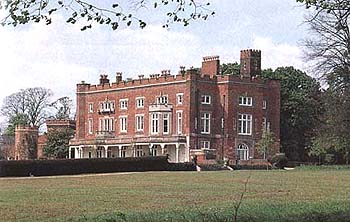
Lady Margaret’s exact role is not clear after she left Princess Mary.  Some speculate that she looked after Henry Fitzroy, the king’s illegitimate son.  She was granted a gift of plate in 1532 even though the Royal household may not have directly employed her at that time (Gairdner V 1711). When she was called upon to care for Elizabeth, Lady Bryan was over the age of 60.  Margaret took charge of Elizabeth at her birth and went on to setup her household at Hatfield three months later. On 2 December 1533, “The king’s highness hath appointed that the lady princess Elizabeth (almost three months old) shall be taken from hence towards Hatfield to remain with such household as the king’s highness has established for the same” (Strickland VI 6).  At Hatfield and Hunsdon is where the princess “spent much of her childhood although, like her parents, she traveled from house to house, staying in such places as Richmond, Eltham, Langley,and the More” (Warnicke 170).
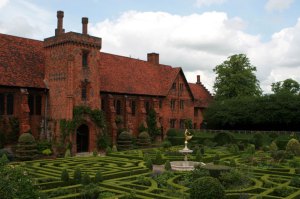
Hatfield_House_Old_Palace
 Hatfield

Much of what we know from the childhoods of Elizabeth and Edward come from the correspondence from Lady Bryan to Thomas Cromwell concerning the households of the children.  In a much quoted letter to Thomas Cromwell soon after Anne’s execution, Lady Bryan lays forth the difficulties of the child’s household with her change of status, her lack of clothing and her method of eating, all to be discussed further.

Held in such esteem by King Henry VIII when his treasured male heir was born in October of 1537, Lady Bryan was installed as his governess and Kat Ashley nee Champernowne took charge as Elizabeth’s. As conscientious with the Prince as she was with Elizabeth, Lady Bryan wrote to Cromwell appraising him of her charge.  A letter survives from 11 March 1539 in which young Edward is praised and touted; “Pleaseth your lordship to understand that, blessed be Jesu, my lord prince’s grace is in good health and merry, as would to God the king’s grace and your lordship had seen him yesternight; for his grace was marvelous pleasantly disposed.  The minstrels played, and his grace danced and played so wantonly that he could not stand still, and was as full of pretty toys as ever I saw a child in my life; as Master Chamberlain and my lady his wife can shew your lordship when they speak with you, whom I assure your lordship giveth as good and diligent attendance as is possible” (Wood 112).

It is unclear if Margaret relinquished her duties prior to Edward’s becoming king.  She was not forgotten as there is a mention of an annuity to her in January 1545. A ledger entry reads for “Lady Margaret Bryane, the King’s servant.  Annuity of 20/ from the Annunciation of Our Lady last.  Greenwich, 16 Jan. 36 Hen. VIII” (Gairdner XX 125).  Once Edward succeeded to the throne, Lady Bryan maintained her title, but lived away from court at her estates in Essex, “where she enjoyed a generous annuity of £70 per year” (Wagner 180).
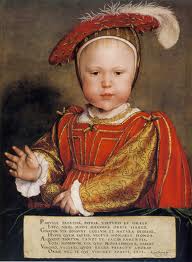
edward 6
Prince Edward by Hans Holbein, 1538

We do know Lady Bryan died in Leyton, a village in Essex; the year is a bit more elusive.  Various sources list her possible years of death as 1551, 1552, and 1554. One source confidently declared that Margaret “died in 1552, shortly before the proving of her will on 21 June” (Wagner 180).

When Anne Boleyn gave birth to Elizabeth in 1533, Margaret transferred her duties to become the governess of the newest royal baby.  Margaret held this post until Edward was born in 1537 when she moved to his household and Katherine Ashley took over duties with Princess Elizabeth.  Anne did not have much say in her child’s upbringing—that was for Henry and his council. When Lady Bryan thought Elizabeth should be weaned, she contacted Lord Cromwell and then he submitted the request to the Privy Council.

A response from Sir William Paulet, onetime Comptroller of the Royal Household and  Lord Chamberlain to Henry VIII,  to Thomas Cromwell on 9 October 1535 addressed the issue of Elizabeth’s weaning.  “The King having considered the letter to Cromwell from lady Brian and other of the Princess’s officers, has determined that she shall be weaned with all diligence” (Gairdner IX 568). Agnes Strickland gives us some sardonic imagery when she tells us that in order for Elizabeth to be weaned “the preliminaries for this important business were arranged between the officers of her household and the cabinet ministers of her august sire, with as much solemnity as if the fate of empires had been involved in the matter” (Strickland Life of Elizabeth 6).
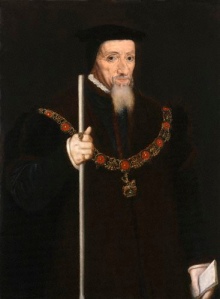
NPG 65,William Paulet, 1st Marquess of Winchester,by Unknown artist
Sir William Paulet

Having the charge of the royal children meant teaching them etiquette and proper manners—and displaying the children in the majesty expected. “Lady Bryan, who had brought Mary up until she was six, had been accustomed to treat her as the heiress to the throne for seventeen years. She must have been profoundly embarrassed when the girl was sent to share Elizabeth’s household with orders to ride behind the baby’s litter on progress and to cede the seat of honour even when the infant was still in the care of a wet-nurse” (Perry 19).  But as a stickler to her duty, it can be assumed she ensured the King’s wishes were fulfilled.

Chapuys, no friend of Elizabeth, shared with Charles V a meeting that took place on the Tuesday following Easter of 1534 between the French Ambassadors, La Pommeraye and Catillion and Elizabeth.  This visit was orchestrated to present Elizabeth as a fitting bride for a French prince and full-credit for its success went to Lady Bryan.  The Ambassadors “went to visit the King’s bastard daughter, who was brought out to them splendidly accoutred and dressed, and in princely state, with all the ceremonial her governess could think of”  (Gayangos V 40).

That Lady Bryan took this portion of her duties seriously was again shown in her letter to Cromwell.  It is speculated this letter was written in response to Lord Chancellor Thomas Audeley’s proposed visit to baby Prince Edward in 1537.  Lady Bryan wrote:

“My lord,
After my most bounden duty I humbly recommend me unto your good lordship; and shall accomplish it to the best of my power…. The best coat my lord prince’s grace hath is tinsel, and that he shall have on at that time; he hath never a good jewel to set on  his cap; howbeit I shall order all things for my lord’s honour the best I can, so as I trust the king’s grace shall be contented withal” (Wood 68-69).

Her affection seemed sincere for her royal charges and her pride in them too. She could not help but brag on Prince Edward, informing Cromwell, “I thank Jesu my lord prince’s grace is in good health and merry, and his grace hath four teeth; three full out, and the fourth appeareth” (Wood 69).
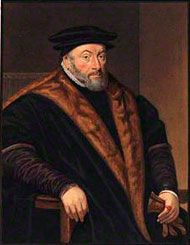
thomasaudley2
 Lord Chancellor, Thomas Audeley

“Much of the future greatness of Elizabeth may reasonably be attributed to the judicious training of her sensible and conscientious governess, combined with the salutary adversity, which deprived her of the pernicious pomp and luxury that had surrounded her cradle while she was treated as heiress of England” (Strickland VI 12).  Elizabeth was brought up calmly in the way that Lady Bryan thought best, shielded from the gossip and temptations of the adult world.  Lady Bryan no doubt shielded Princess Elizabeth as much as she could from the gossip surrounding her mother and the inevitable slander that began shortly after Anne’s death concerning the paternity of her daughter (Weir, The Lady in the Tower 316-317).

The king’s order for Elizabeth to remain in seclusion could have been his attempt to protect her as much as the theory that it was his unwillingness to face the child.  To read further on this topic visit the blog entry “Elizabeth:  Her Mother’s Memory” @elizregina.com.  This blogger believes that Agnes Strickland judged the Tudor Era with the mores of her own time period when she exclaimed that when “Elizabeth was branded with the stigma of illegitimacy; she was for a time exposed to the sort of neglect and contempt which is too often the lot of children to whom that reproach applies” (Strickland VI 9).  Henry VIII did not neglect his recognized illegitimate son, Henry FitzRoy, and perhaps he did not purposefully neglect Elizabeth in the summer of 1536.  He was embarking on a new life with his third wife, Jane Seymour, and was traveling the country.  We have seen how the final word of the organization of the children’s households rested with Henry.  His thoughts were on her to some degree so it could not be his indifference that led to the ‘crisis’ of her wardrobe and her household but perhaps more of benign neglect—administrative oversight.  That her position was diminished was obvious. “On 25 June 1536, an order reconstituted the households of Mary and Elizabeth.  It was certainly no coincidence, in that age when the number of servants in a household was a great status symbol, that Mary was given fourty-two servants, and Elizabeth thirty-two” (Ridley 26).  Below reprinted in chart form is the information from the 10th volume of Letters and Papers of Henry VIII concerning the structural changes made to the two households.

Personages appointed to attend on the lady Mary:—
Gentlewomen. Anne Morgan, Mrs. Finche, Frances Jerningham, Elizabeth Sydney.
Chamberers: Systile (Cecil ?) Barnes, Lucretia the Tumbler.
Gentlemen Ushers and Waiters: Richard Wilbraham, Robt. Chichester, Sir Ric. Baldwin, Walter Bridges, Thos. Burrows.
Wardrobe of Robes: Thos. Palmer, Nic. Newes.
Footman: Chas. Morley.
Laundress: Deachryche (Beatrice) Ap Rice.
Woodbearer: John Layton.
Keeper of Greyhounds: Christopher Bradley.
The Stable: Thos. Jene, yeoman; Ric. Hogg, Nic. Twydall, and Thos. Crabtree, grooms.
The names of persons attending upon lady Mary and lady Elizabeth:— i. On lady Mary:—
Gentlewomen: Susan Clarencyus, Frances Elmer, Mary Baynton Frances Baynan. “Chamberes:” Knyght, Syssele. Physician: Dr. Mychell. Gentlemen: Ant. Cotton, Wm. Chechester, Ric. Wylbram, Randale Dod, Sym Borton. Chaplain: Bauldewen. Yeoman: Geo. Mounge, David à Pryce, Chr. Wryght, John Conwey, Gray. Grooms of the Chamber: Thos. Borow, Walter Brydges, Thos. Palmer, Nic. Newes. Footman: Chas. Morley. Stable: Thos. Gent, yeoman; Thos. Bell, John Smith, and John Hyges, grooms. Laundress: Beatrice a Pryce. Woodbearer: William. Total, 42.
On lady Elizabeth:—
Ladies and gentlewomen: Lady Troy, Mrs. Chambrum, lady Garet, Eliz. Candysche, Mary Norice. “Chamberes:” Alys Huntercum, Jane Bradbelt. Gentlemen: Thos. Torrell, Robt. Porter, Ric. Sandes.Chaplain: Sir Rauffe. Grooms of the Chamber: Ric. Foster, Wm. Russell. Yeomen: David Morgan, Gabryell Tenant. Laundress: Agnes Hylton. Woodbearer: Christopher. Total, 32.
Personages appointed to attend on the lady Elizabethe, the Kinges doughter.”
Gentlewomen: Kateryne Chambernowne, Elizabethe Garret, Mary Hyll, Blanche ap Harrye.
Chamberers: Alice Huntercombe, Jane Bradbelt.
Gentlemen Ushers and Gentlemen Waiters: Rychard Sandes, Robert Power.
Chaplain: Sr Raffe Taylour.
Gromes of the Chambre: Willm. Man, John Acton.
Wardrobe of Robes: John Goughe, yeoman.
Lawndresse: Anne Hilton.
Woodberer: John Wyllycke
(Gairdner X 1187)

Lady Bryan’s letter to Thomas Cromwell in the summer of 1536, which was referred to earlier and has been recreated in full below, can be seen as a way to restore the prestige of and attention on Elizabeth’s household which was at Hunsdon. Cromwell’s response has not survived but Mistress Bryan’s concerns must have been addressed as there appears to be no further pleas on her part.  Her initial issue involved the altered status Elizabeth held.  Lady Bryan was searching for guidance when she wrote, “Now, as my lady Elizabeth is put from that degree she was in, and what degree she is at now I know not but by hearsay, I know not how to order her or myself, or her women or grooms” (Gairdner XI  203).
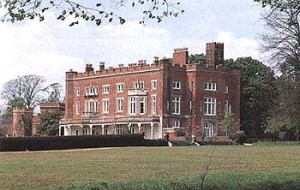
hunsdon
Hunsdon

Next up was the issue of Elizabeth’s wardrobe. It was up to “the lady mistress to make certain Elizabeth looked and acted like a king’s daughter, and proper clothes were essential to the role” (Erickson 37).  Margaret was beside herself as she begged Cromwell “to be good lord to her and hers, and that she may have raiment, for she has neither gown nor kirtle nor petticoat, nor linen foresmocks, nor kerchiefs, rails (night dresses), bodystychets (corsets), handkerchiefs, sleeves, mufflers, nor begins (night-caps).  All thys her Graces must take I have dreven off as long as I can, that, be my trothe, I cannot drive it no lenger. Besseeching you, my lord, that ye will see that her grace may have that which is needful for her, as my trust is that ye will do” (Gairdner XI  203).

The condition of Elizabeth’s wardrobe “reflected the general penury of the household” (Erickson 38).  Money must have been tight as the final concern that Lady Bryan has mixes the role of the steward, John Shelton, with the need for economy.  Shelton, who was responsible for keeping up the supplies of food, drink and other items necessary for the household, wrote to Cromwell shortly after Lady Bryan did to complain that he was “running short of money and ‘could not continue’ without more.”  This may not have been easy to acquire as the king’s Secretary Brian Tuke “had made it clear only a week earlier that he hoped Mr. Shelton would not be appealing for additional funds, as he had little or nothing to give him” (Erickson 38).
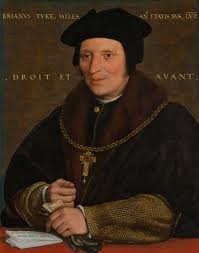
tuke
Sir Brian Tuke by Hans Holbein, 1527

Lady Bryan’s tactic was to explain the poor judgment on Shelton’s part– who, she lets us know, “saith he is master of this house. ‘What fashion that shal be I cannot tel, for I have not seen it afore.’” (Gairdner XI  203)–and offer a solution.  Apparently, Shelton “would have my lady Elizabeth to dine and sup every day at the board of estate.”  Margaret explains that this is not good for a child and “she will see divers meats, fruits, and wine, that it will be hard for me to refrain her from. ‘Ye know, my lord, there is no place of correction there; and she is too young to correct greatly.’ I beg she may have a good mess of meat to her own lodging, with a good dish or two” which would be enough to feed 11 of her personal attendants which in turn would be more economical as less people would have to be fed in the great hall (Gairdner XI  203).

One theory for Mr. Shelton,  a relative of Anne Boleyn, actions could be that he “wished to keep regal state as long as possible round the descendant of the Boleyns” and with “perhaps an eye to ingratiate himself with the infant, by indulging her by the gratification of her palate with mischievous dainties” (Strickland VI 11).  Or, as this blogger wonders, could it be a way for him and his associates to be served elaborate meals at the King’s expense.
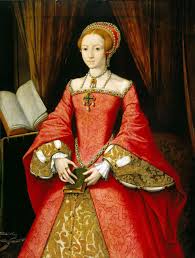
elizabeth 1 by scrouts
Princess Elizabeth

This letter, which gives us a peek into the politics of the household, ends with Margaret expressing sympathy for Elizabeth’s teething.  The governess realizes that witnessing the pain the child is in, “makes me give her her own way more than I would” yet excuses herself by assuring Cromwell that “she is as toward a child and as gentle of conditions as ever I knew any in my life….” Determined in her duties, Lady Bryan wanted to ensure that when the time came for Elizabeth to be “set abroad, I trust so to endeavour me that she shall so do as shall be to the King’s honour and hers…”(Gairdner XI  203).

Letter from Lady Margaret Bryan to Thomas Cromwell, June 1536
I beseech you to be good lord to me now in the greatest need that ever [was], for it hath pleased God to take from me hem (them) that was my most com[fort] in this world, to my great heaviness, Jesu have mercy on his soul, a[nd] I am succourless and as a redeless creature but for my great trust in the King and your good lordship. When your lordship was last here you bade me not mistrust the King or you, which gave me great comfort, and encourages me now to show you my poor mind. When my lady Mary was born the King appointed me lady Mistress, and made me a baroness; ‘And so I have been a governess to the children his Grace have had since.’

Now, as my lady Elizabeth is put from that degree she was in, and what degree she is at now I know not but by hearsay, I know not how to order her or myself, or her women or grooms. I beg you to be good lord to her and hers, and that she may have raiment, for she has neither gown nor kirtle nor petticoat, nor linen foresmocks, nor kerchiefs, rails (night dresses), bodystychets (corsets), handkerchiefs, sleeves, mufflers, nor begins (night-caps).  All thys her Graces must take I have dreven off as long as I can, that, be my trothe, I cannot drive it no lenger. Besseeching you, my lord, that ye will see that her grace may have that which is needful for her, as my trust is that ye will do.  Beseeching ye, mine own good lord, that I may know from you, by writing, how I shall order myself, and what is the king’s grace’s pleasure and yours; and that I shall do in everything?  And whatsomever it shall please the king’s grace or your lordship to command me at all time, I shall fulfil it to the best of my power.

Mr. Shelton saith he is master of this house. ‘What fashion that shal be I cannot tel, for I have not seen it afore.’ I trust to your lordship, who, as every man reports, loveth honour, to see this house honourably ordered,’ howsom ever it hath been aforetime.’ If the head of [the same] know what honor meaneth it will be the better ordered; if not, it will be hard to bring it to pass.

Mr. Shelton would have my lady Elizabeth to dine and sup every day at the board of estate. It is not meet for a child of her age to keep such rule. If she do, I dare not take it upon me to keep her Grace in health; for she will see divers meats, fruits, and wine, that it will be hard for me to refrain her from. ‘Ye know, my lord, there is no place of correction there; and she is too young to correct greatly.’  I know well and she be there, I shall neither bring her up t the king’s grace’s honour, nor hers, nor to her health, nor to my poor honesty.

I beg she may have a good mess of meat to her own lodging, with a good dish or two meet for her to eat of; and the reversion of the mess shall satisfy her women, a gentleman usher, and a groom; ‘which been eleven persons on her side.’ This will also be more economical.

God knoweth my lady hath great pain with her teeth, which come very slowly. This makes me give her her own way more than I would. ‘I trust to God and her teeth were well graft to have her Grace after another fashion than she is yet; so, as I trust, the King’s Grace shall have great comfort in her Grace. For she is as toward a child and as gentle of conditions as ever I knew any in my life, Jesu preserve her Grace. As for a day or two at a hey time or whansomever it shall please the King’s Grace to have her set abroad, I trust so to endeavour me that she shall so do as shall be to the King’s honour and hers; and then after to take her ease again. I think Mr. Shelton will not be content with this. He may not know it is my desire, but that it is the King’s pleasure and yours it should be so.’ From Hunsdon with the evil hand of your daily bede woman.
Apologies for her boldness in writing thus” (Gairdner XI  203).

References

Brewer, J. S. (editor). “Henry VIII: November 1514, 2-10.” Letters and Papers, Foreign and Domestic, Henry VIII, Volume 1: 1509-1514 (1920): 1431-1444. British History Online. Web. 06 July 2013.

Brewer, J. S. (editor). “Henry VIII: November 1517.” Letters and Papers, Foreign and Domestic, Henry VIII, Volume 2: 1515-1518 (1864): 1183-1198. British History Online. Web. 29 June 2013.

Brewer, J. S. (editor). “Henry VIII: July 1519, 1-15.” Letters and Papers, Foreign and Domestic, Henry VIII, Volume 3: 1519-1523 (1867): 121-136. British History Online. Web. 30 June 2013.

Erickson, Carolly. The First Elizabeth. New York: Summit Books. 1983. Print.

Gairdner, James. (editor). “Henry VIII: April 1534, 16-20.” Letters and Papers, Foreign and Domestic, Henry VIII, Volume 7: 1534 (1883): 199-210. British History Online. Web. 29 June 2013.

Gairdner, James (editor). “Henry VIII: February 1535, 11-20.” Letters and Papers, Foreign and Domestic, Henry VIII, Volume 8: January-July 1535 (1885): 75-98. British History Online. Web. 29 June 2013.

Gairdner, James (editor). “Henry VIII: October 1535, 6-10.” Letters and Papers, Foreign and Domestic, Henry VIII, Volume 9: August-December 1535 (1886): 181-195. British History Online. Web. 29 June 2013.

Gairdner, James (editor). “Henry VIII: Miscellaneous, 1536.” Letters and Papers, Foreign and Domestic, Henry VIII, Volume 10: January-June 1536 (1887): 531-537. British History Online. Web. 06 July 2013.

Gairdner, James (editor). “Henry VIII: August 1536, 16-20.” Letters and Papers, Foreign and Domestic, Henry VIII, Volume 11: July-December 1536 (1888): 130-138. British History Online. Web. 28 June 2013.

Gairdner, James (editor). “Henry VIII: June 1538, 26-30.” Letters and Papers, Foreign and Domestic, Henry VIII, Volume 13 Part 1: January-July 1538 (1892): 464-491. British History Online. Web. 06 July 2013. <

Gairdner, James and R. H. Brodie (editors). “Appendix.” Letters and Papers, Foreign and Domestic, Henry VIII, Volume 14 Part 2: August-December 1539 (1895): 359-372. British History Online. Web. 06 July 2013.

Gairdner, James and R. H. Brodie (editors). “Henry VIII: January 1545, 26-31.” Letters and Papers, Foreign and Domestic, Henry VIII, Volume 20 Part 1: January-July 1545 (1905): 38-59. British History Online. Web. 30 June 2013.

Gayangos, de Pascual (editor). “Spain: April 1534, 11-20.” Calendar of State Papers, Spain, Volume 5 Part 1: 1534-1535 (1886): 110-124. British History Online. Web. 07 July 2013.

Gristwood, Sarah.  Elizabeth & Leicester:  Power, Passion, Politics. New York:  Viking, 2007. Print.

Hibbert, Christopher.  The Virgin Queen: Elizabeth I, Genius of the Golden Age.  New York: Addison-Wesley Publishing Company, Inc., 1991.  Print.

Ives, Eric.  The Life and Death of Anne Boleyn: The Most Happy. Oxford: Blackwell Publishing, 2004. Print.

Neale, J. E. Queen Elizabeth I. Garden City, NY: Doubleday, 1957. Print.

Perry, Maria.  The Word of a Prince: A Life of Elizabeth from Contemporary Documents.  Woodbridge, Suffolk: The Boydell Press, 1990.  Print.

Ridgway, Claire.  The Fall of Anne Boleyn:  A Countdown.  UK:  MadeGlobal Publishing, 2012. Print.

Ridley, Jasper. Elizabeth I: The Shrewdness of Virtue.  New York: Fromm International Publishing Corporation, 1989.  Print.

Sander, Nicholas, and Edward Rishton. Rise and Growth of the Anglican Schism. Trans. David Lewis. London: Burns & Oates, 1877. Google Books. Web. 28 June 2013.

Somerset, Anne. Elizabeth I.  New York: Alfred A. Knopf, 1991. Print.

Starkey, David.  Elizabeth:  The Struggle for the Throne. New York:  HarperCollins Publishers. 2001. Print

Strickland, Agnes. The Life of Queen Elizabeth. London: J.M. Dent &, 1906. Google Books. Web. 3 June 2013.

Strickland, Agnes, Elisabeth Strickland, and Rosalie Kaufman. The Queens of England, Vol VI.  Chicago: Werner, 1895. Internet Archive. Web. 4 May 2013.

Wagner, John and Susan Walters Schmid. Encyclopedia of Tudor England. Santa Barbara, California: ABC-CLIO, 2012. Google Books. Web 29 June 2013.

Warnicke, Retha.  The Rise and Fall of Anne Boleyn: Family Politics at the Court of Henry VIII. Cambridge:  Cambridge University Press, 1989.  Print.

Weir, Alison. The Children of Henry VIII.  New York:  Ballantine Books, 1996. Print

Weir, Alison.  Henry VIII:  The King and His Court.  New York:  Ballatine Books, 2001. Google Books. Web. 30 June 2013.

Weir, Alison.  The Lady in the Tower:  The Fall of Anne Boleyn.  London:  Jonathan Cape, 2009.  Print.

Wood, Mary Anne Everett. Letters of Royal and Illustrious Ladies of Great Britain: From the Commencement of the Twelfth Century to the Close of the Reign of Queen Mary : Edited, Chiefly from the Originals in the State Paper Office, the Tower of London, the British Museum and Other State Archives. Vol. III. London: Henry. Colburn, 1846. Google Books. Web. 5 July 2013.

POST THIS ONE AFTER THE ELIZATH AND HER MOTHER SINCE NEED TO GET THE BLOG ADDRESS TO ADD IN HERE

Said it, Believed it, Lived it

Said it, Believed it, Lived it:  Mottoes of Elizabeth Regina

A motto is a short sentence or phrase used to formally summarize or encapsulate the beliefs, motivations, intentions or ideals of an individual, group or institution. Often the motto can become a rule by which someone lives her or his life.  Although a motto can be in any language, Latin is the one mostly used in the Western world.

William Camden, an Officer of Arms under Queen Elizabeth who wrote a history of her reign at the suggestion of Lord Burghley, William Cecil, has become an excellent source for emblems and heraldic arms of the Tudor era although he does not always quote the motto nor offer explanations (Daly 5).  Camden has given his ideal of a motto accompanying heraldry.  He assures us that the picture is the body “and the Motto, which as the soul giveth it life.  That is, the body must be of fair representation, and the word in some different language, witty, short, and answerable thereunto; neither too obscure, nor too plain, and most commended when it is an Hemistich, or parcel of a verse” (Camden Remaines 366-367).

henry8wiki.23
Coat of Arms of Henry VIII

An official definition of motto is as follows: “A sentence added to a device (Ital. –L) L. muttium, mutter, a grunt, a muttered sound; cf. mutire, muttire, to mutter, mumble” (Skeat 387).  Therefore, in heraldry, a motto is shown on a shield as part of a coat of arms.  In English heraldry in particular, the motto is not granted with the armorial bearings and can be changed. 

Members of Tudor upper society certainly embraced the custom of using mottoes and “subjects adopted them as expressions of loyalty” (Cannon 253).  Below are briefly the mottoes of Henry VIII, his wives and his children with expanded explanations on the mottoes of Elizabeth and her mother, Anne Boleyn to follow.

Tudor Mottoes                      

Henry VIII     Dieu et mon droit  —God and my right

Katherine of Aragon     Humble and loyal

Anne Boleyn     The Most Happy                                                                                                 
Jane Seymour     Bound to Obey and Serve

Anne of Cleves     God send me well to keep

Catherine Howard     Non aultrevolontè que le sinne  —No other will than his

Katherine Parr     To be useful in all I do

Edward VI     Dieu et mon droit  —God and my right
                      Modus et Ordo   —Method and Order

Mary I    Veritas filia temporis   —Truth, daughter of time

Elizabeth Regina     Semper Eadem  — Always the Same
                                   Video et taceo   —I see and say nothing

Royal British mottoes can be a bit confusing.  All Knights of the Garter may use the motto, Honi soit qui mal y pense, [Shamed be he who thinks evil of it] added to their heraldry.  Also, the sovereign will use, Dieu et mon droit, [God and my right] on a scroll beneath the shield of the royal coat of arms.  This motto has been attributed to Richard I Lionheart as a battle cry and has been used officially since the time of Henry V.  Obviously, this refers to the monarchs’ divine right to rule.

PTDC0001
Clock given to Anne Boleyn by Henry VIII at the time of their marriage.  The weights are engraved with the initials ‘H’ and ‘A’ and also the mottoes “Dieu et Mon Droit” and “The Most Happy”.

Alternatively, the Royal Arms may depict a monarch’s or consort’s personal motto and may appear on many buildings, possessions, documents, and in more modern times on products—those purveyors who have earned the Royal Warrant.  More on that topic in another blog entry.  Often its use is done for dynastic glorification as illustrated in the cup Henry VIII commissioned by Hans Holbein as a wedding gift to Jane Seymour.  Jane’s motto “Bound to obey and serve” is repeated on the lid and on the base.  The bridal pair’s initials adorned the cup. “Its submissive tone was fairly typical for queen consorts, but it also reflects Jane’s personality and helps explain why she was so attractive to Henry” (Doran Man & Monarch 189).

jane-seymour-s-cup
Cup designed by Hans Holbein for Jane Seymour with her motto on the lid and base

Reigning between queens with mottoes conveying humility and obedience-Katherine of Aragon’s “Humble and loyal” and Jane’s “Bound to obey and serve”-comes Anne Boleyn whose motto was the bold “The most happy”.  Anne adopted this motto as her coronation approached.  She had reason to be “the moost happi”: she had married a supportive and affectionate Henry, she was expecting his child (convinced it was the longed-for male heir), and she had managed to institute several religious changes in the country.

AnneBoleyn4
Anne Boleyn’s medal inscribed around with THE MOOST HAPPI ANNO 1534 and A.R. for Anne Regina next to her portrait

Although some sources attribute the motto “Me and mine” to Anne, this blogger never found true evidence of it.  One motto she adopted in 1530 before she was queen, Aisi sera groigne qui groigne meaning “Let them grumble; that is how it is going to be!” (Ives 141).  This motto had quite a story attached to it.

Paul Friedman was quoting Pascual de Gayangos’ Calendar of State Papers, Spain Vol. 4, Part 2, page 41, which stated that Anne, to show her “contempt for those who opposed her, chose a device which she had heard in France, but which she only partially remembered, Ainsi sera, groigne qui groign! was embroidered on the liveries of her servants” (Friedman 128).  Her arrogance and defiance did not last long.
To her mortification, and to Eustace Chapuys’ glee, she learned that she had “adopted the motto of her bitter enemies, the princes of the house of Burgundy.  ‘Groigne qui groigne’, she heard it repeated, “et vive Bourgoigne!’ The liveries had to be laid aside, and Anne’s servants on Christmas Day appeared in their old doublets” (Friedman 128).

Such a blatant alteration of an Imperialist motto was hardly the way to win supporters at Court and gain Anne acceptance as the replacement of a highly-respected Habsburg queen (Ives 142-143).

The Anne Boleyn Cup. This 16th century gilded silver goblet was given to Dr Richard  Masters by Anne Boleyn, and Dr Masters presented it to the church.
The Boleyn cup 1535-36 in St. John the Baptist Church in Cirencester with motto “The Most Happy.”  Elizabeth inherited this beautiful from her mother and in turn gave it to her physician Richard Master who presented it to the church.

Another motto, Semper eadem, [Always the same], was said to be used by Anne (Weir 324). This blogger could not find primary source evidence to support Anne’s use of this maxim. It was a well-known motto adopted by Anne’s daughter, Elizabeth, when she became queen.  This particular motto appears to be associated with the quality of constancy.  Elizabeth’s constancy can be shown in her willingness to maintain a steadfast government during the transition between her reign and her sister’s.  See the blog entry  https://elizregina.com/2013/04/09/reigned-with-your-loves/ for a list of Marian councilors retained by Elizabeth. Perhaps Elizabeth adopted it for simply sentimental reasons to form a link to her mother.  Another view of this motto reveals it to be a pledge that Elizabeth would not change her religious faith (Collinson 1549).

elizabeth_tudor_coat_of_arms
Coat of Arms of Elizabeth Regina with motto, Semper eadem.

With the childhood fraught with uncertainty and constant change perhaps this motto was a rule in which Elizabeth preferred to live.  It does imply an avoidance of any surprise, uncertainty or disruption.  Could a sovereign associated with such changes that supported exploration, encouraged the Arts and introduced religious reform prefer the status quo?

William Camden deemed Elizabeth’s main care upholding the Protestant faith and her “second care was, to hold an even course in her whole life, and all her actions: whereupon she tooke for her Motto, Semper eadem, that is, Alwayes the same.  The rest of her counsels consisted in these points” (Camden Annales 20). There is some disconnect between this motto and her well-known impulsiveness, indecision and secrecy.

shield motto
 Shield and motto of Queen Elizabeth I by Simon de Passe in the NPG Collection

NPG D42191; Queen Elizabeth I by Simon de Passe, after  Isaac Oliver
 Elizabeth I–obverse of shield and motto line engraving in the NPG collection

Elizabeth’s habit of covering her actions and motives was admired by Camden. When explaining her second motto, Camden discussed her methods “Which notwithstanding Queene Elizabeth dissembled and concealed with silence, according to that motto which she used, video et taceo, that is, I see and say nothing” (Camden Annales 307).

“I see and say nothing” has been termed a political motto used by Elizabeth.  With her impressive humanist education, this motto could be of ancient historical significance or it could be a practical methodology employed by Elizabeth.  No sources that this blogger has discovered definitively explain Elizabeth’s selection of this motto.  An examination of them suggests a link to the equation of Elizabeth’s style with Cicero’s, an acquired maxim from Lady Tyrwhitt, a reflection of her moderate religious policy or a connection to Francis Walsingham’s spy network. More recent authors have interpreted that the use of Elizabeth’s mottoes, Video et taceo, and Semper eadem “alludes to an important feature of prudence, which is that it encompasses the knowledge of when to speak and when to keep quiet” (Broad 34).

ART 246171
The Plimpton “Sieve” Portrait of Elizabeth  I, by George Gower, 1579.  The sieve alludes to the myth of Tuccia, a roman Vestal Virgin who proved her virginity and prudence by carrying water with a sieve.  The coat of arms and the motto in the top right Honi soit qui mal y pense / Semper eadem [Shamed be he who thinks evil of it / Always the same] are the motto of the Order of the Garter and the personal motto of Elizabeth Regina.

What does come to mind to this blogger is the ‘Rainbow’ portrait of Elizabeth with the eyes and ears embroidered on her gown.  The poet John Davies refers to the ears and eyes as how the Queen uses her servants for a sketch he wrote during the Queen’s visit to William Cecil’s house, Theobalds, in 1591.  When asked what use Elizabeth makes of her servants the reply was “She makes the same use of them as the mynde makes of the sences.  Many things she sees and heares through them; but the judgment and election is her owne” (Nichols 77).  Elizabeth clarified her right to rule and have good counsel early in her reign, “I shall desire you all, my lords, (chiefly you the nobility, everyone in his degree and power) to be assistant to me that I, with my ruling, and you with your service, may make a good account to Almighty God and leave some comfort to our posterity on earth.  I mean to direct all my actions by good advice and councel” (Marcus 52).  Through further research I discovered this idea of Elizabeth’s relationship with her advisors and her motto was further explored by Mary Thomas Crane.

Elizabeth_I_Rainbow_Portrait
The “Rainbow” portrait attributed to Marcus Gheeraerts the Younger, 1600-1603.

Professor Crane begins her article “Although one of her mottoes, ‘semper eadem,’ seems to claim a fundamental unity of character, Queen Elizabeth I nevertheless presents us with an array of poses and personae” (Crane 1).  How true.  Students of Elizabeth Regina are familiar with her paradoxically presenting an image of absolute patriarchal power and one of a ‘weak and feeble woman’. How did Elizabeth maneuver within the Privy Council composed of men whose views were the by-products of a time period when authority and advice-giving were the realm of males?  This was an era that considered “Kings were creatures defined by ancient custom; but queens, however loved and admired, were unpredictable” (Loades 318).

The use of the term ‘video’ assures that Elizabeth will listen and evaluate the advice to make up her own mind, as opposed to ‘audio’ that implies she will “accept blindly her advisors’ spoken counsel” (Crane 2).  In an era when women were to remain silent and obedient, ‘taceo’ insinuates that “as queen, she will maintain the silence thought suitable for a woman …” (Crane 2).  The motto encapsulates the fine line Elizabeth struck between asserting her authority and accepting advice from her Council.

She could be silent and allow her statesmen such as Burghley the role of respected advisor and she could be vocal and affirm her authority.  Crane sees Elizabeth’s motto, Video et taceo, as more of the way she uses the political system and her “use of the paradigm of advice-giving reveals a woman who was less completely bound by male structures than some critics have argued” (Crane 2).  Elizabeth “despite her motto, did not always remain silent….  Her skillful use of the humanist rhetoric of authoritative counsel allowed her to break silence and speak the language of authority as a uniquely powerful woman in a man’s world” (Crane 12).

One can suppose she did not believe her own contradiction to her motto when she  teasingly responded to the French Ambassador after he had praised her linguistic skills,  “There is no marvel in a woman learning to speak, but there would be in teaching her to hold her tongue.”

References

Allison, Ronald and Sarah Riddell, editors. The Royal Encyclopedia. London: Macmillian Press, 1991. Print.

“Arms of Tudors; Arms of Henry VIII; Arms of Edward VI.” Victoria and Albert Museum Collections. Victoria and Albert Museum, n.d. Web. 17 June 2013.

Broad, Jacqueline and Karen Green. Virtue, Liberty, and Toleration: Political Ideas of European Women, 1400-1800.  Dordrecht, The Netherlands: Springer, 2007. Google Books. Web 21 Jun 2013.

Camden, William, Robert Norton, Nicholas Hillard, and Francis Delaram. Annales or the History of the Most Renowned and Victorious Princesse Elizabeth Late Queen of England, Containing All the Important and Remarkable Passages of State, Both at Home and Abroad, during Her Long Ans Prosperous Reigne. Trans. R. N. Gent. 3rd ed. London: Harper, 1635. Google Books. Web. 21 June 2013.

Camden, William. Remaines concerning Brittaine: But Especially England, and the Inhabitants Thereof: Their Languages, Names, Syrnames, Allusions, Anagrammes, Armories, Moneys, Empresses, Apparell, Artillerie, Wise Speeches, Prouerbes, Poesies, Epitaphs. London,: Simon Waterson, 1605. Google Books. Web. 21 June 2013.

Cannon, John and Ralph Griffiths. The Oxford Illustrated History of the British Monarchy.  Oxford:  Oxford University Press, 1988. Print.

Collinson, Patrick. Elizabeth I. Oxford: Oxford University Press, 2007. Google Books. Web. 16 June 2013.

Crane, Mary Thomas. “Video Et Taceo”: Elizabeth I and the Rhetoric of Counsel.” Studies in English Literature 1500-1900 28.1 (1988): 1-15. GeoCities, 2001. Web. 20 June 2013.

Daly, Peter, Leslie Duer, Anthony Raspa. The English emblem tradition. Toronto: University of Toronto Press, 1998. Google Books. Web. 21 June 2013.

“Death Could Not Separate Them: How Elizabeth I Connected to Her Deceased Mother.” Web log comment. Being Bess. Ed. Ashlie Jensen. N.p., 5 Aug. 2012. Web. 20 June 2013.

Doran, Susan.  Henry VIII:  Man & Monarch. London:  British Library, 2009. Print.

Doran, Susan.  The Tudor Chronicles 1485-1603.  New York:  Metro Books, 2008. Print.

Eakins, Laura. “Elizabeth I’s other motto.” TudorHistory. Google+Page, 20 Feb. 2012. Web. 17 June 2013.

Eakins, Laura. “Meaning of Anne Boleyn’s motto.” TudorHistory. Google+Page, 31 Dec. 2009. Web. 19 June 2013.

Friedmann, Paul.  Anne Boleyn: A Chapter of English History 1527-1536. London: Macmillian and Co., 1884. Internet Archive. Web. 21 Jun 2013.

de Gayangos, Pascual (editor). “Spain: January 1531, 21-31.” Calendar of State Papers, Spain, Volume 4 Part 2: 1531-1533 (1882): 31-47. British History Online. Web. 22 June 2013. 

Isaacs, Alan and Jennifer Monk, editors.  The Illustrated Dictionary of British Heritage.  London:  Promotional reprint Company, 1993. Print.

Skeat, Walter W. An etymological dictionary of the English language. Oxford: Clarendon Press, 1993. Print.

Ives, Eric.  The Life and Death of Anne Boleyn: The Most Happy. Oxford: Blackwell Publishing, 2004. Print.

Loades, D. M. Elizabeth I. London: Palgrave Macmillilan, 2003. Google Books. Web. 16 June 2013.

Lloyd, Christopher and Simon Thurley. Henry VIII:  Images of a Tudor King.  London: Phaidon Press Limited, 1990.  Print.

“Medallion:  Arms of Henry VIII and Jane Seymour” Victoria and Albert Museum Collections. Victoria and Albert Museum, n.d. Web. 17 June 2013. 

Nichols, John. The Progresses and Public Processions of Queen Elizabeth. Among Which Are Interspersed Other Solemnities, Public Expenditures, and Remarkable Events during the Reign of That Illustrious Princess. Collected from Original MSS., Scarce Pamphlets, Corporation Records, Parochial Registers, &c., &c.: Illustrated with Historical Notes. New York: B. Franklin, Vol 3, 1823. Google Books. Web. 19 Jan. 2013.

Ross, Josephine.  The Tudors, England’s Golden Age.  London: Artus, 1994.  Print. 

Starkey, David.  Henry VIII:  A European Court in England. New York:  Cross River Press, 1991. Print.

Strong, Roy C. Gloriana: The Portraits of Queen Elizabeth I. London: Pimlico, 2003. Print.

Wagner, John. Historical Dictionary of the Elizabethan World: Britain, Ireland, Europe, and America.  New York:  Checkmark Books, 2002. Print.

Warnicke, Retha.  The Rise and Fall of Anne Boleyn: Family Politics at the Court of Henry VIII. Cambridge:  Cambridge University Press, 1989.  Print.

The Third Step-Mother to Elizabeth, Catherine Howard

The Third Step-Mother to Elizabeth, Catherine Howard

Henry was infatuated with Catherine Howard.  At Oatlands the two were married on July 28 a couple of weeks after Henry’s marriage to Anne of Cleves was dissolved. The King kept it a secret for many days because he wanted to enjoy his bride before Court etiquette interfered.

He showered his young bride with gifts, gowns, jewels, anything she wanted and did any act which would show his affection.  Henry granted Catherine all the lands that had been Queen Jane’s and even had a gold half-crown coin minted to commemorate his marriage to this perfection of womanhood with Henricus VIII, Rutilans rosa sine spina; “Henry VIII, the shining rose without a thorn” (Dye 771).  Henry also granted her political protection by passing through parliament the Queen Consort Act of 1540.  This legislation allowed the Queen to “act as a woman sole, without the consent of the King’s Highness” (Weir 436).  Perhaps Henry felt safe in her devotion as Catherine adopted as her device, Non aultre volontè que le sinne; “No other will than his.”

coinrosaspina2
Gold Crown Coin with Henricus VIII, Rutilans rosa sine spina —the reverse the crown shield of the royal coat of arms.  

Many observers did not think he showed such generosity or affection to his other wives.  The French Ambassador, Charles de Marillac reported in early September that the “King is so amourous of her that he cannot treat her well enough and caresses her more than he did the others”  (Gairdner XVI 5).

The new queen was still a teenager.  Most historians calculate that she was about 15 when 49-year-old Henry married her.  Physically, Charles de Marillac described Catherine as “rather graceful than beautiful, of short stature, etc.” (Gairdner XVI 5).

Catherine howared02        catherine howard3
Miniature by Hans Holbein                 After Hans Holbein

Was Catherine, personality-wise, a “frivolous, empty-headed young girl who cared for little else but dancing and pretty clothes” (Weir 434)?  Was she simply captivating, pleasant and kind-hearted enough to want everyone to be happy?  Perhaps she did let things go to her head and recklessness took center-stage but one could not call her scheming, “lewd, sly, pitiable” (Sitwell 53).  It does appear as if Catherine was charming, sensual and obedient–a great combination for Henry.

Catherine Howard / Elizabeth Seymour
Also attributed to Hans Holbein

Not only was Henry delighted with his new bride, Elizabeth, Catherine’s seven-year-old stepdaughter, was too.  When Catherine was publicly acknowledged by Henry as his queen, “she directed that the princess Elizabeth should be placed opposite to her at table, because she was of her own blood and lineage.”  At all the public engagements which continued to celebrate the marriage, Catherine “gave the lady Elizabeth the place of honour nearest to her own person” because, according to Gregorio Leti, “that she [Elizabeth] was her cousin” (Strickland Lives of the Queens of England, from the Norman Conquest 15-16).  Elizabeth Boleyn, Anne’s mother, was a sister to Edmund Howard, Catherine’s father (and to Thomas Howard, Third Duke of Norfolk), so they were first cousins.  Elizabeth Regina would technically have been Catherine’s first cousin once removed.

thomas howard norfolk
Thomas Howard, Duke of Norfolk

Catherine did not only favor Elizabeth when they were residing in the same palaces, she made a point for the two of them to meet.  Based on account records from the Master of the Barge, it has been shown that on 5 May 1541 Catherine arranged that Elizabeth would be taken from Suffolk Place to Chelsea where she, Catherine joined her on 6 May (Gairdner XVI 391). 

Besides the attention Catherine showed her youngest step-daughter she also gave her presents of jewelry as shown in November of 1541.  Records show that she gave a jewel “to lady Elizabeth, the King’s daughter, being …of little thing worth.”  Regardless of the value, it was a kind gesture as when Catherine had “23 pairs of beads minutely described, with crosses, pillars, and tassels attached. One is marked as given by the Queen to lady Elizabeth, the King’s daughter” (Gairdner XVI 686).

Catherine Howard’s fall came after John Lascelles revealed to Archbishop Cranmer the Queen’s sexual activity during her years at the Dowager Duchess of Norfolk’s estate. The Dowager was Catherine’s step-grandmother.  Like all children of aristocratic families, Catherine and her eleven siblings, were sent to other households at young ages.  Included in the Norfolk household was Lascelles’ sister, Mary Hall, who knew of the goings on in the maid’s dormitory.  Many of the young women ‘entertained’ men after hours and Catherine was one of them.  She was about 13 at the time and had a physical relationship with Francis Dereham–after earlier being involved with her music teacher, Henry Manox.

Cranmer took the information very seriously.  Political, religious and social motivations were all involved here as Catherine was a conservative and Lascelles and Cranmer were Protestants.  Cranmer began a full investigation which led to allegations of Catherine’s being intimate with Thomas Culpeper, a member of the king’s privy chamber, after her marriage to Henry.

Thomas_Cranmer
Archbishop of Canterbury Thomas Cranmer

Under interrogation (read that as some type of torture most likely), Culpeper admitted to being in love with Catherine, that she had rebuffed him at first then grew to love him.  Culpeper “persisted in denying his guilt and said it was the Queen who, through lady Rocheford, solicited him to meet her in private in Lincolnshire, when she herself told him that she was dying for his love” (Gairdner XVI 651-652).  The prisoner said that although they spent time alone and in private, they never committed adultery.  This did not matter.  The Council felt there was enough evidence:  Jane Boleyn, Lady Rochford, Catherine’s Lady-in-Waiting, professed to have helped them arrange their meetings and implied she guessed there was a physical relationship between them (Her cooperation did not save her. Rochford was executed as an accomplice.) and, most importantly, a letter from Catherine found in Culpeper’s belongings.  The letter is reproduced below.

jane parkerboylen
Jane Parker Boleyn, Lady Rochford

Master Coulpeper, I hertely recomend me unto youe praying you to 
sende me worde how that you doo. Yt was showed me that you was
sike, the wyche thynge trobled me very muche tell suche tyme that I
here from you praying you to send me worde how that you do.
For I never longed so muche for [a] thynge as I do to se you and
to speke wyth you, the wyche I trust shal be shortely now, the
wyche dothe comforthe me verie much whan I thynk of ett and
wan I thynke agan that you shall departe from me agayne
ytt makes my harte to dye to thynke what fortune I have
that I cannot be always yn your company. Y[e]t my trust ys
allway in you that you wolbe as you have promysed me
and in that hope I truste upon styll, prayng you than that
you wyll com whan my lade Rochforthe ys here, for then
I shalbe beste at leaysoure to be at your commarendmant.
Thaynkyng you for that you have promysed me to be so
good unto that pore felowe my man, whyche is on of the
grefes that I do felle to departe from hym for than I do
know noone that I dare truste to sende to you and therfor
I pray you take hym to be wyth you that I may sumtym
here from you one thynge. I pray you to gyve me a horse
for my man for I hyd muche a do to gat one and
thefer I pray sende me one by hym and yn so doying I
am as I sade afor, and thus I take my leve of you
trusting to se you s[h]orttele agane and I wode you was
wythe me now that yoo maitte se what pane I take
yn wryte[n]g to you.

Yours as long as
lyffe endures
Katheryn

One thyng I had forgotten and that hys to instruct my man to tare here wyt[h] me still, for he sas wat so mever you bed hym he wel do et and […]

When the King was notified of the accusations by a document left for him in his church pew, his anger knew no bounds.  He supposedly called for a sword to slay her himself as she would never have “such delight in her inconstancy as she would have torture in her death” (Hibbert 23).

Catherine was arrested at Hampton Court and moved shortly afterwards to Syon House.  She was there until February 11, 1542, when she was taken by barge to the Tower of London.  On Sunday the 12th she was told to prepare herself for death.  In a dispatch to his king, Chapuys conveyed that “she asked to have the block brought in to her, that she might know how to place herself; which was done, and she made trial of it.”  On February 1542, Marillac reported, she was beheaded on Tower Green by axe “after the manner of the country. The Queen was so weak that she could hardly speak, but confessed in few words that she had merited a hundred deaths for so offending the King who had so graciously treated her” (Gairdner XVI 44).  Chapuys let Charles V know that Catherine was executed “in the same spot where Anne Boleyn had been executed. Her body was then covered [with a black cloak] and her ladies took it away” (Gairdner XVII 51).

syon remnant gothic
Gothic ornamentation remnant from  Syon

No records survive of Elizabeth’s reactions to the sudden loss of any of her step-mothers.  Elizabeth was too young to be greatly affected by the death of Jane Seymour and her only living step-mother, Anne of Cleves, she still had contact with.  What impact would it have had on Elizabeth?  Could we go as far as Anne Somerset working from the text of Larissa J. Taylor-Smither’s article, “Elizabeth I: A Psychological Profile” to say that the “shock of Catherine Howard’s execution (when Elizabeth was at the impressionable age of eight) would have been more immediate, for even if Elizabeth had not been especially close to her young stepmother, Catherine’s sudden extinction must at the very least have had a powerful effect on her subconscious” (Somerset 96).  With no recorded evidence of Elizabeth’s reaction, nor any evidence of altered personality traits or behavior, this blogger thinks it is best to refrain from any such speculation.  

Henry’s reaction to Catherine’s death was made clear. Shortly after her execution, Chapuys wrote that the King has been in better spirits and during the last three days before Lent there has been much feasting (Gairdner XVII 51).  Henry found himself in an unusual position—that of widower.  Anne Boleyn’s death occurred after he had dissolved their marriage so this was the first time he was widowed.

Chapuys, the Spanish Ambassador, reported to his Imperial colleague, Nicolas Granvelle, that Henry “felt the case of the Queen, his wife, and has certainly shown greater sorrow at her loss than at the faults, loss, or divorce of his preceding wives.”  He cites a parable of the widow who cries most bitterly at the death of her tenth husband because she had always been sure of the next.  Chapuys speculates this is the same with Henry as “it does not seem that he has formed any new plan”(Gairdner XVI 653).

nicolas-granvelle
Nicholas Granvelle

Henry, most diplomats and contemporaries assumed, would soon enough be taken up with his matrimonial status.  Charles de Marillac did not mince words to Francis I when he observed “It is not yet said who will be Queen; but the common voice is that this King will not be long without a wife, for the great desire he has to have further issue” (Gairdner XVI 44).  While Eustace Chapuys explained to Charles V that “Parliament prays him to take another wife, he will not, I think, be in a hurry to marry; besides, few, if any, ladies now at Court would aspire to such an honour, for a law has just been passed that should any King henceforth wish to marry a subject, the lady will be bound, on pain of death, to declare if any charges of misconduct can be brought against her, and all who know or suspect anything of the kind against her are bound to reveal it within 20 days, on pain of confiscation of goods and imprisonment for life” (Gairdner XVII 50).

The King was ensuring that his next bride would not put him in a position of uncertainty which would give cause for him to receive any other letters such as the sympathetic, comforting one from his fellow sovereign, Francis I of France.  Francis proclaimed to Henry, concerning Catherine’s behavior, that he “feels the grief of the King, his brother, as his own. Still his good brother should consider that the lightness of women cannot bind the honor of men and that the shame is confined to those who commit the crime” (Gairdner XVI 649).

francisi
King Francis I of France

Even though his matrimonial record was not smooth, King Henry VIII  was not deterred from acquiring another bride. In a relatively short amount of time, he had provided his children with a new step-mother.

References

Denny, Joanna.  Katherine Howard:  A Tudor Conspiracy.  London: Portrait, 2005. Print.

Dye, John S. Dye’s Coin Encyclopædia: A Complete Illustrated History of the Coins of the World. Philadelphia: Bradley & Co., 1883. Google Books. Web. 12 May 2013.

Erickson, Carolly. The First Elizabeth. New York: Summit Books. 1983. Print.

Fraser, Antonia.  The Wives of Henry VIII.  New York:  Alfred A. Knopf, 1992. Print.

Gairdner, James and R. H. Brodie (editors). “Henry VIII: December 1541, 11-20.” Letters and Papers, Foreign and Domestic, Henry VIII, Volume 16: 1540-1541 (1898): 671-681. British History Online. Web. 12 May 2013.

Gairdner, James and R. H. Brodie (editors). “Henry VIII: January 1542, 1-10.” Letters and Papers, Foreign and Domestic, Henry VIII, Volume 17: 1542 (1900): 1-9. British History Online. Web. 12 May 2013.

Hibbert, Christopher.  The Virgin Queen: Elizabeth I, Genius of the Golden Age.  New York: Addison-Wesley Publishing Company, Inc., 1991.  Print.

Hume, Martin. The Wives of Henry the Eighth and the Parts They Played in History. New York: McClure, Phillips & Co., 1905. Google Books, n.d. Web. 06 May 2013.

Lindsey, Karen.  Divorced, Beheaded, Survived:  A Feminist Reinterpretation of the Wives of Henry VIII.  Reading, Massachusetts:  Addison-WESLEY Publishing Company, 1995. Print.

Neale, J. E. Queen Elizabeth I. Garden City, NY: Doubleday, 1957. Print.

Ridley, Jasper. Elizabeth I: The Shrewdness of Virtue.  New York: Fromm International Publishing Corporation, 1989.  Print.

Somerset, Anne. Elizabeth I.  New York: Alfred A. Knopf, 1991. Print.

Starkey, David.  Six Wives: The Queens of Henry VIII.  London:  Chatto & Windus, 2003.  Print.

Strickland, Agnes. Life of Elizabeth, Queen of England, with Anecdotes of Her Court, from Official Records and Other Authentic Documents, Private as Well as Public. New York: Miller, [18-. Internet Archive. Web. 6 May 2013.

Strickland, Agnes, and Elisabeth Strickland. Lives of the Queens of England, from the Norman Conquest; with Anecdotes of Their Courts, Now First Published from Official Records and Other Authentic Documents, Private as Well as Public. Vol. 6. London: Henry Colburn, 1844. Google Books. Web. 15 Mar. 2013.

Weir, Alison.  The Six Wives of Henry VIII.  New York: Grove Weidenfeld, 1991. Print.

The Second Step-Mother to Elizabeth, Anne of Cleves

The Second Step-Mother to Elizabeth, Anne of Cleves

After the death of Jane Seymour, Henry began negotiations with European Royal houses.  Henry was still Catholic in the sense that he did not agree to reforms in the services of worship. In 1539 he had the Act of Six Articles drawn up which kept the traditional church teachings, especially the doctrine of transubstantiation. His advisors such as Cromwell and Cranmer did not relish a Catholic bride and steered Henry toward the Protestant countries and dukedoms.  The Duke of Cleves was a mild Protestant and had two unmarried sisters.  Anne was the ‘lucky’ bride. She was married to Henry in January 1540 and divorced six months later in July.

Cleves henry viii enthronedjpg
Henry VIII illustrated on his Marriage Proclamation to Anne of Cleves, January 5, 1540.

Tradition has passed down that Anne was so disgusting to Henry that he declared after first meeting her that “I like her not”.  Anne gets an unjustified description as ‘The Flanders mare’.  She was not as unattractive (we will not delve into the issue of painting by Hans Hoblein) as Henry’s supporters and biographers make out (for evidence consult the individual biographies referenced below). Their first meeting did not go well and Henry could not overlook her response.  He projected his shortcomings onto her. What had happened was, Henry full of romantic ideas of surprising his bride, entered her presence shortly after her arrival on the shores of England, disguised as a messenger.  Anne spoke few words of English, her ladies in waiting were complete foreigners, and no one advised her about Henry’s preference for masquerades which included coming upon ‘unsuspecting’ Courtiers in disguise. Startled by this muddied, elderly messenger acting very familiarly to her, Anne responded coldly and not with the delighted surprise Henry expected.

cleves holbien
The (in)famous Hans Holbein Painting, 1539

cleves miniture
Miniature attributed to Hans Holbein, 1539

Anne of Cleves
Attributed to Barthel Bruyn, 1540s

Not her features but perhaps the whole package was deemed lacking by Henry—a man captivated by the accomplishments Anne Boleyn learned at the Court of France.  Anne of Cleves, on the other hand, was reared to be a practical companion to a man with position and power, her talents of intelligence and common sense lent themselves to being a successful housewife.  Dancing, playing musical instruments, and speaking in foreign languages would not have been part of her upbringing.  Was she unattractive?  That debate we will leave behind.  This blogger believes Anne was probably attractive but “had no accomplishments whatever” that Henry found so necessary (Strickland 410).

14.236
Ceremonial bedhead created for the marriage of Henry and Anne

According to Gregorio Leti, an Italian historian writing in the late 1600s with access to documents that have since disappeared, Elizabeth wrote to her father about this time asking for permission to meet her new step-mother, Anne of Cleves.

I would like to caution us to accept Leti’s work with a touch of reserve. Mary Anne Everett Wood, a later historian, reminds us “the originals have perished, or are no longer accessible” (Wood 14).  Leti would have translated his sources into his native Italian and the only text available of his work is itself a French translation published in Amsterdam in 1694 titled, La Vie d’Elizabeth, reine d’Angleterre. This work was supposedly suppressed in England by royal authority.  The letter, which has no date or signature, written when Elizabeth would have been a little over six years old is below.

Madame,—I am struggling between two contending wishes—one is my impatient desire to see your Majesty, the other that of rendering the obedience, I owe to the commands of the King my father, which prevent me from leaving my house till he has given me full permission to do so.  But I hope that I shall be able shortly to gratify both these desires.  In the meantime, I entreat your Majesty to permit me to show, by this billet, the zeal with which I devote my respect to you as my queen, and my entire obedience to you as to my mother.  I am too young and feeble to have power to do more than to felicitate you with all my heart in this commencement of your marriage.  I hope that your Majesty will have as much good will for me as I have zeal for your service. (Queen Elizabeth I 21)

Anne showed the letter to the king and he would not let Elizabeth come to court.  Henry “took the letter and gave it to Cromwell” ordering him to write a reply.  “Tell her,” he said brutally, “that she had a mother so different from this woman that she ought not to wish to see her” (Weir 408). Whether or not the story is true, Henry did not withhold permission for long as Elizabeth was eventually brought to Court from Hertford Castle to meet Anne.

Leti reports that “Anne of Cleves, when she saw Elizabeth, was charmed by her beauty, wit and …that she conceived the most tender affection for her. Anne claimed that to have had Elizabeth “for her daughter would have been greater happiness to her than being queen” (Strickland Life of Queen Elizabeth I 15). This sentiment should not be diluted by the fact that Anne was queen for only six months.

When Henry could not evade the wedding, he became determined to divorce Anne as soon as he could. According to Martin Hume, when confronted about a previous marriage (a pre-contract to the Duke of Lorraine has been mentioned in many biographies but no marriage so I take this with a grain of salt) Anne replied, “Please your Majesty, it is true I was espoused to him, but when the Duke spoke to me about marrying your Majesty, he told me my husband was dead, and I know nothing more about it” (Hume 93). Hume continues that Henry, angry at the Duke of Cleves for giving him a married woman, called together his Council for advice on what to do.  The Council recommended a divorce and agreed he should make an allowance for Anne to live on after their marriage was dissolved.  “The lady took it pleasantly enough” (Hume 95).

cleves dedication
Rare document with the signature “Anna the Queen”

download
Most signatures are “Anna the Daughter of Cleves”

When the “conditions of her divorce were arranged, she (Anne) requested, as a great favour, that she might be permitted to see her (Elizabeth) sometimes” (Strickland Life of Queen Elizabeth I 15).  Henry agreed as long as Elizabeth addressed her as Lady Anne instead of Queen Anne (Lindsey 156).  Anne’s relationships and status were established by that new title.
Upon her divorce Anne retained a position in the family and Court with the status as the King’s Sister. She gained a sizable income “secured on the Cornish tin mines,” (Hume 95) plus lands and properties granted to her “to the value of £3,000* a year” (Strickland 419). Anne was given Richmond Palace, Hever Castle, Penshurst, Dartford Castle, a London residence, plus other estates such as the land-hold in Lewes.

richmond palace 001
Gate at Richmond Palace   

OLYMPUS DIGITAL CAMERA
Hever Castle

Anne Cleeves House in Lewes
Anne of Cleves House in Lewes, now a museum

Anne experienced considerable freedom and it appears as if she bore the loss of her husband quite cheerfully. She enjoyed her life in England learning to dance and play music, hunting, dressing in fine clothes and having a pleasant relationship with Henry.

Her amiableness is shown in her dedication to Henry in the Book of Hours, Salisbury 1533 “I beseche your grace huble when ye loke on this rember me. Yor graces assured anne the dowther off cleves” (Anne of Cleves).  In the modern translation: “I beseech your grace humbly when you look on this remember me.  Your grace’s assured Anne the daughter of Cleves.”

cleves book of hours
Dedication in the Book of Hours in Anne’s handwriting.  She gave this to Henry as a gift.  

cleves book of hours pictures
A decorated and illuminated page in the Book of Hours, Salisbury

This daughter of Cleves did have quite a unique status not only in England but in the scene of international politics.  Many could not define if she was free to marry and her brother put out feelers once in a while to consider her return to Cleves or create clarity in her position.  What I found interesting was the diplomatic dispatch, reprinted below, which the French Ambassador, Charles de Marillac, to the English Court sent to his king concerning the inquiry made by the Duke of Cleves after the arrest of Catherine Howard, the fifth wife of Henry VIII.

cleves william
William, Duke of Cleves

December 16, 1541 Marillac to Francis I 
Told by the ambassador of Cleves that, upon letters of credence from his master, he sought to speak with this King about lady Anne, but as the King’s grief did not permit it he yesterday went before the Council and, after declaring his master’s thanks for the King’s liberality to his sister, prayed them [to find] means to reconcile the marriage and restore her to the estate of queen. They answered, on the King’s behalf, that the lady should be graciously entertained and her estate rather increased than diminished, but the separation had been made for such just cause that he prayed the Duke never to make such a request. The ambassador asking to have this repeated, Winchester, with every appearance of anger, said that the King would never take back the said lady and that what was done was founded upon great reason, whatever the world might allege. The ambassador dared not reply, for fear that they might take occasion to treat her worse; but came to tell Marillac, because his master wrote that they would beg Francis to intercede. Thinks there are two courses open, either to intercede so dexterously as not to show that it is done with authority, and thus frighten the English into a league with the Emperor, or else to say nothing about it.  London, 16 Dec. 1541. (Gairdner XVI 678)

After Henry’s death, the financial situation of Anne of Cleves did change and there was talk of her returning to Cleves.  This, of course, came to nothing as she was at Court for Edward and Mary’s rule.

084
St. Augustine’s Abbey, Canterbury.  Anne and Elizabeth spent a great deal of time here. 

Throughout Mary’s reign, Anne and Elizabeth were often seen together. Starting on 30 September 1553 when they rode in a carriage during Queen Mary’s coronation procession.   They were together at the state banquet later too. “The two of them sat together at the end of the table, Elizabeth now heiress-presumptive to the throne, and Anna of Cleves’ precedence moved up to that of the third lady in the land”  (Fraser 409).

Although “Madam of Cleves always paid great honour to Madam Mary” (Hume 92), Anne did create controversy when she joined Elizabeth in not attending the Catholic Mass during the early part of Mary’s reign.  The Queen had words with Anne and she afterwards did attend services (Ridley 47).  Being so close to the same age, one could imagine how Anne and Mary could get along, but it was with Elizabeth that Anne shared the most affection until the day she died, 16 July 1557 at Chelsea Manor.

cleves tomb
Tomb of Anne of Cleves at Westminster Abbey

Anne’s last will and testament was not as bountiful as commentators would have expected.  She did leave some items to her step-daughters.  To Elizabeth she left some jewels with the hope that one of her ladies-in-waiting, Dorothy Curson, could join the younger woman’s household.

Anne’s influence may have extended further than imagined to the unmarried state of Elizabeth.  Somerset implies that witnessing her father’s distaste and rejection of Anne of Cleves and her brother-in-law Philip’s lack of respect and attraction for Mary, Elizabeth did not want to experience the same thing herself.  So as queen Elizabeth supposedly told Count Feria, the Spanish Ambassador, that she had “taken a vow to marry no man whom she has not seen, and will not trust portrait painters” (Somerset 92).

*The equivalent of £3,000 in 1540 would be worth £1,508,000 in 2010 currency of the retail price index. This was calculated using the website, Measuring Worth.com.

References

“Anne of Cleves’s Book of Hours.” -Folger Shakespeare Library. Folger Shakespeare Library, n.d. Web. 8 May 2013.

Elton, G. R. England Under the Tudors. Third ed. London:  Routledge, 1991. Print

Erickson, Carolly. The First Elizabeth. New York: Summit Books. 1983. Print.

Fraser, Antonia.  The Wives of Henry VIII.  New York:  Alfred A. Knopf, 1992. Print.

Gairdner, James and R. H. Brodie (editors). “Henry VIII: December 1541, 11-20.” Letters and Papers, Foreign and Domestic, Henry VIII, Volume 16: 1540-1541 (1898): 671-681. British History Online. Web. 12 May 2013.

Gairdner, James and R. H. Brodie (editors). “Henry VIII: January 1542, 1-10.” Letters and Papers, Foreign and Domestic, Henry VIII, Volume 17: 1542 (1900): 1-9. British History Online. Web. 12 May 2013.

Lindsey, Karen.  Divorced, Beheaded, Survived:  A Feminist Reinterpretation of the Wives of Henry VIII.  Reading, Massachusetts:  Addison-WESLEY Publishing Company, 1995. Print.

Neale, J. E. Queen Elizabeth I. Garden City, NY: Doubleday, 1957. Print.

Norton, Elizabeth.  Anne of Cleves:  Henry VIII’s Discarded Bride.  Stroud, Gloucestershire: Amberley Publishing, 2010. Print.

Queen Elizabeth I, Frank Mumby, and R. S. Rait. The Girlhood of Queen Elizabeth: A Narrative in Contemporary Letters. Boston: Houghton Mifflin, 1909. Google Books. Web. 9 May 2013.

Ridley, Jasper. Elizabeth I: The Shrewdness of Virtue.  New York: Fromm International Publishing Corporation, 1989.  Print.

Saaler, Mary.  Anne of Cleves:  Fourth Wife of Henry VIII.  London:  The Rubicon Press, 1995. Print.

Starkey, David.  Six Wives: The Queens of Henry VIII.  London:  Chatto & Windus, 2003.  Print.

Strickland, Agnes. Life of Elizabeth, Queen of England, with Anecdotes of Her Court, from Official Records and Other Authentic Documents, Private as Well as Public. New York: Miller, 1903 Internet Archive. Web. 6 May 2013.

Strickland, Agnes, Elisabeth Strickland, and Rosalie Kaufman. The Queens of England, Abridged and Adapted from Strickland’s “Queens of England” Chicago: Werner, 1895. Internet Archive. Web. 4 May 2013.

Weir, Alison.  The Six Wives of Henry VIII.  New York: Grove Weidenfeld, 1991. Print.

Warnicke, Retha. The Marrying of Anne of Cleves:  Royal Protocol in Tudor England. Cambridge: Cambridge University Press, 2000. Print.

Wood, Mary Anne Everett. Letters of Royal and Illustrious Ladies of Great Britain: From the Commencement of the Twelfth Century to the Close of the Reign of Queen Mary : Edited, Chiefly from the Originals in the State Paper Office, the Tower of London, the British Museum and Other State Archives. Vol. II. London: Henry. Colburn, 1846. Google Books. Web. 12 May 2013.

The First Step-Mother to Elizabeth, Jane Seymour

The First Step-Mother to Elizabeth, Jane Seymour

Bound to obey and serve.  That was the motto selected by Jane when she became queen.  Was it true or did she know that would be what Henry VIII would want?

Jane had been a lady-in-waiting to Anne Boleyn and her persona does not come to us very clearly via contemporary sources.  History has given her to be modest, virtuous, obedient, and accepting. She is seen as solid, pleasant, dignified and calm.  She is most often judged neither good nor bad.  Sadly, perhaps her character is viewed so positively because of the fact that she produced the longed-for heir and died before Henry became tired of her.

It is not the place here to go into details about Jane Seymour, her courtship with Henry and her death.  Nor enter the debate of whether she was spotted by Henry or was selected (fascinating discussion but one not necessary to this blog entry)

Physically we have paintings by Hans Holbein, in her lifetime, and several artists’ work, posthumously, plus the verbal description by the Spanish Ambassador, Eustace Chapuys who determined that “She is of no great beauty, so fair that one would call her pale.  The said Seymoure is not a woman of great wit, but she may have good understanding” (Lindsey 119).  Historians have given weight to Chapuys’ account since he was not a champion of Anne Boleyn and would have welcomed her fall.

jane holbien to use                   jane unkown

Famous Hans Holbein portrait       Unknown painter

That lack of wit but understanding does lead to the supposition that Jane could figure out how to deal with Henry.  But how could she not be worried about marring a man who had discarded one wife and killed another?  Her understanding had to extend to realizing the possible risk she was taking.

jane english
Jane attributed to The English School

Agnes Strickland does not perpetuate the image of the meek and docile bride as “we have so little that is favorable to relate of this queen” (Strickland 408).  Although Strickland will give Jane credit for being a discrete, beautiful young woman she does wonder if she was as heartless as her bridegroom.  Jane had to know what was happening in the Tower of London to Anne Boleyn while she was planning her marriage to Henry.  “The giddiness of youth cannot be pleaded as apology for Jane Seymour’s indecency, for she was no child when she permitted herself to be courted by the royal Bluebeard, and must have been entirely conscious of the enormity of her actions” (Strickland 403).  Jane’s actions led to her engagement to Henry the day after Anne’s execution and their marriage 10 days later.

We do know that as a step-mother, Jane treated Mary well and granted her special privileges while Elizabeth “was placed out of sight” (Erickson 31). Her motivation for championing Mary could have been kindness or as some believe social snobbery.

She wanted to have someone of her status at Court.  “Now that it hath pleased Your Grace to make me your wife, there are none but my inferiors to make merry withal, Your Grace excepted—unless it would please you that we might enjoy the company of the Lady Mary at court.  I could make merry with her” (Lindsey 132, Hume The Wives of Henry VIII 303).  Although this does not mesh with Polydore Vergil’s view that Jane was “a woman of the utmost charm both in appearance and character,” it is understood that Mary’s situation improved under Jane (Fraser 235). What of Elizabeth?

Martin Hume reported that, after Queen Jane had brought about the reconciliation between Henry and Mary, she fell to her knees and said, “Your Majesty knows how bad Queen Anne was, and it is not fit that her daughter should be Princess.  So the King ordered it to be proclaimed that in future none should dare to call her Princess, but madam Elizabeth” (Hume 72 -73).  This was only done after Henry implied that all the harm that had come to Mary, the humiliations and banishments had been from Anne Boleyn.  “My daughter, she who did you so much harm, and prevented me from seeing you for so long, has paid the penalty” (Hume 72). Therefore, several days after the wedding, The Lord Chancellor made a speech in Parliament about extolling the King’s virtues but ended “with the information that Anne Boleyn’s daughter was not heir to the throne of England” (Strickland 407).  This story appears to come from a Spanish merchant, Antonio de Guaras writing to King Philip II.  Many speculate that this was just wishful thinking on the part of the loyal Spaniard.

Elizabeth was not completely banished from Court. She was brought to Court along with Mary when Henry, faced with rebellion, felt it necessary to show a united front.   This public relations move was reported by Le Cardinal du Bellay Ambassador to the French Court.  He observed that rather than “soften the temper of the people” the peoples’ opinions were so fixed “they think of nothing but liberty. Madam Marie is now the first after the Queen, and sits at table opposite her, a little lower down, after having first given the napkin for washing to the King and Queen.  Madame Isabeau (Elizabeth) is not at that table, though the King is very affectionate to her.  It is said he loves her much” (Gairdner 346).

When Elizabeth was four, Jane gave birth to Edward.  At his baptism at Hampton Court, Mary was a godmother and Elizabeth held the chrisom cloth although she, in turn, was carried by Edward Seymour.  As known, Jane died shortly after the birth due to puerperal fever.  Mary was chief mourner at Jane’s funeral.  Elizabeth did not take part but that was probably due to her age.

jane h e
Posthumous rendering of Jane with Edward and Henry

References

Elton, G. R. England Under the Tudors. Third ed. London:  Routledge, 1991. Print

Erickson, Carolly. The First Elizabeth. New York: Summit Books. 1983. Print.

Fraser, Antonia.  The Wives of Henry VIII.  New York:  Alfred A. Knopf, 1992. Print.

Gairdner, James, ed. Letters and Papers, Foreign and Domestic, of the Reign of Henry VIII. Vol. 11. London: Longman, Green, Longman & Roberts, 1888. Google Books. Web. 4 May 2013.

Hume, Martin A. Sharp. Chronicle of King Henry the Eighth of England: Being a Contemporary Record of Some of the Principal Events of the Reigns of Henry VIII and Edward VI, Written in Spanish by an Unknown Hand ; Translated, with Notes and Introduction, by Martin A. Sharp Hume. London: George Belland Sons, 1889. Internet Archive. Web. 4 May 2013.

Hume, Martin. The Wives of Henry the Eighth and the Parts They Played in History. New York: McClure, Phillips & Co., 1905. Google Books, n.d. Web. 06 May 2013.

Lindsey, Karen.  Divorced, Beheaded, Survived:  A Feminist Reinterpretation of the Wives of Henry VIII.  Reading, Massachusetts:  Addison-WESLEY Publishing Company, 1995. Print.

Ridley, Jasper. Elizabeth I: The Shrewdness of Virtue.  New York: Fromm International Publishing Corporation, 1989.  Print.

Perry, Maria.  The Word of a Prince: A Life of Elizabeth from Contemporary Documents.  Woodbridge, Suffolk: The Boydell Press, 1990.  Print.

Ridgeway, Claire.  The Fall of Anne Boleyn.  UK:  MadeGlobal Publishing, 2012.  Print.

Somerset, Anne. Elizabeth I.  New York: Alfred A. Knopf, 1991. Print.

Starkey, David.  Six Wives: The Queens of Henry VIII.  London:  Chatto & Windus, 2003.  Print.

Strickland, Agnes, Elisabeth Strickland, and Rosalie Kaufman. The Queens of England, Abridged and Adapted from Strickland’s “Queens of England” Chicago: Werner, 1895. Internet Archive. Web. 4 May 2013.

Warnicke, Retha.  The Rise and Fall of Anne Boleyn.  Cambridge:  Cambridge University Press. 1998.  Print.

Weir, Alison.  The Six Wives of Henry VIII.  New York: Grove Weidenfeld, 1991. Print.