The Path to St. Peter ad Vincula: Part III

The Path to St. Peter ad Vincula –Part III

Anne’s possession of banned texts came to the attention of Thomas Wolsey, Lord Chancellor of England, Archbishop of York and Cardinal in the Catholic Church.  Wolsey as a conservative was against reformists from the start and loyal to the cause of Katherine of Aragon.

The relationship between Thomas Wolsey and Anne Boleyn will always be in the forefront of a discussion of the ‘King’s Great Matter’—dissolving his marriage to Katherine of Aragon.  Wolsey was not moving as quickly and assuredly towards obtaining the divorce as Anne, and Henry for that matter, would have liked.  “Anne Boleyn and her friends were not friends of the Cardinal, and the Cardinal had none; the duke of Norfolk, her uncle, hated him, and others were then about the court ready to strike him if they had but the opportunity…” (Sander lxxxi).

Anne remained cordial up until late 1528 but by October 1529 her hostility combined with the pro-Katherine faction at Court forced Henry to deprive Wolsey of his government offices (Wolsey retained the position of Archbishop of York).  Henry made no further move and when Wolsey was taken ill he sent him good wishes.wolseyseal
Cardinal Wolsey surrendering the Great Seal (1529) from Cavendish’s Life of Wolsey Roll 214.5.  The Bodleian Library, Oxford. http://www.luminarium.org/encyclopedia/wolseyseal.jpg

Spanish Ambassador Eustace Chapuys represented the international take on the events in a letter to his Emperor in February of 1530.  “The Cardinal has been ill, and some say feigned illness, in the hope that the King might visit him. He has not done so, but sent him instead a promise of pardon, on the news of which the Cardinal recovered. He will receive his patent today, retain the archbishopric of York, and a pension of 3,000 angels on the see of Winchester, for which he is to resign all other benefices. Besides 10,000 angels the King has given him tapestry and plate for five rooms. All the rest the King retains. His house in town has been taken by the King, who gives another in place to the see of York. Russell told me that in consequence of some words he had spoken to the King in favor of the Cardinal the lady had been very angry, and refused to speak with him. Norfolk told him of her displeasure, and that she was irritated against himself, because he had not done as much against him as he might” (Brewer IV 6199).

part B
A transcription of the letter Chapuys sent to Charles V explaining Henry’s maneuvering over Wolsey.  

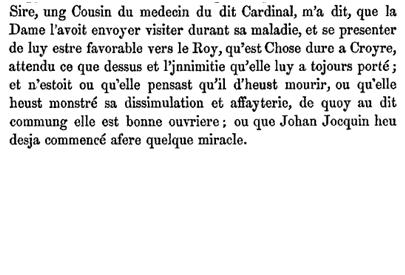
Not to be outdone in the realm of subterfuge, Anne, according to Chapuys, tried to hoodwink Wolsey.  “A cousin of the Cardinal’s physician told me that the lady had sent to visit him during his sickness, and represented herself as favoring him with the King. This is difficult to be believed, considering the hatred she has always borne him. She must have thought he was dying, or shown her dissimulation and love of intrigue, of which she is an accomplished mistress” (Brewer IV 6199).

partc
A transcription of the letter Chapuys sent to Charles V explaining Anne’s treatment of Wolsey.  

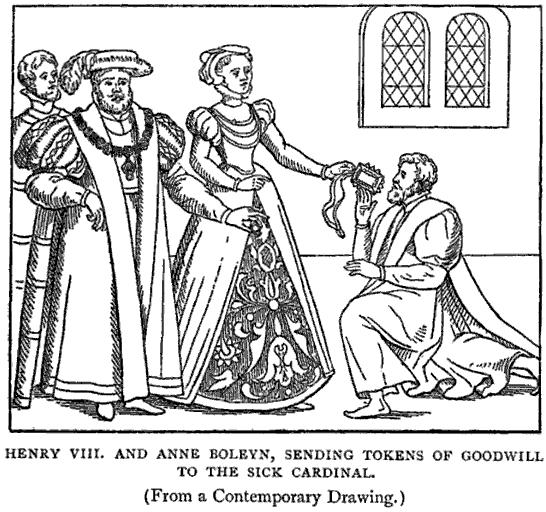
Chapuys’ information was not too far off the mark as seen in a letter Anne wrote to Wolsey in late 1529 or early 1530.  She appeared very accommodating as she in her “most humblyst wyse… do thanke your grace for your kind letter, and for yourer rych and goodly present, the whyche I shall never be able to deserve wyth owt your gret helpe” (Cavendish II 254).  She went on to assure the Cardinal that for all the days of her life there was no one “next to the kyngs grace to love and serve your grace, of the whyche I besyche you never to dowte that ever I shalle vary frome this thought as long as only brethe is in my body” (Cavendish II 254).

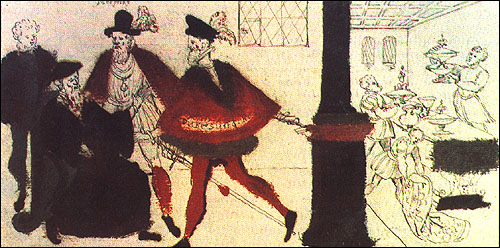
henry anne wolsey
Henry VIII and Anne Boleyn, sending tokens of goodwill to the sick Cardinal Wolsey from a contemporary drawing.  http://www.luminarium.org/encyclopedia/wolseybio.htm

After discussing her thankfulness that Wolsey recovered from his latest sickness “Not doughthyng bot that God has preservyd you…for grete caswsys knwnen allonly to his high wysdome,” Anne approached what must be the main purpose of the letter.  She comments on the arrival in England of the Papal legate letting Wolsey know that “as for the commyng of the legate I desyer that moche; and if it be Goddis pleasor I pray him to send this matter shortly to a goode ende” (Cavendish II 254 – 255).

Anne stressed her good will toward Wolsey and sent him wishes for a “longe lyfe with continewance in honor” signing off with the statement that she had “written wyth the hande of her that is most bound to be Your humble and obedient servant” (Cavendish II 255).  Even the most dedicated champion of Anne Boleyn has to agree to Chapuys’ assessment that she had ‘shown her dissimulation and love of intrigue.’

Yet, this type of deception was typical of Henry. After making a move against his enemy, he then attempted a reconciliation.  Wolsey was pardoned on February 12, 1530, with the following proclamation:  General pardon for Thos. cardinal of York, bishop of Winchester, and perpetual commendatory of the exempt monastery of St. Alban’s, alias late bishop of Bath and Wells, alias late bishop of Durham, alias late chancellor of England and legate de latere of the Apostolic See, alias sometime bishop of Lincoln (Brewer IV 6213).

Wolsey credited the hand of Thomas Cromwell, Chief Minister, and thanked him for his handling of the pardon with the “Kyng in allottyng and appoynttyng of my p[ardon] … yf he lyste. No man can do me more goode and yo[u] … your sylf referre that hys oppynyon was that I shuld [have no] lesse then 4,000l. yeerly to lyve with, wych myn … degre consyderyd ys with the lest, I cowde nat forbere [putting him] in remembrance hereof, remyttyng the betteryng ther[eof to your wisdom] and good handelyng” (Brewer IV 6204). Wolsey assured Cromwell that “Myn only comfort, at the reverens of God leve me not nowe, for yf ye do I shal nat longe lyve in thys wrechyd world. Ye woll nat beleve how I am alteryd, for that I have herd nothing from yow of your procedyngs and expeditions in my maters” (Brewer IV 6203).

Cromwell, the man who would shortly conduct the inventory of goods Wolsey must forfeit to the King, received another letter from Wolsey in which the Cardinal stated that his “comfort & relief I wold have your good sad, syscret advyse & counsell” knowing that Cromwell was working on “sertyng thyngs requyryng expedicion…on my behalf to be solycytyd” (Cavendish II 255-256).  Wolsey wrote to Secretary Stephen Gardiner about the assistance he expected from “my trustyng frend, Thomas Cromwel” (Cavendish II 264). This was trust misplaced, as the pragmatic Cromwell knew where his loyalties lay–with Henry VIII and Anne Boleyn.

Moving quickly, Cromwell acquired the chattel goods of the former Lord Chancellor.  Issuing a decree that Wolsey “having been convicted of various offences against the Crown and the statute of provisors 16 Ric. II., whereby all his property was forfeited. Also grant of all sums of money and goods” (Brewer IV 6214).  Below is the very thorough patent for the recall of Wolsey’s property.

“The money, goods, and chattels given by the King’s grace to the lord Cardinal, whereof mention is made in the King’s letters patent hereunto annexed. First, in ready money, 3,000l. Item, in plate, 9,565¾ oz., at 3s. 8d. the oz., amounteth to 1,753l. 3s. 7½d. Item, divers apparel of household, as hangings, bedding, napry, and other things, as appeareth by the inventory of the same, amounting in value by estimation 800l. Item, in horses and geldings, 80, with their apparel, valued by estimation 150l. Item, in mules for the saddle, four, with [their] apparel, valued by estimation 60l. Item, in mules for carriage, six, with their apparel, valued by estimation 40l. Item, in lynges, 1,000, valued by estimation 50l. Item, in cod and haberdynes, 800, valued by estimation 40l. Item, in salt, 8 way, valued by estimation 10l. Item, in implements of the kitchen, as pots, pans, spits, pewter vessel, and other things necessary for the same, valued by estimation 80l. Item, 52 oxen, valued by estimation 80l. Item, in muttons, 70, valued by estimation 12l. Item, the apparel for his body, valued by estimation 300l.—Sum total, 6,374l. 3s. 7½d.” (Brewer IV 6214).

Again, Spanish Ambassador Eustace Chapuys reported the turn of events to his King.  “One object … was to reinstate the Cardinal in the King’s favor, and, but for the lady, this would be easy, for it is thought the King has no ill-will to the Cardinal. His only wish is for the Cardinal’s goods; and he is not very far wrong, for the Cardinal has spent very large sums of money, and said all he accumulated was for the King; and to take administration of it before the time was not much offence; considering also that the Cardinal, since he began to suspect his fall, and since his destruction, has always said that the King could not do him any greater good than help himself to all that he had. As a proof of the King’s having no ill-will, I am told the King did not wish the Cardinal’s case to be determined by Parliament, as, if it had been decided against him, the King could not have pardoned him” (Brewer IV 6199).
Part a
A transcription of the letter Chapuys sent to Charles V explaining how Anne influenced Henry’s dealings with Wolsey.  

Characteristically of Henry VIII’s Court, the pardon, the apparent reconciliation and Wolsey’s action of handing over his goods and even his residences of Hampton Court and York Place (which became known as the Palace of Whitehall) were not enough to save him.  Previously Henry had trusted Wolsey completely as observed by the Venetian Ambassador Lodovico Falier “he was made Bishop and Cardinal, with papal power. Having achieved so high a position, the King and kingdom were in his sole hands, and he disposed of everything in his own fashion as King and Pope. Very great respect was therefore shown him by all the Powers, whose affairs were always negotiated with his right reverend lordship” (Brown IV 694).  Regardless of his previous powers to regulate the affairs of England, Wolsey was arrested in November 1530 for treason on the grounds that he was communicating with the Pope and the French against the policies of Henry VIII.

On his journey from Yorkshire to face the charges against him, Wolsey had “waxed so sicke” (Cavendish I 311)  when he reached as far as Leicester Abbey he proclaimed, “Father Abbot, I am come heither to leave my bones among you” (Cavendish I 313).

wolsey3
Cardinal Thomas Wolsey, Archbishop of York

Wolsey did die while at the Abbey and the words he spoke on his deathbed showed the regret for the life he had led and the loyalties he had kept, “if I had served God as diligently as I have done the king, he would not have given me over in my grey hairs” (Cavendish I 320).

For references, please refer to the blog entry, Path to St. Peter ad Vincula-Part I

Path to St. Peter ad Vincula–Part II

Path to St. Peter ad Vincular—Part II

Anne Bolyen’s path to her final resting place in St. Peter ad Vincular began the minute King Henry VIII turned his full attention on her.  The personal element of their courtship is not the subject of this blog entry, rather the political and religious maneuverings that culminated in their marriage.

Once Anne came onto the scene, Henry’s previous scruples of being married to his brother’s widow, which was unclean as taught by scripture, became magnified.  It was unacceptable to be married to Katherine of Aragon any longer.  Henry had negotiated with the French King, Francis I, in order to gain support in his bid for a divorce. He also had contact with his nephew-by-marriage, Charles V, to no avail.  Added to these attempts to treat, Henry gathered the opinions of university scholars and theologians throughout Europe in order to bend the Pope to claim in his favor.  Nothing happened as the Pope, in this delicate position, procrastinated.  In frustration Henry wrote to Clement VII on December 6, 1530, from Hampton Court of his displeasure.  Henry believed that “his demands, however just and reasonable, are put aside” and that “sometimes he cannot believe the Pope to have done what he knows he has done.”  Clement refused to allow the divorce case to be heard in England against the support of the French King and his councilors and “also the whole nobility and leading men in England” (Brewer IV 6759).  An exasperated Henry exclaimed that the Pope had shown “by his acts before all the world that he is wholly devoted to the Emperor’s will.” Even more interesting is the fact that Henry, having read William Tyndale’s text (more on that below), laid it out to Clement that if he desires “his own rights to be respected, let him not interfere with those of Henry” and “let him not suppose that either the King or his nobles will allow the fixed laws of his kingdom to be set aside.”  Henry would not let “the laws of England suffer the contrary, and … he will not brook denial” (Brewer IV 6759).

clement2
Pope Clement VII Portrait by Sebastiano del Piombo, 1526

Clement VII responded to Henry’s letter on January 7, 1531, and told Henry “there are many things in your letters in which we miss your usual wisdom, and even your modesty” and denied the “taunt that we are governed by the Emperor” Charles V.  Clement claimed that it was “clear from the complaints against him made by the Emperor” that he had not submitted to Charles’ demands (Gairdner V 31).

number ccxxxviii
Pope Clement VII response to Henry VIII letter

Clement addressed the charge that the case could not be heard in England.  He admitted “that this is so, because it is the peculiar privilege of the Holy See to refer to himself all causes which in any province cannot be effectively determined” and the “Apostolic See allowed her [Katherine] allegation to be considered sufficient, that England was a suspected place, as the King was her opponent” (Gairdner V 31).  Contrary to what Henry had been reading in Tyndale, the Pope emphasized that the kingdom’s laws would not be violated “provided they can be preserved without scandal to the Catholic Church, which is to be preferred to all law.” Perhaps suspecting the loss of Henry to the cause of the Catholic Church Clement beseeched him to remember “his title of Defender of the Faith, and peaceably arrange this cause, or acquiesce in the judgment of the Holy See” (Gairdner V 31).

number cclxv
Anonymous writer’s defense of the Pope

Henry remained as patient as he could for two more years awaiting the Pope’s decision, but with Anne pregnant he took action and married her in January 1533.  In a proclamation Henry declared that he was “married and espoused according to the laws of God and holy Church to the lady Anne, his lawful wife, who as appertaineth to the estate is by the said assent anointed and crowned Queen of this realm” (Pocock 497).  Henry further created a Proclamation in June 1533 to warn his subjects “to avoid the danger and penalty of the Statue of Provision and Premunire” which laid out his divorce from Katherine of Aragon and the fact that he “hath lawfully married and taken to wife, after the laws of the Church, the right high and ecellent princess Lady Anne now Queen of England, and she solemnly crowned and anointed as pertaineith, to the laud, praise, and honour of Almighty God, the surety of the king’s succession and posterity, and to the great joy, comfort, and contantation of all the subjects of this realm” (Pocock 502).  Despite the universal happiness of the realm that Henry proclaimed occurred upon the announcement of his marriage, he had to explain to his people that his divorce from Katherine was final and anyone in doubt would “incur and run in the pains and penalties comprised in the statutes” (Pocock 502).

Within England, the pro-Catholic and the pro-Imperial factions rejoiced when Pope Clement annulled the marriage of Henry and Anne on July 11, 1533, by proclaiming, “Sententia deffinitiva Clementis Popæ septimi pro matrimonio Henrici Octavi Angliæ  Regis cum Catharinâ et contra secundas ejusdem nuptias cum Annâ Bolenâ.  Data Romæ anno Domini 1533.  Pontificatûs Clementis decimo” (Pocock 677).  Of course, Henry ignored the command.  Anne was the one to suffer from the ill will of those in England loyal to the old faith.

Samuel Singer, as editor of the George Cavendish work on Thomas Wolsey, commented that since the “marriage of Henry with Anne Bullen led to the separation of the kingdom from the See of Rome, her memory has consequently always been vituperated in all possible ways by every true son of the Catholic Church…” Protestant writers have not “been wanting in zeal to defend the queen from all the unjust aspersions upon her character, and have considered her as a martyr to the cause of the reformed church” (Cavendish II 44).  However, what was Anne’s true role?  Was she a staunch supporter of the reformed church?  Was she using the Reformation as a means to an end for her acquisition of the queenship? Most pieces of ‘evidence’ could be interpreted to support either proposition.

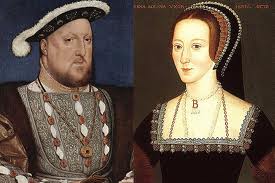
anne boylen
An engraving of Anne Boleyn in the cover George Cavendish’s book, said to be after the original portrait by Holbein.

A story collaborated by John Foxe and George Wyatt (added in George Cavendish’s work on Wolsey) related how Anne Boleyn shared with Henry a copy of the banned book The Obedience of a Christian Man written in 1528 by William Tyndale.  Advocating, among other things, that a king of a country should be the head of the Church not the Pope, Tyndale’s claims were radical and dangerous to say the least.  Although the idea of the divine right of kings did not take a firm foothold during the Tudor era, Henry embraced the idea that a pope had no earthly authority and that the king “is the minister of God,” and kings “are God’s ministers serving for the same purpose….” Henry welcomed Tyndale’s claim that “God therefore hath given laws unto all nations, and in all lands hath put kings, governors, and rulers in his own stead, to rule the world through them” (Tyndale 25).

Therefore while the Catholics blamed Anne for revealing the book to Henry in order to obtain the divorce from Katherine through strengthening his resolve to break from Rome and create a Church under his leadership, the Protestants praised her because “the help of this virtuous Lady, by the means aforesaid, had his eyes opened to the truth, to advance God’s religion and glory, to abhor the Pope’s doctrine” (Strype 172).

Anne had promoted Protestant ideas and had in her possession several banned books beyond Tyndale’s which she shared with Henry.  It appears as if the King enjoyed Simon Fish’s Supplication of the Beggars (Warnicke 111-112) and accepted some of the doctrines of the Protestants.  Henry was a conservative and did not alter many of the Church doctrines.  Anne was the more liberal.  The Scottish clergyman and historian, Alexander Alesius, wrote Elizabeth Regina “true religion in England had its commencement and its end with your mother” (Denny 132).  Influenced by Anne, many ecclesiastical appointments were of evangelical “scholars who favoured the purer doctrine of the gospel” (Denny 212).  Men such as Thomas Cranmer, Hugh Latimer, and Nicholas Shaxton were the most prominent.  Members of her own household were also more liberal including her chaplain, Matthew Parker, future Archbishop of Canterbury, to whom she entrusted the spiritual life of her toddler daughter, Elizabeth, to him in the event of anything happening to her.

download
William Tyndale

Another Protestant doctrine from Tyndale that Anne embraced was the theory that the Bible should be translated into the vernacular.  Showing her reluctance to push conservatives too far by disobeying a strictly forbidden work, Anne never owned an English language Bible—she had one in French.

For References, please refer to the blog entry, Path to St. Peter ad Vincula-Part I

The Path to St. Peter ad Vincula: Part I

The Path to St. Peter ad Vincula:  Part I

Nicholas Sander was an English Catholic who in 1586 wrote The Rise and Growth of the Anglican Schism, (De Origine ac Progressu Schismatis Anglicani.)  For the purpose of this blog the materials relayed from his book will concentrate on Sander’s discussion of Anne Boleyn.  That he was not a supporter of Anne is an understatement. That he saw it as his duty to publish any-and-all anecdotes that reached him is also an understatement.  In an introduction to a later publication of Sander’s book (1877), editor, David Lewis wrote that Sander was not a “slave to his resentments and passions” and did no true harm to Anne’s reputation as many had already done as much (Sander XXVI).

“The French Ambassador did not spare her, and the king’s own sister, the duchess of Suffolk, is said to have uttered ‘opprobrious language’ against her.”  Lewis went on to report that “the Venetian Calendar of State Papers, edited by Mr. Rawdon Brown, is a contemporary account of Anne, not more flattering than that of Dr. Sander” (Sander XXV).

Mario Savorgnano, Venetian Ambassador to England, had many of his dispatches to the Doge and Senate compiled by historian Marnio Sanuto in Diaries.   Sanuto’s work covers the time-period of January 1496 to September 1533 in 58 volumes. Rawdon Brown used materials from these volumes in 1871 in his translations of the Calendar of State Papers Relating to English Affairs in the Archives of Venice.  Savorgnano, while praising King Henry VIII on August 25, 1531, lessened the commendation by declaring that one “thing detracts greatly from his merits, as there is now living with him a young woman of noble birth, though many say of bad character, whose will is law to him” (Brown August 1531 682)

.Marin Sanudo
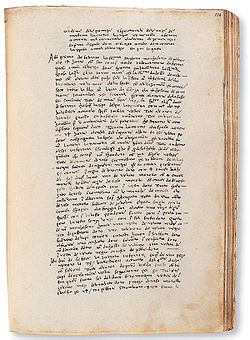
Page from the book, Diaries, by Marnio Sanuto.

Simon Grynaeus, a religious reformer from Basel, who, through Erasmus, had an introduction to Sir Thomas More, spent several months in England in late 1531.  Although he accepted the task to help Henry collect the opinions of the continental reformers on the divorce between Henry VIII and Katherine of Aragon, Grynaeus spoke of Anne “as a woman entitled to no respect” (Sander XXV).

simon gryn booksimon gryn book2
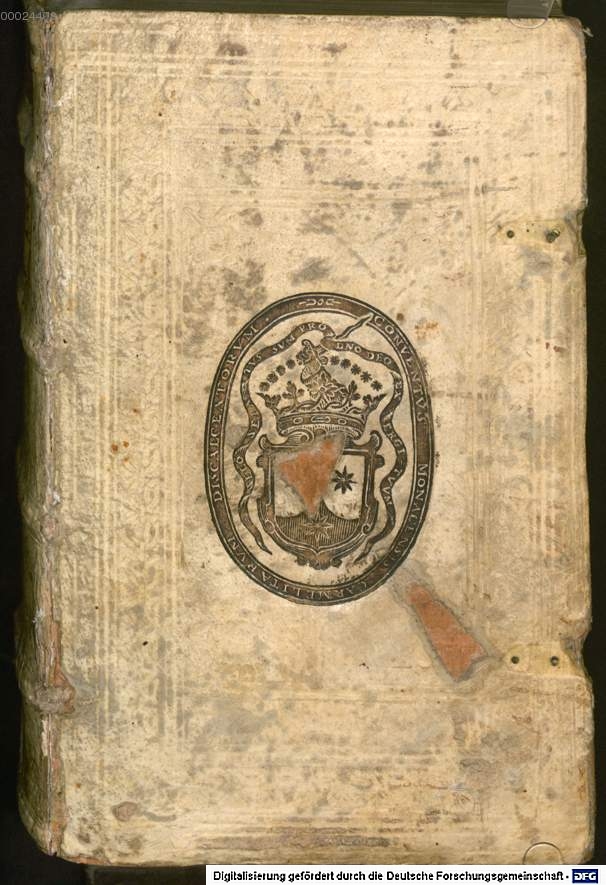
Pages from the book by Simon Grynaeus.

Lodovico Falier, Venetian co-Ambassador to the Court of Henry VIII  from January 1528 until August 1531 wrote a summary report on 10 November 1531 which was presented to the Venetian rulers declaring that Queen Katherine of Aragon was “beloved by the islanders more than any Queen that ever reigned” (Brown November 1531 694).  Sander relayed a contemporary’s assessment of Anne. “Madam Anne is not one of the handsomest women in the world: she is of middling stature, swarthy complexion, long neck, wide mouth, bosom not much raised, and in fact has nothing but the English king’s great appetite and her eyes, which are black and beautiful. That is an account of Anne Boleyn in October 1532, when she was living ‘like a queen at Calais,’ accompanied by the king” (Sander XXV-XXVI).
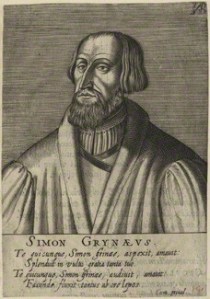
NPG D24782; Simon Grynaeus after Unknown artist
Engraving by an unknown artist of Simon Grynaeus.

The following is a story attributed by Sander only to the ‘French Ambassador in Venice’ who received this about the same time as Falier was giving his report. It is also relayed in Sanuto’s Diaries for the date 24 November, 1531 as reported by Brown in the Calendar of State Papers—Venice. “It is said that more than seven weeks ago a mob of from seven to eight thousand women of London went out of the town to seize Boleyn’s daughter, the sweetheart of the king of England, who was supping at a villa –in una casa di piacere—on a river; the king not being with her; and having received notice of this she escaped by crossing the river in a boat.  The women had intended to kill her, and amongst the mob were many men disguised as women; nor has any great demonstration been made about this, because it was a thing done by women” (Sander xxvii; Brown November 1531 701).

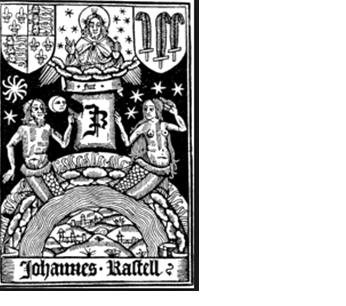
Even more tantalizing than the above story is the one concerning the birth of Anne Boleyn.  Lewis goes on quite a tirade concerning the work of William Rastall (Rastell), Life of Sir Thomas More.  It appeared to be used as an argument for the validity of Dr. Burnet’s (Gilbert Burnet was a 17th century Scottish theologian, respected historian, and Bishop of Salisbury) story of the birth of Anne Boleyn—more on that in a little bit.  Sander’s lengthy discourse caused me to spend way too much time investigating. As near as I can piece together, William Rastell did not write a book about his uncle Sir Thomas More (William’s mother was Sir Thomas’ sister) but printed the text of More’s own work, A dyaloge of Syr Thomas More knyghte: one of the counsayll of oure soverayne lorde the kyng & chauncellour of hys duchy of Lancaster…. William later edited it into More’s English Works.  John Rastell a printer and William’s father, and his subcontractor, Peter Treveris, had completed an initial printing in June 1529 (Devereux 153-155). Therefore, when Lewis pronounced, “Dr. Burnet was a bolder man” than Nicholas Sander and that Brunet “denies also that Rastell ever wrote a Life of Sir Thomas More” as to why his story “deserves to be read” I had to investigate (Sander xxvii).

rastell
Printer’s Mark of John Rastell

“Were true,” writes Burnet, “very much might be drawn from it, both to disparage king Henry, who pretended conscience to annul his marriage for the nearness of affinity, and yet would after that marry his own daughter.  It leaves also a foul and lasting stain both on the memory of Anne Boleyn, and of her incomparable daughter, queen Elizabeth.  It also derogates so much from the first reformers, who had some kind of dependence on queen Anne Boleyn, that it seems to be of great importance, for directing the reader in the judgment he is to make of persons and things, to lay open the falsehood of this account.  It were sufficient for blasting it, that there is no proof pretended to be brought for any part of it, but a book of one Rastall, a judge, that was never seen by any other person than that writer.  The title of the book is ‘The Life of Sir Thomas More.’  There is great reason to think that Rastall never writ any such book; for it is most common for the lives of great authors to be prefixed to their works.  Now this Rastall published all More’s works in queen Mary’s reign, to which if he had written his life, it is likely he would have prefixed it.  No evidence, therefore, being given for his relation, either from record or letters, or the testimony of any person who was privy to the matter, the whole is to be looked on as a black forgery, devised on purpose to defame queen Elizabeth” (Sander xxviii).

images
Sir Thomas More

The implication that Henry VIII had sired a daughter, Anne, by Elizabeth Howard Boleyn was the outgrowth of the steady rumor that Henry had intimate relations with Elizabeth. Henry addressed the gossip to Sir George Throgmorton saying, “Never with the mother” (Friedman 326).  This blog will relay the story via the work of Nicholas Sander relayed through Dr. Burnet and Nicholas Pocock.

Pocock, who wrote Records of the Reformation: The Divorce 1527-1533, was no fan of Sander’s work.  In later years he edited a volume and wrote extensively of Sander’s mistakes.  In a lengthy chapter titled, “An Appendix Concerning Some of the Errors and Falsehoods in Sanders’ Book of the English Schism,” Pocock referred to his predecessor as “so great a master, impudence, and falsehood are matter of fact” (Burnet and Pocock 615).

Henry VIII was determined to marry Anne Boleyn and he was concerned over Cannon Law which could prohibit the marriage due to consanguinity.  It was accepted that Henry had committed “intrigue with Mary Boleyn, the elder sister of Anne” (Pocock xxxviii).  Nicholas Sander would not hold to Henry VIII’s argument that he must divorce Catherine of Aragon due to consanguinity yet would marry Anne Boleyn “having at the same time knowledge that this very impediment subsisted against the marriage with Anne Boleyn” (Sander 95). According to Sander, Henry had confessed in “a letter to Pope Clement VII that he had committed adultery with Mary Boleyn, the sister of Anne” (Sander 98).  This would make Henry related to Anne by the first degree of consanguinity.  Sander chided Henry for his lack of respect to the doctrines of the Church and for “his hypocrisy …and the falsehood of his heart” (Sander 98).  This being reference to Henry divorcing Katherine Aragon as the wife of his brother and for his relations to Mary Boleyn and Elizabeth Boleyn.

“Whether there was any connexion of a similar kind between Henry and the mother of Anne Boleyn may perhaps still be somewhat doubtful.  The king, on one occasion, denied that there had been any such intercourse, thereby tacitly admitting the other charge” (Pocock xxxviii).

ehboley

Portrait believed to be of Elizabeth Howard Boleyn

Whatever the truth concerning the matter of Lady Boleyn and Henry VIII, Pocock believed that Sander overreached himself in his eagerness to defame Elizabeth Regina.  He does later find more charity with Sander and states that Sander truly believed the information he had been given (Pocock xli).    Below is the document dated March 1533, in which a priest named Thomas Jackson was charged with having stated that the King had committed adultery with Anne and Elizabeth Boleyn. It was reported by Sander and later reproduced by Pocock, titled, “Number CCCXXIX.”

Certain Articles deposed against Sir Thomas Jakson,
Chantree priest of Chepax, for certain words spoken by
him maliciously against our sovereign lord and king and
the queen’s grace by John Kepar and Bryan Banke of the
said town, which things also they have confessed before
Mr. William Fairfax, Esquire, Sheriff of the county of York.
First, The said Chantry Priest said that the king’s grace had
lived before this his marriage lawfully made with the queen’s
grace, not after the laws of God, but in adultery with her
grace and so doth now still continue, putting away from him
his lawful wife.
 
Item, He said maliciously that the king’s grace should first
kepe the mother and after the daughter, and now he hath
married her whom he kept afore and her mother also, upon
which words we presented the said preiset unto the sheriff
aforesaid, upon which presentment the said preist was
attached with all his goods, and the said John Kepar
and Brian Banke were by the said sheriff made to bind
themselves ot come hither and present the same to the
king’s grace counsel; which they have now done, most
meekly desiring to be at your pleasure demitted, for
they be poor men, and to lye long here should be to them
great hindrance.
 
Which thing to be true the said John Kepar and Brian Banke
will stand by at all times and have bounden themselves
before the sheriff by their hands and seals.
 
Endorsed—
Certain Articles deposed against Sir Thomas Jakson priest
(Pocock 468).
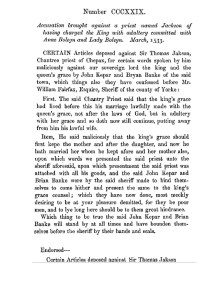
jakson proof of ab
Document Number CCCXXIX

“That the report of such intercourse spread during the first year of the marriage is plain from the document Number CCCXXIX, and the story must be allowed whatever weight is due to an assertion of a charge in itself improbably, and for the invention f which no adequate reason can be assigned.  Hitherto it has been supposed that Nicholas Sanders was the inventor of the libel; but this document shews that the report existed at least half a century before Sanders’ book, ‘De Schismate,’ was published.  It was, of course easy to magnify the particulars of such a story till it grew to the dimensions of Anne being the king’s own daughter” (Pocock xxxix).  Sander declared that “Henry had sinned with the mother of Anne Boleyn. And there was therefore, that relationship between them which subsists between parent and child.  It is never lawful for a father to marry his own daughter” (Sander 99).

Pocock told how Sander had acquired the tale from a book about the life of Sir Thomas More by Rastell and had never checked the facts.  “That Anne could be the king’s daughter by lady Boleyn is easily shewn to be impossible from considerations of time and circumstance” (Pocock xxxix).  Although Pocock never relays to us the proof of this, he does give Sander some slack due to the wording of the dispensation that Cranmer had petitioned from the Pope to allow Henry to marry Anne.  Cranmer had to cover every possible point and we are cautioned not to place too much stress “on Cranmer’s assertion, that the affinity supposed to be contracted by illicit intercourse of a man with his wife’s sister, daughter, or mother.”  Specifics would not even be that necessary as Cannon Law “being express upon this subject: Secundum canones etiam per coitum fornicarium et incestuosum contrahitur affinitas.”  Pocock assures us that the details of Cranmer’s request are “veiled in the decent obscurity of a dead language” (Pocock xxxix-xl).

Thomas_Cranmer
Thomas Cranmer

This blogger is upset with herself for spending too much time and energy on these rumors but they do illustrate the lengths people went to defame Anne Boleyn.  Now we come to the crux of Sander’s argument.

Henry was deemed as shameless and Sander was astounded by the “hypocrisy and the rashness and lewdness of one man” but marveled the more at the fact that “multitudes of men should endure patiently, not their own lewdness, but that of another—not only endure it patiently, but respect it, praise and honour it so far as to build upon it their belief, their hope and salvation” (Sander 99-100).

Anne Boleyn B necklace
Anne Boleyn
He exclaimed that “Now, all English Protestants, honour the incestuous marriage of Henry and Anne Boleyn as the well-spring of their gospel, the mother of their Church, and the source of their belief” (Sander 100).  The religious issue was never far behind the personal and the political.  Pope Clement VII had officially declared that Henry had by “de facto married one Anne, contrary to Our commandments, and in contempt of Our prohibitions contained in Our letter in forma Brevis, thereby temerariously disturbing the due course of law; the marriage contracted by the aforesaid Henry and Anne all manifest and notorious deeds to be what they are and were, null and unjust and contrary to law” (Lilly 350).  For further measure, Clement declared “by the same sentence that the children, born or to be born of that marriage, are and always have been bastards” (Lilly 351).
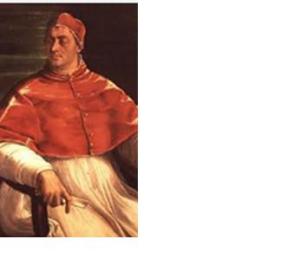
clement2
Pope Clement VII

As mentioned, politics wrapped itself in the religious and personal lives of the Tudor Era and the Pope saw fit to “deal gently and mercifully with the said Henry.” He gave Henry over a year to comply with the orders to repudiate Anne and reinstate Catherine or face excommunication.  The Pope could not afford to alienate Henry and was hoping for a reprieve to allow matters to resolve themselves and thus not offend Charles, Holy Roman Emperor, nephew of Catherine of Aragon.  That fascinating angle to this topic will not be addressed here. Thus, Catholic Sander was convinced that “this marriage opened a door to every heresy and to every sin” which eventually brought her downfall (Sander 101).

References:     

“Act for the Dissolution of the Lesser Monasteries.” Act for the Dissolution of the Lesser Monasteries. The Tudor Place, n.d. Web. 24 Nov. 2013.

“Alesius, Alexander (DNB00).” Wikisource, the Free Online Library, Dictionary of National Biography. (1904). 21 Feb. 2011. Web. 30 Aug. 2013.

“Anne Boleyn’s Book of Hours.” Anne Boleyn’s Book of Hours. British Library, 26 Mar. 2009. Web. 28 Mar. 2014.

Bell, Doyne Courtenay. Notices of the Historic Persons Buried in the Chapel of St. Peter Ad Vincula, in the Tower of London. With an Account of the Discovery of the Supposed Remains of Queen Anne Boleyn. London: J. Murray, 1877. Google Books. Web. 14 Sept. 2013.

Bernard, G. W. Anne Boleyn:  Fatal Attractions. New Haven:  Yale University Press, 2010.  Google Books. Web. 28 Dec. 2013.

Bernard,G.W. “The Fall of Anne Boleyn.” Power and Politics in Tudor England. Burlington: Ashgate, 2000. Google Books. Web. 5 May 2014.

Bordo, Susan.  The Creation of Anne Boleyn:  A New Look at England’s Most Notorious Queen.  New York:  Houghton, Mifflin Harcourt Publishing, 2013.  Google Books. Web. 27 Mar. 2014

Brewer, J. S. (editor). “Henry VIII: November 1517.” Letters and Papers, Foreign and Domestic, Henry VIII, Volume 2: 1515-1518 (1864): 1183-1198. British History Online. Web. 29 June 2013.

Brewer, J. S. (editor). “Henry VIII: December 1528, 2-10.” Letters and Papers, Foreign and Domestic, Henry VIII, Volume 4: 1524-1530 (1875): 2170-2181. British History Online. Web. 10 Nov. 2013.

Brewer, J.S. (editor). “Henry VIII: February 1530, 1-15.” Letters and Papers, Foreign and Domestic, Henry VIII, Volume 4: 1524-1530 (1875): 2773-2790. British History Online. Web. 12 Nov. 2013

Brewer, J. S. (editor). “Henry VIII: December 1530, 1-14.” Letters and Papers, Foreign and Domestic, Henry VIII, Volume 4: 1524-1530 (1875): 3052-3058. British History Online. Web. 02 Nov. 2013. 

Brown, Rawdon (editor). “Volume I 1202-1509.” Calendar of State Papers Relating to English Affairs in the Archives of Venice, (1864): CXXIII. British History Online. Web. 28 Sept. 2013.

Brown, Rawdon (editor). “Venice: August 1531.” Calendar of State Papers Relating to English Affairs in the Archives of Venice, Volume 4: 1527-1533 (1871): 284-289. British History Online. Web. 28 Sept. 2013.

Brown, Rawdon (editor). “Venice: April 1532.” Calendar of State Papers Relating to English Affairs in the Archives of Venice, Volume 4: 1527-1533 (1871): 331-334.  British History Online. Web. 22 Mar. 2014.

Brown, Rawdon (editor). “Venice: November 1531.” Calendar of State Papers Relating to English Affairs in the Archives of Venice, Volume 4: 1527-1533 (1871): 291-307. British History Online. Web. 28 Sept. 2013. 

Burke, James (editor). Lingard’s History of England Abridged: With a Continuation, from 1688 to 1854.  Baltimore: John Murphy & Co., 1875.  Internet Archive. Web. 27 Mar. 2014.

Burnet, Bishop Gilbert.  An Abridgement of Bishop Burnet’s History of the Reformation of the Church of England. New Edition. Vol. I.  London:  F. C. & J. Rivington, 1819.  Google Books. Web. 22 Dec. 2013

Burnet, Gilbert. The History of the Reformation of the Church of England. Vol. I Part I. London:  W. Baynes and Son, 1825.  Google Books.  Web. 3 July 2013.

Burnet, Gilbert, and Nicholas Pocock. The History of the Reformation of the Church of England. Vol. V. Oxford: MacMillian and Company, 1865. Google Books. Web. 27 Sept. 2013. 

Burnet, Bishop Gilbert.  An Abridgement of Bishop Burnet’s History of the Reformation of the Church of England. New Edition. Vol. I.  London:  F. C. & J. Rivington, 1819.  Google Books. Web. 22 Dec. 2013

Butler, Clement Moore. An Ecclesiastical History from the Thriteenth to the Nineteenth Century.  Philadelphia: Claxton, Remsen, and Haffelfinger, 1872.  Google Books.  Web. 8 Feb. 2014.

Cassell Itd. Cassell’s Library of English Literature, Selected, Edited and Arranged by Henry Morley:  The Religious Life of England, Part I. London:  Cassell, Petter, and Galpin, 1876. Google Books. Web. 31 May 2014.

Cavendish, George. The Life of Cardinal Wolsey; and Metrical Visions from the Original Autograph Manuscript. Ed. Samuel Weller Singer. Vol. I. Chiswick: Harding, Triphook, and Lepard, 1825. Google Books. Web. 16 Nov. 2013.

Cavendish, George. The Life of Cardinal Wolsey; and Metrical Visions from the Original Autograph Manuscript. Ed. Samuel Weller Singer. Vol. II. Chiswick: Harding, Triphook, and Lepard, 1825. Google Books. Web. 2 Nov. 2013.

Chapman, Hester W. The Challenge of Anne Boleyn. New York: Coward, McCann & Geoghegan, 1974. Google Books. Web. 3 May 2014.

“Condemnation of Anne Boleyn.” The Museum of Foreign Literature, Vol. XVI: January to June 1830: 289. Philadelphia: E. Littell & Brother, 1830. Google Books. Web. 4 Oct. 2013.

Constantyne, George. “Transcript of an Original Manuscript: Containing a Memorial from George Constantyne to Thomas Lord Cromwell.  Communicated by Thomas Amyot, Esq. F. R.S., Treasurer, in a Letter Addressed to Henry Ellis, Esq. F.R.S., Secretary”. Archaeologia: Or Miscellaneous Tracts Related to Antiquity. Vol XXIII.  London: Society of Antiquaries of London, 1831. Google Books. Web. 7 Feb. 2014.

Davies, Ress (editor). The Royal Historical Society Transactions. Sixth Series Vol. 5.    Cambridge:  Press Syndicate of the University of Cambridge, 1995. Google Books. Web. 4 Sept. 2013.

Denny, Joanna.  Anne Boleyn:  An New Life of England’s Tragic Queen. Philadelphia, PA:  Da Capo Press, 2006. Google Books. Web. 1 Sept. 2013.

Devereux, E. J. “Bibliography of John Rastell.” Quebec:  McGill-Queen’s University Press, 1999.  British History Online. Web.  27 Sept. 2013.

Dodd, A. (Editor). The Life of the Most Reverend Dr. Cranmer, Some Time Lord Archbishop of Canterbury, Primate of all England, and Metropolitan; One of His Majesty’s Most Honourable Privy-Council in the Reign of Henry VIII.  Chairman of the Committee for Compiling the English Liturgy, and Martyr, in the Reign of Queen MaryLondon:  Cook, James and Kingman 1751.  Google Books. Web. 1 Dec. 2013.

Dodds, Madeleine Hope, and Ruth Dodds. The Pligrimage of Grace 1536-1537 and The Exeter Conspiracy 1538. Vol II. Cambridge: University Press, 1915. Internet Archive. Web. 22 Mar. 2014.

Ellis, Henry. Original Letters, Illustrative of English History: Including Numerous Royal Letters from Autographs in the British Museum, and One or Two Other CollectionsVol. II.  London: Harding, Triphook, and Lepard, 1824. Google Books. Web. 3 Jan. 2014.

Elton, G. R. England Under the Tudors. London: Routledge, 1955. Print.

Elton, G. R. Policy and Police:  the Enforcement of the Reformation in the Age of Thomas Cromwell.  Cambridge: Cambridge University Press, 1972. Google Books. Web. 22 Mar. 2014.

Foxe, John (1516-1587) The Acts and Monuments of John Foxe; With a Life of the Martyrologist, and Vindication of the Work, ed George Townsend, 8 volumes, reprinted by AMS Press, New York, 1965. Reformation.org. Web 2. Nov. 2013.

Foxe, John. “Oration to Saint Anne Boleyn from John Foxe, Martyrologist.” The Acts and Monuments of John Foxe: With a Life of the Martyrologist, and Vindication of the Work, ed. George Townsend, Vol. 1-8. New York: AMS Press, 1965.  Reformation.org. Web. 2 Nov. 2013.

Fraser, Antonia.  The Wives of Henry VIII.  New York:  Alfred A. Knopf, 1992. Print.

Freeman, Thomas. “Research, Rumour and Propaganda: Anne Boleyn in Foxe’s ‘Book of Martyrs.’” The Historical Journal 38.4 (1995): 797-819. JSTOR. Web. 1 June 2014.

Friedmann, Paul.  Anne Boleyn: A Chapter of English History, 1527-1536. Vol I. London: Macmillian and Co., 1884. Internet Archive. Web. 21 June 2013.

Friedmann, Paul.  Anne Boleyn: A Chapter in English History, 1527-1536. Vol. II. London:  Macmillian and Company, 1884. Google Books. Web. 19 Oct. 2013.

Froude, James A. The Divorce of Catherine of Aragon:  The Story as Told by the Imperial Ambassadors Resident at the Court of Henry VIII.   New York:  Scriber and Sons, 1891.  Google Books  Web. 15 Mar. 2014.

Gairdner, James (editor). “Henry VIII: January 1531, 1-15.” Letters and Papers, Foreign and Domestic, Henry VIII, Volume 5: 1531-1532 (1880): 10-22. British History Online. Web. 02 Nov. 2013.

Gairdner, James (editor). “Henry VIII: May 1531, 16-31.” Letters and Papers, Foreign and Domestic, Henry VIII, Volume 5: 1531-1532 (1880): 111-130. British History Online. Web. 20 Oct. 2013.

Gairdner, James (editor). “Henry VIII: April 1533, 11-20.” Letters and Papers, Foreign and Domestic, Henry VIII, Vol. 6: 1533 (1882): 151-170. British History Online. Web. 17 Mar. 2014.

Gairdner, James. (editor). “Henry VIII: April 1534, 16-20.” Letters and Papers, Foreign and Domestic, Henry VIII, Volume 7: 1534 (1883): 199-210. British History Online. Web. 29 June 2013.

Gairdner, James (editor). “Henry VIII: April 1534, 26-30.” Letters and Papers, Foreign and Domestic, Henry VIII, Volume 7: 1534 (1883): 217-236. British History Online. Web. 27 Dec. 2013.

Gairdner, James (editor). “Henry VIII: June 1534, 11-15.” Letters and Papers, Foreign and Domestic, Henry VIII, Volume 7: 1534 (1883): 311-317. British History Online. Web. 22 March 2014.

Gairdner, James (editor). “Henry VIII: September 1534, 6-10.” Letters and Papers, Foreign and Domestic, Henry VIII, Volume 7: 1534 (1883): 445-450. British History Online. Web. 20 Oct. 2013.

Gairdner, James (editor). “Henry VIII: February 1535, 11-20.” Letters and Papers, Foreign and Domestic, Henry VIII, Volume 8: January-July 1535 (1885): 75-98. British History Online. Web. 29 June 2013.

Gairdner, James (editor). “Henry VIII: August 1535, 11-20.” Letters and Papers, Foreign and Domestic, Henry VIII, Volume 9: August-December 1535 (1886): 19-40. British History Online. Web. 22 Mar. 2014.

Gairdner, James (editor). “Henry VIII: October 1535, 6-10.” Letters and Papers, Foreign and Domestic, Henry VIII, Volume 9: August-December 1535 (1886): 181-195. British History Online. Web. 29 June 2013.

Gairdner, James (editor). “Henry VIII: February 1536, 11-20.” Letters and Papers, Foreign and Domestic, Henry VIII, Volume 10: January-June 1536 (1887): 108-126. British History Online. Web. 20 Oct. 2013.

Gairdner, James (editor). “Henry VIII: April 1536, 1-10.” Letters and Papers, Foreign and Domestic, Henry VIII, Volume 10: January-June 1536 (1887): 240-259. British History Online. Web. 17 Nov. 2013.

Gairdner, James (editor). “Henry VIII: May 1536, 21-25.” Letters and Papers, Foreign and Domestic, Henry VIII, Volume 10: January-June 1536 (1887): 391-401. British History Online. Web. 16 Nov. 2013.

Gardiner, James (editor). “Henry VIII: June 1536, 1-5.” Letters and Papers, Foreign and Domestic, Henry VIII, Volume 10: January-June 1536 (1887): 424-440. British History Online. Web. 22 Sept. 2013.

Gairdner, James (editor). “Henry VIII: June 1536, 6-10.” Letters and Papers, Foreign and Domestic, Henry VIII, Volume 10: January-June 1536 (1887): 440-470. British History Online. Web. 17 Nov. 2013.

Gairdner, James (editor). “Henry VIII: August 1536, 16-20.” Letters and Papers, Foreign and Domestic, Henry VIII, Volume 11: July-December 1536 (1888): 130-138. British History Online. Web. 28 June 2013.

Gairdner, James (editor). “Henry VIII: June 1537, 11-20.” Letters and Papers, Foreign and Domestic, Henry VIII, Volume 12 Part 2: June-December 1537 (1891): 25-42. British History Online. Web. 29 Dec. 2013.

Gairdner, James (editor). “Henry VIII: October 1537, 11-15.” Letters and Papers, Foreign and Domestic, Henry VIII, Volume 12 Part 2: June-December 1537 (1891): 309-324. British History Online. Web. 22 Mar. 2014.

Gairdner, James and R. H. Brodie (editors). “Letters and Papers: October 1539, 26-31.” Letters and Papers, Foreign and Domestic, Henry VIII, Volume 14 Part 2: August-December 1539 (1895): 137-160. British History Online. Web. 22 June 2014.

Gayangos, Pascual de (editor). “Spain: October 1533, 1-20.” Calendar of State Papers, Spain, Volume 4 Part 2: 1531-1533 (1882): 816-830. British History Online. Web. 17 Mar. 2014.

de Gayangos, Pascual (editor). “Spain: April 1536, 1-20.” Calendar of State Papers, Spain, Volume 5 Part 2: 1536-1538 (1888): 79-85. British History Online. Web. 24 Nov. 2013.

Grosvenor, Bendor. “Anne Boleyn Regains Her Head.” Art History News. Art History News, 15 Dec. 2011. Web. 3 May 2014.

Gunn, Steven. “The Structures of Politics in Early Tudor England.” Ed. Ress Davies. Royal Historical Society Transactions: Sixth Series. Vol. V. Cambridge: Cambridge UP, 1996. 59-90. Google Books. Web. 1 Dec. 2013.

Haigh, Christopher. English Reformations: Religion, Politics, and Society Under the Tudors. Oxford: Clarendon, 2012. Google Books. Web. 13 Nov. 2013.

Hall, Edward, Henry Ellis, and Richard Grafton. Hall’s Chronicle; Containing the History of England, during the Reign of Henry the Fourth, and the Succeeding Monarchs, to the End of the Reign of Henry the Eighth, in Which Are Particularly Described the Manners and Customs of Those Periods. London: Printed for J. Johnson and J. Rivington; T. Payne; WIlkie and Robinson; Longman, Hurst, Rees and Orme; Cadell and Davies; and J. Mawman, 1809. Internet Archive. Web. 2 Jan. 2013. 

Hall, Hubert (editor). A Formula Book of English Official Historical Documents: Part II Ministerial and Judicial Records.  Cambridge:  University Press 1909. Google Books. Web. 29 Nov. 2013.

Harpsfield, Nicholas, Reverend.  A Treatise of Marryage Occasioned by the pretended Divorce of King Henry the Eigth from Q. Catherine of Arragon devided Into three Bookes.  “The third book of Doctor N. Harpsfield’s Treatise of Marriage.” Ed. Charles Eyston. Trans. William Eyston.  Canterbury: Topliffe, 1707. Google Books. Web. 22 Mar. 2014.

Heal, Felicity. Reformation in Britain and Ireland. Oxford: UP 2003.  Google Books. Web. 1 Dec. 2013.

Herbert, Edward, 1st Baron Herbert of Cherbury.  The Life and Reigne of King Henry the Eighth.  London: T. Martyn, S. Mearne and H. Herringmann 1649.  Google Books. Web. 1 Mar. 2014.

Herbert, Henry William. Memoirs of Henry the Eighth of England: With the Fortunes, Fates, and Characters of His Six Wives.  New York: Miller, Orton & Mulligan, 1856. Google Books. Web. 16 Mar. 2014.

Hibbert, Christopher.  The Virgin Queen: Elizabeth I, Genius of the Golden Age.  New York: Addison-Wesley Publishing Company, Inc., 1991.  Print.

Holinshed, Raphael, John Hooker, Francis Thynne, Abraham Fleming, John Stow, and Sir Henry Ellis.  Holinshed’s Chronicles of England, Scotland and Ireland. Vol. III. London: J. Johnson Publishers, 1808. Google Books. Web. 31 May 2014.

Howell, T. B. and Thomas Jones. A Complete Collection of State Trials and Proceedings for High Treason and Other Crimes and Misdemeanors from the Earliest Period to the Year 1783, With Notes and Other Illustrations including, in Addition to the Whole of the Matter Contained int eh Folio Edition of Hargrave, Upwards of Two Hundred Cases Never Before Collected: to Which Subjoined A Table of Parallel Reference. London:  Longman, Hurst, Rees, Orme, and Brown, 1816. Google Books. Web. 3 Jan. 2104.

Hume, David.  The History of England from the Invasion of Julius Caesar to the Abdication of James the Second, 1688. Vol. III.  Boston: Phillips, Sampson and Company, 1858.  Google Books. Web. 21 Nov. 2013.

Hume, Martin A. Sharp. Chronicle of King Henry the Eighth of England: Being a Contemporary Record of Some of the Principal Events of the Reigns of Henry VIII and Edward VI, Written in Spanish by an Unknown Hand ; Translated, with Notes and Introduction, by Martin A. Sharp Hume. London: George Bell and Sons, 1889. Internet Archive. Web. 4 May 2013.

Hume, Martin A. Sharp. Chronicle of King Henry the Eighth of England: Being a Contemporary Record of Some of the Principal Events of the Reigns of Henry VIII and Edward VI, Written in Spanish by an Unknown Hand ; Translated, with Notes and Introduction, by Martin A. Sharp Hume. “How Anne Was Beheaded, and What Took Place Five Days After the Execution of the Duke and the Others.” London: George Bell and Sons, 1889. Internet Archive. Web. 27 Dec. 2013.

Ives, Eric.  The Life and Death of Anne Boleyn: The Most Happy. Oxford: Blackwell Publishing, 2004. Print.

Leach, Arthur Francis.  English Schools at the Reformation. Westminster:  Archibald Constable & Co. 1896.  Google Books. Web. 29 Nov. 2013.

Lilly, William Samuel. Renaissance Types. Ed. Jessopp, Dr. London: T. Fisher Unwin, 1901. Google Books. Web. 5 Oct. 2013.

Lindsey, Karen.  Divorced, Beheaded, Survived:  A Feminist Reinterpretation of the Wives of Henry VIII.  Reading, Massachusetts:  Addison-WESLEY Publishing Company, 1995. Print.

Lipscomb, Suzannah.  1536:  The Year That Changed Henry VIII.  Oxford: Lion Hudson PLC, 2009. Google Books. Web. 22 Mar. 2014.

MacCulloch, Diarmaid.  Thomas Cranmer:  A Life.  New Haven: Yale University Press, 1998.  Google Books. Web. 24 Nov. 2013.

Mackintosh, James. The History of England:  The Cabinet Cyclopaedia Conducted by Reverend Dionysius Lardner. Vol. II. London: Longman, Rees, Orme, Brown & Green, 1831. Google Books. Web. 22 Feb. 2014.

Morris, Sarah and Natalie Grueninger. In the Footsteps of Anne Boleyn. Stroud, Gloucestershire: Amberley, 2013. Print.

Neale, J. E. Queen Elizabeth I. Garden City, NY: Doubleday, 1957 Print.

Newcombe, D. G. ‘Skip, John (d. 1552)’, Oxford Dictionary of National Biography, Oxford University Press, 2004; online ed., Jan. 2008. Web. 1 Dec. 2013.

Nott, George Fred. (editor). The Works of Henry Howard, Earl of Surrey and of Sir Thomas Wyatt, the Elder. Vol II.  London:  Longman, Hurst, Rees, Orme, and Brown, 1816. Google Books. Web. 27 Mar. 2014.

“Passionate Love Letter from Henry VIII to Anne Boleyn on Public Display.” The Daily Telegraph [London] 14 Feb. 2009, Culture sec. Web. 24 Mar. 2014.

Pocock, Nicholas.  The Records of the Reformation:  The Divorce 1527-1533 Mostly Now for the First Time Printed from MSS. In the British Museum, the Public Record Office, the Venetian Archives, and Other Libraries. London:  MacMillian and Company, 1870.  Internet Archive. Web. 6 Oct. 2013.

Pollard, Albert Frederick.  Henry VIII.  London:  Longmans, Green and Company, 1919.  Google Books.  Web. 20 Oct. 2013.

“The Queen Elizabeth Virginal.” V&A Images Collection. Victoria and Albert Museum, n.d. Web. 03 July 2013.

Riehl, Anna. The Face of Queenship:  Early Modern Representations of Elizabeth I.  Basingstoke, Hampshire: Palgrave Macmillian, 2010. Google Books. Web. 3 May 2014.

Ridgway, Claire.  The Fall of Anne Boleyn:  A Countdown.  UK:  MadeGlobal Publishing, 2012. Print.

Sander, Nicholas, and Edward Rishton. Rise and Growth of the Anglican Schism. Trans. David Lewis. London: Burns & Oates, 1877. Google Books. Web. 28 June 2013.

Smeeton, George.  The Life and Death of Anne Bullen, Queen Consort of England.  London: St. Martin’s Church, 1820.  Google Books. Web. 17 Oct. 2013.

Somerset, Anne. Elizabeth I.  New York: Alfred A. Knopf, 1991. Print.

Starkey, David.  Six Wives: The Queens of Henry VIII.  London:  Chatto & Windus, 2003.  Print.

“The Statutes of the Realm”. Vol. 3. London: The House of Commons, 1817. Google Books. Web. 17 Nov. 2013.

Stevenson, Joseph (editor). “Elizabeth: September 1559, 1-5.” Calendar of State Papers Foreign, Elizabeth, Volume 1: 1558-1559 (1863): 524-542. British History Online. Web. 16 Nov. 2013.

Strype, John.  Ecclesiastical memorials, Relating Chiefly to Religion, and The Reformation of It, and the Emergencies of the Church of England, Under King Henry VIII, King Edward VI, and Queen Mary I with Large Appendixes, Containing Original Papers, Records, &c. Historical memorials, Ecclesiastical and Civil, of Events Under the Reign of Queen Mary I Wherein Are Brought to Light Various Things Concerning the Management of Affairs, During the Five Years of Her Government.  Vol. III Part I. Oxford: Clarendon Press, 1822.  Google Books. Web. 17 June 2013.

Thoyras, M. Rapin de. The History of England. Vol. 6.  Trans. N. Tindal. London: James and John Knapton, 1759. Google Books. Web. 17 Feb. 2014.

Tyndale, William.  The Obedience of a Christian Man. New York:  Digireads.com Publishing. Google Books. Web. 3 Nov. 2013.

Schauer, Margery and Frederick Schauer. “Law as the Engine of State: The Trial of Anne Boleyn.”  William and Mary Law Review. Vol. 22 Issue 1. Williamsburg, VA: William & Mary Law School Scholarship Repository, 1980. Web. 1 Mar. 2014.

Stevenson, Joseph Rev.  Calendar of State Papers Foreign Series of the Reign of Elizabeth 1558-1559, Preserved in the State Department of Her Majesty’s Public Records Office. Vol. 3. London:  Longman, Green, Longman, Roberts & Green, 1863. Google Books. Web. 12 Mar. 2013.

Sylvanus, Urban, Gentleman’s Magazine and Historical Chronicle. Vol. CI Part I. London: J. B. Nichols, January to June, 1831. Google Books. Web. 19 Aug. 2013.

Walker, Greg. “Rethinking The Fall Of Anne Boleyn.” Historical Journal 45.1 (2002): 1. MasterFILE Premier EBSCOhost. Web. 2 Sept. 2013.

Warnicke, Retha.  The Rise and Fall of Anne Boleyn: Family Politics at the Court of Henry VIII. Cambridge:  Cambridge University Press, 1989.  Print.

Weir, Alison. The Children of Henry VIII.  New York:  Ballantine Books, 1996. Print

Weir, Alison.  Henry VIII:  The King and His Court.  New York:  Ballatine Books, 2001. Google Books. Web. 30 June 2013. 

Weir, Alison.  The Lady in the Tower:  The Fall of Anne Boleyn.  London:  Jonathan Cape, 2009.  Print.

Weir, Alison.  The Six Wives of Henry VIII.  New York: Grove Weidenfeld, 1991. Print.

Wilson, Derek.  A Brief History of the English Reformation Religion, Politics and Fear: How England was Transformed by the Tudors. London:  Constable & Robinson, Ltd., 2012.  Google Books. Web. 22 Mar. 2014.

Wriothesley, Charles.  A Chronicle of England During the Reigns of the Tudors, From A.D. 1485-1559.  Ed. William Hamilton. Vol. I. Westminster: Camden Society, 1875. Google Books. Web. 22 Dec. 2013.

Zahl, Paul.  Five Women of the English Reformation.  Grand Rapids, MI: William B. Berdmans Publishing Company, 2001.  Google Books. Web. 15 Mar. 2014.

Said it, Believed it, Lived it

Said it, Believed it, Lived it:  Mottoes of Elizabeth Regina

A motto is a short sentence or phrase used to formally summarize or encapsulate the beliefs, motivations, intentions or ideals of an individual, group or institution. Often the motto can become a rule by which someone lives her or his life.  Although a motto can be in any language, Latin is the one mostly used in the Western world.

William Camden, an Officer of Arms under Queen Elizabeth who wrote a history of her reign at the suggestion of Lord Burghley, William Cecil, has become an excellent source for emblems and heraldic arms of the Tudor era although he does not always quote the motto nor offer explanations (Daly 5).  Camden has given his ideal of a motto accompanying heraldry.  He assures us that the picture is the body “and the Motto, which as the soul giveth it life.  That is, the body must be of fair representation, and the word in some different language, witty, short, and answerable thereunto; neither too obscure, nor too plain, and most commended when it is an Hemistich, or parcel of a verse” (Camden Remaines 366-367).

henry8wiki.23
Coat of Arms of Henry VIII

An official definition of motto is as follows: “A sentence added to a device (Ital. –L) L. muttium, mutter, a grunt, a muttered sound; cf. mutire, muttire, to mutter, mumble” (Skeat 387).  Therefore, in heraldry, a motto is shown on a shield as part of a coat of arms.  In English heraldry in particular, the motto is not granted with the armorial bearings and can be changed. 

Members of Tudor upper society certainly embraced the custom of using mottoes and “subjects adopted them as expressions of loyalty” (Cannon 253).  Below are briefly the mottoes of Henry VIII, his wives and his children with expanded explanations on the mottoes of Elizabeth and her mother, Anne Boleyn to follow.

Tudor Mottoes                      

Henry VIII     Dieu et mon droit  —God and my right

Katherine of Aragon     Humble and loyal

Anne Boleyn     The Most Happy                                                                                                 
Jane Seymour     Bound to Obey and Serve

Anne of Cleves     God send me well to keep

Catherine Howard     Non aultrevolontè que le sinne  —No other will than his

Katherine Parr     To be useful in all I do

Edward VI     Dieu et mon droit  —God and my right
                      Modus et Ordo   —Method and Order

Mary I    Veritas filia temporis   —Truth, daughter of time

Elizabeth Regina     Semper Eadem  — Always the Same
                                   Video et taceo   —I see and say nothing

Royal British mottoes can be a bit confusing.  All Knights of the Garter may use the motto, Honi soit qui mal y pense, [Shamed be he who thinks evil of it] added to their heraldry.  Also, the sovereign will use, Dieu et mon droit, [God and my right] on a scroll beneath the shield of the royal coat of arms.  This motto has been attributed to Richard I Lionheart as a battle cry and has been used officially since the time of Henry V.  Obviously, this refers to the monarchs’ divine right to rule.

PTDC0001
Clock given to Anne Boleyn by Henry VIII at the time of their marriage.  The weights are engraved with the initials ‘H’ and ‘A’ and also the mottoes “Dieu et Mon Droit” and “The Most Happy”.

Alternatively, the Royal Arms may depict a monarch’s or consort’s personal motto and may appear on many buildings, possessions, documents, and in more modern times on products—those purveyors who have earned the Royal Warrant.  More on that topic in another blog entry.  Often its use is done for dynastic glorification as illustrated in the cup Henry VIII commissioned by Hans Holbein as a wedding gift to Jane Seymour.  Jane’s motto “Bound to obey and serve” is repeated on the lid and on the base.  The bridal pair’s initials adorned the cup. “Its submissive tone was fairly typical for queen consorts, but it also reflects Jane’s personality and helps explain why she was so attractive to Henry” (Doran Man & Monarch 189).

jane-seymour-s-cup
Cup designed by Hans Holbein for Jane Seymour with her motto on the lid and base

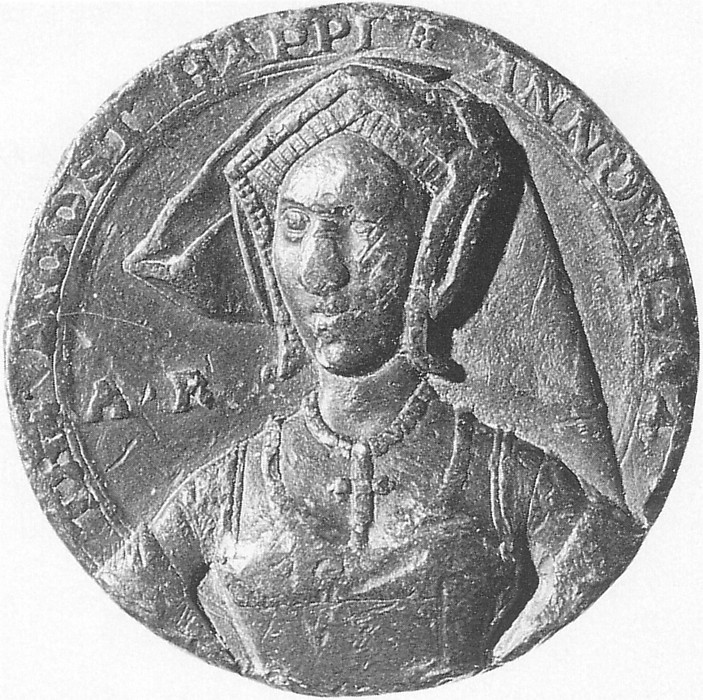
Reigning between queens with mottoes conveying humility and obedience-Katherine of Aragon’s “Humble and loyal” and Jane’s “Bound to obey and serve”-comes Anne Boleyn whose motto was the bold “The most happy”.  Anne adopted this motto as her coronation approached.  She had reason to be “the moost happi”: she had married a supportive and affectionate Henry, she was expecting his child (convinced it was the longed-for male heir), and she had managed to institute several religious changes in the country.

AnneBoleyn4
Anne Boleyn’s medal inscribed around with THE MOOST HAPPI ANNO 1534 and A.R. for Anne Regina next to her portrait

Although some sources attribute the motto “Me and mine” to Anne, this blogger never found true evidence of it.  One motto she adopted in 1530 before she was queen, Aisi sera groigne qui groigne meaning “Let them grumble; that is how it is going to be!” (Ives 141).  This motto had quite a story attached to it.

Paul Friedman was quoting Pascual de Gayangos’ Calendar of State Papers, Spain Vol. 4, Part 2, page 41, which stated that Anne, to show her “contempt for those who opposed her, chose a device which she had heard in France, but which she only partially remembered, Ainsi sera, groigne qui groign! was embroidered on the liveries of her servants” (Friedman 128).  Her arrogance and defiance did not last long.
To her mortification, and to Eustace Chapuys’ glee, she learned that she had “adopted the motto of her bitter enemies, the princes of the house of Burgundy.  ‘Groigne qui groigne’, she heard it repeated, “et vive Bourgoigne!’ The liveries had to be laid aside, and Anne’s servants on Christmas Day appeared in their old doublets” (Friedman 128).

Such a blatant alteration of an Imperialist motto was hardly the way to win supporters at Court and gain Anne acceptance as the replacement of a highly-respected Habsburg queen (Ives 142-143).

The Anne Boleyn Cup. This 16th century gilded silver goblet was given to Dr Richard  Masters by Anne Boleyn, and Dr Masters presented it to the church.
The Boleyn cup 1535-36 in St. John the Baptist Church in Cirencester with motto “The Most Happy.”  Elizabeth inherited this beautiful from her mother and in turn gave it to her physician Richard Master who presented it to the church.

Another motto, Semper eadem, [Always the same], was said to be used by Anne (Weir 324). This blogger could not find primary source evidence to support Anne’s use of this maxim. It was a well-known motto adopted by Anne’s daughter, Elizabeth, when she became queen.  This particular motto appears to be associated with the quality of constancy.  Elizabeth’s constancy can be shown in her willingness to maintain a steadfast government during the transition between her reign and her sister’s.  See the blog entry  https://elizregina.com/2013/04/09/reigned-with-your-loves/ for a list of Marian councilors retained by Elizabeth. Perhaps Elizabeth adopted it for simply sentimental reasons to form a link to her mother.  Another view of this motto reveals it to be a pledge that Elizabeth would not change her religious faith (Collinson 1549).

elizabeth_tudor_coat_of_arms
Coat of Arms of Elizabeth Regina with motto, Semper eadem.

With the childhood fraught with uncertainty and constant change perhaps this motto was a rule in which Elizabeth preferred to live.  It does imply an avoidance of any surprise, uncertainty or disruption.  Could a sovereign associated with such changes that supported exploration, encouraged the Arts and introduced religious reform prefer the status quo?

William Camden deemed Elizabeth’s main care upholding the Protestant faith and her “second care was, to hold an even course in her whole life, and all her actions: whereupon she tooke for her Motto, Semper eadem, that is, Alwayes the same.  The rest of her counsels consisted in these points” (Camden Annales 20). There is some disconnect between this motto and her well-known impulsiveness, indecision and secrecy.

shield motto
 Shield and motto of Queen Elizabeth I by Simon de Passe in the NPG Collection

NPG D42191; Queen Elizabeth I by Simon de Passe, after  Isaac Oliver
 Elizabeth I–obverse of shield and motto line engraving in the NPG collection

Elizabeth’s habit of covering her actions and motives was admired by Camden. When explaining her second motto, Camden discussed her methods “Which notwithstanding Queene Elizabeth dissembled and concealed with silence, according to that motto which she used, video et taceo, that is, I see and say nothing” (Camden Annales 307).

“I see and say nothing” has been termed a political motto used by Elizabeth.  With her impressive humanist education, this motto could be of ancient historical significance or it could be a practical methodology employed by Elizabeth.  No sources that this blogger has discovered definitively explain Elizabeth’s selection of this motto.  An examination of them suggests a link to the equation of Elizabeth’s style with Cicero’s, an acquired maxim from Lady Tyrwhitt, a reflection of her moderate religious policy or a connection to Francis Walsingham’s spy network. More recent authors have interpreted that the use of Elizabeth’s mottoes, Video et taceo, and Semper eadem “alludes to an important feature of prudence, which is that it encompasses the knowledge of when to speak and when to keep quiet” (Broad 34).

ART 246171
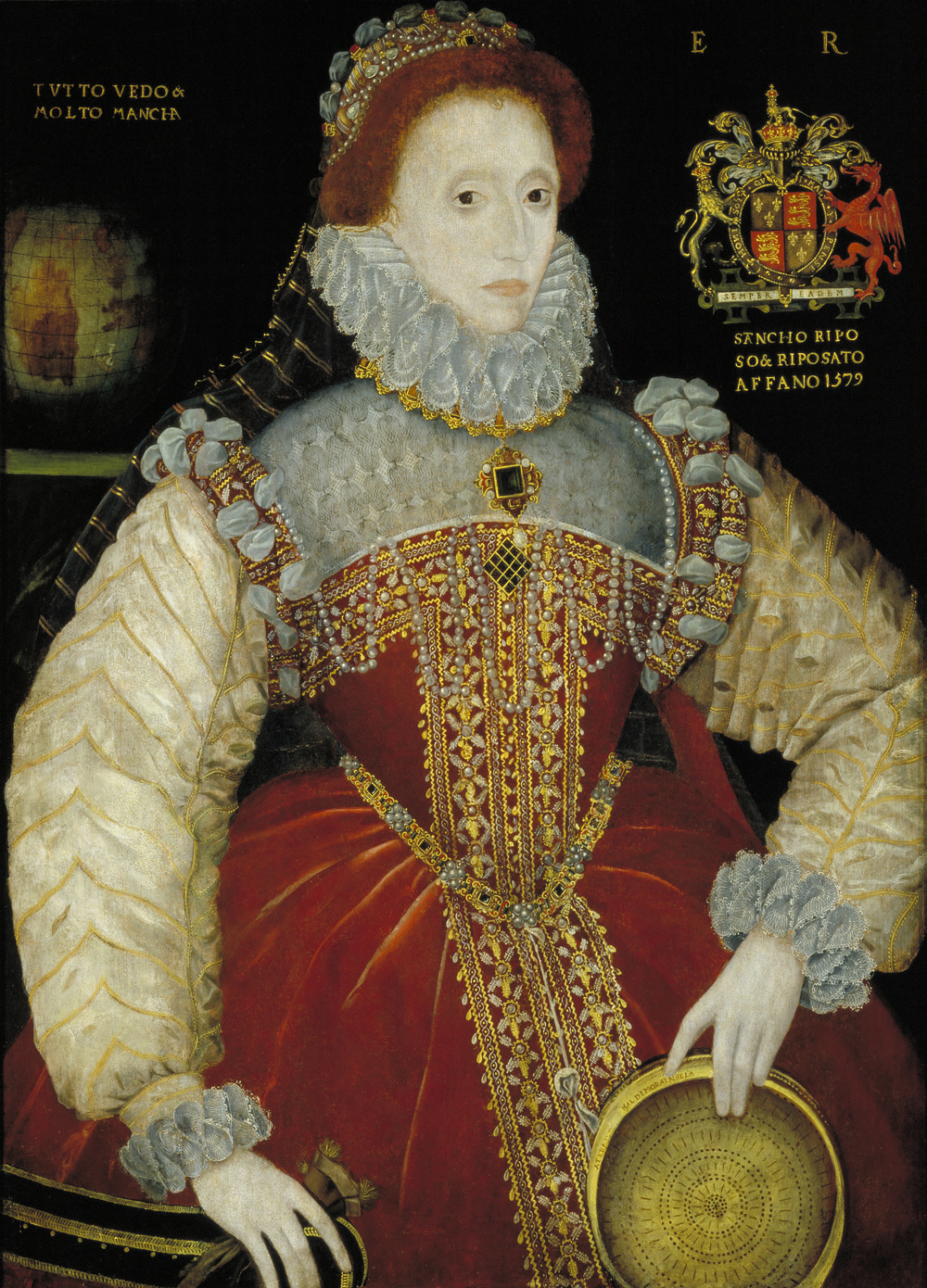
The Plimpton “Sieve” Portrait of Elizabeth  I, by George Gower, 1579.  The sieve alludes to the myth of Tuccia, a roman Vestal Virgin who proved her virginity and prudence by carrying water with a sieve.  The coat of arms and the motto in the top right Honi soit qui mal y pense / Semper eadem [Shamed be he who thinks evil of it / Always the same] are the motto of the Order of the Garter and the personal motto of Elizabeth Regina.

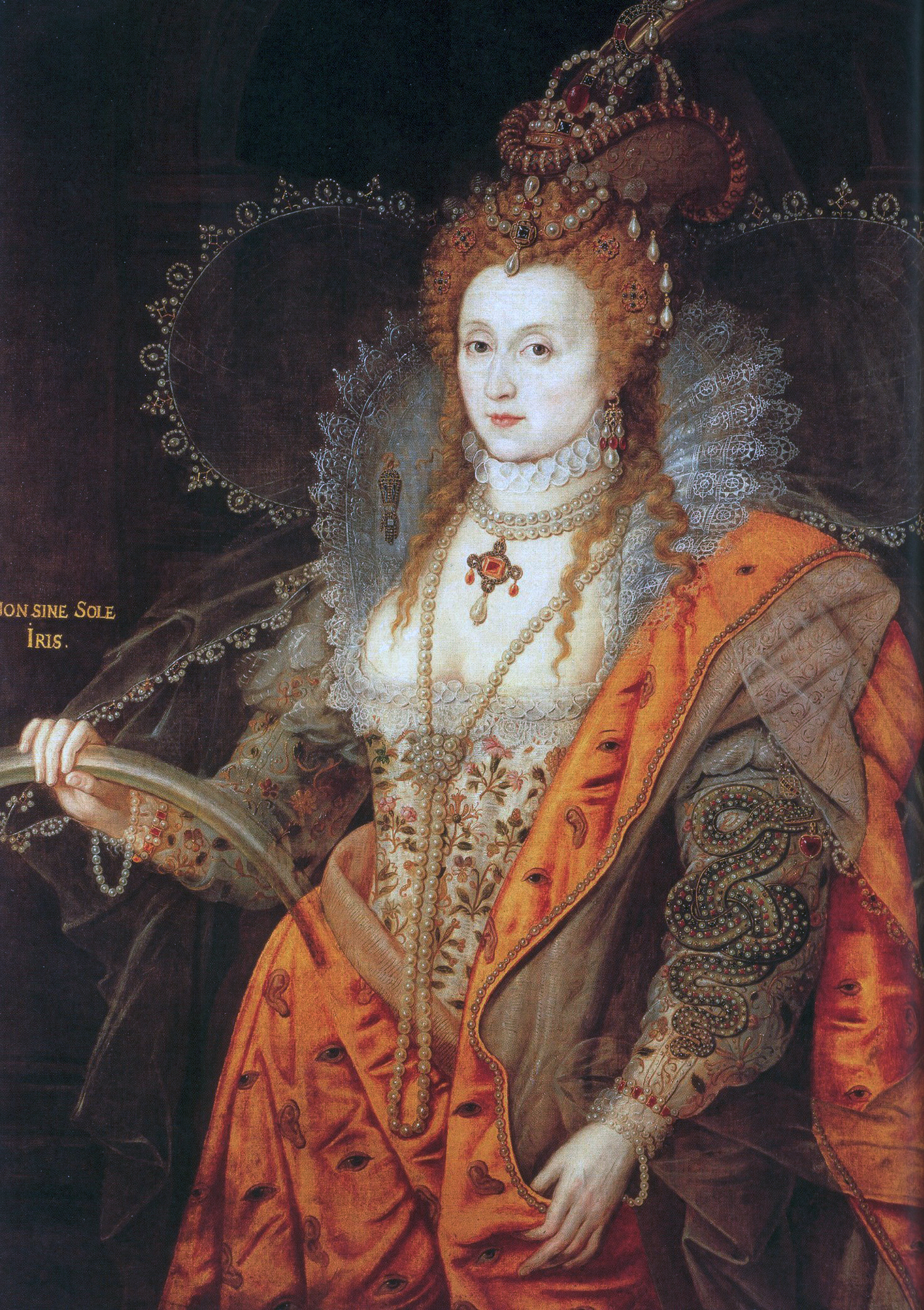
What does come to mind to this blogger is the ‘Rainbow’ portrait of Elizabeth with the eyes and ears embroidered on her gown.  The poet John Davies refers to the ears and eyes as how the Queen uses her servants for a sketch he wrote during the Queen’s visit to William Cecil’s house, Theobalds, in 1591.  When asked what use Elizabeth makes of her servants the reply was “She makes the same use of them as the mynde makes of the sences.  Many things she sees and heares through them; but the judgment and election is her owne” (Nichols 77).  Elizabeth clarified her right to rule and have good counsel early in her reign, “I shall desire you all, my lords, (chiefly you the nobility, everyone in his degree and power) to be assistant to me that I, with my ruling, and you with your service, may make a good account to Almighty God and leave some comfort to our posterity on earth.  I mean to direct all my actions by good advice and councel” (Marcus 52).  Through further research I discovered this idea of Elizabeth’s relationship with her advisors and her motto was further explored by Mary Thomas Crane.

Elizabeth_I_Rainbow_Portrait
The “Rainbow” portrait attributed to Marcus Gheeraerts the Younger, 1600-1603.

Professor Crane begins her article “Although one of her mottoes, ‘semper eadem,’ seems to claim a fundamental unity of character, Queen Elizabeth I nevertheless presents us with an array of poses and personae” (Crane 1).  How true.  Students of Elizabeth Regina are familiar with her paradoxically presenting an image of absolute patriarchal power and one of a ‘weak and feeble woman’. How did Elizabeth maneuver within the Privy Council composed of men whose views were the by-products of a time period when authority and advice-giving were the realm of males?  This was an era that considered “Kings were creatures defined by ancient custom; but queens, however loved and admired, were unpredictable” (Loades 318).

The use of the term ‘video’ assures that Elizabeth will listen and evaluate the advice to make up her own mind, as opposed to ‘audio’ that implies she will “accept blindly her advisors’ spoken counsel” (Crane 2).  In an era when women were to remain silent and obedient, ‘taceo’ insinuates that “as queen, she will maintain the silence thought suitable for a woman …” (Crane 2).  The motto encapsulates the fine line Elizabeth struck between asserting her authority and accepting advice from her Council.

She could be silent and allow her statesmen such as Burghley the role of respected advisor and she could be vocal and affirm her authority.  Crane sees Elizabeth’s motto, Video et taceo, as more of the way she uses the political system and her “use of the paradigm of advice-giving reveals a woman who was less completely bound by male structures than some critics have argued” (Crane 2).  Elizabeth “despite her motto, did not always remain silent….  Her skillful use of the humanist rhetoric of authoritative counsel allowed her to break silence and speak the language of authority as a uniquely powerful woman in a man’s world” (Crane 12).

One can suppose she did not believe her own contradiction to her motto when she  teasingly responded to the French Ambassador after he had praised her linguistic skills,  “There is no marvel in a woman learning to speak, but there would be in teaching her to hold her tongue.”

References

Allison, Ronald and Sarah Riddell, editors. The Royal Encyclopedia. London: Macmillian Press, 1991. Print.

“Arms of Tudors; Arms of Henry VIII; Arms of Edward VI.” Victoria and Albert Museum Collections. Victoria and Albert Museum, n.d. Web. 17 June 2013.

Broad, Jacqueline and Karen Green. Virtue, Liberty, and Toleration: Political Ideas of European Women, 1400-1800.  Dordrecht, The Netherlands: Springer, 2007. Google Books. Web 21 Jun 2013.

Camden, William, Robert Norton, Nicholas Hillard, and Francis Delaram. Annales or the History of the Most Renowned and Victorious Princesse Elizabeth Late Queen of England, Containing All the Important and Remarkable Passages of State, Both at Home and Abroad, during Her Long Ans Prosperous Reigne. Trans. R. N. Gent. 3rd ed. London: Harper, 1635. Google Books. Web. 21 June 2013.

Camden, William. Remaines concerning Brittaine: But Especially England, and the Inhabitants Thereof: Their Languages, Names, Syrnames, Allusions, Anagrammes, Armories, Moneys, Empresses, Apparell, Artillerie, Wise Speeches, Prouerbes, Poesies, Epitaphs. London,: Simon Waterson, 1605. Google Books. Web. 21 June 2013.

Cannon, John and Ralph Griffiths. The Oxford Illustrated History of the British Monarchy.  Oxford:  Oxford University Press, 1988. Print.

Collinson, Patrick. Elizabeth I. Oxford: Oxford University Press, 2007. Google Books. Web. 16 June 2013.

Crane, Mary Thomas. “Video Et Taceo”: Elizabeth I and the Rhetoric of Counsel.” Studies in English Literature 1500-1900 28.1 (1988): 1-15. GeoCities, 2001. Web. 20 June 2013.

Daly, Peter, Leslie Duer, Anthony Raspa. The English emblem tradition. Toronto: University of Toronto Press, 1998. Google Books. Web. 21 June 2013.

“Death Could Not Separate Them: How Elizabeth I Connected to Her Deceased Mother.” Web log comment. Being Bess. Ed. Ashlie Jensen. N.p., 5 Aug. 2012. Web. 20 June 2013.

Doran, Susan.  Henry VIII:  Man & Monarch. London:  British Library, 2009. Print.

Doran, Susan.  The Tudor Chronicles 1485-1603.  New York:  Metro Books, 2008. Print.

Eakins, Laura. “Elizabeth I’s other motto.” TudorHistory. Google+Page, 20 Feb. 2012. Web. 17 June 2013.

Eakins, Laura. “Meaning of Anne Boleyn’s motto.” TudorHistory. Google+Page, 31 Dec. 2009. Web. 19 June 2013.

Friedmann, Paul.  Anne Boleyn: A Chapter of English History 1527-1536. London: Macmillian and Co., 1884. Internet Archive. Web. 21 Jun 2013.

de Gayangos, Pascual (editor). “Spain: January 1531, 21-31.” Calendar of State Papers, Spain, Volume 4 Part 2: 1531-1533 (1882): 31-47. British History Online. Web. 22 June 2013. 

Isaacs, Alan and Jennifer Monk, editors.  The Illustrated Dictionary of British Heritage.  London:  Promotional reprint Company, 1993. Print.

Skeat, Walter W. An etymological dictionary of the English language. Oxford: Clarendon Press, 1993. Print.

Ives, Eric.  The Life and Death of Anne Boleyn: The Most Happy. Oxford: Blackwell Publishing, 2004. Print.

Loades, D. M. Elizabeth I. London: Palgrave Macmillilan, 2003. Google Books. Web. 16 June 2013.

Lloyd, Christopher and Simon Thurley. Henry VIII:  Images of a Tudor King.  London: Phaidon Press Limited, 1990.  Print.

“Medallion:  Arms of Henry VIII and Jane Seymour” Victoria and Albert Museum Collections. Victoria and Albert Museum, n.d. Web. 17 June 2013. 

Nichols, John. The Progresses and Public Processions of Queen Elizabeth. Among Which Are Interspersed Other Solemnities, Public Expenditures, and Remarkable Events during the Reign of That Illustrious Princess. Collected from Original MSS., Scarce Pamphlets, Corporation Records, Parochial Registers, &c., &c.: Illustrated with Historical Notes. New York: B. Franklin, Vol 3, 1823. Google Books. Web. 19 Jan. 2013.

Ross, Josephine.  The Tudors, England’s Golden Age.  London: Artus, 1994.  Print. 

Starkey, David.  Henry VIII:  A European Court in England. New York:  Cross River Press, 1991. Print.

Strong, Roy C. Gloriana: The Portraits of Queen Elizabeth I. London: Pimlico, 2003. Print.

Wagner, John. Historical Dictionary of the Elizabethan World: Britain, Ireland, Europe, and America.  New York:  Checkmark Books, 2002. Print.

Warnicke, Retha.  The Rise and Fall of Anne Boleyn: Family Politics at the Court of Henry VIII. Cambridge:  Cambridge University Press, 1989.  Print.

The Lion’s Grandcub: Conclusion

The Lion’s Grandcub: Conclusion:

Personalities
This blog has discussed in several entries the initial proposal that Henry VII and Elizabeth I were the Tudors who most closely resembled each other.  Discussions included many aspects: their physical appearance, their internships, their manner of rule and their basic accomplishments.

Similarities between Henry VII and Elizabeth Regina are easiest at the superficial level of their appearance.  Obviously, they were described at various times of their lives by numerous people (some perhaps being less subjective than others).  Their physiques were tall, slender, and strong.  Their features were narrow, high-browed, with prominent cheek bones and pale complexions.  For detailed descriptions of both Henry VII and Elizabeth Regina, based on primary sources, consult https://elizregina.com/2013/01/ the blog entry “Eat, Drink and Be Moderate”.

henry 7                 e1 like h7

Character sketches also invoke parallels.  Polydore Vergil’s description of Henry VII could easily be applied to his granddaughter.  Using words such as distinguished, wise, prudent, brave, shrewd, intelligent, and gracious along with praising a “pertinacious memory” (Vergilus 143-147).

Alison Weir’s description of Elizabeth could easily be applied to her grandfather.  Using words such as tenacity, cautious, realism, dissemble, parsimonious, dithering, and devious along with describing a “subtle brain” (Weir 17).

We know that like Henry VII whose speech was “gracious in diverse languages,” his “counseyelles fortunate and taken by wyse delyberacyon” and his “wytte always quycke and redy,” Elizabeth was also praised for her skill at languages, her wise counsel and quick wit (Fisher 269).

Lovers of Peace Not War
Throughout each of their reigns the negotiations undertaken by Henry and Elizabeth on the international level proved what lengths they would go to preserve peace.  Henry VII nor his granddaughter relished the cost of war in lives and money.  Gairdner declared that Henry made overtures to war only when it was “really forced upon him by the necessities of his position” (Gairdner 214).

Bacon was a bit more cynical and believed that Henry VII used “a noise of war” to gain funding from Parliament and so that a peace “might coffer up” (Bacon The Major Works 45).  It was the reality, “by refraining from war he ended solvent…”  (Loades 8).

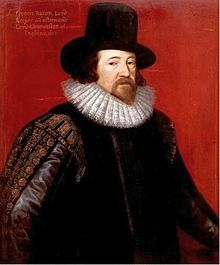
francis bacon 
Sir Francis Bacon

He knew that “the way to peace was not to seem to be desirous to avoid wars: therefore would he make offers and fames of wars, till he had mended the conditions of peace” (Bacon and Lumby 212).  Henry called Parliament together to approve war with France, yet “in his secret intentions he had no purpose to go through with any war” (Bacon and Lumby 91).  For this he was praised at the end of his life for spending “many a day in pease and tranquyllyte” (Fisher 269).

Elizabeth is treated a bit more harshly by the historian James Anthony Froude.  He theorized that during the Scottish Rebellion if Elizabeth I had committed troops and money earlier thousands of lives and pounds would have been saved.  Rather than formulate an aggressive foreign policy to handle the international elements of this issue “she gravitated towards … peace” (Froude 409). “It was like dancing a tight rope.  Her movements may have been extremely clever, but they were also extremely dangerous” (Froude 443-444).

When peace negotiations did not work, both rulers turned to marriage alliances.  As a way to establish the legitimacy of their rule there was no faster way than to have a powerful, established foreign power seriously consider such a match with the Tudor Dynasty.  Weddings were far cheaper than wars.

Their preference for peace could have been their natural dispositions or political clemency. As seen in their handling of insurgents (Perkin Warbeck and Mary, Queen of Scots) both Henry VII and Elizabeth I were reluctant to execute.  Unless the security of the realm dictated otherwise, punishments were imprisonment, loss of lands and fines.

Perkin warbeck       mary scots
Perkin Warbeck                                      Mary, Queen of Scots

Renaissance Princes
Henry had reason to bolster the legitimacy of his claim to the English throne and Elizabeth had reason to bolster her right to the throne being declared an illegitimate child and as an unmarried woman.  Surprisingly one way these two rulers intended to establish the Tudor Dynastic legitimacy was through patronage of the arts.

“Henry assembled an impressive array of scholars and notables at his court, favouring the foreign-born rather than the native English” (Tucker 327).

“The King’s passion for music, court revels, sport, foreign scholarship, and more lowly amusements, reveals a keen interest in life and in the new intellectual currents which were transforming the Continent” (Tucker 331).  Consequently, many Continental elements “evolved to a distinct English form” and were manifested in the marriage celebrations of Arthur, Prince of Wales and Katherine of Aragon in 1501 (White 141).

Arthur_Prince_of_Wales            Katherine-of-aragon
Arthur, Prince of Wales                              Katherine of Aragon

Gordon Kipling persuades us that Henry VII felt compelled to display the “magnificence of his royal household and regime through calculated patronage of literature, drama, painting, music, glasswork, tapestry, and every aspect of cultural life…. Henry’s patronage …has been consistently undervalued” (White 141).

Henry employed humanistic tutors for his children.  The men at Oxford that Erasmus praised “were in the vanguard of the English humanists who were reforming education at both the secondary and university level” (Tucker 329).

erasmus1         oxforduniversity
Erasmus                                         Modern view of Oxford University

Royal daughters as well as royal sons were educated and we saw that carried through to Elizabeth’s own education. Here we must give her father, Henry VIII, and her mother, Anne Boleyn, credit for continuing Henry VII’s interests in classics, foreign languages, religion, art, music, dance and deportment.

H8 AB
Henry VIII and Anne Boleyn

While Henry can be credited with adding the secular classical themes of the Franco-Burgundian Court to England which encouraged alternative cultural elements, Elizabeth added national days, such as Accession Day, rather than religious days to the calendar which encouraged the Renaissance to take firm hold during her reign (Loades 71).

Jan van Dorsten argues that in Elizabethan England “patronage had declined to a very low ebb by the beginning of Elizabeth’s reign” which was certainly reversed by the end of her rule as “the use of patronage to secure political ends by Elizabeth’s courtiers was still intense in a political context”  (White 140).  Elizabeth’s Court is famous for patronizing troupes of actors, yet recognition as the first sovereign to sponsor troupes of dramatic players goes to Henry VII.

henry7manuscript2
Henry VII being presented with a manuscript on astrology

Lord Chamerlain's Men
The Lord Chamberlain’s Men, sponsored by the Lords Hunsdon until King James I took over patronage.

Elizabeth became the subject of many artists’ work from portraits, sonnets and famously, The Faerie Queene.  Decades earlier, Henry was compared to the legendary Hercules by Bernard Andre in the poem, Les Douze Triomphes de Henry VII (Tucker 328).

Andre became a tutor for Prince Arthur making true Gordon Kipling’s observation that “Artists in his [Henry VII’s] service became servants in his household…his artists were expected to enhance his estate through their poetry, pageantry, and paintings” (White 140).

Circumstances of Childhoods
Without getting into the ‘nature v. nurture’ debate, one must acknowledge that hereditary traits, physiological and psychological, are present in family members even when the people are not in close proximity (or one has died before the birth of descendants).  Also circumstances of a childhood can greatly effect a person.

The upbringings of Henry VII and Elizabeth I (discussed in earlier blogs, “Fate is Remarkable’ and “Persona Non Grata” at www.elizregina.com) taught them to be cautious.  “Always guarded in his dealings with others” (Jones 75), Henry’s caution came via military experience and living as a prisoner and political exile for most of his early life.  Elizabeth learned early to “keep her own counsel, control her emotions, and to behave circumspectly in public… ” (Weir 17).

Neither Henry nor Elizabeth was kept in the English public’s eye, so to speak, yet both managed to gain widespread support.  Henry, living away from England, lost familiarity with English politics.  Why so popular?  Was it his appeal or were people tired of war?

Elizabeth could have been seen as the calming answer to the religious upheaval from Queen Mary’s reign.  Regardless of why, somehow Henry and Elizabeth managed to convey a belief that they had the good of the people at heart.  It worked.  Years later Elizabeth would exclaim “I care not for myself; my life is not dear to me.  My care is for my people” (Elizabeth I).

While Henry learned his statecraft through the observations of Louis XI, The Spider, Elizabeth learned from William Cecil.  Henry’s policies of taxation and financial extractions, plus his use of men from the mercantile class as advisors and intelligence agents throughout his reign, came straight from ‘The Spider’ (Wilson 15).  Elizabeth adopted most of these ideas in a broad sense.  When she learned from William Lambarde, The Keeper of the Records at the Tower of London, about money lent to subjects for bond repayment, she exclaimed, “So did my good grandfather King Henry VII, sparing to dissipate his treasure or lands” (Rowse 56).

Louis Spider King            William Lambarde
Louis XI, The Spider               William Lambarde

Quotation of Psalms
Their religious and Latin studies emerged in a simplistic way as both quoted psalms at the crucial time of their rise to power.  When Henry landed on English soil he reportedly quoted Psalm 43:1, Judica me, Deus, et discerne causam meam de gente non sancta: ab homine iniquo et doloso erue me. Do me justice, O God, and fight my fight against an unholy people, rescue me from the wicked and deceitful man (Temperley 16).

Elizabeth is said to have whispered from Psalm 118:23 what she truly must have felt, “A Domino factum est istud et est mirabile in oculis nostris.” This is the Lord’s doing, and it is marvelous in our eyes.

e1 at prayer
Elizabeth Regina at prayer

Big Picture, Small Details
Having a strong general background on the lives of Henry VII and Queen Elizabeth this blogger decided on the topic series, The Lion’s Grandcub.  Comparing the two opened up avenues of study previously unexplored.  So many things were learned, so many more questions raised, so many hours diverted from other topics—what bliss for an amateur historian.

Perhaps the biggest surprise was the discovery of so many sources available digitally and in translation.  Of course, many primary sources are not objective and history tends to revise its opinion on past figures.  Regardless, research eventually taps all available resources and the historian, left to the mercy of said sources, is stopped.  That was not the case here. Instead this blogger had to restrain herself and resist continued inquiry into these fascinating characters of Henry VII and Elizabeth I.

Both sovereigns were intelligent, tenacious, independent, and dedicated. They strengthened the country through their appointment of capable advisors, promotion of the arts, fiscal policies and adherence to peace at home and abroad.  How easy to admire them as exceptional rulers in exceptional times.

Although this series is completed, this blogger is eagerly anticipating dealing with other topics concerning Elizabeth Regina.

References

Bacon, Francis.  The Major Works.  Ed. Brian Vickers. Oxford: Oxford University Press, 2002.  Google Books. Web. 9 Mar. 2013.

Bacon, Francis, and J. Rawson Lumby. Bacon’s History of the Reign of King Henry VII,. Cambridge: University, 1902. Internet Archive. Web. 22 Jan. 2013.

Carpenter, Christine. The Wars of the Roses: Politics and the Constitution in England, C. 1437-1509. Cambridge: Cambridge University Press, 1997. Google Books. Web. 21 Apr. 2013.

Elizabeth I. ed. Chamberlain, Frederick.  The Sayings of Queen Elizabeth I.  Londo:  Dodd, Mead & Company: New York, 1923.  Google Books.  Web.  11 Mar. 2013

Fisher, John, and John E. B. Mayor. “Sermon Sayd in the Cathderall Chyrche of Saynt Poule within the Cyte of London the Body Being Present of the Moost Famous Prynce Kyng Henry the VIII, 10 May MCCCCCIX. Enprinted by Wynkyn De Worde 1 H. VIII.”The English Works of John Fisher, Bishop of Rochester. London: N. Trübner for the Early English Text Society, 1876. 268-88. Google Books. Web. 1 Dec. 2012.

Froude, James Anthony. History of England from the Fall of Wolsey to the Defeat of the Spanish Armada. London: Longman, Green, 1908. Google Books. Web. 10 Mar. 2013. 

Frye, Susan.  Elizabeth I:  The Competition for Representation. Oxford:  Oxford Univseity Press. 1993. Print.

Gairdner, James. Henry the Seventh,. London: Macmillan, 1889. Google Books. Web. 26 Nov. 2012.

The History of the Life and Reign of That Excellent Princess Queen Elizabeth from Her Birth to Her Death: As Also the Trial, Sufferings, and Death of Mary Queen of Scots. With the Whole Proceedings of the Divorce of King Henry VIII. from Queen Catherine; His Marriage with the Lady Anne Bullen, and the Cause of Her Unfortunate Death on the Scaffold. London: Printed, and Sold by the sellers in Town and Country, 1739. Google Books. Web. 9 Mar. 2013.

Jones, Michael K. and Malcolm G. Underwood.  The King’s Mother: Lady Margaret

Beaufort, Countess of Richmond and Derby. New York: Cambridge University Press. 1992. Print.

Loades, David, ed. The Tudor Chronicles: The Kings.  New York: Grove Weidenfeld, 1990.  Print.

Rowse, A. L. The England of Elizabeth; the Structure of Society. New York: Macmillan, 1951. Google Books. Web. 20 Feb. 2013.

Temperley, Gladys. Henry 7. London: Constable, 1917. Google Books. Web. 20 Feb. 2013.

Thornton, Tim. Prophecy, Politics and the People in Early Modern England. Woodbridge: Boydell, 2006. Google Books. Web. 2 Feb. 2013.

Thomas, Heather, M.Phil. “Elizabeth R.” Elizabeth I’s Pastimes. Self-Published, 27 Sept. 2012. Web. 21 Apr. 2013.

Tucker, M. J. “Life at Henry VII’s Court.” History Today. History Today.com, n.d. Web. 4 Feb. 2013.

Vergilius, Polydorus, and Denys Hay. The Anglica Historia of Polydore Vergil: A.D. 1485-1537. Google Books.  Web. 2 Jan. 2013.

Weir, Alison.  The Life of Elizabeth I.  New York: Ballatine Books, 1998. Print.

White, Paul Whitfield., and Suzanne R. Westfall. Shakespeare and Theatrical Patronage in Early Modern England. Cambridge, UK: Cambridge UP, 2002. Google Books. Web. 17 Feb. 2013.

Wilson, Derek. “Web of Intrigue.” History Today 63.4 (2013): 10-16. Print.