Path to St. Peter ad Vincula-Part VI-D

Path to St. Peter ad Vincula-Part VI-D

It is not the intent here to explain the entire proceedings of the trials of the men in question.  It shall suffice to say that the evidence was flimsy at best and non-existent in most cases.  Even Ambassador Chapuys, an outspoken opponent of Anne, recognized that with only one of the men confessing to the alleged crimes, the “others were condemned upon presumption and certain indications, without valid proof or confession” (Gairdner X 908). 

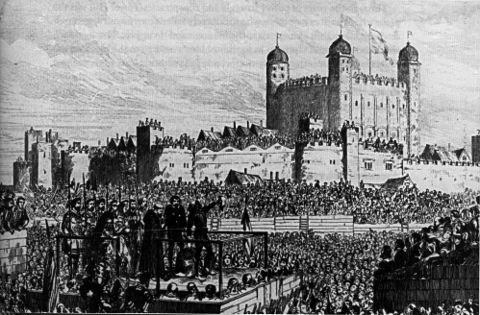
Indicted in the counties of Kent and Middlesex, as the locations of the alleged treason, Court records show that Anne and the accused were not even in the same surroundings at the same time. Regardless, on May 12th the four commoners, Norris, Weston, Brereton and Smeaton, were tried in Westminster Hall by a Commission of Oyer and Terminer and found guilty in Westminster Hall by the “lords of the Kinges Counsell” (Wriothesley 36).  Judgment was given, that they should be drawn to the place of execution, and some of them to be hanged, others to be beheaded, and all to be quartered, as guilty of high treason” (Burnet 263). All “the gentlemen were beheaded on the Skaffolde at the Tower hyll” (Hall 268). 
A Trial for High Treason, in Westminster Hall, during the Tudor period
A trial for high treason in Westminster Hall during the Tudor period, albeit a 17th century drawing.

Anne’s Letter to King Henry VIII
Henry VIII was the targeted recipient of a letter from Anne while she was in the Tower.  Is it a forgery?  This blogger will not take a position on that issue.  Granted there are unusual circumstances surrounding its discovery. Found with Sir William Kingston’s letters among Cromwell’s papers, scholars have agreed that stylistically it is from the Tudor Era.  Also agreed, the document is not in Anne’s handwriting.  This is not actually a deal breaker since it can easily be explained as being a copy.  At the top of the sheet the letter is “endorsed, ‘To the King from the Ladye in the Tower’ in Cromwell’s handwriting” (Bell 99). It does not make sense why Cromwell would refer to Anne as ‘The Ladye in the Tower’ unless he did not want to call attention to the missive but wanted to preserve it. Because of the location amongst Cromwell’s papers many historians find it plausible to be authored by Anne.

The “pathetical letter” has been described as “farther proof of the innocence” of Anne (Smeeton 48).  She “pleaded her innocence, in a strain of so much wit and moving passionate eloquence, as perhaps can scarce be paralleled: certainly her spirit is were much exalted when she wrote it, for it is a pitch above her ordinary style” (Burnet 319). The “letter contains so much nature, and even elegance, as to deserve to be transmitted to posterity…” (Hume, David 458).  Regardless of her expressiveness, the plea never reached Henry’s hands—maybe she knew that would happen which is why she gave way to her frustration over Jane Seymour and did indulge in some scolding.  Worthy of reading it is reproduced in its entirety below.

“Sir, your grace’s displeasure and my imprisonment are things so strange unto me, as what to write or what to excuse I am altogether ignorant.  Whereas you send unto me (willing me to confess a truth, and so obtain your favour) by such an one whom you know to be mine ancient professed enemy, I no sooner received this message by him than I rightly conceived your meaning; and if as you say, confessing a truth indeed may procure my safety, I shall with all willingness and duty perform your command. 

‘But let not your grace ever imagine that your poor wife will ever be brought to acknowledge a fault where not so much as a thought thereof preceded.  And, to speak a truth, never prince had a wife more loyal in all duty, and in all true affection, than you have ever found in Anne Boleyn: with which name and place I could willingly have contented myself, if God and your grace’s pleasure had been so pleased.  Neither did I at any time so far forget myself in my exaltation or received queenship, but that I always looked for such an alteration as I now find; for the ground of my preferment being on no surer foundation than your grace’s fancy the least alteration I know was fit and suffient to draw that fancy to some other object.  You have chosen me from a low estate to be your queen and companion, far beyond my desert or desire.  If then you found me worthy of such honour, good your grace let not any light fancy, or bad counsel of mine enemies, withdraw your princely favour from me: neither let that stain, that unworthy stain, of a disloyal heart towards your good grace, ever cast so foul a blot on your most dutiful wife and the infant princess your daughter.  Try me, good king, but let me have a lawful trial, and let not my sworn enemies sit as my accusers and judges; yea let me receive an open trial, for my truth shall fear no open shame; then shall you see either mine innocence cleared, your suspicion and conscience satisfied, the ignominy and slander of the world stopped, or my guilt openly declared.  So that whatsoever God or you may determine of me, your grace may be freed from an open censure; and mine offence being so lawfully proved, your grace is at liberty both before God and man not only to execute worthy punishment on me as an unlawful wife, but to follow your affection already settled on that party for whose sake I am now as I am, whose name I could some good while since have pointed unto, your grace not being ignorant of my suspicion therein.

‘But if you have already determined of me, and that not only my death, but an infamous slander, must bring you the enjoying of your desired happiness, then I desire of God that he will pardon your great sin therein, and likewise mine enemies, the instruments thereof, and that he will not call you to a strict account of your unprincely and cruel useage of me, at his general judgment seat, where both you and myself must shortly appear, and in whose judgment I doubt not (whatsoever the world may think of me) mine innocence shall be openly known and sufficiently cleared.

‘My last and only request shall be, that myself may only bear the burden of your grace’s displeaure, and that it may not touch the innocent souls of those poor gentlemen who (as I understand) are likewise in strait imprisonment for my sake.  If ever I have found favour in your sight, if ever the name of Anne Boleyn hath been pleasing in your ears, then let me obtain this request, and I will so leave to trouble your grace any farther, with mine earnest prayer to the Trinity to have your grace his good keeping, and to direct you in all our actions.  From my doleful prison in the Tower, this sixth of May; Your most loyal and ever faithful wife, –Anne Boleyn” (“Condemnation of Anne Boleyn” 289).
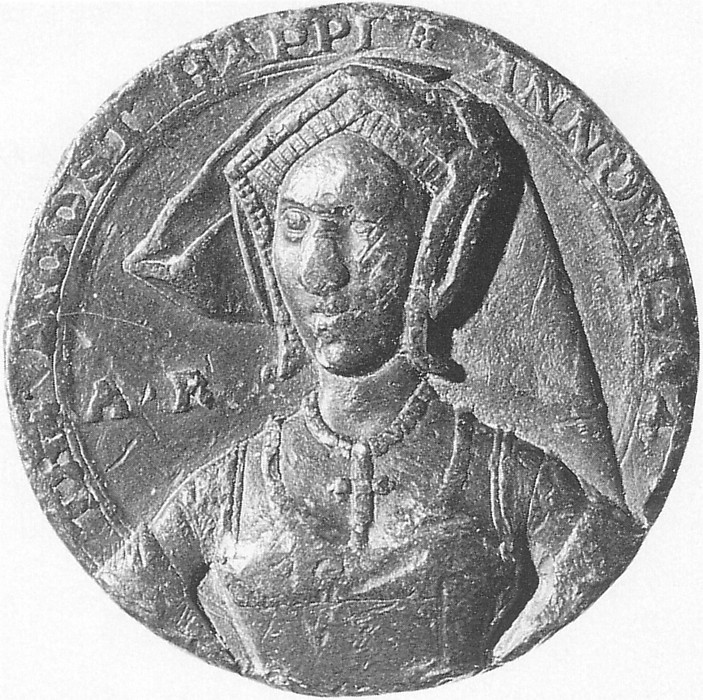
Anne Boleyn Hever
Anne Boleyn, Hever Portrait

Trials and Tribulations:
Beyond the accusations of adultery and incest–this charge was brought against her brother “because he had been once found a long time with her” (Gairdner X 908), Anne was “accused of having conspired with these five men to bring about the death of the king, and of having said that she did not love him, and that after his death she would marry one of her lovers”  (Friedmann II 262-263).  The indictment claimed that “despising her marriage, and entertaining malice against the King, and following daily her frail and carnal lust, did falsely and traitorously procure by base conversations and kisses, touchings, gifts, and other infamous incitations, divers of the King’s daily and familiar servants to be her adulterers and concubines, so that several of the King’s servants yielded to her vile provocations” (Gairdner X 876). Whether these were truths, “or the effects of imagination and vapours, cannot be certainly determined at this distance.  It is probable there had been some levities in her carriage that were not becoming” (Burnet 111).

‘Levities in her carriage’—the Council’s reaction to indiscretions seems rather severe to modern eyes.  This is why it is difficult for present day students to grasp the magnitude of Henry’s personality, the strength of his sycophantic Court and the effects of the social, political and religious institutions of the Tudor Era. Could Anne have been divorced and set aside as her successor Anne of Cleves would be?  Most likely not.  Anne of Cleves had powerful international connections which made her survival more important; she did not have any children who needed to be clearly shown as illegitimate; and she followed Anne Boleyn—circumstances were altered because of what happened in 1536. Henry, and more importantly Cromwell, saw the need to eliminate Anne Boleyn, destroy her reputation, weaken the powerful factions at Court and send a message to the world—Henry VIII was in control in England (Okay, based on the charges against Anne, he could not control his wife, but assuredly no one was going to make that connection to him).

On May 15, 1536, the Queen was brought into the King’s Hall of the Tower of London “where was made a chaire for her to sitt downe in, and then her indictment was redd” (Bell 102).  Anne was arraigned “for treason againste the Kinges owne person” (Wriothesley 37).  The crimes charged on her were that “she had procured, her brother and the other four to lie with her, which they had done often; that she had said to every one of them by themselves, that she loved them better than any person whatsoever: which was to slander the issue that was begotten between the king and her and this was treason, according to the statute made in the twenty sixth year of this reign….  It was also added in the indictment, that she and her accomplices had conspired the king’s death” (Burnet 263-264). Ales claimed the Queen had been “accused of having danced in the bedroom with the gentlemen of the King’s chamber and of having kissed her brother” (Stevenson 1303).  Chapuys reported that “there was a promise between her and Norris to marry after the King’s death,” she had “laughed at the King and his dress,” and “certain ballads that the King composed” were snickered at by Anne and her brother “as foolish things, which was objected to as a great crime” (Gairdner X 908).

Court proceedings were not conducted in secret for there were more than 2,000 persons present and documents exist in the Public Records Office which show the trial was conducted “with a scrupulousness without a parallel in the criminal records of the time” (Bell 103).  Twenty-six peers tried Anne and George Boleyn with the Duke of Norfolk acting as Lord High Steward accompanied by “the duke of Suffolk, the marquis of Exeter, the earls of Arundel, Oxford, Northumberland, Westmoreland, Derby, Worcester, Rutland, Sussex, and Huntington; and the Lords Audley, Delaware, Montague, Morley, Dacres, Cobham, Maltravers, Powis, Mounteagle, Clinton, Sands, Windsor, Wentworth, Burgh, and Mordaunt” (Burnet 263-264).  For details of the trial see materials by Bell, Burnet, Cavendish, Friedmann and Howell to name a few.  This blog entry will direct comments to specific areas of interest.

thomas howard norfolk
Thomas Howard, Duke of Norfolk, Anne’s uncle and judge

Obviously the verdict was a foregone conclusion.  Though unassisted by counsel, Anne “made so wise and discreete aunsweres to all thinges layde against her, excusinge herselfe with her wordes so clearlie, as thoughe she had never bene faultie to the same” (Wriothesley 37-38).  She defended herself so well “the spectators could not forbear pronouncing her entirley innocent” (Hume 328).  Alas, it was for naught.  Not only was it Henry’s will that Anne be found guilty but logically with her trial coming after four men had been found culpable of adultery with her, the chances of her being reprieved were non-existent no matter what the evidence or lack thereof.

Anne Boleyn Museum Lit Sci
An engraving of Anne Boleyn’s trial by Kearney from a painting by Smirk

The Commission could not bring Smeaton, the only person who confessed to a crime, forward to confront the Queen because he had been convicted three days earlier and could not be used as a witness.  Therefore, the evidence brought in was hearsay and unsubstantiated.  Many historians have discussed the role of Jane Boleyn, Lady Rochford (Anne’s jealous sister-in-law); Lady Bridget Wingfield (a lady of the bedchamber who had died in 1534–the evidence used was a letter written by Bridget to someone else about Anne); and, Elizabeth Browne, Countess of Worcester (Anne’s lady-in-waiting who initiated infidelity rumors in early 1536).  “From such arguments as those which were advanced against the Queen … no probable suspicion of adultery could be collected” (Stevenson 1303).

“Rochford was said to have been arrested for having connived at his sister’s evil deeds” (Friedmann II 256) and for “having spread reports which called in question whether his sister’s daughter was the King’s child” (Gairdner X 908). This last accusation is preposterous!  Why would a man whose very livelihood depended on his royal connections infer his niece was not of royal blood?  Interestingly, Chapuys, no friend to the Boleyns, claimed that Rochford defended himself against the charges so well “several of those present wagered 10 to 1 that he would be acquitted, especially as no witnesses were produced” (Gairdner X 908).  Acquittal was not in the plans.  The Bishop of Carlisle told Chapuys that the “King had said to him, among other things, that he had long expected the issue of these affairs” (Gairdner X 908).

George_Boleyn_signature
Signature of George Boleyn, Lord Rochford

For References, please refer to Path to St. Peter ad Vincular Part I
Path to St. Peter ad Vincula-Part VI-C

Path to St. Peter ad Vincula-Part VI-C

When is a Friend Not a Friend?

Some people at Court were not opposed to Anne and many owed their positions to her patronage, but the vast majority of them were pliant (or worldly) enough to realize doing the King’s bidding would be the most expedient. Therefore, Anne’s friends did little to help her and even less to support her good name.  Most were content to let the events unfold while distancing themselves from anyone closely associated with her.  A story circulated that reached the ears of the Imperial Ambassador Eustace Chapuys, who relished in relaying it to his king, Charles V.  Evidently, on being consulted whether Anne and Henry were truly married, the Bishop of London, John Stokesley, replied he would “not give any opinion to anyone but the King himself.”  And “before doing so he would like to know the King’s own inclination” (Gairdner X 752).  It is easy to interpret this to mean that Stokesley would not put himself in danger knowing the king’s volatility. 

One young man, Roland Buckley, a lawyer at Grey’s Inn, seemingly wholly unconnected with Anne, wrote to his brother Richard, Chamberlain of North Wales, on May 2nd when he heard the news of Anne’s arrest. He quickly dispatched the following letter into the hands of a trusted servant, Geoffrey Griffith.
     “Sir ye shall untherstande that the queene is in the towere, the ierles of Wyltshyre her father my lorde Rocheforde her brother, maister norres on of the king previe chamber, on maister Markes on of the kings preyve chamber, wyth divers others soundry ladys. The causse of there committing there is of certen hie treson comytyde conscernyng there prynce, that is to saye that maister norres shuld have a doe wyth the queyne and Marke and the other acsesari to the sayme. The arre lyke to suffyre, all ther morre is the pitte” (Gairdner X 785).
     ‘Yff it plesyde good otherwise I praye you macke you redy in all the haste that can be and come downe to youre prynce for you your seffte may do more than xx men in your absence, therefore mayke haste for ye may be ther or onny a worde be of theyr deth, when it is ones knowe that the shall dede all wilbe to latte therefore mayke haste” (Friedmann 258). 

Geoffrey was apprehended near Shrewsbury on his way to Wales.  The letter was found and caused concern among the local dignitaries.  Buckley seemed to be enticing his brother to take some type of action—not specifically stated but obviously feeling Richard could hold the persuasive power of 20 men over Henry.  Roland Lee, Bishop of Coventry and Lichfield, along with three other prominent citizens, wrote to Secretary Cromwell requesting guidance or more specifically “the King’s pleasure” in dealing with the situation (Gairdner X 820). Frustratingly, this blogger has not been able to uncover what actions were taken against the three principals involved.   

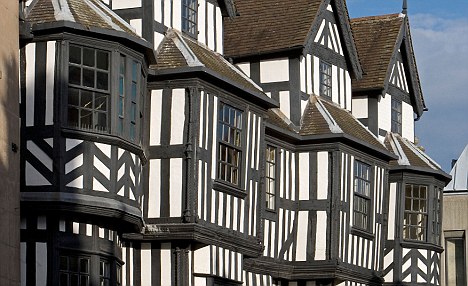
Shrewsbury timber framed building Shropshire UK Great Britain
Buildings from the Tudor era in Shrewsbury.

Understandably, the arrests led to a great deal of talk and several letters survive written from diplomats, churchmen and merchants.  Reports varied in accuracy (from the outlandish, such as Anne’s mother had been arrested to pinpoint correctness in naming which prisoners would be allowed to escape) and tone (from gleeful fascination to straightforward disinterest).

Sir John Duddeley wrote to Lady Lisle on some issue of patronage and concluded that he was sure “there is no need to write the news, for all the world knows them by this time. Today Mr. Norres, Mr. Weston, William a Brearton, Markes, and lord Rocheforde were indicted, and on Friday they will be arraigned at Westminster. The Queen herself will be condemned by Parliament. Wednesday, 10 May” (Gairdner X 837). 

A footnote in Friedmann’s text relayed from the letter of Eustace Chapuys to the Emperor Charles V that the commitment of Anne and her brother to the Tower along with others “is of certen hie treson comytyde conscernyng there prynce, that is to saye that maister norres shuld have a doc with the queyn and Marke and the other acesari to the sayme” (Friedmann 256).

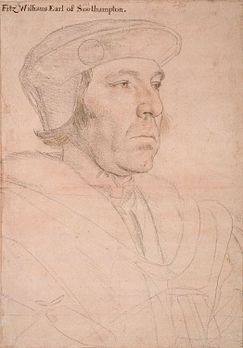
Sir Edward Baynton wrote to Treasurer FitzWilliam (it is assumed this is William FitzWilliam, 1st Earl of Southampton when he was Treasurer of the Household), with concern over the lack of confessions from the prisoners.  He then cryptically comments that “I have mused much at [the conduct] of Mrs. Margery, who hath used her[self] strangely toward me of late, being her friend as I have been. There has been great friendship of late between the Queen and her. I hear further that the Queen standeth stiffly in her opinion, that she wi[ll not be convicted], which I think is in the trust that she [hath in the o]ther two” (Gairdner X 799).  An interesting mix of gossip and worry for himself—letting an official know that he has been associating with someone close to the Queen but in a benign capacity.

William_Fitzwilliam
Sir William Fitzwilliam, Earl of Southampton, by Hans Holbein

The Mayor of Sandwich wrote to Henry VIII concerning the Queen’s emissary, Sir Reverend William Latymer, who had been to Flanders on business for the Queen.  Evidently, Latymer had purchased several books in her name.  Some “of the books he had with him, and of others in his mail, which had not yet arrived, but which were to be conveyed to London to one Mrs. Wilkinson” (Gairdner X 827). Luckily for all involved, Thomas Boys, “one of the King’s servants”, was present who would “convey Latymer himself to the King” and directly testify about the books and Latymer’s role.

Catholic hopes ran as high as the gossip swirled.  Cardinal Rudolfo Pio da Carpi, Bishop of Faenza, optimistically wrote to Prothonotary Monsignor Ambrogio Ricalcato, Chief Secretary to Pope Paul III, “News came yesterday from England that the King had caused to be arrested the Queen, her father, mother, brother, and an organist with whom she had been too intimate. If it be as is reported, and as the cardinal Du Bellay has given him to understand, it is a great judgment of God” (Gairdner X 838). 

 Bishop of Faenza
Cardinal Rudolfo Pio, Bishop of Faenza by Francesco de’ Rossi and in the 
Kunsthistorisches Museum, Vienna, Austria

John Husee, Lord Lisle’s London business agent, kept his boss informed of the happenings in London.  On May 12th he shared, “Today Mr. Norrys, Weston, Bryerton, and Markes have been arraigned, and are judged to be drawn, hanged, and quartered. They shall die tomorrow or Monday. Anne the queen, and her brother, shall be arraigned in the Tower, some think tomorrow, but on Monday at furthest, and that they will suffer there immediately ‘for divers considerations, which are not yet known.’ Mr. Payge and Mr. W[y]at are in the Tower, but it is thought without danger of life, though Mr. Payge is banished the King’s court for ever” (Gairdner X 855).

The next day Husee succumbed to the confusion of reports by declaring that there “are so many tales I cannot tell what to write. This day, some say, young Weston shall escape, and some that none shall die but the Queen and her brother; others, that Wyat and Mr. Payge are as like to suffer as the others. The saying now is that those who shall suffer shall die when the Queen and her brother go to execution; but I think they shall all suffer. If any escape, it will be young Weston, for whom importunate suit is made” (Gairdner X 865).

Later John Husee’s opening remarks in a letter to Lady Lisle exclaimed over the world’s previously collective writings that vilified women were “nothing in comparison of that which hath been done and committed by Anne the Queen; which, though I presume be not althing as it is now rumoured, yet that which hath been by her confessed, and other offenders with her by her own alluring, procurement, and instigation, is so abominable and detestable that I am ashamed that any good woman should give ear thereunto. I pray God give her grace to repent while she now liveth. I think not the contrary but she and all they shall suffer” (Gairdner X 866).

Husee heraldry
John Husee heraldry 

A Portuguese merchant in London wrote to a contemporary back home, “The Council then declared that the Queen’s daughter was the child of her brother; and that as the child of a private person, the child be forthwith removed from that place; and that the King should again receive that Princess who was the daughter of the former and the true Queen, as his own and real daughter, and as being his successor in the kingdom” (Urban 56).

With the current situation so unpredictable, Anne’s friends and allies had to distance themselves from her and dared not interfere.  It appeared as if “all the Court was now turned against her, and she had no friend about the King but Cranmer and therefore her enemies procured an order for him not to come to Court” (Burnet 111).

Archbishop of Canterbury Thomas Cranmer’s Letter to Henry VIII

Aware of what he owed to her favor, Cranmer made an attempt to show his gratitude to the Queen by writing a letter to Henry VIII on May 3, 1536, expressing his favorable impressions of Anne “as far as was consistent with prudence and charity” (Burnet 260).  Cranmer knew the king’s temperament and an out and out defense of Anne would place the Archbishop of Canterbury in jeopardy.

Cranmer began by informing Henry that he had relocated to Lambeth to await the king’s pleasure and with the wish to bring comfort.  Cranmer consoled the king that with Henry’s “great wisdom, and by the assistance of God’s help, somewhat to suppress the deep sorrows of your grace’s heart, and to take all adversities of God’s hands both patiently and thankfully” (Burnet 260).

The Archbishop acknowledged the grievances Henry faced “whether the things that commonly be spoken of be true or not” (Burnet 261).  The king was likened to Job and Cranmer stressed that by accepting adversities as well as glory he was showing his obedience to God.   After flattering Henry, Cranmer then goes on to cushion his remarks which were favorable to Anne.  Yes, here is a man nervous of his own position and even, life yet conscientious enough to know he is obliged to Anne to utter some words of support.
Thomas_Cranmer
Thomas Cranmer, Archbishop of Canterbury

“And if it be true, that is openly reported of the queen’s grace, if men had a right estimation of things, they should not esteem any part of your grace’s honour to be touched thereby, but her honour only to be clearly disparaged.  And I am in such a perplexity, that my mind is clean amazed:  for I never had better opinion in woman, than I had in her; which maketh me to think, that she should not be culpable.  And again, I think your highness would not have gone so far, except she had surely been culpable.

‘Now I think that your grace best knoweth, that, next unto your grace, I was most bound  unto her of all creatures living.  Wherefore, I most humbly beseech your grace, to suffer me in that, which both God’s law, nature, and also her kindness bindeth me unto; that is, that I may, with your grace’s favor, wish and pray for her that she may declare herself inculpable and innocent.  And if she be found culpable, considering your grace’s goodness towards her, and from what condition your grace of your only mere goodness took her, and set the crown upon her head; I reput him not your grace’s faithful servant and subject, nor true unto the realm, that would not desire the offence without mercy to be punished, to the example of all other.  And as I loved her not a little, for the love which I judged her to bear towards God and his gospel; so if she be proved culpable, there is not one that loveth God and his gospel that ever will favour her, but must hate her above all other; and the more they favour the gospel, the more they will hate her: for then there was never creature in our time that so much slandered the gospel” (Burnet 261-262).

Cranmer then goes to the heart of the issue—the preservation of the reformist movement. The Church, which Anne helped create was in its infancy and Cranmer wanted to ensure that Henry VIII did not place the faults of Anne onto the reformist movement.  “Wherefore, I trust that your grace will bear no less entire favour unto the truth of the gospel than you did before: forsomuch as your grace’s favor to the gospel was not led by affection unto her, but by zeal unto the truth.  And thus I beseech Almighty God, whose gospel he hath ordained your grace to be defender of, ever to preserve your grace from all evil, and give you at the end the promise of his gospel. From Lambeth, the 3d day of May” (Burnet 261-262).

Astoundingly, the letter does not end there.  A postscript was added, “After I had written this letter unto your grace, my lord chancellor, my lord of Oxford, my lord of Sussex, and my lord chamberlain of your grace’s house, sent for me to come unto the star-chamber; and there declared unto me such things as your grace’s pleasure was they should make me privy unto.  For the which I am most bounded unto your Grace.  And what communication we had together, I doubt not but they will make the true report thereof unto your grace.  I am exceedingly sorry that such faults can be proved by the queen, as I heard of their relation.  But I am, and ever shall be, your faithful subject.
Your grace’s,
Humble subject and chaplain
T. Cantuariensis” (Burnet 262).

Although Cranmer was summoned on the King’s orders to hear the evidence against Queen Anne, he still did not alter his letter.  Perhaps he was doubtful about the strength of the charges against Anne; perhaps he wanted to ensure the evangelical reforms; perhaps he was flattered that the king felt it necessary to advise him of the Queen’s crimes; or, perhaps, his compassion outweighed his caution.  Regardless, the missive was sent and no repercussion fell upon him, nor was Anne’s situation abated.

For References, please refer to Path to St. Peter ad Vincular Part I
Path to St. Peter ad Vincula-Part VI-B

Path to St. Peter ad Vincula-Part VI-B

Arrests, Interrogations and Confessions

“On May Day, suddenly “the kyng departed having not above vi. persons with him, and came in the evening from Grenewyche to his place at Westminster” (Hall 268). Anne was confined to her chamber. “Of this sodayn departynge many men mused, but moste chiefely the queen” (Hall 268). The “seconde daie of Maie, Mr. Norris and my Lorde of Rochforde were brought to the Towre of London as prisoners; and the same daie, about five of the clocke at night, the Queene Anne Bolleine was brought to the Towre of London” (Wriothesley 36). To clarify the prisoners and their Court positions–Henry Norris, Groom of the Stole; Sir Francis Weston, Privy Chamber member; William Brereton (also known as Bryerton), Privy Chamber member; and Mark Smeton (sometimes spelled Smeaton), a musician.
Francis_weston
Portrait believed to be Sir Francis Weston

The indictments were made for five men. It is contended that Norris, Weston and Bryerton could not escape punishment as Henry had “no intention, after the death of Anne, to effect a reconciliation with Rome, the three last named might have been allowed to escape; but if he wished to keep a middle course it was his interest to eliminate form the party of the reformation as many as possible of those who might drive it to extremes, and thereby force the government to lean to the other side” (Friedmann II 261-262). On a more personal level, the men may also try to avenge the wrongs against them and the Queen. It was better that they die.

“Besides the persons who were actually sent to prison, a good many others were bound under heavy fines to present themselves before Cromwell and the royal council. They were thus kept in suspense and fear, and could not exert themselves in favour of the accused” (Friedman II 261). Anne’s enemies “searched eagerly for evidence against her, and examined every one who seemed likely to know anything to her disadvantage. Sir William Fitzwilliam and Sir William Paulet, aided by Sir Edward Baynton, seemed to have distinguished themselves in this way at Greenwich, where Anne’s personal servants had remained” (Friedmann II 259). Thomas Wyatt probably was arrested to provide evidence, not to be condemned. When Cromwell discovered that he had not been in close communication with Anne for years, he wrote Sir Henry Wyatt “that the young man would be spared. It was decided, too, that Sir Richard Page, who was connected with the Fitzwilliams and the Russels should be allowed to escape” (Friedmann II 262).
Sir Henry Norris had been “in the King’s favour, and an offer was made him of his life, if he would confess his guilt, and accuse the Queen. But he generously rejected that unhandsome proposition, and said that in his conscience he thought her innocent of these things laid to her charge but whether she was or not, he would not accuse her of any thing, and he would die a thousand times rather than ruin an innocent person” (Ellis 65-66).

Mark Smeaton was the only man who was arrested who “confessed to inappropriate behavior toward the Queen” (Burnet 110-111). His confession was the only solid evidence that Cromwell had. It has been suggested that Smeaton was promised a pardon if he pled guilty and implicated Anne. There is speculation that he confessed under torture, an interrogation technique that would have been readily used against the commoner. Because he did not recant at the scaffold, there is a theory that, in the exchanges he had with Anne (which she talks about while in the Tower), he responded familiarly and his haughtiness earned him a rebuke. Perhaps realizing he was not going to be pardoned, Smeaton decided to gain revenge on Anne by confessing to adultery (Davies). If revenge was his motive, he was successful.

While at Greenwich Anne learned that Norris and Smeaton had been arrested. “Combining these facts with Henry’s growing coldness to herself, and his increasing affection for Jane Seymour, Anne began to fear that she would have to take the same way. She was absolutely without means of defence” (Friedmann II 252). Anne herself would try to put a positive spin on her situation and claim that “the most par of Yngland prays for me, and yf I dy you shall se the grettest punishment for me withyn thys vij yere that ever cam to Yngland,’ & then she syad I shall b ein heaven, for’ I have done mony gud dedys in my days…” (Cavendish 223-225). This was not the case. With Henry away at Westminster, she could not use her influence on him. Coupled with his physical distance, most courtiers went with him including not only her enemies but also her allies. Friedman implies that Anne’s brother, Lord Rochford, would use his talents to defend his sister in any way he could which explains his arrest. Her father “had always disapproved of his daughter’s bold and violent courses. There was, therefore, no reason to fear that he would try to defend her” (Friedmann II 254).
greenwich 1533
Greenwich Palace

Anne could not flee from her confinement at Greenwich as this would have proven unsafe to do if not impossible without resources and it would have been an admission of guilt (for whatever was her crime). The Queen was not left in the dark for long. On May 2, 1536, she was summoned before the council. Anne would later claim that she “was creuely handeled …. at Greweche with the kyngs counsel” (Cavendish 223-225). The Queen was interrogated and charged with treason and adultery. Protestations of innocence had no effect and she was arrested and told she would be taken to the Tower. “At two o’clock her barge was in readiness, and in broad daylight, exposed to the gaze of the populace who had assembled on the banks or in boats and barges, she was carried along the river to traitors’ gate” (Friedmann II 253).

Spanish Ambassador, Eustace Chapuys, was giddy when he wrote his official report on the day of Anne’s arrest that it was “still more wonderful to think of the sudden change from yesterday to today, and the manner of the departure from Greenwich” (Gairdner X 782). His exuberance was not masked when he said things had “come to pass much better than anybody could have believed, to the great disgrace [of the Concubine], who by the judgment of God has been brought in full daylight from Greenwich to the Tower of London, conducted by the duke of Norfolk, the two Chamberlains, of the realm and of the chamber, and only four women have been left to her. The report is that it is for adultery” (Gairdner X 782).

Conveyance to and Time in the Tower

Upon arriving at the Tower Anne exclaimed loudly, “I entered with more ceremony the last time I came” (Hume 64). She maintained her composure up to the time the gates were closed when she asked the Constable of the Tower, William Kingston, if he “was leading her to a dungeon” (Friedmann II 255). When he assured her he was taking her to the rooms she occupied before her coronation, “this somewhat relieved her distress. ‘It is too good for me,’ she exclaimed.” Then her nerve did falter when she came to the “court gate, entering in, she fell downe on her knees before the said lords, beseeching God to helpe her as she was not giltie of her accusement, and also desired the said lords to beseech the Kinges grace to be good unto her, and so they left her their prisoner” (Wriothesley 36).
byward tower
Byward Tower–the most likely entrance of Anne Boleyn into the Tower of London

Once in her apartments she made inquiries about her brother, she asked for the eucharist to be brought in to a room nearby so that she could pray, and she “began to assert her innocence of the crimes with which she was charged” (Freidmann II 256).

According to an anonymous Spanish report, when examined she professed her innocence and asserted that she knew what was the cause of her arrest. “I have never wronged the King, but I know well that he is tired of me, as he was before of the good lady Katharine.” She exclaimed that “the King has fallen in love, as I know, with Jane Seymour, and does not know how to get rid of me. Well, let him do as he likes, he will get nothing more out of me” (Hume 65). William Lancelot expressed Anne’s anguish in his poem. With no further hope, she would confess to nothing. “Riens ne confesse, et ne resiste fort Comme voulant presque estre délivre De vivre icy, pour aulz cieulz aller vivre; Et l’espoir tant en icelle surmonte, Que de la mort ne tient plus aucun compte” (Gairdner X 1036)

“Anne herself was not examined any further. At first orders had been issued that, except in the presence of Lady Kingston, she was to hold no communication with the four women deputed to serve her; but it was soon decided that this would neither be practicable nor expedient. So her attendants were allowed to talk with her, on condition that everything of any importance which she might say to them should be reported to the constable. In a state of hysterical excitement Anne was unable to weigh her words and to control her tongue” (Friedmann II 259). Sometimes “she laughed, and at other times she wept excessively; she was also devout and light by turns; and sometimes she stood upon her vindication, and at other times she confessed some indiscretions, which she afterwards denied” (Burnet 110).

“On the morning after her arrest she spoke of Noreys, and told Mrs. Cosyns, one of her attendants, of the conversation she had had with him. She then talked of Weston, whose indiscretion she seemed greatly to fear” (Friedmann II 259). This whole conversation (and those that ensued) was immediately reported to Kingston, who in his turn sent an account to Cromwell—several are reproduced below.

tower of london more contemp
A relatively contemporary image (circa 1553) of the Tower of London

“Thy sys to advertyse you upon my Lord of Norfolk and the kyngs counsell depart[inge] from the Towre I went before the queen in to hyr lodging, & [then she] sayd unto me, M. Kyngston, shall I go in to a dungyn? Now, madam, y[ou] shall go into your logyng that you lay in at your cornonacion. It ys to gu[de] for me, she sayd, Jesu, have mercy on me; and kneled downe wepyng a [great] pace, and in the same sorow fell in to agret lawyng, and she hathe done [so] mony tymes syns. And then she desyred me to move the Kyngs hynes that she [myght] have the sacrament in the closet by hyr chambr, that she my[ght pray] for mercy, for I am as clere from the company of man, as for s[yn, sayd she as I] am clere from you, and am the kyngs trew wedded wyf; and then sh[e sayd] M. Kyngston, do you know wher I am here, and I sayd, Nay, and then [she sayd] when saw you the kyng? And I sayd, I saw hym not syns I saw [him in] the Tylte yerde, and then M. K. I pray you to tell me wher my [Lord Roch]ford ys? And I told hyr I saw hum afore dyner in the cort. O [where ys] my set brod’er? I sayd I left hym at York place, and so I dyd. I [hear say, say]d she, that I shuld be accused with iij men; and I can say [no more but] nay, withyowt I shuld open my body; and there with opynd [her gown saying, O Nor]res, hast thow accused me, thow ar in the Towre with me, & [thou and I shal]l dy to gether: and, Marke, thou art here to. O my mother, [thou wilt dy] for sorrow, and meche lamented my lady of Worcet, for by ca[urse her child] dyd not store in hyr body, and my wyf sayd what shuld [be the cawse, she] sayd for the sorrow she toke for me: and then she sayd M. K[ingston, shall I dy] with yowt just; & I sayd, the porest sugett the kung [hath had justis, and] ther with she lawed. All thys sayings was yeter ny[ght]……. & thys moryng dyd talke with mestres Cousyns [and said that Nor]res dyd say on Sunday last unto the queens amn[er, that he wold sw]ere fro the queen that she was a gud woman. [And then sayd Mrs.} Cosyn, Madam, why shuld ther be hony seche maters [spoken of? Mary,] syad she, I had hym do so, for I asked hym why he [went not through with] hys maryage? And he made ansur he would tary [a time. Then said she, you’ loke for ded mens showys; for yf owth cam[e to the king but good,] you would loke to have me; and he sayd, yf he [should have any soch though,] he wold hys hed war of; and then she sayd, [she could undo him if she wold,] and ther with thay fell yowt. Bot [she said, she more feared Weston; for] on Wysson Twysday last [Westong told he]r that Nores cam more u[nto her chawmbre for her then….

Wher I was commanded to charge the gentlewomen that y gyf thaye atende apon the queen, that ys to say, Thay shuld have now commynycaseon with hyr, in lese my wyf ware present, and so I dyd hit, notwithstaundyng it canot be; for my lady Bolen and mestrys Cosyn lyes on the queens palet, and I and my wyf at the dore with yowt, so that thay most nedes talke that be without” (Cavendish 223-225).

Anne’s natural intelligence would have sparked in her the realization that anything she said or did in confinement would most likely be reported to the authorities. Yet, she could not keep her chaotic thoughts to herself and spoke of her previous encounters with the accused men. To which Kingston would add postscripts explaining her further revelations. He informed Cromwell that “syns the making of thys letter the queen spake of Weston that she had spoke to hym by cause he dyd love hyr kynswoman Mrs. Skelton and that she sayd he loved not hys wyf; and he made anser to hyr again that he loved won in hyr howse bettr than them bother; she asked him who is that? To which he answered that it ys your self; and then she defied hym” (Cavendish II 217-220).
Mary Shelton
Mary Shelton, attributed to Hans Holbein the Younger

Days later Kingston wrote to Cromwell concerning the discussion of Jane Boleyn, and Anne’s further encounters with Mark Smeaton and Thomas Wyatt.

“Quene said unto me that same nyght that the Kyng wyst what he dyd when he put such ij. abowt hyr as my lady Boleyn and Mestres Cofyn; for thay cowd tell her now thynge of my Lord her father, nor nothynge ellys, bot she defyed them alle. But then upon this my lady Boleyn sayd to hyr, Seche desyre as you have had to such tales hase browthe you to thys, and then sayd Mrs. Stoner, Mark [Smeaton] ys the worst cherysshe of hony an in the house, for he wayres yernes. She sayd that was because he was no gentelman; bot he wase never in my chamber but at Winchester, and there] she sent for hym to play on the virginals, for there my logynge was above the King’s for I never spake with hym syns bot upon Saterday before Mayday; and then I fond hym standyng in the ronde wyndo in my chambre of presens. And I asked why he wase so sad, and he ansured and sayd it was now mater; and then she sayd, You may not loke to have me speke to you as I shuld do to a nobulle man by cause you be aninferor person. No, no, madam, a loke sufficed me, and thus fare you welle. She hathe asked my wyf whether hony body makes thayr beddes, and my wyf ansured and sayd, Nay, I warant you; then she sayd thay myght make balettes well now, bot ther ys non bot . . . . . . de that can do it. Yese, sayd my wyf, Master Wyett by . . . . . . . sayd trew. . . . . . my Lorde my broder wille dy . . . ne I am sure thys was as . . . tt downe to dener thys day. Will’m Kyngston” (Gairdner X 798).

For references, please refer to the blog entry, Path to St. Peter ad Vincula-Part I

Path to St. Peter ad Vincula: Part V–B

Path to St. Peter ad Vincula:  Part V–B

In Henry’s mind, the person thwarting him was Anne. Although she had successfully delivered a daughter and had at least two miscarriages—one in 1534 and one in 1536 that attest to her ability to conceive, Anne’s future and her strength lay in providing Henry with a male heir.  Yet, suddenly, Anne who was used to accompanying Henry wherever he went, remained at Greenwich “while he spent with his courtiers a merry shrove-tide in London” (Friedmann 203).  Henry’s actions were a surprise to many:  that he could leave Anne at this time “when formerly he could not leave her for an hour” (Gairdner X 351).  A man who could not bear leaving his wife for even short increments, was amidst reports that said he was considering leaving her for another woman.  Although earlier in the year of 1536 Chapuys confessed the idea that Henry would replace Anne was “very difficult …to believe”, he would “watch to see if there are any indications of its probability” (Gairdner X 199).
Anne Boleyn Hever
Queen Anne Boleyn

In Transactions of the Royal Historical Society: Volume 5, Steve Gunn succinctly discussed in the introduction to a chapter, “The Structures of Politics in Early Tudor England” the recent historiography of the state of Henry and Anne’s marriage, her miscarriage and her fall.  Astoundingly, a great deal has been written, conjectured and surmised based on the scant surviving records and the conclusions have altered through the years. Here is what Gunn has to say:

Three scholars have recently set out and defended against one another divergent explanations of her fall.  Professor Ives and Professor Warnicke can agree that Dr. Bernard is wrong: Anne cannot possibly have been destroyed by a masterful and jealous king who may reasonably have believed her guilty of multiple adultery as charged.  Dr. Bernard and Professor Ives can agree that Professor Warnicke is wrong:  Anne’s fall cannot be attributed to her miscarriage of a deformed foetus, awakening the king’s fears of witchcraft and its sixteenth-century stablemates, sodomy and incest.  Professor Warnicke and Dr. Bernard can agree that Professor Ives is wrong:  Anne cannot have been ousted by a factional plot at court, coordinated by Thomas Cromwell and cynically using fabricated charges of adultery to hustle the king into destroying the queen and her partisans at a single blow” (Davies 59).

For discussions on the theory of Anne’s trial and court factions, see the blog entries Path to St. Peter ad Vincula:  Part IV and Part VI.  As for the miscarriage, this blogger does not agree with the theory that Anne’s last pregnancy ended in anything other than a miscarriage. If there had been a deformity in the fetus, contemporary sources would have mentioned it and Anne’s enemies would have latched on to it as evidence of her wickedness.  Perhaps the idea of a deformity stems from the phrase by Nicholas Sander “a shapeless mass of flesh” (Sander 132) as contemporary sources claim otherwise.
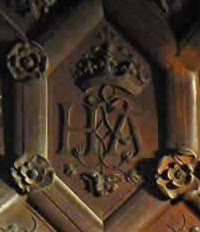
KingsCollegeChapelHA
Surviving example of Henry’s devotion to Anne, their intertwined initials at King’s College Chapel, Cambridge. 

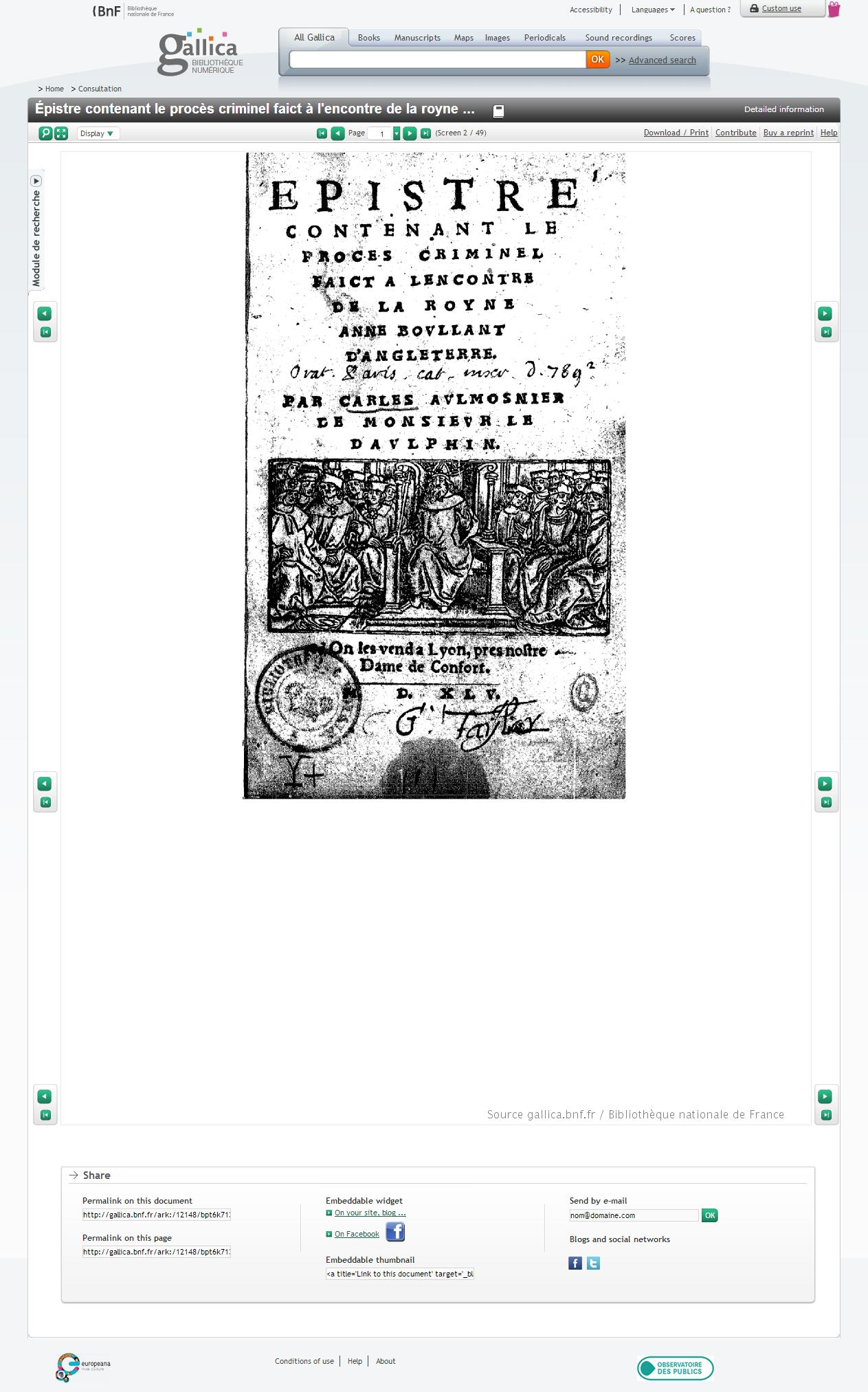
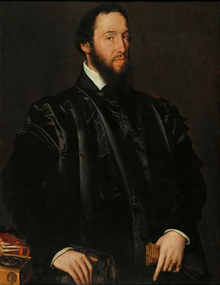
A poem, Epistre Contenant le Procès Criminel Faict a l’Encontre de la Royne Anne Boullant d’Angleterre (A Letter Containing the Criminal Charges Laid Against Queen Anne Boleyn of England), was summarized in dispatch papers 2 June 1536.  Referred to as a “poem descriptive of the life of Anne Boleyn, composed at London”, it was written by Lancelot de Carle (also spelled Carles) while serving as secretary to the French Ambassador in England, Antoine de Castelnau (Gairdner X 1036).

Published in Lyon in 1545 for Dauphin Charles, the poem had been in circulation prior to that.  In fact, it was mentioned in a correspondence by Henry VIII to his Ambassador to France, Stephen Gardiner, 12 June 1537, after de Carle returned to his native country.  Gardiner was told that Henry, “on having first knowledge of the book and the malice of it” which was “written in form of a tragedy,” was grieved “as sundry copies and impressions of it have got abroad.” Henry urged “that all copies be taken in and suppressed” (Gairdner XII ii 78).

Certainly this could be a different work, as a year interval from the time it was mentioned in dispatches to the time Henry made attempts to restrict its circulation appears a bit long.  Yet, it is feasible that the king was not made aware of it until after Carle completed his diplomatic mission.  With the author being identified as Carle—writing during the time he was “attendant upon the French ambassador” it seems to indicate it was the same poem (Gairdner XII ii 78).

Lancelot Anne Boullantmmmm
Title page of the poem by Lancelot de Carle

The poem was brought to this blogger’s attention as a footnote in G. W. Bernard’s biography, Anne Boleyn: Fatal Attractions, under “Chapter 8:  Anne’s Miscarriage.”  Although one cannot be too trusting of the poem’s historical accuracy, a portion of it –the part summarized in dispatch papers as “Anne met with divers ominous occurrences … the King had a fall from horseback which it was thought would prove fatal, and caused her to give premature birth to a dead son” will be where we direct our attention (Gairdner X 1036). In the poem, lines 324-326 refer to the ‘beautiful boy’ that was born before term.  A translation follows:

Her flat belly brought forth its fruit
and gave birth to a beautiful boy before term
whose stillbirth gave birth to many tears
Lancelot Poem

The stressful conditions that Anne was under not only to provide a son but to literally survive due to the factions at Court had her “worn out by constant exertion and anxiety” and were enough to jeopardize any pregnancy (Friedmann II 138).  Add in the equation the simple fact that the successful birthrate in the 16th century was not high plus the possible medical conditions of Anne and Henry (the Rh factor for her and diabetes for him) and the loss of an infant does not seem implausible.  Whatever the cause of the tragedy, the outcome was felt on the familial level, on the national level and on the international level.

For References please refer to the blog entry Path to St. Peter ad Vincula- Part I
Path to St. Peter ad Vincula: Part V–A

Path to St. Peter ad Vincula:  Part V–A

Anne’s path to St. Peter ad Vincula involved political and religious reasons both on domestic and international levels.  This blog entry will deal with an issue that involved political and religious issues that were of a purely personal nature–her inability to provide Henry with a male heir.

Parliamentary members were obliged in 1533 to swear that the marriage between Henry VIII and Catherine of Aragon was invalid, the marriage of Henry and Anne Boleyn valid and “that Elizabeth was born in lawful wedlock, and heir to the crown” (Sander 110).  Henry was optimistic (and as equally adamant) that this would be a temporary solution.  He would have a legitimate male heir and that would be the responsibility of Anne Boleyn. 

 catherine aragon
Katherine of Aragon

Producing the son Henry required would not prove easy.  Considering the stress she was under, Anne surprisingly conceived soon after Elizabeth’s birth.  In a letter written from his Ambassador, Eustace Chapuys, Charles V heard as early as January 28, 1534,  that “Anne Boleyn is now pregnant and in condition to have more children” (Gairdner VII 114).  A month later on 26 February Chapuys reiterated that, while Henry was ironing out the succession between his daughters, he considered that “there was no other princess except his daughter Elizabeth, until he had a son which he thought would happen soon” (Gairdner VII  232).  George Tayllour [Taylor] wrote to Lady Lisle from Greenwich on 27 April 1534, that the “King and Queen are merry and in good health.  The Queen hath a goodly belly, praying our Lord to send us a prince” (Gairdner VII 556). 

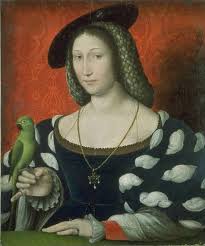
Intriguingly, very little fanfare was made of Anne’s pregnancy in 1534. There are scant formal,diplomatic mentions of it—although on 7 July official instructions to George Boleyn, Lord Rochford, concerning the arrangements of a meeting between Anne and Marguerite, Queen of Navarre (while Henry would have been in France meeting King Francis) had to be “deferred, as the time would be very inconvenient to her….”  Anne would not be able to accompany Henry to France her “reasons are, that being so far gone with child, she could not cross the sea with the King, and she would be deprived of his Highness’s presence when it was most necessary” (Gairdner VII 958).  Later that month Chapuys still believed Anne to be pregnant as he mentioned again that meetings between Henry and Francis would have to be postponed because “those here say the reason is that the lady de Boulans (Anne Boleyn) wishes to be present, which is impossible on account of her condition” (Gairdner VII 1013). Were these references all to the same pregnancy?  January to July would encompass close to a full-term pregnancy yet no mention was made of a child being born and dying afterwards nor of any miscarriage.  Regardless, at least a single pregnancy had to have ended which was kept secret. 
marguerite navarre
Marguerite, Queen of Navarre

What emerges is another comment made by Chapuys in September of 1534 that the King did “doubt whether his lady was enceinte or not” (Gairdner VII 1193). Interesting phraseology as Anne was not in a precarious position at this time.  Certainly, she was vulnerable but there were neither hints of her being replaced nor plots to discard her—until nearly a year and a half later.

On January 7, 1536, Katherine of Aragon died at Kimbolton Castle.  Upon the death of Katherine, “Queen Anne did not carry this so decently as became a happy rival” (Burnet 106).  Anne gave the messenger who brought the news of Katherine’s death to her at Greenwich a substantial reward.  Famously, Henry and Anne put on a show of exuberance dressing in yellow instead of mourning for Katherine’s death and parading Elizabeth triumphantly.  Although as Charles V was apprised by his ambassador in late January, “notwithstanding the joy shown by the concubine at the news of the good Queen’s death… she had frequently wept, fearing that they might do with her as with the good Queen” (Gairdner X 199). 

Anne could see that the international situation was now altered and the domestic scene was less idyllic.  Without Katherine to prompt familial ties in Charles V, he could now concentrate on his Italian campaigns and as seen in a previous blog entry Path to St. Peter ad Vincula-Part IV,  the ties of France and England had lessened. At home, Henry had set his sights on Jane Seymour and it would not have taken much for Anne to wonder if she too would be replaced in the king’s affections. What Anne had in her favor was her latest pregnancy.  Unlike the pregnancy of 1534, there is no prior mention of the one in 1536.  Anne would have been aware that the successful delivery of a male heir would certainly secure her position.  Unfortunately, that was not to be.

While participating in a joust, Henry’s horse took a fall in the tiltyard on January 24, 1536, and the king lost consciousness for several hours.  The entire Court feared for his life and, even though Henry made an astounding recovery, more proved at stake than his recuperation.  Shortly thereafter, on 29 January the day of Katherine’s funeral, “Queene Anne was brought a bedd and delivered of a man chield, as it was said, afore  her tyme, for she said that she had reckoned herself at that tyme but fifteen weekes gonne with chield; it was said she tooke a fright, for the King ranne that tyme at the ring and had a fall from his horse, but he had no hurt; and she tooke such a fright withal that it caused her to fall in travaile, and so was delivered afore her full tyme” (Wriothesley 33).  The “excitement of the last few days had told upon her health, which constant anxiety had been steadily undermining” (Friedmann 199). 

King Henry VIII armor
Armour made for King Henry VIII

Ambassador Chapuys wrote the details as known to him in a dispatch to Charles V on 10 February 1536.  Some discrepancy occurred in the interpretations of the cause but readers should not be alarmed at the term abortion, as it is the 16th century translation of the word miscarriage.

“On the day of the interment [the burial of Katherine of Aragon] the Concubine had an abortion which seemed to be a male child which she had not borne 3½ months, at which the King has shown great distress. The said concubine wished to lay the blame on the duke of Norfolk, whom she hates, saying he frightened her by bringing the news of the fall the King had six days before. But it is well known that is not the cause, for it was told her in a way that she should not be alarmed or attach much importance to it. Some think it was owing to her own incapacity to bear children, others to a fear that the King would treat her like the late Queen, especially considering the treatment shown to a lady of the Court, named Mistress Semel, to whom, as many say, he has lately made great presents.” Henry’s attention to Jane Seymour (Mistress Semel) led many people to “fear the King might take another wife” (Gairdner X 282).

Chapuys continued that Henry VIII divulged to “his most trusted servants …Lord and Lady Exeter” (Friedmann 202-203) that “in great confidence, and as it were in confession, that he had made this marriage, seduced by witchcraft, and for this reason he considered it null; and that this was evident because God did not permit them to have any male issue, and that he believed that he might take another wife, which he gave to understand that he had some wish to do” (Gairdner X 199).   

A couple of weeks later Ambassador Chapuys wrote about Anne’s reasoning for the loss of the child to Charles V.  “The said Concubine attributed the misfortune to two causes: first, the King’s fall; and, secondly, that the love she bore him was far greater than that of the late Queen, so that her heart broke when she saw that he loved others” (Gairdner X 351). A later report, much disputed, claimed that Anne could not keep from scolding Henry and exclaimed “See, how well I must be since the day I caught that abandoned woman Jane sitting on your knees” (Sander 132).
charles v older
Charles V, Holy Roman Emperor

Many at Court, especially the conservative faction considered that with “Queen Catharine being dead, the King might marry another, and be set right again with the Pope and the Emperor: and the issue by any other marriage would never be questioned; whereas, while Queen Anne lived, the ground of the controversy still remained, and her issue would be illegitimated, her marriage being null from the beginning, as they thought” (Burnet 109). Chapuys also believed the “King knew very well that his marriage to Anne could never be held as valid, for many reasons, …from another marriage, more legitimate than his last, the King might possibly have male issue” (de Gayangos V 43).

Continuing the theme of the legitimacy of Henry’s marriage to Anne, Chapuys wrote to Nicholas Granvelle (also known as Grenvelle), Chancellor to Charles V on 25 February 1536: “I am credibly informed that the Concubine, after her abortion, consoled her maids who wept, telling them it was for the best, because she would be the sooner with child again, and that the son she bore would not be doubtful like this one, which had been conceived during the life of the Queen; thereby acknowledging a doubt about the bastardy of her daughter” (Gairdner X 352). 

Would Anne have expressed herself in such a way as to question Elizabeth’s legitimacy?  It is hard to believe. 

One thing is sure, Anne believed she would have another child.  These sentiments were in direct contrast to those Chapuys wrote on 10 February 1536, to Chancellor Granvelle  “there are innumerable persons who consider that the concubine is unable to conceive, and say that the daughter said to be hers and the abortion the other day are supposititious” (Gairdner X 283). Rumors concerning the extremes of Anne’s behavior flew then and were maintained in the 1980s.  While traveling in England my husband and I were regaled with the story that Elizabeth was a changeling.  The story unfolded that the infant daughter that Anne gave birth to had died and fearing Henry’s wrath Anne found a substitute child of comparable age and coloring.  Unfortunately, the infant was a boy—and thus the reason Elizabeth never married.

The absurdity of the above story stands its own test, let alone the cruel irony that Anne desperately wanted a male child.  As Henry’s “new amours” continued toward Jane

“to the intense rage of the concubine” (Gairdner X 495).  ‘Les nouvelles amours de ce roy avec la demoyselle dont ait cydevant escript vont tousiours en avant a la grosse raige de la concubyne’ (Friedmann 202).  Chapuys wrote a fuller description of Jane to Granvelle’s son, Antoine Perronet, that he had no news “except to tell you something of the quality of the King’s new lady, which the Emperor and Granvelle would perhaps like to hear. She is sister of one Edward Semel, of middle stature and no great beauty, so fair that one would call her rather pale than otherwise” (Gairdner X 901).
Antonie Perrenot
Antoine Perronet, son of Chancellor Nicholas Granvelle

Apparently, Henry overlooked that Jane was not “a woman of great wit” and that “she inclines to be proud and haughty” (Gairdner X 901).  He seemed delighted that her temperament was “between the gravity of Queen Catharine, and the pleasantness of Queen Anne” (Burnet 109).  As for Jane’s virtue, it was opinioned by Perrenot that “although Henry necessarily affected to believe in her virtue, she was no better than the other young women of a coarse and dissolute court” (Friedmann 201). Ambassador Chapuys gave the opinion that Henry would make it a condition of the marriage that Jane be a virgin so “when he has a mind to divorce her he will find enough of witnesses” (Gairdner X 901).  Despite the contemporary beliefs of Jane’s uprightness, the King “was as well pleased with a decent appearance of virtue as with virtue itself” (Friedmann 201 – 202). 

Jane’s influence, therefore, increased, and the “whole party of Anne became seriously alarmed” (Friedmann 201 – 202). A gloating Sander reported that Anne faced a serious rival, “for the king began to grow weary of Anne” (Sander 132).  “The poor Queen used all possible arts to reinflame a dying affection; but the King was changed” (Burnet 109).

Not only was Henry growing weary of Anne, his “old conscience began to work again” (Pollard 343).  Contemporaries mentioned that Anne’s “miscarriage was thought to have made an ill impression on the King’s mind, who from thence concluded that this marriage was displeasing to God” (Wriorthesley 33).

Henry’s marked coldness to Anne was remarked upon by many contemporary sources; what varied was the degree of his ill-favor.  Chapuys learned “from several persons of Court” that Henry had “not spoken ten times to the Concubine, and that when she miscarried he scarcely said anything to her, except that he saw clearly that God did not wish to give him male children” (Gairdner X 351).  Henry went to her bedside “bewailing and complaining unto her the loss of his boy,”(Cavendish 208-209) and “gruffly told her that he now saw that God would not give him a son; then, rising to leave, he said harshly that when she recovered he would speak to her” (Friedmann 199).  From the time of the miscarriage “henceforth the harm still more increased, and he was then heard to say to her:  he would have no more boys by her” (Cavendish 209).

It is obvious to see that reports shifted from Henry declaring that God denied him male children to the conviction that he would have no sons by Anne.  These could be the result of translations committed after the fact, as history showed what eventually were Henry’s actions even if, at the end of January 1536, he was not set on the course of repudiating Anne.  Nicholas Sander claims Anne had an inkling as Henry greeted her after her miscarriage “by saying, ‘Be of good cheer, sweetheart, you will have no reason to complain of me again’and went away sorrowing” (Sander 132). The altered demeanor of the king towards Anne was generally remarked upon, and “held to bode no good to her” (Friedmann 203) and “was a great discompfort to all in this realm” (Wriothesley 33).
Anne Boleyn B necklace
Queen Anne Boleyn

The king was frustrated at Anne’s miscarriage and was maddened at her reprimands over his association with Jane Seymour.  That Anne was indiscrete and flirtatious with members of Court could be believed but her biggest mistake was not understanding the strength of Henry’s passion for Jane Seymour.  Years earlier it had been commented about Henry that “rather than miss or want any part of his will or appetite he would put the loss of one half of his kingdom in danger, and that he had often knelled before him the space of an hour or two to persuade him from his will and appetite, but could never bring to pass to dissuade him therefrom” (Cavendish 45).  Henry was used to getting his own way and not encountering much resistance.  Yet, thwarted he was in the incidence with the greatest meaning to him, the birth of a son.  

For References please refer to the blog entry Path to St. Peter ad Vincula–Part I

Elizabeth Regina: Her Mother’s Memory

Elizabeth:  Her Mother’s Memory

Elizabeth at the age of two years and eight months upon the death of her mother, probably never had concrete recollections of her mother Anne Boleyn.  There is no evidence that Anne Boleyn was mentioned by any of Elizabeth’s household members during her childhood.  It is pure speculation as to which adults told the youngster about her mother and when she would have possibly learned about Anne’s execution and the scandalous reasons for it.  There are plenty of assumptions that Henry had placed a moratorium on the subject of Anne Boleyn which would not be implausible, but what is conjecture is based on the fact that Elizabeth was confined to her estate because Henry could not bear the sight of her and wanted no remembrance of her or her mother.  We know Sir John Shelton assured Cromwell on Wednesday 16 August 1536 from Hunsdon that he would ensure “the King’s pleasure that my lady Elizabeth shall keep her chamber and not come abroad, and that I shall provide for her as I did for my lady Mary when she kept her chamber” (Gairdner XI 312).  We know Elizabeth remained secluded at Hunsdon; we just do not know why—it could have been Henry trying to protect her from court gossip.
thomas cromwell
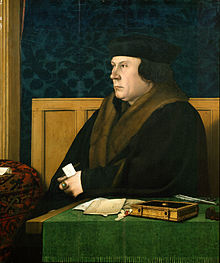
Thomas Cromwell

Lady Bryan, in August 1536, had already questioned Cromwell on the status of her charge.  “Now, as my lady Elizabeth is put for that degree she was in, and what degree she is at now, I know not but by hearsay, I know not how to order her or myself, or her women or grooms” (Gairdner XI 203).  Obviously, there was some confusion in her household.  Even Elizabeth was confused; when a gentleman of her household, often identified as either Sir John Shelton or Sir Thomas Bryan, referred to her by the demoted title of Lady Elizabeth, she responded “how haps it, Governor, yesterday my Lady Princess, and today but my Lady Elizabeth?” (Hibbert 20).  An astute child such as this would have understood the danger of asking questions about her mother or even mentioning her.

There are only two recorded times when Elizabeth mentioned her mother in public.  One was when she was 20 and hinted to the Spanish ambassador that she was disliked by Mary because of the distress her mother had caused. The second was when she informed the Venetian ambassador that her mother would never have cohabitated with the king without the ties of matrimony (Weir The Children of Henry VIII 7).  Is this anemic display evidence that she did not have any feelings for her mother or that she did not want to be associated with Anne?  Probably not.  It would not have been politically wise for Elizabeth to be linked too often and too closely with Anne Boleyn so one can understand the lack of mention by an aware and intelligent child.  This did not mean complete elimination of connections and when she was more secure as queen, several examples are in evidence of her identification with her mother although the earliest example comes when she was about ten.

elizabeth 1 by scrouts
Princess Elizabeth 

This early example was when she wore the ‘A’ necklace in the painting,The Family of Henry VIII.”  Supposedly this was “one of Anne Boleyn’s initial pendants” that was inherited from Elizabeth’s mother (Weir Lady in the Tower 306).

Jewelry was one way that Elizabeth showed her relationship with her mother.
Anne Boleyn was said to have three pendants of initials; an “A”, a “B”, and an “AB”. The “B” necklace is the most famous and is in portraits displayed at the National Portrait Gallery and Hever Castle more readily validated as representative of Anne. The “AB” is perhaps in a less famous painting; one not completely authenticated as Anne, and is referred to as the Nidd Hall portrait.

Anne Boleyn B necklace
Anne Boleyn, National Portrait Gallery

Anne Boleyn Hever
Anne Boleyn, ‘Hever Castle Portrait’ a copy of the lost original painted in 1534
AnneBoleynAB
Anne Boleyn, ‘Nidd Hall Portrait’ with the pendent of ‘AB’ hanging upon her gown
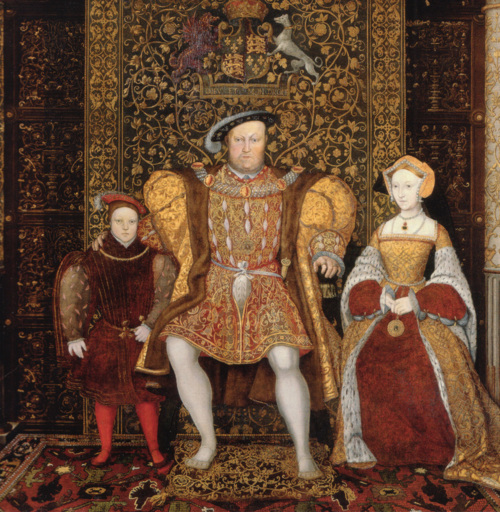
It is claimed that Elizabeth was wearing the “A” necklace in “The Family of Henry VIII” painting that hung in Hampton Court. (Weir Henry VIII: The King and His Court 187).  This blogger must disagree with some reports that she was wearing the necklace in defiance of her father.  He had full control of all of his public imagery.  I cannot imagine the artist risking his life, quite literally, by painting in the “A” if it was not sanctioned by Henry.   It is hard to imagine that Elizabeth would so blatantly wear this piece of jewelry without Henry’s permission.  This blogger could start an unsupported theory that this could be the cause of Elizabeth’s exile from 1543 to 1544 (see blog entry “The Fourth Step-Mother of Elizabeth, Katherine Parr” at https://elizregina.com/2013/06/04/the-fourth-step-mother-of-elizabeth-katherine-parr/).  This is clearly on a weak foundation considering the painting, according to Roy Strong, was completed between 1543 -1547. If Henry became incensed enough to banish his daughter for wearing an inherited item of jewelry from her disgraced mother, surely he would have ordered it painted out of the completed picture.  Perhaps allowing Elizabeth to display this necklace was a kind gesture on the king’s part or it was a tactic wanting everyone to associate the girl with her mother and her illegitimacy, in contrast to the legitimate heir next to him.
H8 Family
The Family of Henry VIII
BLow up M and E try this one
An enlargement obtained by Flickr of the princesses 

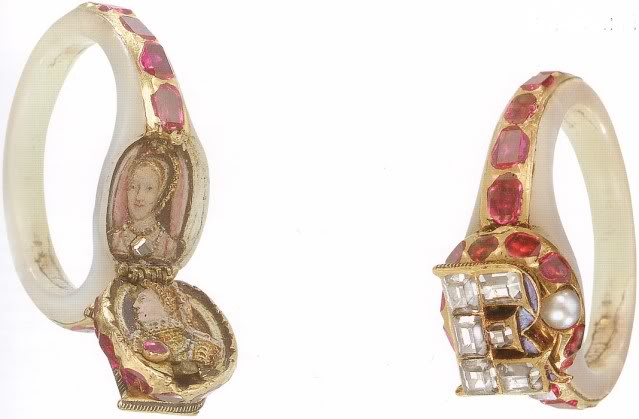
Apart from the wearing of one of Anne Boleyn’s necklaces, another piece of jewelry associated with Elizabeth and her mother is the Chequers ring.  Dated to around 1575 the Chequers Ring, thus named as it is now in the possession of that estate, clearly has a diamond encrusted ‘E’ and ‘R’ on the face. The locket opens to reveal a portrait of Elizabeth and an unidentified woman, usually and logically identified as Anne Boleyn; although, speculation ranges from it being a younger Elizabeth to Katherine Parr.  The history of the ring is too sketchy for this blogger to comfortably say that Elizabeth commissioned it as opposed to a courtier.  It is also difficult to agree with Weir, and many other writers who claim the ring “was only removed from her finger at her death, when it was taken to her successor, James VI of Scotland, as proof of her demise” (Weir Lady in the Tower 306). There is no definitive proof that Elizabeth constantly wore the ring or that it was the particular jewel taken to Scotland by Robert Carey.

Chequers ring to use
Chequers ring–this blogger was fortunate to see this locket ring at “Elizabeth:  The Exhibition at the National Maritime Museum” in Greenwich on August 8, 2003.

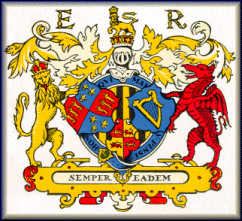
Another way Elizabeth linked to her mother was the use of her mother’s heraldic badge the crowned falcon upon a tree stump, surrounded by Tudor roses.  Although this was not implemented consistently as Elizabeth’s badge, there are several places it is displayed and on several items such as her virginal. The spinet “bears the royal coat of arms and the falcon holding a scepter, the private emblem of her mother, Anne Boleyn” (“The Queen Elizabeth Virginal”).  It is also speculated that Elizabeth adopted one of Anne’s mottoes, Semper eadem.  This is discussed on the blog “Said it, Believed it, Lived it” at https://elizregina.com/2013/06/25/said-it-believed-it-lived-it/.

virginals w falcon
Virginal of Elizabeth I, the Boleyn badge is on the left.

Elizabeth continued her links with her mother by promoting members of Anne’s household staff, Matthew Parker as Archbishop of Canterbury and relatives; notably the Careys, Knollyse, Sackvilles and even Howards until their alliance to Catholicism made it politically impossible.  Anne was also commemorated in a biography by William Latymer and in an unfinished treatise by George Wyatt (Weir, The Lady in the Tower 307-308).

A way in which Elizabeth kept her mother’s influence alive was in her understanding of the benefits and necessity of display. “Between Anne and Elizabeth there was an uncanny similarity of attitude towards the projection of monarchy, and of themselves as chosen by God to rule” (Ives 218).  It is estimated Anne spent £40* a month mostly on clothes for herself and Elizabeth (Ives 217).  Had Anne lived, her wardrobe would have “rivalled the 2000 costumes which tradition assigns to that most fashion-conscious of monarchs, her daughter Elizabeth” (Ives 253).  Catholic chronicler, Nicholas Sander, no friend of Anne’s, conceded that she “was always well dressed, and every day made some change in the fashion of her garments” (Sander 25).

Anne has been criticized for having such an active interest in her daughter’s wardrobe; one wonders if this was an area in which she could direct her wishes and so she did.  Taking an inordinate amount of care in the purchase of materials and the ordering of garments for her child was perhaps the method of bestowing attention that was socially and politically acceptable for Anne.

We have a dispatch that Sir William Loke, mercer and merchant adventurer who supplied the king with clothes of gold, silver and other luxurious fabrics and performed diplomatic missions on his buying trips abroad, wrote personally to the king in February 1534:  “The sale of cloths by your subjects has been good, but money is scarce.  I trust I have done my best to provide such things as the Queen gave me commission for” (Gairdner VIII 197). Loke kept extensive account records (published in the text, An Account of Materials Furnished for Use of Queen Anne Boleyn and the Princess Elizabeth, by William Loke ‘the King’s Mercer’ Between the 20th January 1535 [27th year of Henry VIII], and the 27th April 1536.  Communicated by J. B. Heath) which reveal clothing being sent to the princess.  It was  obvious that the “king’s heir, who was not yet three years old, was quite properly to be dressed in fashionable and expensive clothing”  (Warnicke 170).

armada
An example of elaborate clothing worn by Elizabeth in the ‘Armada Portrait’.

In Anne’s account books of May 19, 1536, are entries for payment for “boat-hire form Greenwich to London and back to take measure of caps for my lady Princess, and again to fetch the Princess’s purple satin cap to mend it.”  Anne, apparently, was especially fussy about her daughter’s caps: this particular one required at least three journeys to Greenwich to get it right” (Ives 253). Included in the accounts was “an ell of ‘tuke’ and crimson fringe for the Princess’s cradle head.”  Added to this finery was “a fringe of Venice gold and silver for the little bed.” Included were more assorted caps, white, crimson, purple and a “cap of taffeta covered with a caul of damask gold for the Princess” (Gairdner X 913).

Queen Anne Boleyn never had a full say in her child’s upbringing. That was the business of the king and his council. Famously, when it came to decide if Elizabeth should be weaned, her governess wrote to Thomas Cromwell for permission (Warnicke 170).  We do know from William Latymer, chaplain to Anne Boleyn who wrote Chronickille of Anne Bulleyne during the reign of Elizabeth, reported that Anne “had wanted her child, as her elder half-sister had been, trained in classical languages” (Warnicke 171).  When Anne realized that she was in serious danger of losing her life she gave unto Matthew Parker, her devoted chaplain and later Archbishop of Canterbury during the reign of Elizabeth, the care of her child.  This move can be seen as her wish for Elizabeth to have not only a classical education but also a more evangelical religious upbringing.

Matthew_Parker
Matthew Parker, Archbishop of Canterbury during the reign of Elizabeth 

Besides directing Elizabeth’s wardrobe and directing her education, how else did Anne bestow attention on her daughter?  This is impossible to know. Following standards of the day, Elizabeth was removed from her parents’ household when she was three months old.  She was sent to her own residence, Hatfield, with a wet-nurse and her governess, Margaret Bourchier, Lady Bryan.  “Here and at Hunsdon in Hertfordshire the princess spent much of her childhood although, like her parents, she traveled from house to house, staying in such places as Richmond, Eltham, Langley,and the More” (Warnicke 170).  Contemporary records indicate that Anne did visit regularly as we see from a letter written by Sir William Kyngston, courtier and Constable of the Tower of London, to Lord Lisle, Arthur Plantagenet on 18 April 1534.  “To day the King and Queen were at Eltham, and saw my lady Princess, as goodly a child as hath been seen and her grace is much in the King’s favour as goodly child should be, God save her”  (Gairdner VII 509).

The visits were not always private, as we would assume between a mother and her child as Eustace Chapuys mentions in a dispatch to Charles V on 24 October 1534. “On Thursday, the day before yesterday, being at Richmond with the little lass (garce) the Lady came to see her said daughter, accompanied by the dukes of Norfolk and Suffolk and others, including some of the ladies, which was a novelty” (Gairdner VII 1297).  Besides these visits, Anne was in contact with Lady Bryan through letters concerning the care of Elizabeth (Ives 256).  A response to a request from Elizabeth’s household officers to the Council was sent in a packet with “letters to them, and one from the Queen to lady Brian” (Gairdner IX 568).

Richmond 1562
Richmond Palace, 1562

Speculation is futile regarding the feelings both mother and daughter felt for each other; no written records exist.  Anne, following the social dictates and court etiquette of the day, rarely saw her daughter.  Not only was Elizabeth reared by people other than her parents, she was physically removed from them, as was her siblings so some people placing emphasis on the fact she was taken to Hatfield at the age of three months was proof her mother was as disappointed as her father in her birth.  Henry’s treasured heir, Edward, was also reared in a separate household.  Evaluation of those persons surrounding the infant Elizabeth does lend itself to assume a strong influence of Anne.  Many had Boleyn connections: Lady Margaret Bryan was not only Princess Mary’s former governess but related to Anne as they shared a maternal grandmother; Lady Shelton, also from Princess Mary’s household and given charge of the combined establishment of Mary and Elizabeth was Anne’s Aunt; and Kat Ashley nee Champernowne was married to Anne’s cousin. After Anne Boleyn’s execution, Henry did not alter the positions of these people closest to Elizabeth.  He too must have trusted them and was not worried about how Anne would be portrayed to their daughter by ‘Boleyn’ servants.  Elizabeth would later comment that “we are more bound to them that bringeth us up well than to our parents… our bringers-up are a cause to make us live well in [the world]” (Marcus 34).

*£40 from 1535 would be £19,000.00 using the retail price index or£266,000.00 using average earnings based on calcualtions from the “Measuring Worth” website.

References:

Brewer, J. S. (editor). “Henry VIII: November 1517.” Letters and Papers, Foreign and Domestic, Henry VIII, Volume 2: 1515-1518 (1864): 1183-1198. British History Online. Web. 29 June 2013.

Burnet, Gilbert. The History of the Reformation of the Church of England. Vol.I Part I. London:  W. Baynes and Son, 1825.  Google Books.  Web.  3 July 2013.

Gairdner, James. (editor). “Henry VIII: April 1534, 16-20.” Letters and Papers, Foreign and Domestic, Henry VIII, Volume 7: 1534 (1883): 199-210. British History Online. Web. 29 June 2013. 

Gairdner, James (editor). “Henry VIII: February 1535, 11-20.” Letters and Papers, Foreign and Domestic, Henry VIII, Volume 8: January-July 1535 (1885): 75-98. British History Online. Web. 29 June 2013.

Gairdner, James (editor). “Henry VIII: October 1535, 6-10.” Letters and Papers, Foreign and Domestic, Henry VIII, Volume 9: August-December 1535 (1886): 181-195. British History Online. Web. 29 June 2013.

Gairdner, James (editor). “Henry VIII: February 1536, 1-5.” Letters and Papers, Foreign and Domestic, Henry VIII, Volume 10: January-June 1536 (1887): 82-98. British History Online. Web. 01 July 2013.

Gairdner, James (editor). “Henry VIII: August 1536, 16-20.” Letters and Papers, Foreign and Domestic, Henry VIII, Volume 11: July-December 1536 (1888): 130-138. British History Online. Web. 28 June 2013.

Hibbert, Christopher.  The Virgin Queen: Elizabeth I, Genius of the Golden Age.  New York: Addison-Wesley Publishing Company, Inc., 1991.  Print.

Ives, Eric.  The Life and Death of Anne Boleyn: The Most Happy. Oxford: Blackwell Publishing, 2004. Print.

Marcus, Leah S. et al., eds. Elizabeth I: The Collected Works. Chicago: University of Chicago Press, 2002. Print.

“The Queen Elizabeth Virginal.” V&A Images Collection. Victoria and Albert Museum, n.d. Web. 03 July 2013.

Ridgway, Claire.  The Fall of Anne Boleyn:  A Countdown.  UK:  MadeGlobal Publishing, 2012. Print.

Sander, Nicholas, and Edward Rishton. Rise and Growth of the Anglican Schism. Trans. David Lewis. London: Burns & Oates, 1877. Google Books. Web. 28 June 2013.

Somerset, Anne. Elizabeth I.  New York: Alfred A. Knopf, 1991. Print.

Warnicke, Retha.  The Rise and Fall of Anne Boleyn: Family Politics at the Court of Henry VIII. Cambridge:  Cambridge University Press, 1989.  Print.

Weir, Alison. The Children of Henry VIII.  New York:  Ballantine Books, 1996. Print

Weir, Alison.  Henry VIII:  The King and His Court.  New York:  Ballatine Books, 2001. Google Books. Web. 30 June 2013.

Weir, Alison.  The Lady in the Tower:  The Fall of Anne Boleyn.  London:  Jonathan Cape, 2009.  Print.

Said it, Believed it, Lived it

Said it, Believed it, Lived it:  Mottoes of Elizabeth Regina

A motto is a short sentence or phrase used to formally summarize or encapsulate the beliefs, motivations, intentions or ideals of an individual, group or institution. Often the motto can become a rule by which someone lives her or his life.  Although a motto can be in any language, Latin is the one mostly used in the Western world.

William Camden, an Officer of Arms under Queen Elizabeth who wrote a history of her reign at the suggestion of Lord Burghley, William Cecil, has become an excellent source for emblems and heraldic arms of the Tudor era although he does not always quote the motto nor offer explanations (Daly 5).  Camden has given his ideal of a motto accompanying heraldry.  He assures us that the picture is the body “and the Motto, which as the soul giveth it life.  That is, the body must be of fair representation, and the word in some different language, witty, short, and answerable thereunto; neither too obscure, nor too plain, and most commended when it is an Hemistich, or parcel of a verse” (Camden Remaines 366-367).

henry8wiki.23
Coat of Arms of Henry VIII

An official definition of motto is as follows: “A sentence added to a device (Ital. –L) L. muttium, mutter, a grunt, a muttered sound; cf. mutire, muttire, to mutter, mumble” (Skeat 387).  Therefore, in heraldry, a motto is shown on a shield as part of a coat of arms.  In English heraldry in particular, the motto is not granted with the armorial bearings and can be changed. 

Members of Tudor upper society certainly embraced the custom of using mottoes and “subjects adopted them as expressions of loyalty” (Cannon 253).  Below are briefly the mottoes of Henry VIII, his wives and his children with expanded explanations on the mottoes of Elizabeth and her mother, Anne Boleyn to follow.

Tudor Mottoes                      

Henry VIII     Dieu et mon droit  —God and my right

Katherine of Aragon     Humble and loyal

Anne Boleyn     The Most Happy                                                                                                 
Jane Seymour     Bound to Obey and Serve

Anne of Cleves     God send me well to keep

Catherine Howard     Non aultrevolontè que le sinne  —No other will than his

Katherine Parr     To be useful in all I do

Edward VI     Dieu et mon droit  —God and my right
                      Modus et Ordo   —Method and Order

Mary I    Veritas filia temporis   —Truth, daughter of time

Elizabeth Regina     Semper Eadem  — Always the Same
                                   Video et taceo   —I see and say nothing

Royal British mottoes can be a bit confusing.  All Knights of the Garter may use the motto, Honi soit qui mal y pense, [Shamed be he who thinks evil of it] added to their heraldry.  Also, the sovereign will use, Dieu et mon droit, [God and my right] on a scroll beneath the shield of the royal coat of arms.  This motto has been attributed to Richard I Lionheart as a battle cry and has been used officially since the time of Henry V.  Obviously, this refers to the monarchs’ divine right to rule.

PTDC0001
Clock given to Anne Boleyn by Henry VIII at the time of their marriage.  The weights are engraved with the initials ‘H’ and ‘A’ and also the mottoes “Dieu et Mon Droit” and “The Most Happy”.

Alternatively, the Royal Arms may depict a monarch’s or consort’s personal motto and may appear on many buildings, possessions, documents, and in more modern times on products—those purveyors who have earned the Royal Warrant.  More on that topic in another blog entry.  Often its use is done for dynastic glorification as illustrated in the cup Henry VIII commissioned by Hans Holbein as a wedding gift to Jane Seymour.  Jane’s motto “Bound to obey and serve” is repeated on the lid and on the base.  The bridal pair’s initials adorned the cup. “Its submissive tone was fairly typical for queen consorts, but it also reflects Jane’s personality and helps explain why she was so attractive to Henry” (Doran Man & Monarch 189).

jane-seymour-s-cup
Cup designed by Hans Holbein for Jane Seymour with her motto on the lid and base

Reigning between queens with mottoes conveying humility and obedience-Katherine of Aragon’s “Humble and loyal” and Jane’s “Bound to obey and serve”-comes Anne Boleyn whose motto was the bold “The most happy”.  Anne adopted this motto as her coronation approached.  She had reason to be “the moost happi”: she had married a supportive and affectionate Henry, she was expecting his child (convinced it was the longed-for male heir), and she had managed to institute several religious changes in the country.

AnneBoleyn4
Anne Boleyn’s medal inscribed around with THE MOOST HAPPI ANNO 1534 and A.R. for Anne Regina next to her portrait

Although some sources attribute the motto “Me and mine” to Anne, this blogger never found true evidence of it.  One motto she adopted in 1530 before she was queen, Aisi sera groigne qui groigne meaning “Let them grumble; that is how it is going to be!” (Ives 141).  This motto had quite a story attached to it.

Paul Friedman was quoting Pascual de Gayangos’ Calendar of State Papers, Spain Vol. 4, Part 2, page 41, which stated that Anne, to show her “contempt for those who opposed her, chose a device which she had heard in France, but which she only partially remembered, Ainsi sera, groigne qui groign! was embroidered on the liveries of her servants” (Friedman 128).  Her arrogance and defiance did not last long.
To her mortification, and to Eustace Chapuys’ glee, she learned that she had “adopted the motto of her bitter enemies, the princes of the house of Burgundy.  ‘Groigne qui groigne’, she heard it repeated, “et vive Bourgoigne!’ The liveries had to be laid aside, and Anne’s servants on Christmas Day appeared in their old doublets” (Friedman 128).

Such a blatant alteration of an Imperialist motto was hardly the way to win supporters at Court and gain Anne acceptance as the replacement of a highly-respected Habsburg queen (Ives 142-143).

The Anne Boleyn Cup. This 16th century gilded silver goblet was given to Dr Richard  Masters by Anne Boleyn, and Dr Masters presented it to the church.
The Boleyn cup 1535-36 in St. John the Baptist Church in Cirencester with motto “The Most Happy.”  Elizabeth inherited this beautiful from her mother and in turn gave it to her physician Richard Master who presented it to the church.

Another motto, Semper eadem, [Always the same], was said to be used by Anne (Weir 324). This blogger could not find primary source evidence to support Anne’s use of this maxim. It was a well-known motto adopted by Anne’s daughter, Elizabeth, when she became queen.  This particular motto appears to be associated with the quality of constancy.  Elizabeth’s constancy can be shown in her willingness to maintain a steadfast government during the transition between her reign and her sister’s.  See the blog entry  https://elizregina.com/2013/04/09/reigned-with-your-loves/ for a list of Marian councilors retained by Elizabeth. Perhaps Elizabeth adopted it for simply sentimental reasons to form a link to her mother.  Another view of this motto reveals it to be a pledge that Elizabeth would not change her religious faith (Collinson 1549).

elizabeth_tudor_coat_of_arms
Coat of Arms of Elizabeth Regina with motto, Semper eadem.

With the childhood fraught with uncertainty and constant change perhaps this motto was a rule in which Elizabeth preferred to live.  It does imply an avoidance of any surprise, uncertainty or disruption.  Could a sovereign associated with such changes that supported exploration, encouraged the Arts and introduced religious reform prefer the status quo?

William Camden deemed Elizabeth’s main care upholding the Protestant faith and her “second care was, to hold an even course in her whole life, and all her actions: whereupon she tooke for her Motto, Semper eadem, that is, Alwayes the same.  The rest of her counsels consisted in these points” (Camden Annales 20). There is some disconnect between this motto and her well-known impulsiveness, indecision and secrecy.

shield motto
 Shield and motto of Queen Elizabeth I by Simon de Passe in the NPG Collection

NPG D42191; Queen Elizabeth I by Simon de Passe, after  Isaac Oliver
 Elizabeth I–obverse of shield and motto line engraving in the NPG collection

Elizabeth’s habit of covering her actions and motives was admired by Camden. When explaining her second motto, Camden discussed her methods “Which notwithstanding Queene Elizabeth dissembled and concealed with silence, according to that motto which she used, video et taceo, that is, I see and say nothing” (Camden Annales 307).

“I see and say nothing” has been termed a political motto used by Elizabeth.  With her impressive humanist education, this motto could be of ancient historical significance or it could be a practical methodology employed by Elizabeth.  No sources that this blogger has discovered definitively explain Elizabeth’s selection of this motto.  An examination of them suggests a link to the equation of Elizabeth’s style with Cicero’s, an acquired maxim from Lady Tyrwhitt, a reflection of her moderate religious policy or a connection to Francis Walsingham’s spy network. More recent authors have interpreted that the use of Elizabeth’s mottoes, Video et taceo, and Semper eadem “alludes to an important feature of prudence, which is that it encompasses the knowledge of when to speak and when to keep quiet” (Broad 34).

ART 246171
The Plimpton “Sieve” Portrait of Elizabeth  I, by George Gower, 1579.  The sieve alludes to the myth of Tuccia, a roman Vestal Virgin who proved her virginity and prudence by carrying water with a sieve.  The coat of arms and the motto in the top right Honi soit qui mal y pense / Semper eadem [Shamed be he who thinks evil of it / Always the same] are the motto of the Order of the Garter and the personal motto of Elizabeth Regina.

What does come to mind to this blogger is the ‘Rainbow’ portrait of Elizabeth with the eyes and ears embroidered on her gown.  The poet John Davies refers to the ears and eyes as how the Queen uses her servants for a sketch he wrote during the Queen’s visit to William Cecil’s house, Theobalds, in 1591.  When asked what use Elizabeth makes of her servants the reply was “She makes the same use of them as the mynde makes of the sences.  Many things she sees and heares through them; but the judgment and election is her owne” (Nichols 77).  Elizabeth clarified her right to rule and have good counsel early in her reign, “I shall desire you all, my lords, (chiefly you the nobility, everyone in his degree and power) to be assistant to me that I, with my ruling, and you with your service, may make a good account to Almighty God and leave some comfort to our posterity on earth.  I mean to direct all my actions by good advice and councel” (Marcus 52).  Through further research I discovered this idea of Elizabeth’s relationship with her advisors and her motto was further explored by Mary Thomas Crane.

Elizabeth_I_Rainbow_Portrait
The “Rainbow” portrait attributed to Marcus Gheeraerts the Younger, 1600-1603.

Professor Crane begins her article “Although one of her mottoes, ‘semper eadem,’ seems to claim a fundamental unity of character, Queen Elizabeth I nevertheless presents us with an array of poses and personae” (Crane 1).  How true.  Students of Elizabeth Regina are familiar with her paradoxically presenting an image of absolute patriarchal power and one of a ‘weak and feeble woman’. How did Elizabeth maneuver within the Privy Council composed of men whose views were the by-products of a time period when authority and advice-giving were the realm of males?  This was an era that considered “Kings were creatures defined by ancient custom; but queens, however loved and admired, were unpredictable” (Loades 318).

The use of the term ‘video’ assures that Elizabeth will listen and evaluate the advice to make up her own mind, as opposed to ‘audio’ that implies she will “accept blindly her advisors’ spoken counsel” (Crane 2).  In an era when women were to remain silent and obedient, ‘taceo’ insinuates that “as queen, she will maintain the silence thought suitable for a woman …” (Crane 2).  The motto encapsulates the fine line Elizabeth struck between asserting her authority and accepting advice from her Council.

She could be silent and allow her statesmen such as Burghley the role of respected advisor and she could be vocal and affirm her authority.  Crane sees Elizabeth’s motto, Video et taceo, as more of the way she uses the political system and her “use of the paradigm of advice-giving reveals a woman who was less completely bound by male structures than some critics have argued” (Crane 2).  Elizabeth “despite her motto, did not always remain silent….  Her skillful use of the humanist rhetoric of authoritative counsel allowed her to break silence and speak the language of authority as a uniquely powerful woman in a man’s world” (Crane 12).

One can suppose she did not believe her own contradiction to her motto when she  teasingly responded to the French Ambassador after he had praised her linguistic skills,  “There is no marvel in a woman learning to speak, but there would be in teaching her to hold her tongue.”

References

Allison, Ronald and Sarah Riddell, editors. The Royal Encyclopedia. London: Macmillian Press, 1991. Print.

“Arms of Tudors; Arms of Henry VIII; Arms of Edward VI.” Victoria and Albert Museum Collections. Victoria and Albert Museum, n.d. Web. 17 June 2013.

Broad, Jacqueline and Karen Green. Virtue, Liberty, and Toleration: Political Ideas of European Women, 1400-1800.  Dordrecht, The Netherlands: Springer, 2007. Google Books. Web 21 Jun 2013.

Camden, William, Robert Norton, Nicholas Hillard, and Francis Delaram. Annales or the History of the Most Renowned and Victorious Princesse Elizabeth Late Queen of England, Containing All the Important and Remarkable Passages of State, Both at Home and Abroad, during Her Long Ans Prosperous Reigne. Trans. R. N. Gent. 3rd ed. London: Harper, 1635. Google Books. Web. 21 June 2013.

Camden, William. Remaines concerning Brittaine: But Especially England, and the Inhabitants Thereof: Their Languages, Names, Syrnames, Allusions, Anagrammes, Armories, Moneys, Empresses, Apparell, Artillerie, Wise Speeches, Prouerbes, Poesies, Epitaphs. London,: Simon Waterson, 1605. Google Books. Web. 21 June 2013.

Cannon, John and Ralph Griffiths. The Oxford Illustrated History of the British Monarchy.  Oxford:  Oxford University Press, 1988. Print.

Collinson, Patrick. Elizabeth I. Oxford: Oxford University Press, 2007. Google Books. Web. 16 June 2013.

Crane, Mary Thomas. “Video Et Taceo”: Elizabeth I and the Rhetoric of Counsel.” Studies in English Literature 1500-1900 28.1 (1988): 1-15. GeoCities, 2001. Web. 20 June 2013.

Daly, Peter, Leslie Duer, Anthony Raspa. The English emblem tradition. Toronto: University of Toronto Press, 1998. Google Books. Web. 21 June 2013.

“Death Could Not Separate Them: How Elizabeth I Connected to Her Deceased Mother.” Web log comment. Being Bess. Ed. Ashlie Jensen. N.p., 5 Aug. 2012. Web. 20 June 2013.

Doran, Susan.  Henry VIII:  Man & Monarch. London:  British Library, 2009. Print.

Doran, Susan.  The Tudor Chronicles 1485-1603.  New York:  Metro Books, 2008. Print.

Eakins, Laura. “Elizabeth I’s other motto.” TudorHistory. Google+Page, 20 Feb. 2012. Web. 17 June 2013.

Eakins, Laura. “Meaning of Anne Boleyn’s motto.” TudorHistory. Google+Page, 31 Dec. 2009. Web. 19 June 2013.

Friedmann, Paul.  Anne Boleyn: A Chapter of English History 1527-1536. London: Macmillian and Co., 1884. Internet Archive. Web. 21 Jun 2013.

de Gayangos, Pascual (editor). “Spain: January 1531, 21-31.” Calendar of State Papers, Spain, Volume 4 Part 2: 1531-1533 (1882): 31-47. British History Online. Web. 22 June 2013. 

Isaacs, Alan and Jennifer Monk, editors.  The Illustrated Dictionary of British Heritage.  London:  Promotional reprint Company, 1993. Print.

Skeat, Walter W. An etymological dictionary of the English language. Oxford: Clarendon Press, 1993. Print.

Ives, Eric.  The Life and Death of Anne Boleyn: The Most Happy. Oxford: Blackwell Publishing, 2004. Print.

Loades, D. M. Elizabeth I. London: Palgrave Macmillilan, 2003. Google Books. Web. 16 June 2013.

Lloyd, Christopher and Simon Thurley. Henry VIII:  Images of a Tudor King.  London: Phaidon Press Limited, 1990.  Print.

“Medallion:  Arms of Henry VIII and Jane Seymour” Victoria and Albert Museum Collections. Victoria and Albert Museum, n.d. Web. 17 June 2013. 

Nichols, John. The Progresses and Public Processions of Queen Elizabeth. Among Which Are Interspersed Other Solemnities, Public Expenditures, and Remarkable Events during the Reign of That Illustrious Princess. Collected from Original MSS., Scarce Pamphlets, Corporation Records, Parochial Registers, &c., &c.: Illustrated with Historical Notes. New York: B. Franklin, Vol 3, 1823. Google Books. Web. 19 Jan. 2013.

Ross, Josephine.  The Tudors, England’s Golden Age.  London: Artus, 1994.  Print. 

Starkey, David.  Henry VIII:  A European Court in England. New York:  Cross River Press, 1991. Print.

Strong, Roy C. Gloriana: The Portraits of Queen Elizabeth I. London: Pimlico, 2003. Print.

Wagner, John. Historical Dictionary of the Elizabethan World: Britain, Ireland, Europe, and America.  New York:  Checkmark Books, 2002. Print.

Warnicke, Retha.  The Rise and Fall of Anne Boleyn: Family Politics at the Court of Henry VIII. Cambridge:  Cambridge University Press, 1989.  Print.

The First Step-Mother to Elizabeth, Jane Seymour

The First Step-Mother to Elizabeth, Jane Seymour

Bound to obey and serve.  That was the motto selected by Jane when she became queen.  Was it true or did she know that would be what Henry VIII would want?

Jane had been a lady-in-waiting to Anne Boleyn and her persona does not come to us very clearly via contemporary sources.  History has given her to be modest, virtuous, obedient, and accepting. She is seen as solid, pleasant, dignified and calm.  She is most often judged neither good nor bad.  Sadly, perhaps her character is viewed so positively because of the fact that she produced the longed-for heir and died before Henry became tired of her.

It is not the place here to go into details about Jane Seymour, her courtship with Henry and her death.  Nor enter the debate of whether she was spotted by Henry or was selected (fascinating discussion but one not necessary to this blog entry)

Physically we have paintings by Hans Holbein, in her lifetime, and several artists’ work, posthumously, plus the verbal description by the Spanish Ambassador, Eustace Chapuys who determined that “She is of no great beauty, so fair that one would call her pale.  The said Seymoure is not a woman of great wit, but she may have good understanding” (Lindsey 119).  Historians have given weight to Chapuys’ account since he was not a champion of Anne Boleyn and would have welcomed her fall.

jane holbien to use                   jane unkown

Famous Hans Holbein portrait       Unknown painter

That lack of wit but understanding does lead to the supposition that Jane could figure out how to deal with Henry.  But how could she not be worried about marring a man who had discarded one wife and killed another?  Her understanding had to extend to realizing the possible risk she was taking.

jane english
Jane attributed to The English School

Agnes Strickland does not perpetuate the image of the meek and docile bride as “we have so little that is favorable to relate of this queen” (Strickland 408).  Although Strickland will give Jane credit for being a discrete, beautiful young woman she does wonder if she was as heartless as her bridegroom.  Jane had to know what was happening in the Tower of London to Anne Boleyn while she was planning her marriage to Henry.  “The giddiness of youth cannot be pleaded as apology for Jane Seymour’s indecency, for she was no child when she permitted herself to be courted by the royal Bluebeard, and must have been entirely conscious of the enormity of her actions” (Strickland 403).  Jane’s actions led to her engagement to Henry the day after Anne’s execution and their marriage 10 days later.

We do know that as a step-mother, Jane treated Mary well and granted her special privileges while Elizabeth “was placed out of sight” (Erickson 31). Her motivation for championing Mary could have been kindness or as some believe social snobbery.

She wanted to have someone of her status at Court.  “Now that it hath pleased Your Grace to make me your wife, there are none but my inferiors to make merry withal, Your Grace excepted—unless it would please you that we might enjoy the company of the Lady Mary at court.  I could make merry with her” (Lindsey 132, Hume The Wives of Henry VIII 303).  Although this does not mesh with Polydore Vergil’s view that Jane was “a woman of the utmost charm both in appearance and character,” it is understood that Mary’s situation improved under Jane (Fraser 235). What of Elizabeth?

Martin Hume reported that, after Queen Jane had brought about the reconciliation between Henry and Mary, she fell to her knees and said, “Your Majesty knows how bad Queen Anne was, and it is not fit that her daughter should be Princess.  So the King ordered it to be proclaimed that in future none should dare to call her Princess, but madam Elizabeth” (Hume 72 -73).  This was only done after Henry implied that all the harm that had come to Mary, the humiliations and banishments had been from Anne Boleyn.  “My daughter, she who did you so much harm, and prevented me from seeing you for so long, has paid the penalty” (Hume 72). Therefore, several days after the wedding, The Lord Chancellor made a speech in Parliament about extolling the King’s virtues but ended “with the information that Anne Boleyn’s daughter was not heir to the throne of England” (Strickland 407).  This story appears to come from a Spanish merchant, Antonio de Guaras writing to King Philip II.  Many speculate that this was just wishful thinking on the part of the loyal Spaniard.

Elizabeth was not completely banished from Court. She was brought to Court along with Mary when Henry, faced with rebellion, felt it necessary to show a united front.   This public relations move was reported by Le Cardinal du Bellay Ambassador to the French Court.  He observed that rather than “soften the temper of the people” the peoples’ opinions were so fixed “they think of nothing but liberty. Madam Marie is now the first after the Queen, and sits at table opposite her, a little lower down, after having first given the napkin for washing to the King and Queen.  Madame Isabeau (Elizabeth) is not at that table, though the King is very affectionate to her.  It is said he loves her much” (Gairdner 346).

When Elizabeth was four, Jane gave birth to Edward.  At his baptism at Hampton Court, Mary was a godmother and Elizabeth held the chrisom cloth although she, in turn, was carried by Edward Seymour.  As known, Jane died shortly after the birth due to puerperal fever.  Mary was chief mourner at Jane’s funeral.  Elizabeth did not take part but that was probably due to her age.

jane h e
Posthumous rendering of Jane with Edward and Henry

References

Elton, G. R. England Under the Tudors. Third ed. London:  Routledge, 1991. Print

Erickson, Carolly. The First Elizabeth. New York: Summit Books. 1983. Print.

Fraser, Antonia.  The Wives of Henry VIII.  New York:  Alfred A. Knopf, 1992. Print.

Gairdner, James, ed. Letters and Papers, Foreign and Domestic, of the Reign of Henry VIII. Vol. 11. London: Longman, Green, Longman & Roberts, 1888. Google Books. Web. 4 May 2013.

Hume, Martin A. Sharp. Chronicle of King Henry the Eighth of England: Being a Contemporary Record of Some of the Principal Events of the Reigns of Henry VIII and Edward VI, Written in Spanish by an Unknown Hand ; Translated, with Notes and Introduction, by Martin A. Sharp Hume. London: George Belland Sons, 1889. Internet Archive. Web. 4 May 2013.

Hume, Martin. The Wives of Henry the Eighth and the Parts They Played in History. New York: McClure, Phillips & Co., 1905. Google Books, n.d. Web. 06 May 2013.

Lindsey, Karen.  Divorced, Beheaded, Survived:  A Feminist Reinterpretation of the Wives of Henry VIII.  Reading, Massachusetts:  Addison-WESLEY Publishing Company, 1995. Print.

Ridley, Jasper. Elizabeth I: The Shrewdness of Virtue.  New York: Fromm International Publishing Corporation, 1989.  Print.

Perry, Maria.  The Word of a Prince: A Life of Elizabeth from Contemporary Documents.  Woodbridge, Suffolk: The Boydell Press, 1990.  Print.

Ridgeway, Claire.  The Fall of Anne Boleyn.  UK:  MadeGlobal Publishing, 2012.  Print.

Somerset, Anne. Elizabeth I.  New York: Alfred A. Knopf, 1991. Print.

Starkey, David.  Six Wives: The Queens of Henry VIII.  London:  Chatto & Windus, 2003.  Print.

Strickland, Agnes, Elisabeth Strickland, and Rosalie Kaufman. The Queens of England, Abridged and Adapted from Strickland’s “Queens of England” Chicago: Werner, 1895. Internet Archive. Web. 4 May 2013.

Warnicke, Retha.  The Rise and Fall of Anne Boleyn.  Cambridge:  Cambridge University Press. 1998.  Print.

Weir, Alison.  The Six Wives of Henry VIII.  New York: Grove Weidenfeld, 1991. Print.