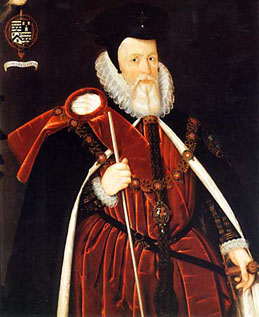
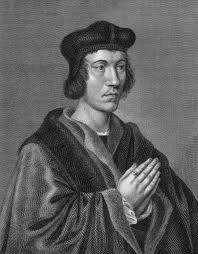
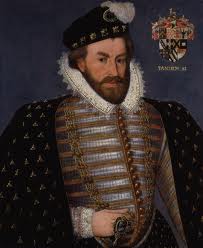
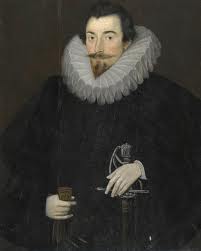
Friend, Cousin, Brother? Part I

Henry Carey, Lord Hunsdon Part I

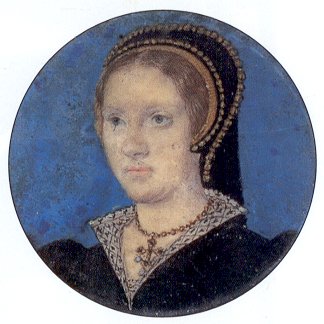
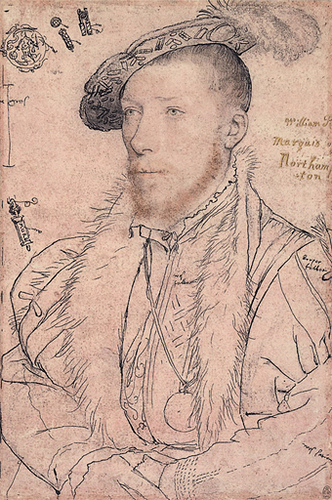
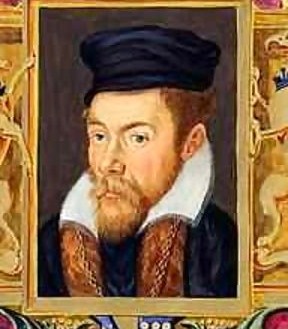
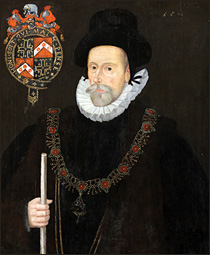
Henry Carey, Lord Hunsdon was born 4 March 1526 to Mary Boleyn and William Carey who married on 4 February 1520.  Mary was the eldest daughter of Thomas Boleyn, 1st Earl of Wiltshire and Lady Elizabeth Howard, eldest daughter of Thomas Howard, 2nd Duke of Norfolk. Mary was the sister to Anne Boleyn, second wife to Henry VIII.

henry carey
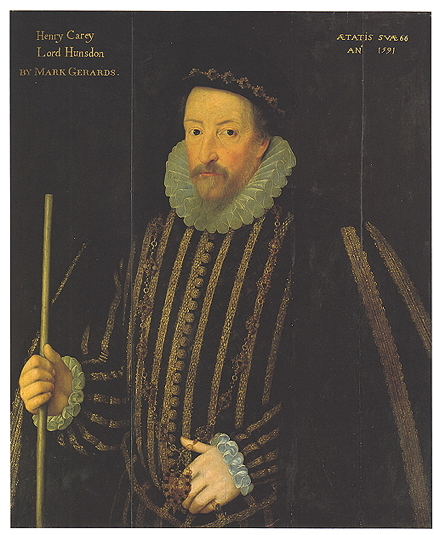
 Henry Carey, Lord Hunsdon

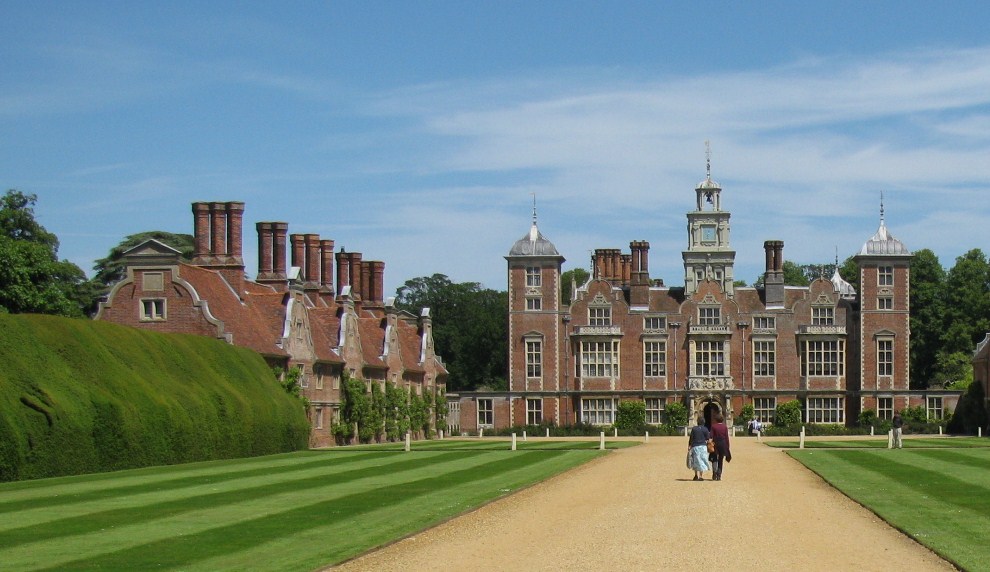
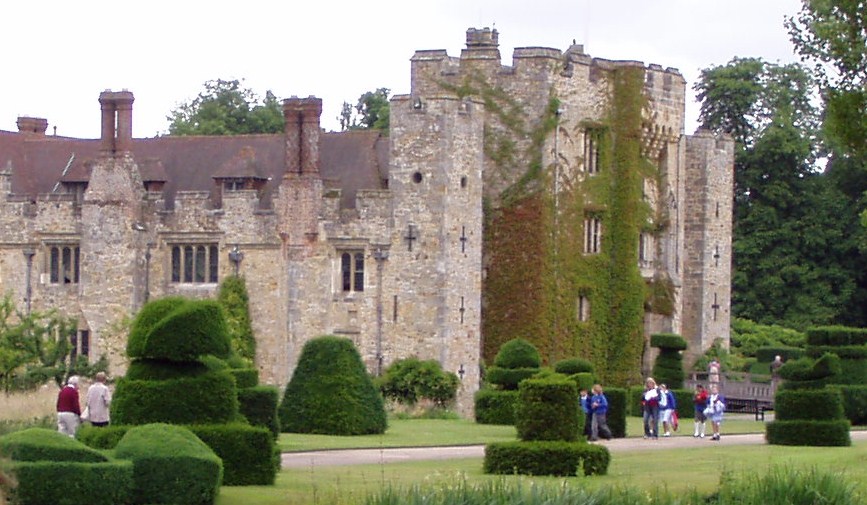
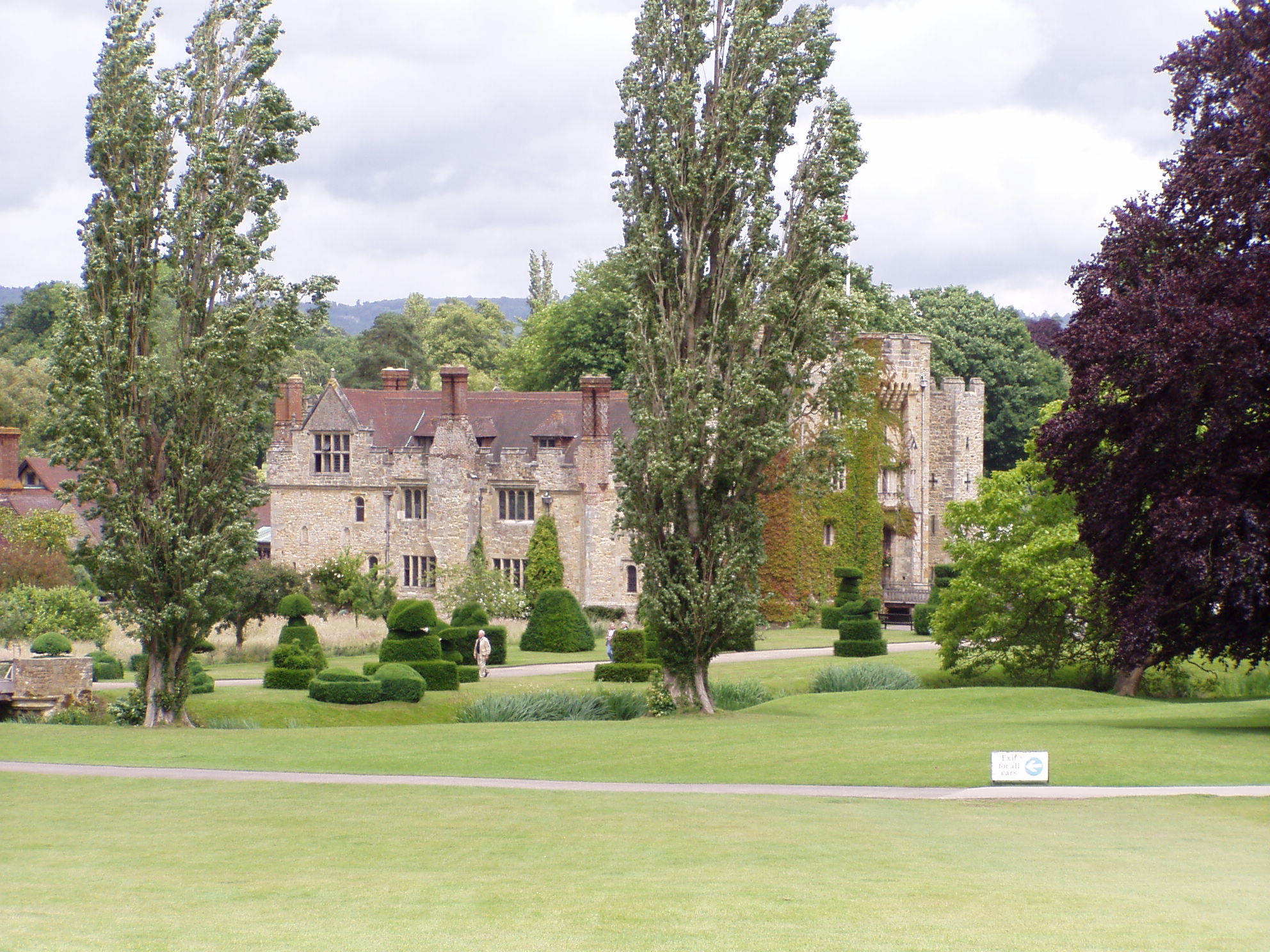
Mary Boleyn, was born most likely at Blickling Hall and reared at Hever Castle; with no evidence of an exact date for her birth most historians place it in the year 1499. Mary, tutored at home along with her siblings George and Anne, received a conventional education until 1514.  Her father arranged for her to become a maid-of-honor to Mary Tudor, sister to Henry VIII, who was soon to become the bride of King Louis XII of France. Mary Tudor was widowed shortly after her wedding and returned home. Mary Boleyn’s reputation through generations has implied affairs with French courtiers and even the new King of France Francis I.  Mary Boleyn became a maid-of-honor to Catherine of Aragon and shortly after wed Sir William Carey.  It was believed that she began an affair with King Henry around this time.  This was not a publicized liaison but the evidence is difficult to shift through.  Was the relationship not well-known at the time or was it suppressed later?  After Henry VIII had discarded Catherine due to the rise in his conscience of marrying the wife of his brother (against scripture Leviticus 20:21), could he have destroyed all evidence of an affair once he became determined to marry Anne?  If he had fathered children by Mary, would he also have repressed those facts? 

213 Welcome to my home
Blickling Hall June 2012

OLYMPUS DIGITAL CAMERA
Hever Castle 2007

Evidence is strong that Henry VIII did have an affair with Mary Boleyn.  Paul Friedmann relays that Dr. Ortiz, the Spanish theologian sent to Rome to assist the cause of Catherine of Aragon, “wrote to the empress, ‘that some time ago he [Henry] sent to ask his holiness for a dispensation to marry her, notwithstanding the affinity between them on account of his having committed adultery with her sister.’ In 1529 Charles V had already heard of the matter. Charles declared that Henry’s conscientious scruples did not seem to be justified, especially ‘if it were true, as his said Majesty had heard (although he himself would not positively affirm it), that the said king had kept company with the sister of her whom he now, it was stated, wanted to marry.’ In 1532, Eustache Chapuis speaks of the former adultery of Henry with Mary Boleyn as a well-known fact of which there can be no doubt. ‘Even if,’ he writes, ‘he could separate from the queen, he could not have her [Anne], for he has had to do with her sister.’ Such, in the main, are the arguments for the opinion that Mary Carey had been the mistress of Henry” (Friedmann 325-327).

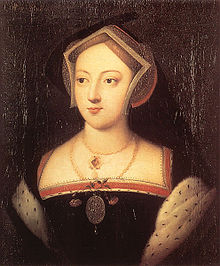
Mary_Boleyn   William_Cary
Mary Boleyn Carey                               William Carey

Of course, there is the famous incident of Sir George Throgmorton speaking to the king of the rumor that Henry had improper relations with Anne’s mother and sister, and “Henry replied, ‘Never with the mother;’ and Cromwell, who was present, added, ‘Nor with the sister either.’” (Friedman 326).  Could even Henry VIII have been such a hypocrite to justify marriage to Anne Boleyn after he had discarded Catherine of Aragon for being the wife of his brother? One must remember, Henry desperately wanted to marry Anne.

Another rumor passed down through the centuries is that Henry Carey was the natural son of Henry VIII.  If this were true, would the king have recognized the boy as such?  After all, Henry had acknowledged Henry FitzRoy, the child he had with Elizabeth Blount, and rewarded him accordingly. The difference is the king did not want to marry Elizabeth Blount’s sister.  Would measures have been taken at the time to suppress the truth?  Even if Henry had acknowledged Mary’s child, would he have disposed of all official records two to three years later when he became infatuated with Anne?

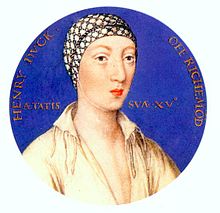
HenryFitzRoy
Henry FitzRoy

Allison Weir is adamant that Henry did not father Mary Boleyn Carey’s child (Weir Lady in the Tower 309-310). This blogger also wonders if Anne would have obligingly taken the wardship of Henry Carey when William Carey died if she thought he could be a threat to her own children as an illegitimate son to the king?  Very few contemporary sources mention this possibility.  John Haile*, vicar of Isleworth, wrote on April 20, 1535, that Morever, Mr. Skydmore dyd show to me yongge Master Care, saying that he was our suffren Lord the Kynge’s son by our suffren Lady the Qwyen’s syster, whom the Qwyen’s grace might not suffer to be yn the Cowrte” (Hoskins).

John_Hale_DSCN5606
John Haile 

Mary’s disgrace came in 1534 when she secretly married a soldier, William Stafford.  As a second son of a modestly wealthy landowner, William’s prospects were not great. Queen Anne was furious and banished her sister from Court.  After her siblings were executed in 1536, her parents died within a short time period.  As sole heir Mary then inherited some family property.  She lived comfortably and quietly until her death in July of 1543. 

thomas boleyn        elboleyn
Thomas Boleyn                          Believed to be Elizabeth Boleyn

When William Carey died of the sweating sickness 23 June 1528, Anne Bolyen was granted Henry’s wardship. He benefited enormously as Anne had him educated by “Nicholas Bourbon, a French humanist and other prominent educators” (Warnicke 148).  This patronage came to an end when Anne was executed in May of 1536; Henry was ten years old. 

Anne Morgan, the daughter of Sir Thomas Morgan and Anne Whitney, was his bride on 21 May 1545.  The couple would eventually have 12 children. In 1547, Henry was elected as a member of Parliament for Buckingham where he served for many years.  During the reign of Edward VI, he received several manors to provide a living for him and his family.  Soon after the accession of Elizabeth Regina, Henry received a knighthood (his wife was appointed as a Lady of the Privy Chamber) and was elevated to the peerage by letters patent, as Baron Hunsdon. Along with the peerage was a grant of the estate of Hunsdon in Hertfordshire and a pension of £4,000 a year “(according to the valuation in that age) in fair desmesnes, parks, and lands lying about it” (Fuller 47). 

anne morgan
Anne Morgan, Lady Hunsdon, portrait is displayed at Hatfield House

*John Haile was one of the first priests to die as a result of the Act of Supremacy (not acknowledging Henry VIII as Head of the Church).  He, along with several others, was hanged, drawn and quartered at Tyburn on 4 May 1535. Haile was beatified by Pope Leo XIII in 1886.

Henry Carey, Lord Hunsdon Part II will follow as the next published blog entry.

Said it, Believed it, Lived it

Said it, Believed it, Lived it:  Mottoes of Elizabeth Regina

A motto is a short sentence or phrase used to formally summarize or encapsulate the beliefs, motivations, intentions or ideals of an individual, group or institution. Often the motto can become a rule by which someone lives her or his life.  Although a motto can be in any language, Latin is the one mostly used in the Western world.

William Camden, an Officer of Arms under Queen Elizabeth who wrote a history of her reign at the suggestion of Lord Burghley, William Cecil, has become an excellent source for emblems and heraldic arms of the Tudor era although he does not always quote the motto nor offer explanations (Daly 5).  Camden has given his ideal of a motto accompanying heraldry.  He assures us that the picture is the body “and the Motto, which as the soul giveth it life.  That is, the body must be of fair representation, and the word in some different language, witty, short, and answerable thereunto; neither too obscure, nor too plain, and most commended when it is an Hemistich, or parcel of a verse” (Camden Remaines 366-367).

henry8wiki.23
Coat of Arms of Henry VIII

An official definition of motto is as follows: “A sentence added to a device (Ital. –L) L. muttium, mutter, a grunt, a muttered sound; cf. mutire, muttire, to mutter, mumble” (Skeat 387).  Therefore, in heraldry, a motto is shown on a shield as part of a coat of arms.  In English heraldry in particular, the motto is not granted with the armorial bearings and can be changed. 

Members of Tudor upper society certainly embraced the custom of using mottoes and “subjects adopted them as expressions of loyalty” (Cannon 253).  Below are briefly the mottoes of Henry VIII, his wives and his children with expanded explanations on the mottoes of Elizabeth and her mother, Anne Boleyn to follow.

Tudor Mottoes                      

Henry VIII     Dieu et mon droit  —God and my right

Katherine of Aragon     Humble and loyal

Anne Boleyn     The Most Happy                                                                                                 
Jane Seymour     Bound to Obey and Serve

Anne of Cleves     God send me well to keep

Catherine Howard     Non aultrevolontè que le sinne  —No other will than his

Katherine Parr     To be useful in all I do

Edward VI     Dieu et mon droit  —God and my right
                      Modus et Ordo   —Method and Order

Mary I    Veritas filia temporis   —Truth, daughter of time

Elizabeth Regina     Semper Eadem  — Always the Same
                                   Video et taceo   —I see and say nothing

Royal British mottoes can be a bit confusing.  All Knights of the Garter may use the motto, Honi soit qui mal y pense, [Shamed be he who thinks evil of it] added to their heraldry.  Also, the sovereign will use, Dieu et mon droit, [God and my right] on a scroll beneath the shield of the royal coat of arms.  This motto has been attributed to Richard I Lionheart as a battle cry and has been used officially since the time of Henry V.  Obviously, this refers to the monarchs’ divine right to rule.

PTDC0001
Clock given to Anne Boleyn by Henry VIII at the time of their marriage.  The weights are engraved with the initials ‘H’ and ‘A’ and also the mottoes “Dieu et Mon Droit” and “The Most Happy”.

Alternatively, the Royal Arms may depict a monarch’s or consort’s personal motto and may appear on many buildings, possessions, documents, and in more modern times on products—those purveyors who have earned the Royal Warrant.  More on that topic in another blog entry.  Often its use is done for dynastic glorification as illustrated in the cup Henry VIII commissioned by Hans Holbein as a wedding gift to Jane Seymour.  Jane’s motto “Bound to obey and serve” is repeated on the lid and on the base.  The bridal pair’s initials adorned the cup. “Its submissive tone was fairly typical for queen consorts, but it also reflects Jane’s personality and helps explain why she was so attractive to Henry” (Doran Man & Monarch 189).

jane-seymour-s-cup
Cup designed by Hans Holbein for Jane Seymour with her motto on the lid and base

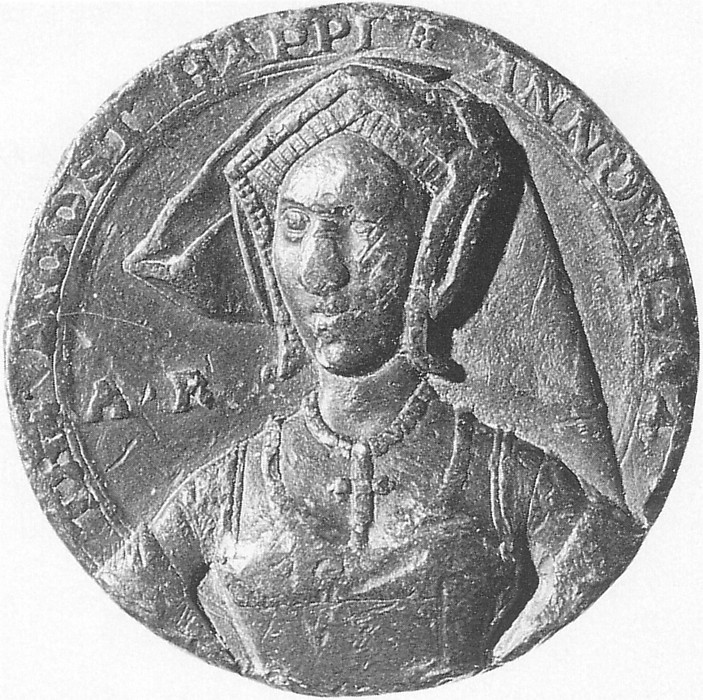
Reigning between queens with mottoes conveying humility and obedience-Katherine of Aragon’s “Humble and loyal” and Jane’s “Bound to obey and serve”-comes Anne Boleyn whose motto was the bold “The most happy”.  Anne adopted this motto as her coronation approached.  She had reason to be “the moost happi”: she had married a supportive and affectionate Henry, she was expecting his child (convinced it was the longed-for male heir), and she had managed to institute several religious changes in the country.

AnneBoleyn4
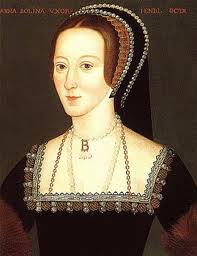
Anne Boleyn’s medal inscribed around with THE MOOST HAPPI ANNO 1534 and A.R. for Anne Regina next to her portrait

Although some sources attribute the motto “Me and mine” to Anne, this blogger never found true evidence of it.  One motto she adopted in 1530 before she was queen, Aisi sera groigne qui groigne meaning “Let them grumble; that is how it is going to be!” (Ives 141).  This motto had quite a story attached to it.

Paul Friedman was quoting Pascual de Gayangos’ Calendar of State Papers, Spain Vol. 4, Part 2, page 41, which stated that Anne, to show her “contempt for those who opposed her, chose a device which she had heard in France, but which she only partially remembered, Ainsi sera, groigne qui groign! was embroidered on the liveries of her servants” (Friedman 128).  Her arrogance and defiance did not last long.
To her mortification, and to Eustace Chapuys’ glee, she learned that she had “adopted the motto of her bitter enemies, the princes of the house of Burgundy.  ‘Groigne qui groigne’, she heard it repeated, “et vive Bourgoigne!’ The liveries had to be laid aside, and Anne’s servants on Christmas Day appeared in their old doublets” (Friedman 128).

Such a blatant alteration of an Imperialist motto was hardly the way to win supporters at Court and gain Anne acceptance as the replacement of a highly-respected Habsburg queen (Ives 142-143).

The Anne Boleyn Cup. This 16th century gilded silver goblet was given to Dr Richard  Masters by Anne Boleyn, and Dr Masters presented it to the church.
The Boleyn cup 1535-36 in St. John the Baptist Church in Cirencester with motto “The Most Happy.”  Elizabeth inherited this beautiful from her mother and in turn gave it to her physician Richard Master who presented it to the church.

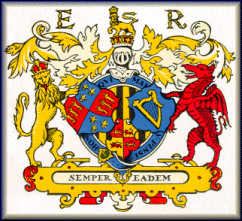
Another motto, Semper eadem, [Always the same], was said to be used by Anne (Weir 324). This blogger could not find primary source evidence to support Anne’s use of this maxim. It was a well-known motto adopted by Anne’s daughter, Elizabeth, when she became queen.  This particular motto appears to be associated with the quality of constancy.  Elizabeth’s constancy can be shown in her willingness to maintain a steadfast government during the transition between her reign and her sister’s.  See the blog entry  https://elizregina.com/2013/04/09/reigned-with-your-loves/ for a list of Marian councilors retained by Elizabeth. Perhaps Elizabeth adopted it for simply sentimental reasons to form a link to her mother.  Another view of this motto reveals it to be a pledge that Elizabeth would not change her religious faith (Collinson 1549).

elizabeth_tudor_coat_of_arms
Coat of Arms of Elizabeth Regina with motto, Semper eadem.

With the childhood fraught with uncertainty and constant change perhaps this motto was a rule in which Elizabeth preferred to live.  It does imply an avoidance of any surprise, uncertainty or disruption.  Could a sovereign associated with such changes that supported exploration, encouraged the Arts and introduced religious reform prefer the status quo?

William Camden deemed Elizabeth’s main care upholding the Protestant faith and her “second care was, to hold an even course in her whole life, and all her actions: whereupon she tooke for her Motto, Semper eadem, that is, Alwayes the same.  The rest of her counsels consisted in these points” (Camden Annales 20). There is some disconnect between this motto and her well-known impulsiveness, indecision and secrecy.

shield motto
 Shield and motto of Queen Elizabeth I by Simon de Passe in the NPG Collection

NPG D42191; Queen Elizabeth I by Simon de Passe, after  Isaac Oliver
 Elizabeth I–obverse of shield and motto line engraving in the NPG collection

Elizabeth’s habit of covering her actions and motives was admired by Camden. When explaining her second motto, Camden discussed her methods “Which notwithstanding Queene Elizabeth dissembled and concealed with silence, according to that motto which she used, video et taceo, that is, I see and say nothing” (Camden Annales 307).

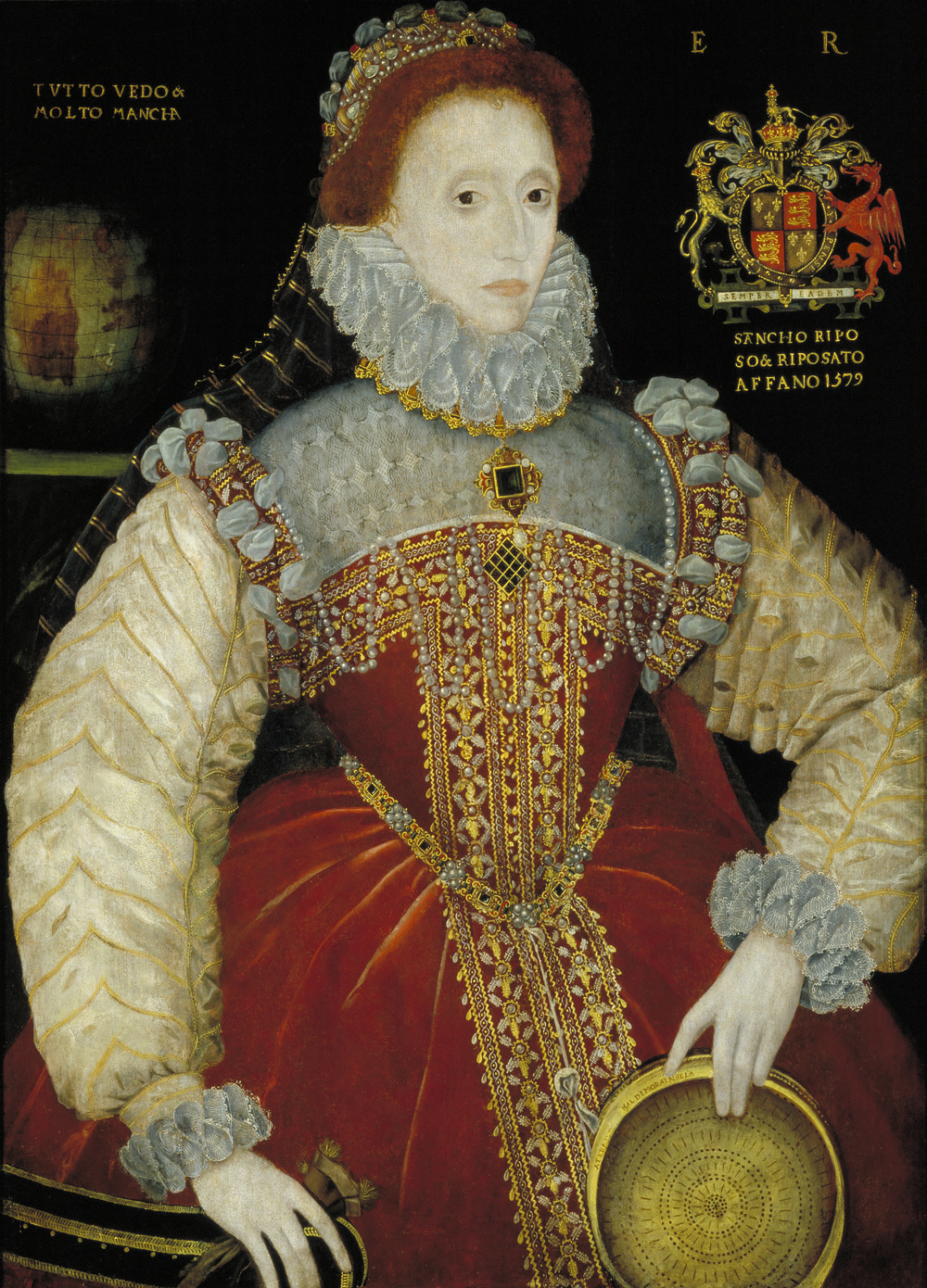
“I see and say nothing” has been termed a political motto used by Elizabeth.  With her impressive humanist education, this motto could be of ancient historical significance or it could be a practical methodology employed by Elizabeth.  No sources that this blogger has discovered definitively explain Elizabeth’s selection of this motto.  An examination of them suggests a link to the equation of Elizabeth’s style with Cicero’s, an acquired maxim from Lady Tyrwhitt, a reflection of her moderate religious policy or a connection to Francis Walsingham’s spy network. More recent authors have interpreted that the use of Elizabeth’s mottoes, Video et taceo, and Semper eadem “alludes to an important feature of prudence, which is that it encompasses the knowledge of when to speak and when to keep quiet” (Broad 34).

ART 246171
The Plimpton “Sieve” Portrait of Elizabeth  I, by George Gower, 1579.  The sieve alludes to the myth of Tuccia, a roman Vestal Virgin who proved her virginity and prudence by carrying water with a sieve.  The coat of arms and the motto in the top right Honi soit qui mal y pense / Semper eadem [Shamed be he who thinks evil of it / Always the same] are the motto of the Order of the Garter and the personal motto of Elizabeth Regina.

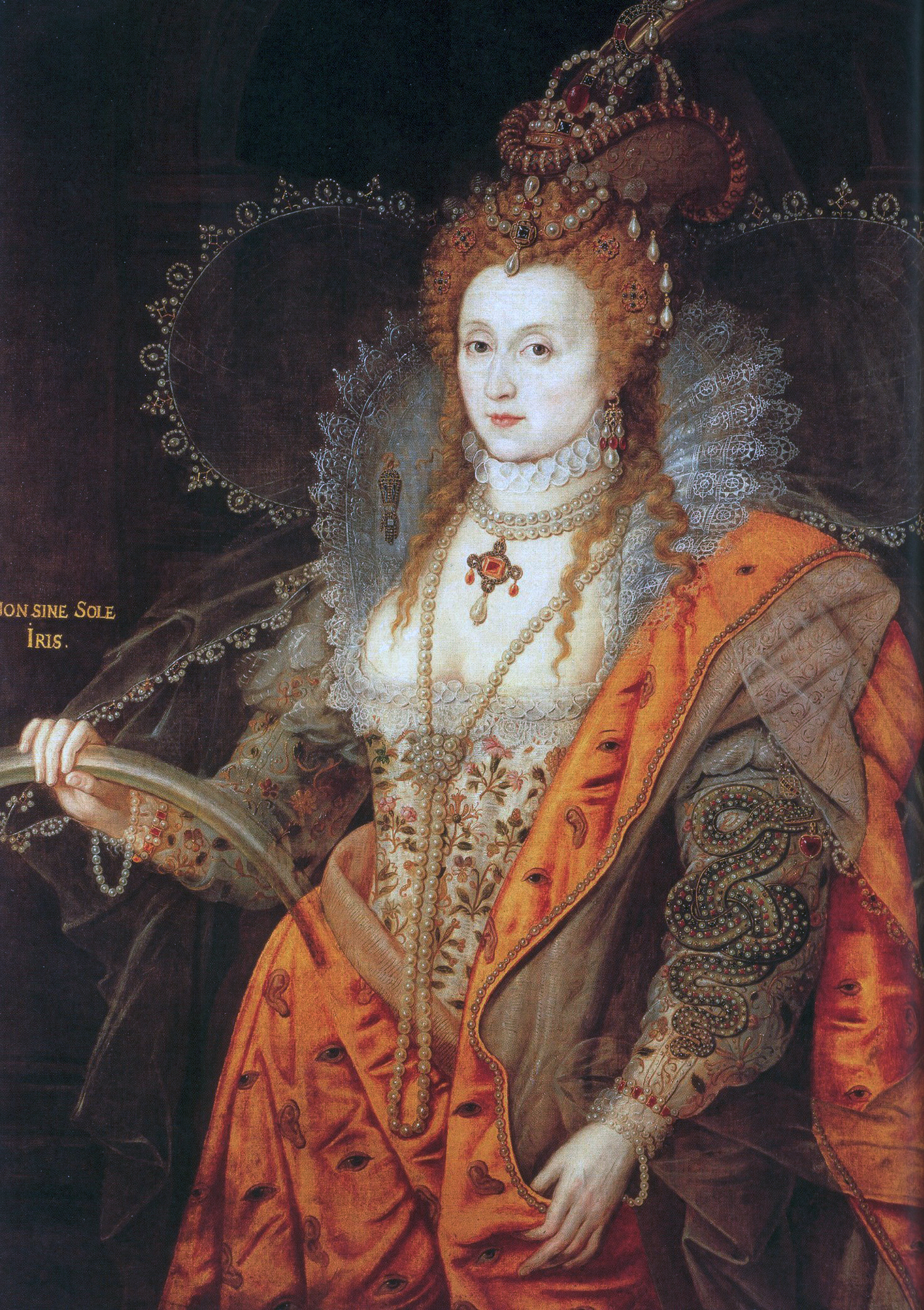
What does come to mind to this blogger is the ‘Rainbow’ portrait of Elizabeth with the eyes and ears embroidered on her gown.  The poet John Davies refers to the ears and eyes as how the Queen uses her servants for a sketch he wrote during the Queen’s visit to William Cecil’s house, Theobalds, in 1591.  When asked what use Elizabeth makes of her servants the reply was “She makes the same use of them as the mynde makes of the sences.  Many things she sees and heares through them; but the judgment and election is her owne” (Nichols 77).  Elizabeth clarified her right to rule and have good counsel early in her reign, “I shall desire you all, my lords, (chiefly you the nobility, everyone in his degree and power) to be assistant to me that I, with my ruling, and you with your service, may make a good account to Almighty God and leave some comfort to our posterity on earth.  I mean to direct all my actions by good advice and councel” (Marcus 52).  Through further research I discovered this idea of Elizabeth’s relationship with her advisors and her motto was further explored by Mary Thomas Crane.

Elizabeth_I_Rainbow_Portrait
The “Rainbow” portrait attributed to Marcus Gheeraerts the Younger, 1600-1603.

Professor Crane begins her article “Although one of her mottoes, ‘semper eadem,’ seems to claim a fundamental unity of character, Queen Elizabeth I nevertheless presents us with an array of poses and personae” (Crane 1).  How true.  Students of Elizabeth Regina are familiar with her paradoxically presenting an image of absolute patriarchal power and one of a ‘weak and feeble woman’. How did Elizabeth maneuver within the Privy Council composed of men whose views were the by-products of a time period when authority and advice-giving were the realm of males?  This was an era that considered “Kings were creatures defined by ancient custom; but queens, however loved and admired, were unpredictable” (Loades 318).

The use of the term ‘video’ assures that Elizabeth will listen and evaluate the advice to make up her own mind, as opposed to ‘audio’ that implies she will “accept blindly her advisors’ spoken counsel” (Crane 2).  In an era when women were to remain silent and obedient, ‘taceo’ insinuates that “as queen, she will maintain the silence thought suitable for a woman …” (Crane 2).  The motto encapsulates the fine line Elizabeth struck between asserting her authority and accepting advice from her Council.

She could be silent and allow her statesmen such as Burghley the role of respected advisor and she could be vocal and affirm her authority.  Crane sees Elizabeth’s motto, Video et taceo, as more of the way she uses the political system and her “use of the paradigm of advice-giving reveals a woman who was less completely bound by male structures than some critics have argued” (Crane 2).  Elizabeth “despite her motto, did not always remain silent….  Her skillful use of the humanist rhetoric of authoritative counsel allowed her to break silence and speak the language of authority as a uniquely powerful woman in a man’s world” (Crane 12).

One can suppose she did not believe her own contradiction to her motto when she  teasingly responded to the French Ambassador after he had praised her linguistic skills,  “There is no marvel in a woman learning to speak, but there would be in teaching her to hold her tongue.”

References

Allison, Ronald and Sarah Riddell, editors. The Royal Encyclopedia. London: Macmillian Press, 1991. Print.

“Arms of Tudors; Arms of Henry VIII; Arms of Edward VI.” Victoria and Albert Museum Collections. Victoria and Albert Museum, n.d. Web. 17 June 2013.

Broad, Jacqueline and Karen Green. Virtue, Liberty, and Toleration: Political Ideas of European Women, 1400-1800.  Dordrecht, The Netherlands: Springer, 2007. Google Books. Web 21 Jun 2013.

Camden, William, Robert Norton, Nicholas Hillard, and Francis Delaram. Annales or the History of the Most Renowned and Victorious Princesse Elizabeth Late Queen of England, Containing All the Important and Remarkable Passages of State, Both at Home and Abroad, during Her Long Ans Prosperous Reigne. Trans. R. N. Gent. 3rd ed. London: Harper, 1635. Google Books. Web. 21 June 2013.

Camden, William. Remaines concerning Brittaine: But Especially England, and the Inhabitants Thereof: Their Languages, Names, Syrnames, Allusions, Anagrammes, Armories, Moneys, Empresses, Apparell, Artillerie, Wise Speeches, Prouerbes, Poesies, Epitaphs. London,: Simon Waterson, 1605. Google Books. Web. 21 June 2013.

Cannon, John and Ralph Griffiths. The Oxford Illustrated History of the British Monarchy.  Oxford:  Oxford University Press, 1988. Print.

Collinson, Patrick. Elizabeth I. Oxford: Oxford University Press, 2007. Google Books. Web. 16 June 2013.

Crane, Mary Thomas. “Video Et Taceo”: Elizabeth I and the Rhetoric of Counsel.” Studies in English Literature 1500-1900 28.1 (1988): 1-15. GeoCities, 2001. Web. 20 June 2013.

Daly, Peter, Leslie Duer, Anthony Raspa. The English emblem tradition. Toronto: University of Toronto Press, 1998. Google Books. Web. 21 June 2013.

“Death Could Not Separate Them: How Elizabeth I Connected to Her Deceased Mother.” Web log comment. Being Bess. Ed. Ashlie Jensen. N.p., 5 Aug. 2012. Web. 20 June 2013.

Doran, Susan.  Henry VIII:  Man & Monarch. London:  British Library, 2009. Print.

Doran, Susan.  The Tudor Chronicles 1485-1603.  New York:  Metro Books, 2008. Print.

Eakins, Laura. “Elizabeth I’s other motto.” TudorHistory. Google+Page, 20 Feb. 2012. Web. 17 June 2013.

Eakins, Laura. “Meaning of Anne Boleyn’s motto.” TudorHistory. Google+Page, 31 Dec. 2009. Web. 19 June 2013.

Friedmann, Paul.  Anne Boleyn: A Chapter of English History 1527-1536. London: Macmillian and Co., 1884. Internet Archive. Web. 21 Jun 2013.

de Gayangos, Pascual (editor). “Spain: January 1531, 21-31.” Calendar of State Papers, Spain, Volume 4 Part 2: 1531-1533 (1882): 31-47. British History Online. Web. 22 June 2013. 

Isaacs, Alan and Jennifer Monk, editors.  The Illustrated Dictionary of British Heritage.  London:  Promotional reprint Company, 1993. Print.

Skeat, Walter W. An etymological dictionary of the English language. Oxford: Clarendon Press, 1993. Print.

Ives, Eric.  The Life and Death of Anne Boleyn: The Most Happy. Oxford: Blackwell Publishing, 2004. Print.

Loades, D. M. Elizabeth I. London: Palgrave Macmillilan, 2003. Google Books. Web. 16 June 2013.

Lloyd, Christopher and Simon Thurley. Henry VIII:  Images of a Tudor King.  London: Phaidon Press Limited, 1990.  Print.

“Medallion:  Arms of Henry VIII and Jane Seymour” Victoria and Albert Museum Collections. Victoria and Albert Museum, n.d. Web. 17 June 2013. 

Nichols, John. The Progresses and Public Processions of Queen Elizabeth. Among Which Are Interspersed Other Solemnities, Public Expenditures, and Remarkable Events during the Reign of That Illustrious Princess. Collected from Original MSS., Scarce Pamphlets, Corporation Records, Parochial Registers, &c., &c.: Illustrated with Historical Notes. New York: B. Franklin, Vol 3, 1823. Google Books. Web. 19 Jan. 2013.

Ross, Josephine.  The Tudors, England’s Golden Age.  London: Artus, 1994.  Print. 

Starkey, David.  Henry VIII:  A European Court in England. New York:  Cross River Press, 1991. Print.

Strong, Roy C. Gloriana: The Portraits of Queen Elizabeth I. London: Pimlico, 2003. Print.

Wagner, John. Historical Dictionary of the Elizabethan World: Britain, Ireland, Europe, and America.  New York:  Checkmark Books, 2002. Print.

Warnicke, Retha.  The Rise and Fall of Anne Boleyn: Family Politics at the Court of Henry VIII. Cambridge:  Cambridge University Press, 1989.  Print.

Announcing Elizabeth’s Birth

Elizabeth’s Birth Announcement:

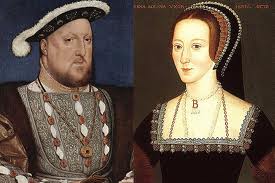
In the summer of 1533, as the birth of the child of Henry VIII and Anne Boleyn drew nearer, a courtier, John Russell, wrote in a letter to Lord Lisle, Captain of Calais, that he “never saw the King merrier” (Nichols 443). The royal couple were at Windsor until 21 August when they traveled to Whitehall.  From there on 26 August, they moved to Greenwich where Anne was to take to her chamber. This required a formal ceremony to be performed.  Anne went in procession to the Chapel Royal to hear mass, then to her Great Chamber.  She and her guests dined and then ate ceremoniously from a “goodly spice plate…of spice and comfettes.” The Lord Mayor of London provided “a cuppe of assaie of gold, and after that she had dronke, she gave the Maior the cuppe.” Once the refreshments were partaken of, Anne “under her Canapie, departed to her Chamber” and at the entry of her chamber, she gave her Canopy of State to the barons “accordyng to their clayme” (Hall 805). Anne’s Lord Chamberlain called for all to pray for the safe delivery of her child and then Anne and her women entered her chamber” (Hall 805).    Henry 8      anneboleyn
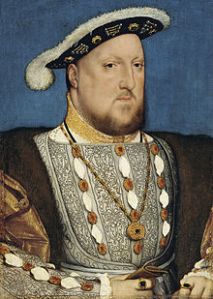
            King Henry VIII                           Queen Anne Boleyn

Anne’s chambers would have been altered tremendously to create the lying-in chamber to provide enough storage for multiple weeks of supplies and baby items.  Included would have been furniture: beds for the birth, recovery and ceremonies, and the baby cot; plus blankets, pillows and bedding.  An altar for religious services would have been included along with candlesticks, crucifixes and religious images.  Tapestries would have covered the walls, ceiling and all windows except for one.  Alison Weir stated that the tapestries showed St. Ursula and her 11,000 virgins (Weir Six Wives 257).  David Starkey, on the other hand, informed that the tapestries would not have depicted animals or humans as that could trigger fantasies in the mother-to-be and lead to a deformed child (Starkey Elizabeth 2). Regardless of the decoration themes, one can envision the chamber as being a “cross between a chapel and a luxuriously padded cell” (Starkey Elizabeth 2).
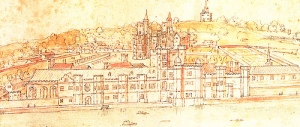
greenwich 1533
 Greenwich 1533

William Blount, 4th Baron Mountjoy, Chamberlain to Catherine of Aragon sent to his counterpart in Anne’s household, George Brooke, 9th Baron Cobham, advice on the correct method for the confinement and ensuing ceremonies.  A general procedure had been followed for generations, and it was unlikely that Henry VIII would jeopardize the successful birth of his male heir by altering the steps in any way.  That is why the speculation that Henry kept Anne from her confinement in order to dupe the general population about the date of conception does not make sense.
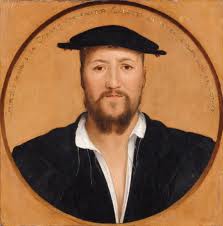
george brooke
George Brooke, 9th Baron of Cobham and Queen Anne’s Lord Chamberlain

Once a woman entered her lying-in chamber, it was a signal that she did not expect to have her child for about a month. Anne gave birth within two weeks. How and why could there be such a miscalculation? Retha Warnicke speculates that Henry took advantage of Anne’s good health in the summer of 1533 and delayed her entry to her chamber.  He wanted to confuse people over the delivery date to convince them that the child had been conceived during the time of their marriage (Warnicke 164).  Would Henry do that?  Would he risk the health of his male child in such a way?  I do not think so.  Would he encourage people to assume the date of their wedding was earlier than it was?  Probably.

Chronicler Edward Hall insisted that Henry and Anne married on 14 November 1532 on “sainct Erkenwalds daie” and managed it to be “kept so secrete, that very fewe knewe it, til Builyne she was greate with child, at Easter after” (Hall 794).  Other sources state the wedding was on 25 January 1533.  Eric Ives speculates that the earlier date was used much afterwards to protect Elizabeth’s reputation against being born out of wedlock.  If a compromise theory is believed, a commitment ceremony could have been held in November that would “stand up in canon law– espousals de praesenti before witnesses which, if sealed by intercourse, would have been canonically valid …” (Ives 170).  Henry would have then held another ceremony, before a priest, in January once it was obvious Anne was pregnant: or could the mid-wives and physicians have underestimated the delivery date?  We will never know.  What we do know is that on “vii day of September being Sondaie, between thre and foure of the Clocke after noone, the Quene was delivred of a faire lady” (Hall 805).

The fact that the child was a girl was a shock to her parents so sure they were that they would have a son.  Tradition tells us that Henry responded appropriately to Anne by saying that all was well since they were both young “by God’s grace, boys will follow” (Weir, pg. 258).  Immediately following the birth, a Te Deum was sung and “great preparacion was made for the christening” with the Mayor of London, Stephen Peacock, and chief citizens “commaunded to bee at the Christenyng, the Wednesdaie folowyng” in all of their finery went by barge to Greenwich.  “All the walles betwene the Kynges place and the Friers, were hanged with Arras, and all the waie strawcd with grene” the Observant Friars Church was also hung in tapestries.  The font was “of siluer, and stoode in the midles of the Churche, three steppes high, whiche was couered with a line clothe … oner it hong a square Canape of crimosin Satten, fringed with golde” and in an area close by was a brazier with a fire in it to keep the child warm.  When “al these thynges wer ordered, the child was brought to the hall,” followed by members of Court with “the Erie of Essex, bearyng the couered Basins gilte, after hym the Marques of Excester with taper of virgin waxe, next hym the Marques Dorset, bearyng the salt, behynd-hym the lady Mary of Norffolk, bearyng the cesom whiche was very riche of perle & stone, the old Duches of Norffolk bare the childe” (Hall 805).   The child wore, in addition to a christening robe heavy and stiff with gold embroidery…a royal mantle of purple velvet and miniver, with a train so long that it was borne up by a lady and two gentlemen (Tytler 2).

frances
Portrait identified as Frances Brandon Grey, Marchioness of Dorset, Duchess of Suffolk

An enthusiastic Hall continues to describe the scene as the Duke of Norfolk walked to the right of the baby, the Duke of Suffolk to the left and the Countess of Kent bore the train along with other noble ladies.  The baby’s uncle, Lord Rochford and three others carried a canopy over her.  When “the child was come to the churche dore, the bishop of London met it with diverse bishoppes and Abbottes mitred, and began the observances of the Sacrament” (Hall 806).

One godmother was the baby’s cousin, Frances Brandon, Marchioness of Dorset; the other, who carried the child, was her great-grandmother, Agnes, Dowager Duchess of Norfolk, the godfather was Archbishop of Canterbury, Thomas Cranmer.  The Bishop of London John Stokesley, assisted by other clergy performed the ceremony (Tytler 2). The “childe was named Elizabeth: and after that al thyng was done, at the churche dore the child was brought to the Fount, and christened” (Hall 806).
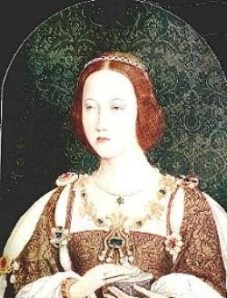
agnes norfolk3
Agnes, Dowager Duchess of Norfolk

We are told that the Garter Chief King of Arms then proclaimed “God of His infinite goodness, send a prosperous life and long, to the high and mighty princess of England Elizabeth” (Strickland 4). Next Elizabeth was confirmed as part of the extended ceremony. Afterwards servants brought in “wafers, comfits and hypocras in such plenty that every man had as much as he would desire” (Somerset 4). “Then they set forwardes, the trumpettes goyng before in thesame ordre, towarde the kynges place, as they did when they came thether warde, … and in this ordre thei brought the princes, to the Quenes chamber (Hall 806).  With Henry VIII in attendance, Queen Anne received her child back while Londoners rejoiced with Court supplied wine and bonfires in the streets but no jousts or fireworks—this was a princess not a prince.  Publically Henry continued to reassure that the princess was not a disappointment.  Privately, as reported by a gleeful Eustace Chapuys, Spanish Ambassador, the birth was a “great regret both of him and the lady, and to the great reproach of the physicians, astrologers, sorcerers, and sorceresses, who affirmed that it would be a male child. But the people are doubly glad that it is a daughter rather than a son, and delight to mock those who put faith in such divinations, and to see them so full of shame” (Gairdner VI 1112).

How could the predictions go so wrong? 

Besides soliciting physicians’ opinions on the sex of the child, astrologers and soothsayers were also consulted.  Only one did not predict a son.  William Glover wrote to Queen Anne of a vision he had in which she gave birth to a “woman child” and he instructed she “should be delivered of your burden at Greenwich” (Gardiner VI 1599).

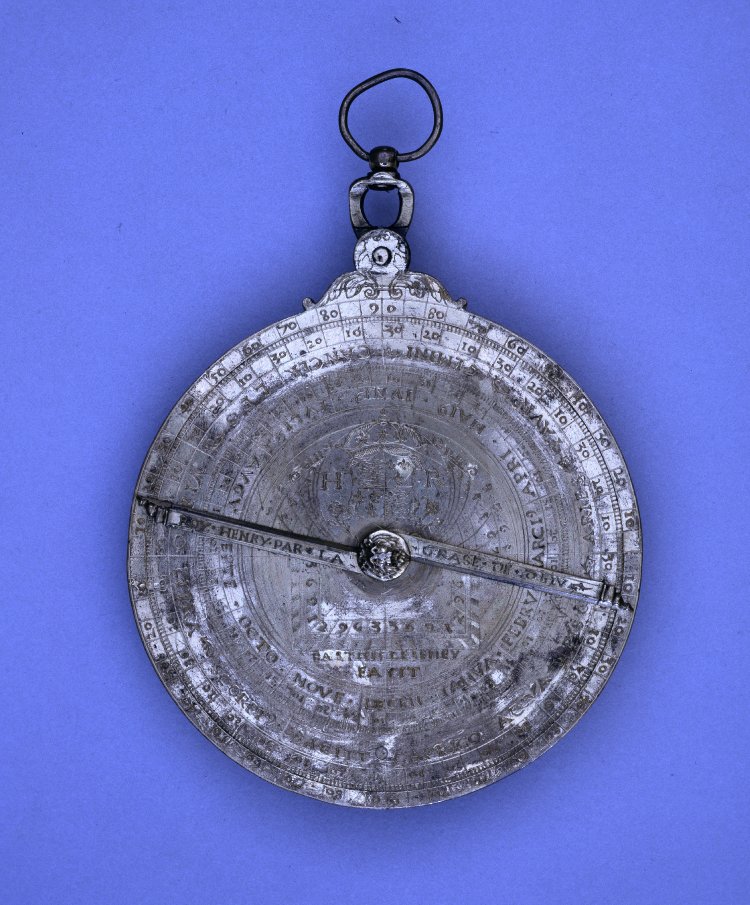
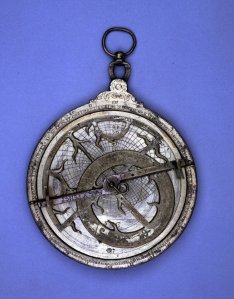
Physicians “studied astronomy, astrology, geometry, mathematics, music and philosophy” in the 16th century.  “The Tudors believed strongly in the divine plan ….  Fate, fortune and goodwill might cure” (Hurren). Included in the studies of sciences, astrology was certainly compatible with religion at this time.  Astrology was considered a way to understand God’s plan.  Henry VIII received predictions that the child Anne was carrying was a boy—there was no reason to doubt that.  God had punished Henry for co-habitating with his brother’s wife, Catherine of Aragon, against the teachings of Leviticus, by not granting living male children to that union.  Surely, he could not have misinterpreted the signs of the divine will to divorce Catherine.  Sons would come from his union with Anne.
AN00247557_001_l  AN00247559_001_hhl
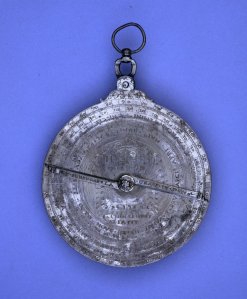
Henry VIII’s astrolabe made for him by Bastien le Seney, royal clockmaker

References to prophecies and predictions were accepted at the time as were the “astrological superstitions of the generation” (Tytler 2). In one of his love letters to Anne, Henry showed a “personal interest in astrology: in attempting to dispel her fears about their forced separation” (Warnicke 165).

“I and my heart put ourselves in your hands. Let not absence lessen your affection; for it causes us more pain than I should ever have thought, reminding us of a point of astronomy that the longer the days are, the further off is the sun, and yet the heat is all the greater. So it is with our love, which keeps its fervour in absence, at least on our side. Prolonged absence would be intolerable, but for my firm hope in your indissoluble affection. As I cannot be with you in person, I send you my picture set in bracelets” (Brewer).

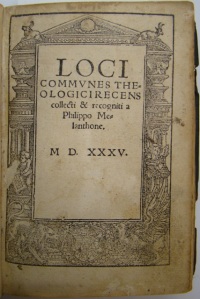
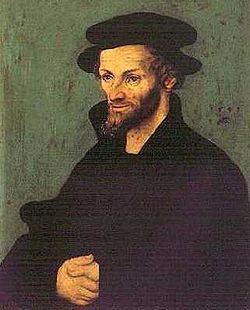
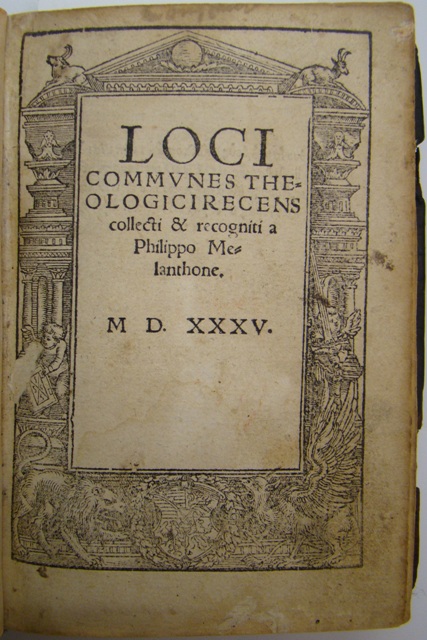
As Lutheran theologian Philipp Melancthon later said in his dedication to the text, Theological Commonplaces, “Henry is ‘the most learned of kings not only in theology, but also in other philosophy, and especially in the study of the movement of the heavens’. Since the king and his contemporaries held ‘a complex view of conception in which both the physical and spiritual’ were intertwined, he may have been persuaded of the validity of the prophecies about the child’s sex because he had personally done all that was necessary for him to earn and to merit a divine blessing in the form of a son” (Warnicke 165).

PhilippMelanchthon
Theologian, Philipp Melancthon
loci15352
Theological Commonplace, 1535 which had the dedication to Henry VIII.

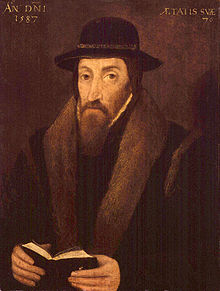
“Anne’s skeptical attitude toward the most superstitious of them must have been well-known” as John Foxe later discussed it (Warnicke 165).  Foxe recounted a story that implied Anne’s “true faith …for when king Henry was with her at Woodstock, and there, being afraid of an old blind prophecy, for which neither he nor other kings before him durst hunt in the said park of Woodstock, nor enter into the town of Oxford, at last, through the Christian and faithful counsel of that queen, he was so armed against all infidelity, that both he hunted in the aforesaid park, and also entered into the town of Oxford, and had no harm”  (Foxe 136). Popular belief maintained that Henry did abide by the use of prophecies.
John_Foxe
John Foxe

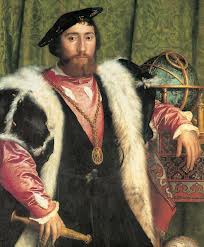
Certain the child would be a boy, Henry and Anne had selected the names of Edward and Henry and had asked Francis I, King of France to be godfather.  In a dispatch to Francis, his Ambassador, Jean de Dinteville, The Bailly of Troyes*, explains how he had been asked to “hold at the font the child of which the Queen is pregnant, if it is a boy” (Gairdner VI 1070).

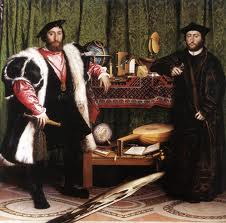
As an aside, de Dinteville (also as known as d’Intevile Polizy) “chevalier Sieur de Polizy, near Bar-sur-Seyne, Bailly of Troyes who was Ambassador in England for King Francis I in the years 1532-1533” was identified in the late 19th century as one of the sitters in the Ambassadors painting by Hans Holbein (Hervey 12).  Without going into extreme detail, the clues in the painting confirmed what Hervey discovered on a fragment of manuscript.  An example would be the seigneurie, an area of manorial influence that de Dinteville held, was Polizy in Burgundy shown on the globe in the painting  (Hervey 8).
jeandinteville
Jean de Dinteville, French Ambassador 
ambassadors
The Ambassadors by Hans Holbein, 1533
Jean de Dinteiville and Georges de Selve

There is no record of whether or not Francis I felt any sympathy for Henry’s disappointment but it was clear he would not be asked as godfather for a princess’s baptism. While de Dinteville showed his “complete allegiance to the Crown of France” (Hervey 41), being ready to fill whatever office would be required even for a princess, his Spanish counterpart, Eustace Chapuys, was interpreting the birth of a daughter to Henry as the divine will that “Misfortune manages well; and God has forgotten him entirely, hardening him in his obstinacy to punish and ruin him” (Gairdner VI 1112).
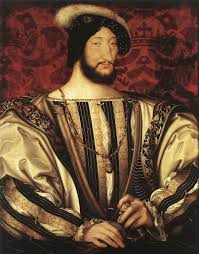
francisi
King Francis I of France   

After the ceremony de Dinteville exclaimed “the whole occasion was so perfect that nothing was lacking” (Hibbert 14).  Chapuys concluded “the christening has been like her mother’s coronation, very cold and disagreeable both to the Court and to the city, and there has been no thought of having the bonfires and rejoicings usual in such cases. After the child was baptised, a herald in front of the church-door proclaimed her princess of England (Gairdner VI 1125).
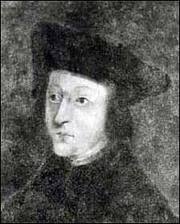
chapuys
Eustace Chapuys, Spanish Ambassador

Prior to the christening, Chapuys claimed that the child would “be called Mary, like the Princess; which title, I hear in many quarters, will be taken from the true princess and given to her” (Gairdner 1112).  He had to retract saying “the daughter of the lady has been named Elizabeth, and not Mary” (Gairdner 1125).  Obviously, the child was named for her two grandmothers, Elizabeth of York and Elizabeth Howard.

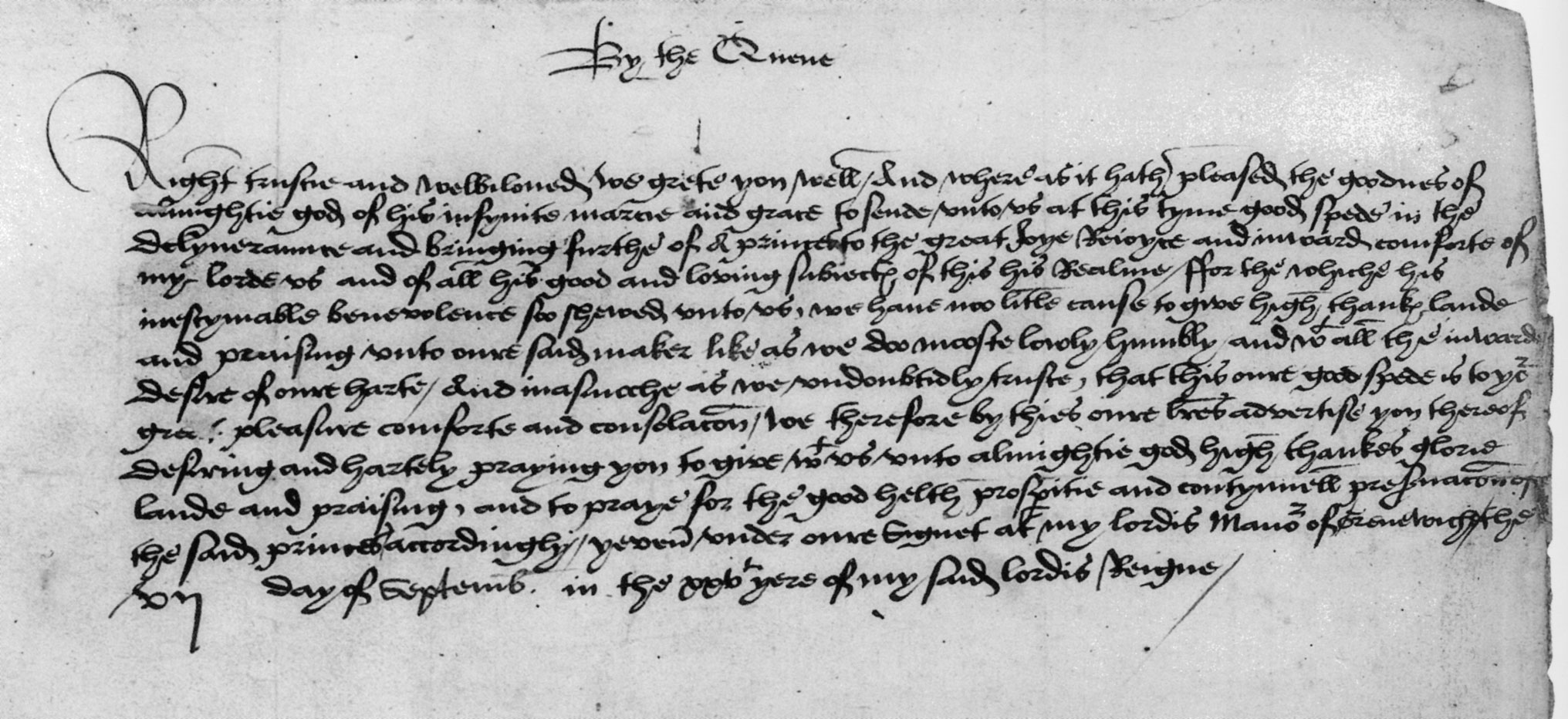
So sure were the parents that the child would be a boy, official announcements, which were to be sent throughout the realm and to the Courts of Europe from the Queen listed the child as a prince.  One such letter is preserved written to Lord Cobham, Anne’s Chancellor informing him of the birth at Greenwich on 7 September during the 25th year of the reign of Henry (Gairdner VI 1089).   An ‘s’ was added to the word prince (see the facsimile below—the first is in the third line, center also shown in an enlargement—and secondly in the final sentence) which would have altered it enough in the 16th century to signify the word princess.
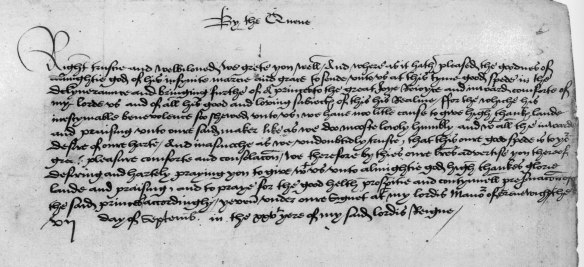
elizabethbirthannouncement
Letter of Lord Cobham– the area with the ‘s’ insertion is enlarged below.  A transcription is also included.
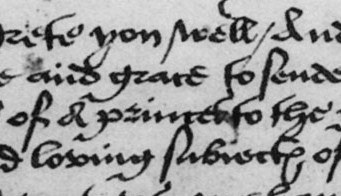
elizabethbirthannouncement

By the Quene
Right trustie and welbiloved, we grete you well. And where as it hath pleased the goodnes of Almightie God, of his infynite marcie and grace, to sende unto us, at this tyme, good spede, in the delyveraunce and bringing furthe of a Princes, to the great joye, rejoyce, and inward comforte of my Lorde, us, and all his good and loving subjectes of this his realme; for the whiche his inestymable benevolence, soo shewed unto us, we have noo litle cause to give high thankes, laude, and praising unto oure said Maker, like as we doo mooste lowly, humbly, and with all the inwarde desire of our harte. And inasmuche as we undoubtidly truste, that this oure good spede is to your great pleasure, comforte, and consolation, We, therefore, by thies our letters, advertise you thereof, desiring and hartely praying you to give, with us, unto Almightie God, high thankes, glorie, laude, and praising; and to praye for the good helth, prosperitie, and contynuall preservation of the said Princes accordingly. Yeven under our Signet, at my Lordis Manour of Grenewiche, the 7 day of September, in the 25th yere of my said Lordis reigne.
To oure right trustie and welbiloved, the Lorde Cobham.

During a lecture at the Newberry Library in Chicago on November 22, 2003, David Starkey stated that the most important document in Elizabeth’s life was the letter announcing her birth.  The Tudor Court needed a male heir.  Society held the  attitude that a woman would not be able to hold public office and have influence.

Anne Boleyn had disappointed Henry and the kingdom.  Everyone was yet to see the significance of the life of this child that began with such an unpleasant shock yet would produce a ruler with “the body of a weak and feeble woman …but the heart and stomach of a king, and a king of England too” (Marcus 326).

*The bailly was a French “Crown officer in whose name justice was administered throughout a certain district” (Hervey 38),

References

Brewer, J.S. (editor).  “Henry VIII: July 1527, 1-10.” Letters and Papers, Foreign and Domestic, Henry VIII, Volume 4: 1524-1530 (1875): 1465-1477. British History Online. Web. 02 June 2013.

Denny, Joanna. Anne Boleyn: A New Life of England’s Tragic Queen. Cambridge, MA: Da Capo, 2006. Google Books. Web. 7 June 2013.

Doran, Susan.  Henry VIII:  Man & Monarch. London:  British Library, 2009. Print.

Eakins, Laura. “Elizabeth Birth Announcement.” TudorHistory. Google+Page, n.d. Web. 2 June 2013.

Elton, G. R. England Under the Tudors. Third ed. London:  Routledge, 1991.

Erickson, Carolly. The First Elizabeth. New York: Summit Books. 1983. Print.

Foxe, John. The Acts and Monuments of John Foxe: A New and Complete Edition. Ed. Stephen Reed Cattley, M. A., Rev. Vol. V. London: R.B. Seeley and W. Burnside, 1837. Google Books. Web. 4 June 2013.

Fraser, Antonia.  The Wives of Henry VIII.  New York:  Alfred A. Knopf, 1992. Print.

Gairdner, James (editor). “Henry VIII: Miscellaneous, 1533.” Letters and Papers, Foreign and Domestic, Henry VIII, Volume 6: 1533 (1882): 449-466; 653-680. British History Online. Web. 02 June 2013.

Hall, Edward, Henry Ellis, and Richard Grafton. Hall’s Chronicle; Containing the History of England, during the Reign of Henry the Fourth, and the Succeeding Monarchs, to the End of the Reign of Henry the Eighth, in Which Are Particularly Described the Manners and Customs of Those Periods. London: Printed for J. Johnson and J. Rivington; T. Payne; WIlkie and Robinson; Longman, Hurst, Rees and Orme; Cadell and Davies; and J. Mawman, 1809. Internet Archive.org. Web. 2 Jan. 2013.

Hervey, Mary F. S., and Hans D. J. Holbein. Holbein’s ‘Ambassadors’, the Picture and the Men. London: G. Bell & Sons, 1900. Google Books. Web. 13 June 2013.

Hibbert, Christopher.  The Virgin Queen: Elizabeth I, Genius of the Golden Age.  New

York: Addison-Wesley Publishing Company, Inc., 1991.  Print.

Hurren, Elizabeth T., Dr., Senior Lecturer History of Medicine Oxford Brookes University.  “Henry VIII’s Medical World.” Henry VIII’s Medical World. Wellness Trust at Oxford Brookes University, n.d. Web. 7 June 2013.

Ives, Eric.  The Life and Death of Anne Boleyn: The Most Happy. Oxford: Blackwell Publishing, 2004. Print.

Lindsey, Karen.  Divorced, Beheaded, Survived:  A Feminist Reinterpretation of the Wives of Henry VIII.  Reading, Massachusetts:  Addison-WESLEY Publishing Company, 1995. Print.

Marcus, Leah S. et al., eds. Elizabeth I: The Collected Works. Chicago: University of Chicago Press, 2002. Print.

Nichols, Francis Morgan. The Hall of Lawford Hall: Records of an Essex House and of Its Proprietors,. London: Printed for the Author, 1880-1890, and Sold by Ellis and Elvey, 1891. Google Books. Web. 4 June 2013.

Ridgway, Claire.  The Fall of Anne Boleyn:  A Countdown.  UK:  MadeGlobal Publishing, 2012. Print.

Somerset, Anne. Elizabeth I.  New York: Alfred A. Knopf, 1991. Print.

Starkey, David.  Elizabeth:  The Struggle for the Throne. New York:  HarperCollins Publishers. 2001. Print

Starkey, David, Dr. “Queen Elizabeth and Her Court.” Elizabeth I: Ruler and Legend. Newberry Library, Chicago. 22 Nov. 2003. Lecture.

Starkey, David.  Six Wives: The Queens of Henry VIII.  London:  Chatto & Windus, 2003.  Print.

Strickland, Agnes. The Life of Queen Elizabeth, London: J.M. Dent &, 1906. Google Books. Web. 3 June 2013.

THECREATIONOFANNEBOLEYN. “Anne and Elizabeth: Consulting the Stars for Elizabeth’s Birth.” Web log post. Semper Eadem. WordPress.com, 28 Aug. 2011. Web. 2 June 2013.

Tytler, Sarah.  Tudor Queens and Princesses.  New York:  Barnes and Noble, 1993. Print.

Warnicke, Retha.  The Rise and Fall of Anne Boleyn: Family Politics at the Court of Henry VIII. Cambridge:  Cambridge University Press, 1989.  Print.

Weir, Alison.  The Lady in the Tower:  The Fall of Anne Boleyn.  London:  Jonathan Cape, 2009.  Print.

Weir, Alison.  The Six Wives of Henry VIII.  New York: Grove Weidenfeld, 1991. Print.

Whitelock, Anna.  Mary Tudor:  Princess, Bastard, Queen. New York:  Random House, 2009. Print.

His Last Letter

His Last Letter

At her death in 1603, Leicester’s last letter* to Elizabeth (written six days before his death in September 1588) was found in a small casket by her bed with “His Last Letter” written in her own handwriting on it. This story has always captured my imagination as a very adoring gesture taken by this imposing historical figure.

leicester letter 001

His Last Letter.  For a modern transcription see below*.

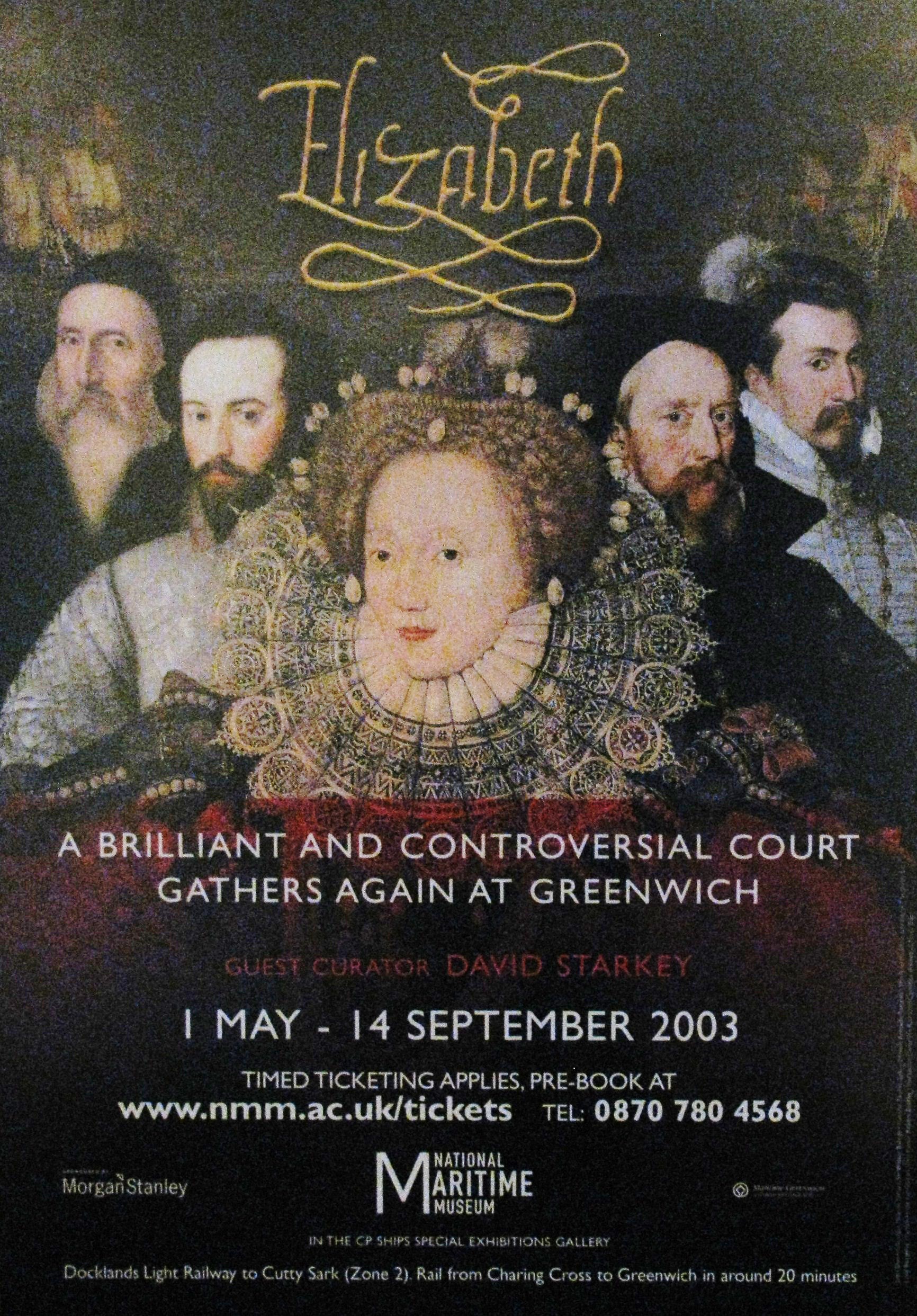
In the early summer of 2003, I came home from work to find a present waiting for me from my husband. When I opened it, imagine my surprise when I found Susan Doran’s Elizabeth: The Exhibition at the National Maritime Museum--the catalog to the Greenwich Exhibition celebrating the 400th anniversary of the death of Queen Elizabeth I. Along with the catalog were entry tickets for August 8th and plane and hotel reservations.  I was going!  The catalog was read thoroughly beforehand with meticulous notes taken on which items would be “Want to See” and “Must See”.  Lot #70, Leicester’s last letter written to Elizabeth, was a “Must See” and became one of the top artifacts that I said I would die if I didn’t see.  What a way to set myself up.

We arrived early at the National Maritime Museum.  I was so excited.  We were some of the first in the doors that morning and sat front and center to watch the introductory video narrated by Guest Curator, David Starkey then I was ready to view the artifacts.

Armed with my list of exhibits to see (see below for an abbreviated chart of artifacts), I came upon Lot #70 and the letter wasn’t there!  There was #69 and #71 immediately next to it.  No #70.  I kept looking expecting it to miraculously materialize.  Nothing.  My husband looked: he called a docent over and they looked together.  The young man expressed great concern and radioed his supervisor who came to spend over 15 minutes looking for it.  Neither one of them could come up with a reason for its absence.  Still mystified, I finished the rest of the exhibit, went back to admire some particular items, wrote my notes and had to leave despite not seeing “His Last Letter.”

robertdudley

Robert Dudley, Earl of Leicester 

The rest of my surprise trip to Great Britain was a thrill (My visit to the Chapel of St. Peter ad Vincula in the Tower of London is for another blog entry).  Upon my return home to the USA, I was determined to discover what had happened to Lot #70.  Leicester’s last letter had become almost as important to me as it had to Elizabeth I.  I researched as much as I could and came up empty handed until my husband and I attended Dr. David Starkey’s lecture at the Newberry Library in Chicago, IL on November 22, 2003.

While standing in line to have books autographed (I took Elizabeth: The Exhibition at the National Maritime Museum and my husband had Six Wives: The Queens of Henry VIII), I resolved to ask him about the letter.  Dr. Starkey was wonderful to take the time to answer my questions (with a queue trailing behind me) and expressed surprise that I did not see the letter. He assured me that it should have been there.

books                   six

My next step, e-mailing the National Maritime Museum, which I did on November 24, 2003, asking if the lot had been removed for some reason.

The reply I received on November 26, 2003 is as follows.  [Having eliminated the name of the respondent for privacy.]

             Dear Jodi,

             Dudley’s last letter was on display in the exhibition but unfortunately, the  
 National Archives would only loan it to us for 3 months or so. By the time you 
 visited, it was replaced with another letter from Dudley to Elizabeth.>

 An image of the letter is available to view on our website. [The link is not active  
now in 2013.] http://www.nmm.ac.uk/site/request/setTemplate:singlecontent/
contentTypeA/conWebDoc.contentld/6088/viewPage

Mystery solved.  It still does not end my disappointment of not seeing the actual letter but ten years later and I am close to being over it.  Happily, I have a framed poster of the fantastic Exhibition in my den as a reminder.

poster2

National Maritime Museum Exhibition on Queen Elizabeth I

Attended August 8, 2003

Lot

*Must See

Subject

Form

Comments

*7 Elizabeth Locket ring Has picture of her mom.
*26 Elizabeth & Mary Letter Hard to read as faded at the top of the paper.  Elizabeth wrote to Mary requesting an audience during the Wyatt Rebellion interrogation—diagonals across the bottom so no one could add anything.
*70 Elizabeth & Dudley Letter Was not there—his last letter to her with her writing on it identifying it as his last letter.
*192 Elizabeth Portrait Three Goddess.
*193 Elizabeth Portrait Pelican—from Walker Art Gallery.
*196 Elizabeth Portrait Peace
4 Anne Boleyn Pendant Given to her by Henry VIII.
5 Anne Boleyn Medal Has her motto on it.
12 Elizabeth, Katherine Parr, Henry VIII Book Elizabeth made for Henry of Katherine’s writings.
17 Elizabeth & Katherine Parr Letter Elizabeth forgot the word ‘them’ in the two letters on display. Letters she wrote to her little brother Edward were also interesting to see.
29 Elizabeth Portrait Coronation (Enjoyed the one of her at about age 14 also.)
69 Elizabeth & Dudley Letter He wrote to her as her ‘eyes’ signature was Ȱ Ȱ.  (Well, close to that.)
118 Elizabeth Inventory Great Wardrobe inventory of 1600 with separate exhibits of a pair of gloves and even her saddle.
264/265 Elizabeth Drawings Funeral procession.  (These drawings appear to be seen infrequently prior to this exhibit.)

 Newberry Library Elizabeth I Exhibit—Attnded November 22, 2003

Subject

Comments

Quentin Massey’s “Sieve” Portrait From 1580-83, after the one in Sienna, Italy.
Copy book by Roger Ascham (her tutor) Book on the education of children.
Elizabeth letter to Seymour Written February 21, 1549.
Evangelical Shepherd 1533 Gift to Anne Boleyn from Francis I with the introduction by a French poet.
Small portrait of Elizabeth She is in black and has a watch noticeably –from 1564-1567.
Elizabeth’s letter to Catherine de Medici The letter offers condolences over d’Alencon’s death in 1584—it was in French and in her  handwriting.
Answer to the Lords Petition that she marry It had her scribbles etc.  It was delivered in 1563 to Parliament by Nicholas Bacon with her seated nearby.
Speech of 1567 Elizabeth gave the speech herself to Parliament on the topic of her marrying –calling it “lip labored orations.”
Copy of Stubbs pamphlet It protested her marriage to d’Alencon– of which cost him his right hand.
Copy of Knox’s book, Blast on Female Rulers. It was a colonial copy from 1766 printed in Philadelphia.
Elizabeth speech to Parliament Topic concerned Mary, Queen of Scots on November 12, 1586.
Letter Elizabeth wrote to James Written in January 1593 offering advice.
Letter to Elizabeth from James The letter was written after Mary, Queen of Scots execution and dated March 1587.  He protests the action but would say—gently.
Mary’s execution drawing Similar to the one seen in Greenwich Exhibition.
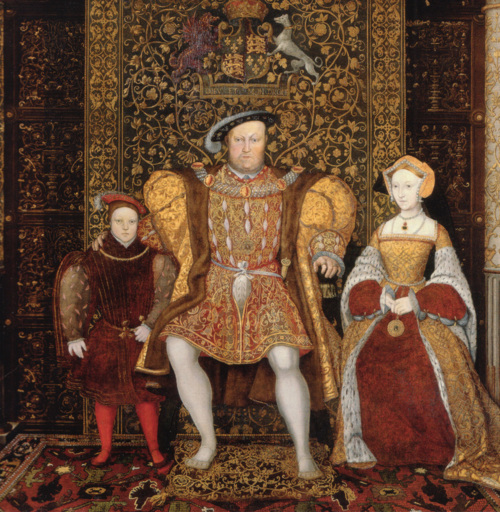
Painting of Henry VIII, Edward VI and Elizabeth  from 1597 Had never seen this painting before although it is from the Art Institute of Chicago.57197_764549
Essex letter to Elizabeth from November 1597 Essex pleading for her forgiveness in his own arrogant way.
Version of Tilbury speech August 9, 1588 Written by an eyewitness.
Scroll of funeral procession, from British Library Forty feet long by College of Heralds.  Had listed Walter Raleigh as Capitan of the Guard.
William Camden Annals of 1625 Definitive source of information on Elizabeth.

Afterward:

In October of 2012 inquires were made as how Liecester’s letter came to the ownership of the National Archives.  My first e-mail was mistakenly taken as a request for a copy (for those of you who are interested, here is the web address where it can be purchased: https:www.nationalarchives.gov.uk/recordcopying/estimateoptions.aspx).  A second e-mail fielded this reply:

Dear Jodi,

Thank you for your further email, and I am sorry if my colleague did not fully answer your enquiry. While it is often very difficult to check the provenance of a single document, more generally the National Archives holds the archive of the crown and central government, and as such many personal documents from the reigning monarch ended up amongst more formal state documents, known collectively as State Papers. Some have ended up elsewhere, as royal officials often treated official papers as personal property, but royal letters can be found for all the Tudor monarchs in our collections. There is some background research guidance on this in:http://www.nationalarchives.gov.uk/records/research-guides/state-papers-1547-1649.htm. Elizabeth’s letter is likely to have been in custody of royal officials since her death.

 Yours sincerely,
 Dr. #####  ######
Medieval and Early Modern Team
Advice and Records Knowledge (ARK)
The National Archives, Kew, Richmond, Surrey TW9 4DU
http://www.nationalarchives.gov.uk

It must be surmised that the letter was treated as a “State Paper” and handled as such throughout.  I am just thankful that it is still in existence and the story of Elizabeth I treasuring it for the 15 years until her own death is preserved as well.

*“I most humbly beseech your Majesty to pardon your poor old servant to be thus bold in sending to know how my gracious lady doth, and what ease of her late pains she finds, being the chiefest thing in this world I do pray for, for her to have good health and long life. For my own poor case, I continue still your medicine and find that (it) amends much better than with any other thing that hath been given me. Thus hoping to find perfect cure at the bath, with the continuance of my wonted prayer for your Majesty’s most happy preservation, I humbly kiss your foot. From your old lodging at Rycote, this Thursday morning, ready to take on my Journey, by your Majesty’s most faithful and obedient servant,

R. Leicester

Even as I had writ thus much, I received Your Majesty’s token by Young Tracey.”

The Fourth Step-Mother of Elizabeth, Katherine Parr

The Fourth Step-Mother of Elizabeth, Katherine Parr
As discussed in an earlier blog entry, Catherine Howard, Henry VIII passed a law that required all future queens of England to have chaste pasts or be willing to confess any ‘indiscretions.’  Obviously, this eliminated many candidates.  Who would be free from scandal or brave enough to tell Henry if she was not?

Enter Katherine Parr, the daughter of Thomas and Maud Parr.  Maud, a lady-in-waiting to Queen Catherine of Aragon, was a highly intelligent and well-educated woman.  Queen Catherine placed her in charge of the education of many of the youngsters at Court. Her children, especially Katherine, benefited greatly from the Court tutors and developed a life-long love of learning.  Maud was widowed at the age of 25 and never remarried.  She concentrated her efforts on establishing good matches for her children and protecting her son’s inheritance.  In 1529 when Katherine was 16 or 17, she was married to Edward Borough.  Edward was in his early twenties when he died in 1533.  It is often confused that she married his grandfather, another Edward, perpetuating the myth of her marrying aged widowers. This blogger wonders if the confusion came because she would have resided in a multi-generational household perhaps with the grandfather-in-law as the head.

gains
The Borough family manor, Gainsborough Old Hall.

gbbimages
Gainsborough Old Hall

Maud Parr died the year after Katherine was widowed and it left the young woman basically independent.  Katherine arranged her own next marriage to John Neville, Lord Latimer of Snape Castle in Yorkshire, a man in his early forties.  The exact date is unknown but they married in 1534.  Lord Latimer had two children both of whom became very close to their young stepmother, especially the daughter, Margaret.  From the time of her marriage, Katherine had the responsibilities of the household.  Her responsibilities expanded to include the entire estate when Lord Latimer took an active role, on the side of the rebels, in the Pilgrimage of Grace.  As examples of her abilities, Katherine withheld a siege, protected the occupants of the household and managed, with the help of her brother William, to gain a pardon for Latimer.  King Henry did not hold it against Latimer and both Katherine and her husband were welcomed back to Court.

snape9
Snape Castle

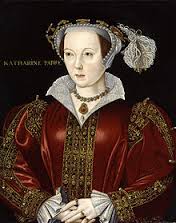
It was while at Court, with Latimer ailing and soon dying, that Henry became aware of the thirty-year-old Lady Latimer.  Described as attractive but not pretty, Katherine always dressed impeccably, had the translucent skin that was so praised in Tudor times, auburn colored hair and a dignified bearing.

parrk
Katherine Parr by an unknown artist.  Displayed at Montacute House.

Thomas Wriothesley, Lord Chancellor, wrote to the Duke of Norfolk that there was “a woman, in my judgement, for certain virtue, wisdom and gentleness, most meet for his Highness.  And sure I am that his Majesty had never a wife more agreeable to his heart than she is.  The Lord grant them long life and much joy together” (Weir 498).  Praise indeed considering he later tried to have her arrested and executed.

Eustace Chapuys, the Spanish Ambassador, reported to Charles V that Katherine “is graceful and of cheerful countenance; and is praised for her virtue” (Hume 248).  He continued that she was not “so beautiful” and that there was “no hope of issue, seeing that she had none with her two former husbands” (Gairdner XVIII 954).  Charming and amiable, she was pleasant to nobles and servants alike.  Sensible and efficient, a good conversationalist, experienced with step-children, and having aided an ailing spouse, Katherine seemed ideal to become the sixth wife of Henry VIII.

parrhorenbout
Miniature of Katherine by Lucas Horenbout, 1544

kp5
Held in the possession of the National Portrait Gallery, this portrait had been mistakenly identified as Lady Jane Grey for many years.  Done in 1545 it is now credited to be Katherine Parr.

Interestingly, she was the only one of Henry’s wives who did not want to become his next bride. Historians believe this for a couple of reasons: she was intelligent enough to see the dangers involved; and she had developed an interest in Thomas Seymour, Lord High Admiral.  Once Henry proposed, Katherine accepted her fate and became determined to make the best of the situation.  Most commentators now believe she saw her chance to promote a more liberal religious agenda and the betterment of her family.  As was Henry’s custom, his bride’s family advanced along with her elevation.  Katherine’s brother, William Parr, was granted the Earldom of Essex in his own right.  Her sister Ann and brother-in-law Sir William Herbert gained positions at Court as did members of her extended family, the Throckmortons and her step-daughter Margaret Neville.

parr by holbien
William Parr in a sketch by Hans Holbein.

As Queen, Katherine used her influence to encourage the King to bring to Court his children from their respective households.  She felt they should be there, beyond the wedding celebrations, and see their father more.  Henry gave his approval and Katherine wrote them all to come.  Agnes Strickland assures that Katherine, who knew Princess Mary well, was also “acquainted with Elizabeth before she became queen, and greatly admired her wit and manners” (Strickland Volume 4 14).

A letter from 10-year-old Elizabeth survives in which she wrote, flowing with gratitude, to acknowledge what Katherine had done.

“Madame, The affection that you have testified in wishing that I should be suffered to be with you in the Court, and requesting this of the King my father, with so much earnestness, is a proof of your goodness.  
So great a mark of your tenderness for me obliges me to examine myself a little, to see if I can find anything in me that can merit it, but I can find nothing but a great zeal and devotion to the service of your Majesty.  But as that zeal has not been called into action so as to manifest itself, I see well tha tit is only the greatness of soul in your Majesty which makes you do me this honour, and this redoubles my zeal towards your Majesty.  I can assure you also that my conduct will be such that you shall never have cause to complain of hainv done me the honour of calling me to you; at least, I will make it my constant care that I do nothing but with a design to show always my obedience and respect.  I await with  much iimpatience the orders of the King my father for the accomplishment of the happiness for which I sigh, and I remain with much submission, your Majesty’s very dear Elizabeth” (Queen Elizabeth I 21-22).

There is an interesting interlude in the chronology of Elizabeth’s life between the summers of 1543 and 1544.  Most historians (Linda Porter is an exception) believe Elizabeth offended her father in some way and was banished to Ashridge near the Hertfordshire-Buckinghamshire border—near Berkhamsted where the Queen held the lordship of the manor. Because Katherine kept in contact with Elizabeth and she sent her other step-daughter, Margaret Neville, to act “as liaison between her step-mother and step-sister” it appears as if the youngster had not offended her (James 172-173).  Elizabeth, obviously, had no ill-feelings as she wrote to Katherine that “Inimical Fourtune …has deprived me for a whole year of your most illustrious presence….”  Elizabeth conveyed to Katherine her belief that she was “not only bound to serve but also to revere you with daughterly love …”(Marcus 5).

Henry was abroad, Katherine was Regent and Elizabeth was persistent.  By petitioning her step-mother to speak to her father, who was on military campaign, Elizabeth was able to end “this my exile” (Marcus 5). Katherine successfully convinced the King to allow Elizabeth to join her at Hampton Court in late July of 1544 cementing her step-daughter’s affection.  Elizabeth seemed secure in Katherine’s affection although she never took it for granted as she wrote “I know that I have your love and that you have not forgotten me for if your grace had not a good opinion of me you would not have offered friendship to me that way” (James 136).

exile letter 001

Fragment of the letter to Katherine from 10-year-old Elizabeth.  Written in Italian.  On line five you can make out the reference to her exile [mio exilio].

The regard Elizabeth had for Katherine was also shown in the New Year’s Day gift that she presented to her in December of 1544.  Elizabeth translated, in italic script, Marguerite of Navarre’s Le Miroir de l’ame pecheresse [The Mirror of a Sinful Soul].  The gift itself was a tribute to her spiritual leanings, her education and her affection.  The dedication was “To our most noble and virtuous Queen Katherine, Elizabeth, her humble daughter, wisheth perpetual felicity and everlasting joy.” In the accompanying letter Elizabeth hoped that Katherine would “rub out, polish, and mend (or else cause to mend) the words (or rather the order of my writing), the which I know in many places to be rude and nothing done as it should be” (Marcus 6-7).  This shows the trust Elizabeth had for Katherine as a loving mentor and the respect she had for Katherine’s intellectual abilities.

bookblue
Elizabeth’s translation of The Mirror of the Sinful Soul with a cover of embroidery she worked herself.  Notice Katherine’s initials in the center.

The next year, Elizabeth translated Katherine’s book, Prayers or Meditations, into French, Italian and Latin for her father (James 137).  One would suspect that Elizabeth would not want to upset Henry nor jeopardize Katherine by presenting to him materials that would be contrary to his religious beliefs.
gift
Gift to Henry VIII from Elizabeth.  A translation of the work, Prayers or Meditations, by Katherine Parr in multiple languages and covered in embroidery by Elizabeth. 

When Henry had gone to France in July 1544, he appointed Katherine his Regent. This certainly was an expression of his respect and affection for her.  Lord Chancellor Wriothesley, Archbishop Cranmer, Lord Hertford, Dr. Thomas Thirlby and William Petre were her advisors.  Not a woman to be gainstayed, in September 1544, Katherine, dealing with her Regency Council, let it be known that exasperation had set in and she was “wearied with their continual clamor” (Gairdner XIX 231).

Thomas Wriothesley, despite his earlier praise for Katherine, grew to distrust her as he was concerned about the liberal religious views she held and strong personality.  Early in 1544 Katherine had written in the Tenth Psalm of her text Psalms or Prayers taken out of the Holy Scripture this thought-provoking sentence “I am so vexed that I am utterly weary; help me against them that lie in wait for me” (Parr 318).  This has been tagged as a response to the Catholic attempts to discredit her, led by Wriothesley and Stephen Gardiner, Bishop of Winchester, because of her evangelical leanings.

1stEarlOfSouthampton
Thomas Wriothesley, 1st Earl of Southampton, Lord Chancellor

The unease of these two men reached a peak in the summer of 1546 and led to their attempt to arrest Katherine.  They convinced Henry that she harbored radical leanings and fueled his irritation of the recent views Katherine had expressed. Wriothesley lined up the arrest warrant, gathered forty yeomen of the guard and descended upon Katherine while she was in the Whitehall gardens with Henry.

Little did Wriothesley know, Katherine had been warned and had hastened to Henry to apologize for seeming to overstep her boundaries.  She assured the King that she had debated him to distract him from the pain in his leg and to take instruction from him on the proper theological discourse, not to lecture him. Katherine supposedly said that she felt it “preposterous for a woman to instruct her lord” (Strickland III 246). Henry was certainly ready to believe her.  Upon the conclusion of Katherine’s assurances, Henry replied, “And is it so, sweetheart?  Then we are perfect friends” (Strickland III 246).

When Wriothesley came to arrest her, Henry gave him a dressing down and sent him off.  Obviously, this was a very close call for Katherine and she never again conveyed any views counter to the Establishment.

One area which Katherine thwarted convention was in her encouragement of Elizabeth’s education.  The resulting life-long influence cannot be undervalued.  For over four years, although they did not live together that entire time, a close bond was formed. This intelligent and capable woman encouraged and loved this exceptional child.  By taking charge of Elizabeth’s education, both book learning and practical application (Elizabeth witnessed Katherine’s Regency), Katherine influenced the reign of her step-daughter.

Elizabeth received an excellent education.  She was educated alongside her brother for many years until it was decided by Katherine to employ a tutor solely for the princess. This would have been an exception rather than the rule in 16th century England although there were many highly educated women of the previous generation:  Anne Boleyn, Mary More and, of course, Katherine Parr.  Katherine’s deep and genuine love of learning makes her so admirable as an interesting, remarkable woman.

Lamentations1
Copy of Katherine’s text, Lamentations of a Sinner, published in 1547 with her signature.
signature

As Maud Parr’s daughter, a woman who had set up a school at Court and bequeathed money in her will for education, Katherine’s taste for learning was formed young and continued throughout her life.  Margaret Neville, her step-daugher, said in the spring of 1545 “I am never able to render to her grace sufficient thanks for the goodly education and tender love and bountiful goodness which I have evermore found in her highness….”  Prince Edward pretty much said the same thing in 1546.  He thanked Katherine for her “tender and loving letters” and for the “encouragement to go forward in such things wherein your grace beareth me on hand that I am already entered” (James 141).  And Elizabeth praised Katherine for her “fervent zeal your Highness hath towards all godly learning” (Wood 178).

The educations of Edward and Elizabeth were certainly guided by Katherine Parr. Many of their tutors were committed Protestants and humanists.  The tutors’ willingness to educate the princess in the exacting disciplines was telling.  With Katherine also in charge of Jane Grey’s education, her patronage and direction helped formulate two of the sharpest minds of the era—both belonging to females.  Of note is a rare difference of opinion between Katherine and her step-daughter.  In early 1548, Elizabeth’s tutor, William Grindal died.  Katherine wanted to replace him with Francis Goldsmith but Elizabeth wanted Roger Ascham, a fellow from St. John’s College in Cambridge who was well-acquainted with Katherine (James 322).  Writing to Edward’s tutor, Sir John Cheke, Ascham expressed his “uneasy at being the cause of disagreement between the queen and her stepdaughter on such an important matter, actually counseled Elizabeth to accept Goldsmith” (Porter 306). It probably did not take much persuasion, as Ascham became the royal tutor.

roger asham                  dowmmnload

Roger Ascham                                            Sir John Cheke

Elizabeth is a product of Katherine Parr.  The future Queen Regina’s education, religious beliefs, and open-mindedness stem from the guidance of her step-mother. Her devotion was reflected in 1582, when Thomas Bentley’s work, The Monument of Matrons, depicted Katherine Parr as one of the virtuous Queens of history (Fraser 405). Elizabeth’s actions of not forgetting the woman who had permitted her to see the possibilities of rule and to establish England as a cultural center, was certainly a tribute.

The relationship of Elizabeth and Katherine cannot be revealed without the discussion of Thomas Seymour.  This blogger does not want to expend too much time on this topic for all its relevance because of its worthiness of an entire entry on its own.  Thomas Seymour, as brother-in-law to King Henry VIII and uncle to the future king, held prominent positions at Court.  He was there during the times that Katherine Parr was and they began a romance before Henry VIII turned his attention to her.  Upon Henry’s death in January of 1547, the sensible Katherine allowed Seymour to talk her into marriage well before the conventional time-frame of mourning was over.  Katherine had married him for love and as a last chance of happiness.

Seymour Thomas
Thomas Seymour, Lord High Admiral

Little did Katherine know that Seymour had had designs on Elizabeth as a possible wife.  He never quite seemed to relinquish the idea and for her own safety, Elizabeth was removed from her step-mother’s household at Chelsea in 1548 to the care of Anthony Denny and his wife at Cheshunt.  Katherine was pregnant and Seymour could not keep in check his, shall it be said, emotional immaturity and grandiose aspirations.

The story leads to Sudeley Castle where Katherine gave birth to a baby girl, Mary, and died days later of puerperal fever.  She is buried in the chapel in the Castle grounds.

sudeley
Sudeley Castle

burial
Katherine Parr was interred in St. Mary’s Chapel on the grounds of Sudeley under this tomb in the 1800s.

When Elizabeth left Chelsea for her own residence of Cheston, Katherine, according to Gregorio Leti, told her “God has given you great qualities.  Cultivate them always, and labour to improve them, for I believe you are destined by Heaven to be Queen of England” (Strickland 26).

References

Erickson, Carolly. The First Elizabeth. New York: Summit Books. 1983. Print.

Fraser, Antonia.  The Wives of Henry VIII.  New York:  Alfred A. Knopf, 1992. Print.

Gairdner, James, ed. Letters and Papers, Foreign and Domestic, of the Reign of Henry VIII. Vol. 19. London: Longman, Green, Longman & Roberts, 1888. Google Books. Web. 4 May 2013..

Haselkorn, Anne M., and Betty Travitsky. The Renaissance Englishwoman in Print: Counterbalancing the Canon. Amherst: University of Massachusetts, 1990. Google Books. Web. 27 May 2013.

Hibbert, Christopher.  The Virgin Queen: Elizabeth I, Genius of the Golden Age.  New York: Addison-Wesley Publishing Company, Inc., 1991.  Print.

Hume, Martin A. Sharp. Chronicle of King Henry the Eighth of England: Being a Contemporary Record of Some of the Principal Events of the Reigns of Henry VIII and Edward VI, Written in Spanish by an Unknown Hand ; Translated, with Notes and Introduction, by Martin A. Sharp Hume. London: George Belland Sons, 1889. Internet Archive. Web. 4 May 2013.

James, Susan. Catherine Parr:  Henry VIII’s Last Love. Stroud, Gloucestershire: Tempus Publishing. 2008. Print.

James, Susan.  Kateryn Parr:  The Making of a Queen. Brookfield, USA: Ashgate, 1999. Print.
Lindsey, Karen.  Divorced, Beheaded, Survived:  A Feminist Reinterpretation of the Wives of Henry VIII.  Reading, Massachusetts:  Addison-WESLEY Publishing Company, 1995. Print.
Loades, David. The Chronicles of the Tudor Queens.  Stroud, Gloucestershire: Sutton Publishing, 2002. Print.

Marcus, Leah S. et al., eds. Elizabeth I: The Collected Works. Chicago: University of Chicago Press, 2002. Print.

McCaffrey  MacCaffrey, Wallace. Elizabeth I. London: E. Arnold. 1993. Print.

Neale, Neale, J. E. Queen Elizabeth I. Garden City, NY: Doubleday, 1957. Print.
Parr, Katherine, and Janel Mueller. Katherine Parr: Complete Works and Correspondence. Chicago, IL [etc.: University of Chicago, 2011. Google Books. Web. 23 May 2013.

Porter, Linda.  Katherine the Queen:  The Remarkable Life of Katherine Parr.  London:  McMillian, 2010. Print.
Pryor, Felix.  Elizabeth I, Her Life in Letters.  Berkeley, California: University of           California Press, 2003.  Print.
Queen Elizabeth I, Frank Mumby, and R. S. Rait. The Girlhood of Queen Elizabeth: A Narrative in Contemporary Letters. Boston: Houghton Mifflin, 1909. Google Books. Web. 9 May 2013.

Ridley Ridley, Jasper. Elizabeth I: The Shrewdness of Virtue.  New York: Fromm International Publishing Corporation, 1989.  Print.
Somerset Somerset, Anne. Elizabeth I.  New York: Alfred A. Knopf, 1991. Print.

Starkey, David.  Six Wives: The Queens of Henry VIII.  London:  Chatto & Windus, 2003.  Print.
Strickland, Agnes, and Elisabeth Strickland. Lives of the Queens of England, from the Norman Conquest. Vol. III. London: Colburn & Co. Publishers, 1851. Google Books. Web. 7 May 2013.

Strickland, Agnes, and Elisabeth Strickland. Lives of the Queens of England, from the Norman Conquest. Vol. IV. London: Longmans, Green, 1857. Google Books. Web. 2 May 2013.

Strickland, Agnes, and Elisabeth Strickland. Lives of the Queens of England, from the Norman Conquest; with Anecdotes of Their Courts, Now First Published from Official Records and Other Authentic Documents, Private as Well as Public. Vol. VI. London: Henry Colburn, 1844. Google Books. Web. 15 Mar. 2013.

Tytler, Sarah.  Tudor Queens and Princesses.  New York:  Barnes and Noble, 1993. Print.
Weir, Alison. The Children of Henry VII.  New York:  Ballantine Books, 1996. Print

Weir, Alison.  The Six Wives of Henry VIII.  New York: Grove Weidenfeld, 1991. Print.
Wood, Mary Anne Everett. Letters of Royal and Illustrious Ladies of Great Britain: From the Commencement of the Twelfth Century to the Close of the Reign of Queen Mary : Edited, Chiefly from the Originals in the State Paper Office, the Tower of London, the British Museum and Other State Archives. Vol. II. London: Henry. Colburn, 1846. Google Books. Web. 12 May 2013.

The Third Step-Mother to Elizabeth, Catherine Howard

The Third Step-Mother to Elizabeth, Catherine Howard

Henry was infatuated with Catherine Howard.  At Oatlands the two were married on July 28 a couple of weeks after Henry’s marriage to Anne of Cleves was dissolved. The King kept it a secret for many days because he wanted to enjoy his bride before Court etiquette interfered.

He showered his young bride with gifts, gowns, jewels, anything she wanted and did any act which would show his affection.  Henry granted Catherine all the lands that had been Queen Jane’s and even had a gold half-crown coin minted to commemorate his marriage to this perfection of womanhood with Henricus VIII, Rutilans rosa sine spina; “Henry VIII, the shining rose without a thorn” (Dye 771).  Henry also granted her political protection by passing through parliament the Queen Consort Act of 1540.  This legislation allowed the Queen to “act as a woman sole, without the consent of the King’s Highness” (Weir 436).  Perhaps Henry felt safe in her devotion as Catherine adopted as her device, Non aultre volontè que le sinne; “No other will than his.”

coinrosaspina2
Gold Crown Coin with Henricus VIII, Rutilans rosa sine spina —the reverse the crown shield of the royal coat of arms.  

Many observers did not think he showed such generosity or affection to his other wives.  The French Ambassador, Charles de Marillac reported in early September that the “King is so amourous of her that he cannot treat her well enough and caresses her more than he did the others”  (Gairdner XVI 5).

The new queen was still a teenager.  Most historians calculate that she was about 15 when 49-year-old Henry married her.  Physically, Charles de Marillac described Catherine as “rather graceful than beautiful, of short stature, etc.” (Gairdner XVI 5).

Catherine howared02        catherine howard3
Miniature by Hans Holbein                 After Hans Holbein

Was Catherine, personality-wise, a “frivolous, empty-headed young girl who cared for little else but dancing and pretty clothes” (Weir 434)?  Was she simply captivating, pleasant and kind-hearted enough to want everyone to be happy?  Perhaps she did let things go to her head and recklessness took center-stage but one could not call her scheming, “lewd, sly, pitiable” (Sitwell 53).  It does appear as if Catherine was charming, sensual and obedient–a great combination for Henry.

Catherine Howard / Elizabeth Seymour
Also attributed to Hans Holbein

Not only was Henry delighted with his new bride, Elizabeth, Catherine’s seven-year-old stepdaughter, was too.  When Catherine was publicly acknowledged by Henry as his queen, “she directed that the princess Elizabeth should be placed opposite to her at table, because she was of her own blood and lineage.”  At all the public engagements which continued to celebrate the marriage, Catherine “gave the lady Elizabeth the place of honour nearest to her own person” because, according to Gregorio Leti, “that she [Elizabeth] was her cousin” (Strickland Lives of the Queens of England, from the Norman Conquest 15-16).  Elizabeth Boleyn, Anne’s mother, was a sister to Edmund Howard, Catherine’s father (and to Thomas Howard, Third Duke of Norfolk), so they were first cousins.  Elizabeth Regina would technically have been Catherine’s first cousin once removed.

thomas howard norfolk
Thomas Howard, Duke of Norfolk

Catherine did not only favor Elizabeth when they were residing in the same palaces, she made a point for the two of them to meet.  Based on account records from the Master of the Barge, it has been shown that on 5 May 1541 Catherine arranged that Elizabeth would be taken from Suffolk Place to Chelsea where she, Catherine joined her on 6 May (Gairdner XVI 391). 

Besides the attention Catherine showed her youngest step-daughter she also gave her presents of jewelry as shown in November of 1541.  Records show that she gave a jewel “to lady Elizabeth, the King’s daughter, being …of little thing worth.”  Regardless of the value, it was a kind gesture as when Catherine had “23 pairs of beads minutely described, with crosses, pillars, and tassels attached. One is marked as given by the Queen to lady Elizabeth, the King’s daughter” (Gairdner XVI 686).

Catherine Howard’s fall came after John Lascelles revealed to Archbishop Cranmer the Queen’s sexual activity during her years at the Dowager Duchess of Norfolk’s estate. The Dowager was Catherine’s step-grandmother.  Like all children of aristocratic families, Catherine and her eleven siblings, were sent to other households at young ages.  Included in the Norfolk household was Lascelles’ sister, Mary Hall, who knew of the goings on in the maid’s dormitory.  Many of the young women ‘entertained’ men after hours and Catherine was one of them.  She was about 13 at the time and had a physical relationship with Francis Dereham–after earlier being involved with her music teacher, Henry Manox.

Cranmer took the information very seriously.  Political, religious and social motivations were all involved here as Catherine was a conservative and Lascelles and Cranmer were Protestants.  Cranmer began a full investigation which led to allegations of Catherine’s being intimate with Thomas Culpeper, a member of the king’s privy chamber, after her marriage to Henry.

Thomas_Cranmer
Archbishop of Canterbury Thomas Cranmer

Under interrogation (read that as some type of torture most likely), Culpeper admitted to being in love with Catherine, that she had rebuffed him at first then grew to love him.  Culpeper “persisted in denying his guilt and said it was the Queen who, through lady Rocheford, solicited him to meet her in private in Lincolnshire, when she herself told him that she was dying for his love” (Gairdner XVI 651-652).  The prisoner said that although they spent time alone and in private, they never committed adultery.  This did not matter.  The Council felt there was enough evidence:  Jane Boleyn, Lady Rochford, Catherine’s Lady-in-Waiting, professed to have helped them arrange their meetings and implied she guessed there was a physical relationship between them (Her cooperation did not save her. Rochford was executed as an accomplice.) and, most importantly, a letter from Catherine found in Culpeper’s belongings.  The letter is reproduced below.

jane parkerboylen
Jane Parker Boleyn, Lady Rochford

Master Coulpeper, I hertely recomend me unto youe praying you to 
sende me worde how that you doo. Yt was showed me that you was
sike, the wyche thynge trobled me very muche tell suche tyme that I
here from you praying you to send me worde how that you do.
For I never longed so muche for [a] thynge as I do to se you and
to speke wyth you, the wyche I trust shal be shortely now, the
wyche dothe comforthe me verie much whan I thynk of ett and
wan I thynke agan that you shall departe from me agayne
ytt makes my harte to dye to thynke what fortune I have
that I cannot be always yn your company. Y[e]t my trust ys
allway in you that you wolbe as you have promysed me
and in that hope I truste upon styll, prayng you than that
you wyll com whan my lade Rochforthe ys here, for then
I shalbe beste at leaysoure to be at your commarendmant.
Thaynkyng you for that you have promysed me to be so
good unto that pore felowe my man, whyche is on of the
grefes that I do felle to departe from hym for than I do
know noone that I dare truste to sende to you and therfor
I pray you take hym to be wyth you that I may sumtym
here from you one thynge. I pray you to gyve me a horse
for my man for I hyd muche a do to gat one and
thefer I pray sende me one by hym and yn so doying I
am as I sade afor, and thus I take my leve of you
trusting to se you s[h]orttele agane and I wode you was
wythe me now that yoo maitte se what pane I take
yn wryte[n]g to you.

Yours as long as
lyffe endures
Katheryn

One thyng I had forgotten and that hys to instruct my man to tare here wyt[h] me still, for he sas wat so mever you bed hym he wel do et and […]

When the King was notified of the accusations by a document left for him in his church pew, his anger knew no bounds.  He supposedly called for a sword to slay her himself as she would never have “such delight in her inconstancy as she would have torture in her death” (Hibbert 23).

Catherine was arrested at Hampton Court and moved shortly afterwards to Syon House.  She was there until February 11, 1542, when she was taken by barge to the Tower of London.  On Sunday the 12th she was told to prepare herself for death.  In a dispatch to his king, Chapuys conveyed that “she asked to have the block brought in to her, that she might know how to place herself; which was done, and she made trial of it.”  On February 1542, Marillac reported, she was beheaded on Tower Green by axe “after the manner of the country. The Queen was so weak that she could hardly speak, but confessed in few words that she had merited a hundred deaths for so offending the King who had so graciously treated her” (Gairdner XVI 44).  Chapuys let Charles V know that Catherine was executed “in the same spot where Anne Boleyn had been executed. Her body was then covered [with a black cloak] and her ladies took it away” (Gairdner XVII 51).

syon remnant gothic
Gothic ornamentation remnant from  Syon

No records survive of Elizabeth’s reactions to the sudden loss of any of her step-mothers.  Elizabeth was too young to be greatly affected by the death of Jane Seymour and her only living step-mother, Anne of Cleves, she still had contact with.  What impact would it have had on Elizabeth?  Could we go as far as Anne Somerset working from the text of Larissa J. Taylor-Smither’s article, “Elizabeth I: A Psychological Profile” to say that the “shock of Catherine Howard’s execution (when Elizabeth was at the impressionable age of eight) would have been more immediate, for even if Elizabeth had not been especially close to her young stepmother, Catherine’s sudden extinction must at the very least have had a powerful effect on her subconscious” (Somerset 96).  With no recorded evidence of Elizabeth’s reaction, nor any evidence of altered personality traits or behavior, this blogger thinks it is best to refrain from any such speculation.  

Henry’s reaction to Catherine’s death was made clear. Shortly after her execution, Chapuys wrote that the King has been in better spirits and during the last three days before Lent there has been much feasting (Gairdner XVII 51).  Henry found himself in an unusual position—that of widower.  Anne Boleyn’s death occurred after he had dissolved their marriage so this was the first time he was widowed.

Chapuys, the Spanish Ambassador, reported to his Imperial colleague, Nicolas Granvelle, that Henry “felt the case of the Queen, his wife, and has certainly shown greater sorrow at her loss than at the faults, loss, or divorce of his preceding wives.”  He cites a parable of the widow who cries most bitterly at the death of her tenth husband because she had always been sure of the next.  Chapuys speculates this is the same with Henry as “it does not seem that he has formed any new plan”(Gairdner XVI 653).

nicolas-granvelle
Nicholas Granvelle

Henry, most diplomats and contemporaries assumed, would soon enough be taken up with his matrimonial status.  Charles de Marillac did not mince words to Francis I when he observed “It is not yet said who will be Queen; but the common voice is that this King will not be long without a wife, for the great desire he has to have further issue” (Gairdner XVI 44).  While Eustace Chapuys explained to Charles V that “Parliament prays him to take another wife, he will not, I think, be in a hurry to marry; besides, few, if any, ladies now at Court would aspire to such an honour, for a law has just been passed that should any King henceforth wish to marry a subject, the lady will be bound, on pain of death, to declare if any charges of misconduct can be brought against her, and all who know or suspect anything of the kind against her are bound to reveal it within 20 days, on pain of confiscation of goods and imprisonment for life” (Gairdner XVII 50).

The King was ensuring that his next bride would not put him in a position of uncertainty which would give cause for him to receive any other letters such as the sympathetic, comforting one from his fellow sovereign, Francis I of France.  Francis proclaimed to Henry, concerning Catherine’s behavior, that he “feels the grief of the King, his brother, as his own. Still his good brother should consider that the lightness of women cannot bind the honor of men and that the shame is confined to those who commit the crime” (Gairdner XVI 649).

francisi
King Francis I of France

Even though his matrimonial record was not smooth, King Henry VIII  was not deterred from acquiring another bride. In a relatively short amount of time, he had provided his children with a new step-mother.

References

Denny, Joanna.  Katherine Howard:  A Tudor Conspiracy.  London: Portrait, 2005. Print.

Dye, John S. Dye’s Coin Encyclopædia: A Complete Illustrated History of the Coins of the World. Philadelphia: Bradley & Co., 1883. Google Books. Web. 12 May 2013.

Erickson, Carolly. The First Elizabeth. New York: Summit Books. 1983. Print.
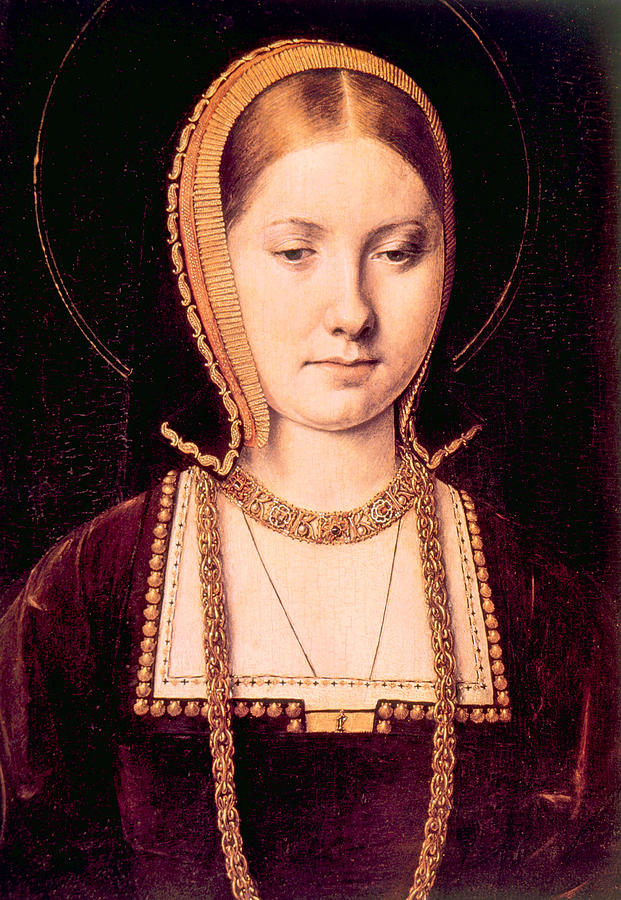
Fraser, Antonia.  The Wives of Henry VIII.  New York:  Alfred A. Knopf, 1992. Print.

Gairdner, James and R. H. Brodie (editors). “Henry VIII: December 1541, 11-20.” Letters and Papers, Foreign and Domestic, Henry VIII, Volume 16: 1540-1541 (1898): 671-681. British History Online. Web. 12 May 2013.

Gairdner, James and R. H. Brodie (editors). “Henry VIII: January 1542, 1-10.” Letters and Papers, Foreign and Domestic, Henry VIII, Volume 17: 1542 (1900): 1-9. British History Online. Web. 12 May 2013.

Hibbert, Christopher.  The Virgin Queen: Elizabeth I, Genius of the Golden Age.  New York: Addison-Wesley Publishing Company, Inc., 1991.  Print.

Hume, Martin. The Wives of Henry the Eighth and the Parts They Played in History. New York: McClure, Phillips & Co., 1905. Google Books, n.d. Web. 06 May 2013.

Lindsey, Karen.  Divorced, Beheaded, Survived:  A Feminist Reinterpretation of the Wives of Henry VIII.  Reading, Massachusetts:  Addison-WESLEY Publishing Company, 1995. Print.

Neale, J. E. Queen Elizabeth I. Garden City, NY: Doubleday, 1957. Print.

Ridley, Jasper. Elizabeth I: The Shrewdness of Virtue.  New York: Fromm International Publishing Corporation, 1989.  Print.

Somerset, Anne. Elizabeth I.  New York: Alfred A. Knopf, 1991. Print.

Starkey, David.  Six Wives: The Queens of Henry VIII.  London:  Chatto & Windus, 2003.  Print.

Strickland, Agnes. Life of Elizabeth, Queen of England, with Anecdotes of Her Court, from Official Records and Other Authentic Documents, Private as Well as Public. New York: Miller, [18-. Internet Archive. Web. 6 May 2013.

Strickland, Agnes, and Elisabeth Strickland. Lives of the Queens of England, from the Norman Conquest; with Anecdotes of Their Courts, Now First Published from Official Records and Other Authentic Documents, Private as Well as Public. Vol. 6. London: Henry Colburn, 1844. Google Books. Web. 15 Mar. 2013.

Weir, Alison.  The Six Wives of Henry VIII.  New York: Grove Weidenfeld, 1991. Print.

The Second Step-Mother to Elizabeth, Anne of Cleves

The Second Step-Mother to Elizabeth, Anne of Cleves

After the death of Jane Seymour, Henry began negotiations with European Royal houses.  Henry was still Catholic in the sense that he did not agree to reforms in the services of worship. In 1539 he had the Act of Six Articles drawn up which kept the traditional church teachings, especially the doctrine of transubstantiation. His advisors such as Cromwell and Cranmer did not relish a Catholic bride and steered Henry toward the Protestant countries and dukedoms.  The Duke of Cleves was a mild Protestant and had two unmarried sisters.  Anne was the ‘lucky’ bride. She was married to Henry in January 1540 and divorced six months later in July.

Cleves henry viii enthronedjpg
Henry VIII illustrated on his Marriage Proclamation to Anne of Cleves, January 5, 1540.

Tradition has passed down that Anne was so disgusting to Henry that he declared after first meeting her that “I like her not”.  Anne gets an unjustified description as ‘The Flanders mare’.  She was not as unattractive (we will not delve into the issue of painting by Hans Hoblein) as Henry’s supporters and biographers make out (for evidence consult the individual biographies referenced below). Their first meeting did not go well and Henry could not overlook her response.  He projected his shortcomings onto her. What had happened was, Henry full of romantic ideas of surprising his bride, entered her presence shortly after her arrival on the shores of England, disguised as a messenger.  Anne spoke few words of English, her ladies in waiting were complete foreigners, and no one advised her about Henry’s preference for masquerades which included coming upon ‘unsuspecting’ Courtiers in disguise. Startled by this muddied, elderly messenger acting very familiarly to her, Anne responded coldly and not with the delighted surprise Henry expected.

cleves holbien
The (in)famous Hans Holbein Painting, 1539

cleves miniture
Miniature attributed to Hans Holbein, 1539

Anne of Cleves
Attributed to Barthel Bruyn, 1540s

Not her features but perhaps the whole package was deemed lacking by Henry—a man captivated by the accomplishments Anne Boleyn learned at the Court of France.  Anne of Cleves, on the other hand, was reared to be a practical companion to a man with position and power, her talents of intelligence and common sense lent themselves to being a successful housewife.  Dancing, playing musical instruments, and speaking in foreign languages would not have been part of her upbringing.  Was she unattractive?  That debate we will leave behind.  This blogger believes Anne was probably attractive but “had no accomplishments whatever” that Henry found so necessary (Strickland 410).

14.236
Ceremonial bedhead created for the marriage of Henry and Anne

According to Gregorio Leti, an Italian historian writing in the late 1600s with access to documents that have since disappeared, Elizabeth wrote to her father about this time asking for permission to meet her new step-mother, Anne of Cleves.

I would like to caution us to accept Leti’s work with a touch of reserve. Mary Anne Everett Wood, a later historian, reminds us “the originals have perished, or are no longer accessible” (Wood 14).  Leti would have translated his sources into his native Italian and the only text available of his work is itself a French translation published in Amsterdam in 1694 titled, La Vie d’Elizabeth, reine d’Angleterre. This work was supposedly suppressed in England by royal authority.  The letter, which has no date or signature, written when Elizabeth would have been a little over six years old is below.

Madame,—I am struggling between two contending wishes—one is my impatient desire to see your Majesty, the other that of rendering the obedience, I owe to the commands of the King my father, which prevent me from leaving my house till he has given me full permission to do so.  But I hope that I shall be able shortly to gratify both these desires.  In the meantime, I entreat your Majesty to permit me to show, by this billet, the zeal with which I devote my respect to you as my queen, and my entire obedience to you as to my mother.  I am too young and feeble to have power to do more than to felicitate you with all my heart in this commencement of your marriage.  I hope that your Majesty will have as much good will for me as I have zeal for your service. (Queen Elizabeth I 21)

Anne showed the letter to the king and he would not let Elizabeth come to court.  Henry “took the letter and gave it to Cromwell” ordering him to write a reply.  “Tell her,” he said brutally, “that she had a mother so different from this woman that she ought not to wish to see her” (Weir 408). Whether or not the story is true, Henry did not withhold permission for long as Elizabeth was eventually brought to Court from Hertford Castle to meet Anne.

Leti reports that “Anne of Cleves, when she saw Elizabeth, was charmed by her beauty, wit and …that she conceived the most tender affection for her. Anne claimed that to have had Elizabeth “for her daughter would have been greater happiness to her than being queen” (Strickland Life of Queen Elizabeth I 15). This sentiment should not be diluted by the fact that Anne was queen for only six months.

When Henry could not evade the wedding, he became determined to divorce Anne as soon as he could. According to Martin Hume, when confronted about a previous marriage (a pre-contract to the Duke of Lorraine has been mentioned in many biographies but no marriage so I take this with a grain of salt) Anne replied, “Please your Majesty, it is true I was espoused to him, but when the Duke spoke to me about marrying your Majesty, he told me my husband was dead, and I know nothing more about it” (Hume 93). Hume continues that Henry, angry at the Duke of Cleves for giving him a married woman, called together his Council for advice on what to do.  The Council recommended a divorce and agreed he should make an allowance for Anne to live on after their marriage was dissolved.  “The lady took it pleasantly enough” (Hume 95).

cleves dedication
Rare document with the signature “Anna the Queen”

download
Most signatures are “Anna the Daughter of Cleves”

When the “conditions of her divorce were arranged, she (Anne) requested, as a great favour, that she might be permitted to see her (Elizabeth) sometimes” (Strickland Life of Queen Elizabeth I 15).  Henry agreed as long as Elizabeth addressed her as Lady Anne instead of Queen Anne (Lindsey 156).  Anne’s relationships and status were established by that new title.
Upon her divorce Anne retained a position in the family and Court with the status as the King’s Sister. She gained a sizable income “secured on the Cornish tin mines,” (Hume 95) plus lands and properties granted to her “to the value of £3,000* a year” (Strickland 419). Anne was given Richmond Palace, Hever Castle, Penshurst, Dartford Castle, a London residence, plus other estates such as the land-hold in Lewes.

richmond palace 001
Gate at Richmond Palace   

OLYMPUS DIGITAL CAMERA
Hever Castle

Anne Cleeves House in Lewes
Anne of Cleves House in Lewes, now a museum

Anne experienced considerable freedom and it appears as if she bore the loss of her husband quite cheerfully. She enjoyed her life in England learning to dance and play music, hunting, dressing in fine clothes and having a pleasant relationship with Henry.

Her amiableness is shown in her dedication to Henry in the Book of Hours, Salisbury 1533 “I beseche your grace huble when ye loke on this rember me. Yor graces assured anne the dowther off cleves” (Anne of Cleves).  In the modern translation: “I beseech your grace humbly when you look on this remember me.  Your grace’s assured Anne the daughter of Cleves.”

cleves book of hours
Dedication in the Book of Hours in Anne’s handwriting.  She gave this to Henry as a gift.  

cleves book of hours pictures
A decorated and illuminated page in the Book of Hours, Salisbury

This daughter of Cleves did have quite a unique status not only in England but in the scene of international politics.  Many could not define if she was free to marry and her brother put out feelers once in a while to consider her return to Cleves or create clarity in her position.  What I found interesting was the diplomatic dispatch, reprinted below, which the French Ambassador, Charles de Marillac, to the English Court sent to his king concerning the inquiry made by the Duke of Cleves after the arrest of Catherine Howard, the fifth wife of Henry VIII.

cleves william
William, Duke of Cleves

December 16, 1541 Marillac to Francis I 
Told by the ambassador of Cleves that, upon letters of credence from his master, he sought to speak with this King about lady Anne, but as the King’s grief did not permit it he yesterday went before the Council and, after declaring his master’s thanks for the King’s liberality to his sister, prayed them [to find] means to reconcile the marriage and restore her to the estate of queen. They answered, on the King’s behalf, that the lady should be graciously entertained and her estate rather increased than diminished, but the separation had been made for such just cause that he prayed the Duke never to make such a request. The ambassador asking to have this repeated, Winchester, with every appearance of anger, said that the King would never take back the said lady and that what was done was founded upon great reason, whatever the world might allege. The ambassador dared not reply, for fear that they might take occasion to treat her worse; but came to tell Marillac, because his master wrote that they would beg Francis to intercede. Thinks there are two courses open, either to intercede so dexterously as not to show that it is done with authority, and thus frighten the English into a league with the Emperor, or else to say nothing about it.  London, 16 Dec. 1541. (Gairdner XVI 678)

After Henry’s death, the financial situation of Anne of Cleves did change and there was talk of her returning to Cleves.  This, of course, came to nothing as she was at Court for Edward and Mary’s rule.

084
St. Augustine’s Abbey, Canterbury.  Anne and Elizabeth spent a great deal of time here. 

Throughout Mary’s reign, Anne and Elizabeth were often seen together. Starting on 30 September 1553 when they rode in a carriage during Queen Mary’s coronation procession.   They were together at the state banquet later too. “The two of them sat together at the end of the table, Elizabeth now heiress-presumptive to the throne, and Anna of Cleves’ precedence moved up to that of the third lady in the land”  (Fraser 409).

Although “Madam of Cleves always paid great honour to Madam Mary” (Hume 92), Anne did create controversy when she joined Elizabeth in not attending the Catholic Mass during the early part of Mary’s reign.  The Queen had words with Anne and she afterwards did attend services (Ridley 47).  Being so close to the same age, one could imagine how Anne and Mary could get along, but it was with Elizabeth that Anne shared the most affection until the day she died, 16 July 1557 at Chelsea Manor.

cleves tomb
Tomb of Anne of Cleves at Westminster Abbey

Anne’s last will and testament was not as bountiful as commentators would have expected.  She did leave some items to her step-daughters.  To Elizabeth she left some jewels with the hope that one of her ladies-in-waiting, Dorothy Curson, could join the younger woman’s household.

Anne’s influence may have extended further than imagined to the unmarried state of Elizabeth.  Somerset implies that witnessing her father’s distaste and rejection of Anne of Cleves and her brother-in-law Philip’s lack of respect and attraction for Mary, Elizabeth did not want to experience the same thing herself.  So as queen Elizabeth supposedly told Count Feria, the Spanish Ambassador, that she had “taken a vow to marry no man whom she has not seen, and will not trust portrait painters” (Somerset 92).

*The equivalent of £3,000 in 1540 would be worth £1,508,000 in 2010 currency of the retail price index. This was calculated using the website, Measuring Worth.com.

References

“Anne of Cleves’s Book of Hours.” -Folger Shakespeare Library. Folger Shakespeare Library, n.d. Web. 8 May 2013.

Elton, G. R. England Under the Tudors. Third ed. London:  Routledge, 1991. Print

Erickson, Carolly. The First Elizabeth. New York: Summit Books. 1983. Print.

Fraser, Antonia.  The Wives of Henry VIII.  New York:  Alfred A. Knopf, 1992. Print.

Gairdner, James and R. H. Brodie (editors). “Henry VIII: December 1541, 11-20.” Letters and Papers, Foreign and Domestic, Henry VIII, Volume 16: 1540-1541 (1898): 671-681. British History Online. Web. 12 May 2013.

Gairdner, James and R. H. Brodie (editors). “Henry VIII: January 1542, 1-10.” Letters and Papers, Foreign and Domestic, Henry VIII, Volume 17: 1542 (1900): 1-9. British History Online. Web. 12 May 2013.

Lindsey, Karen.  Divorced, Beheaded, Survived:  A Feminist Reinterpretation of the Wives of Henry VIII.  Reading, Massachusetts:  Addison-WESLEY Publishing Company, 1995. Print.

Neale, J. E. Queen Elizabeth I. Garden City, NY: Doubleday, 1957. Print.

Norton, Elizabeth.  Anne of Cleves:  Henry VIII’s Discarded Bride.  Stroud, Gloucestershire: Amberley Publishing, 2010. Print.

Queen Elizabeth I, Frank Mumby, and R. S. Rait. The Girlhood of Queen Elizabeth: A Narrative in Contemporary Letters. Boston: Houghton Mifflin, 1909. Google Books. Web. 9 May 2013.

Ridley, Jasper. Elizabeth I: The Shrewdness of Virtue.  New York: Fromm International Publishing Corporation, 1989.  Print.

Saaler, Mary.  Anne of Cleves:  Fourth Wife of Henry VIII.  London:  The Rubicon Press, 1995. Print.

Starkey, David.  Six Wives: The Queens of Henry VIII.  London:  Chatto & Windus, 2003.  Print.

Strickland, Agnes. Life of Elizabeth, Queen of England, with Anecdotes of Her Court, from Official Records and Other Authentic Documents, Private as Well as Public. New York: Miller, 1903 Internet Archive. Web. 6 May 2013.

Strickland, Agnes, Elisabeth Strickland, and Rosalie Kaufman. The Queens of England, Abridged and Adapted from Strickland’s “Queens of England” Chicago: Werner, 1895. Internet Archive. Web. 4 May 2013.

Weir, Alison.  The Six Wives of Henry VIII.  New York: Grove Weidenfeld, 1991. Print.

Warnicke, Retha. The Marrying of Anne of Cleves:  Royal Protocol in Tudor England. Cambridge: Cambridge University Press, 2000. Print.

Wood, Mary Anne Everett. Letters of Royal and Illustrious Ladies of Great Britain: From the Commencement of the Twelfth Century to the Close of the Reign of Queen Mary : Edited, Chiefly from the Originals in the State Paper Office, the Tower of London, the British Museum and Other State Archives. Vol. II. London: Henry. Colburn, 1846. Google Books. Web. 12 May 2013.

The First Step-Mother to Elizabeth, Jane Seymour

The First Step-Mother to Elizabeth, Jane Seymour

Bound to obey and serve.  That was the motto selected by Jane when she became queen.  Was it true or did she know that would be what Henry VIII would want?

Jane had been a lady-in-waiting to Anne Boleyn and her persona does not come to us very clearly via contemporary sources.  History has given her to be modest, virtuous, obedient, and accepting. She is seen as solid, pleasant, dignified and calm.  She is most often judged neither good nor bad.  Sadly, perhaps her character is viewed so positively because of the fact that she produced the longed-for heir and died before Henry became tired of her.

It is not the place here to go into details about Jane Seymour, her courtship with Henry and her death.  Nor enter the debate of whether she was spotted by Henry or was selected (fascinating discussion but one not necessary to this blog entry)

Physically we have paintings by Hans Holbein, in her lifetime, and several artists’ work, posthumously, plus the verbal description by the Spanish Ambassador, Eustace Chapuys who determined that “She is of no great beauty, so fair that one would call her pale.  The said Seymoure is not a woman of great wit, but she may have good understanding” (Lindsey 119).  Historians have given weight to Chapuys’ account since he was not a champion of Anne Boleyn and would have welcomed her fall.

jane holbien to use                   jane unkown

Famous Hans Holbein portrait       Unknown painter

That lack of wit but understanding does lead to the supposition that Jane could figure out how to deal with Henry.  But how could she not be worried about marring a man who had discarded one wife and killed another?  Her understanding had to extend to realizing the possible risk she was taking.

jane english
Jane attributed to The English School

Agnes Strickland does not perpetuate the image of the meek and docile bride as “we have so little that is favorable to relate of this queen” (Strickland 408).  Although Strickland will give Jane credit for being a discrete, beautiful young woman she does wonder if she was as heartless as her bridegroom.  Jane had to know what was happening in the Tower of London to Anne Boleyn while she was planning her marriage to Henry.  “The giddiness of youth cannot be pleaded as apology for Jane Seymour’s indecency, for she was no child when she permitted herself to be courted by the royal Bluebeard, and must have been entirely conscious of the enormity of her actions” (Strickland 403).  Jane’s actions led to her engagement to Henry the day after Anne’s execution and their marriage 10 days later.

We do know that as a step-mother, Jane treated Mary well and granted her special privileges while Elizabeth “was placed out of sight” (Erickson 31). Her motivation for championing Mary could have been kindness or as some believe social snobbery.

She wanted to have someone of her status at Court.  “Now that it hath pleased Your Grace to make me your wife, there are none but my inferiors to make merry withal, Your Grace excepted—unless it would please you that we might enjoy the company of the Lady Mary at court.  I could make merry with her” (Lindsey 132, Hume The Wives of Henry VIII 303).  Although this does not mesh with Polydore Vergil’s view that Jane was “a woman of the utmost charm both in appearance and character,” it is understood that Mary’s situation improved under Jane (Fraser 235). What of Elizabeth?

Martin Hume reported that, after Queen Jane had brought about the reconciliation between Henry and Mary, she fell to her knees and said, “Your Majesty knows how bad Queen Anne was, and it is not fit that her daughter should be Princess.  So the King ordered it to be proclaimed that in future none should dare to call her Princess, but madam Elizabeth” (Hume 72 -73).  This was only done after Henry implied that all the harm that had come to Mary, the humiliations and banishments had been from Anne Boleyn.  “My daughter, she who did you so much harm, and prevented me from seeing you for so long, has paid the penalty” (Hume 72). Therefore, several days after the wedding, The Lord Chancellor made a speech in Parliament about extolling the King’s virtues but ended “with the information that Anne Boleyn’s daughter was not heir to the throne of England” (Strickland 407).  This story appears to come from a Spanish merchant, Antonio de Guaras writing to King Philip II.  Many speculate that this was just wishful thinking on the part of the loyal Spaniard.

Elizabeth was not completely banished from Court. She was brought to Court along with Mary when Henry, faced with rebellion, felt it necessary to show a united front.   This public relations move was reported by Le Cardinal du Bellay Ambassador to the French Court.  He observed that rather than “soften the temper of the people” the peoples’ opinions were so fixed “they think of nothing but liberty. Madam Marie is now the first after the Queen, and sits at table opposite her, a little lower down, after having first given the napkin for washing to the King and Queen.  Madame Isabeau (Elizabeth) is not at that table, though the King is very affectionate to her.  It is said he loves her much” (Gairdner 346).

When Elizabeth was four, Jane gave birth to Edward.  At his baptism at Hampton Court, Mary was a godmother and Elizabeth held the chrisom cloth although she, in turn, was carried by Edward Seymour.  As known, Jane died shortly after the birth due to puerperal fever.  Mary was chief mourner at Jane’s funeral.  Elizabeth did not take part but that was probably due to her age.

jane h e
Posthumous rendering of Jane with Edward and Henry

References

Elton, G. R. England Under the Tudors. Third ed. London:  Routledge, 1991. Print

Erickson, Carolly. The First Elizabeth. New York: Summit Books. 1983. Print.

Fraser, Antonia.  The Wives of Henry VIII.  New York:  Alfred A. Knopf, 1992. Print.

Gairdner, James, ed. Letters and Papers, Foreign and Domestic, of the Reign of Henry VIII. Vol. 11. London: Longman, Green, Longman & Roberts, 1888. Google Books. Web. 4 May 2013.

Hume, Martin A. Sharp. Chronicle of King Henry the Eighth of England: Being a Contemporary Record of Some of the Principal Events of the Reigns of Henry VIII and Edward VI, Written in Spanish by an Unknown Hand ; Translated, with Notes and Introduction, by Martin A. Sharp Hume. London: George Belland Sons, 1889. Internet Archive. Web. 4 May 2013.

Hume, Martin. The Wives of Henry the Eighth and the Parts They Played in History. New York: McClure, Phillips & Co., 1905. Google Books, n.d. Web. 06 May 2013.

Lindsey, Karen.  Divorced, Beheaded, Survived:  A Feminist Reinterpretation of the Wives of Henry VIII.  Reading, Massachusetts:  Addison-WESLEY Publishing Company, 1995. Print.

Ridley, Jasper. Elizabeth I: The Shrewdness of Virtue.  New York: Fromm International Publishing Corporation, 1989.  Print.

Perry, Maria.  The Word of a Prince: A Life of Elizabeth from Contemporary Documents.  Woodbridge, Suffolk: The Boydell Press, 1990.  Print.

Ridgeway, Claire.  The Fall of Anne Boleyn.  UK:  MadeGlobal Publishing, 2012.  Print.

Somerset, Anne. Elizabeth I.  New York: Alfred A. Knopf, 1991. Print.

Starkey, David.  Six Wives: The Queens of Henry VIII.  London:  Chatto & Windus, 2003.  Print.

Strickland, Agnes, Elisabeth Strickland, and Rosalie Kaufman. The Queens of England, Abridged and Adapted from Strickland’s “Queens of England” Chicago: Werner, 1895. Internet Archive. Web. 4 May 2013.

Warnicke, Retha.  The Rise and Fall of Anne Boleyn.  Cambridge:  Cambridge University Press. 1998.  Print.

Weir, Alison.  The Six Wives of Henry VIII.  New York: Grove Weidenfeld, 1991. Print.

The Lion’s Grandcub: Conclusion

The Lion’s Grandcub: Conclusion:

Personalities
This blog has discussed in several entries the initial proposal that Henry VII and Elizabeth I were the Tudors who most closely resembled each other.  Discussions included many aspects: their physical appearance, their internships, their manner of rule and their basic accomplishments.

Similarities between Henry VII and Elizabeth Regina are easiest at the superficial level of their appearance.  Obviously, they were described at various times of their lives by numerous people (some perhaps being less subjective than others).  Their physiques were tall, slender, and strong.  Their features were narrow, high-browed, with prominent cheek bones and pale complexions.  For detailed descriptions of both Henry VII and Elizabeth Regina, based on primary sources, consult https://elizregina.com/2013/01/ the blog entry “Eat, Drink and Be Moderate”.

henry 7                 e1 like h7

Character sketches also invoke parallels.  Polydore Vergil’s description of Henry VII could easily be applied to his granddaughter.  Using words such as distinguished, wise, prudent, brave, shrewd, intelligent, and gracious along with praising a “pertinacious memory” (Vergilus 143-147).

Alison Weir’s description of Elizabeth could easily be applied to her grandfather.  Using words such as tenacity, cautious, realism, dissemble, parsimonious, dithering, and devious along with describing a “subtle brain” (Weir 17).

We know that like Henry VII whose speech was “gracious in diverse languages,” his “counseyelles fortunate and taken by wyse delyberacyon” and his “wytte always quycke and redy,” Elizabeth was also praised for her skill at languages, her wise counsel and quick wit (Fisher 269).

Lovers of Peace Not War
Throughout each of their reigns the negotiations undertaken by Henry and Elizabeth on the international level proved what lengths they would go to preserve peace.  Henry VII nor his granddaughter relished the cost of war in lives and money.  Gairdner declared that Henry made overtures to war only when it was “really forced upon him by the necessities of his position” (Gairdner 214).

Bacon was a bit more cynical and believed that Henry VII used “a noise of war” to gain funding from Parliament and so that a peace “might coffer up” (Bacon The Major Works 45).  It was the reality, “by refraining from war he ended solvent…”  (Loades 8).

francis bacon 
Sir Francis Bacon

He knew that “the way to peace was not to seem to be desirous to avoid wars: therefore would he make offers and fames of wars, till he had mended the conditions of peace” (Bacon and Lumby 212).  Henry called Parliament together to approve war with France, yet “in his secret intentions he had no purpose to go through with any war” (Bacon and Lumby 91).  For this he was praised at the end of his life for spending “many a day in pease and tranquyllyte” (Fisher 269).

Elizabeth is treated a bit more harshly by the historian James Anthony Froude.  He theorized that during the Scottish Rebellion if Elizabeth I had committed troops and money earlier thousands of lives and pounds would have been saved.  Rather than formulate an aggressive foreign policy to handle the international elements of this issue “she gravitated towards … peace” (Froude 409). “It was like dancing a tight rope.  Her movements may have been extremely clever, but they were also extremely dangerous” (Froude 443-444).

When peace negotiations did not work, both rulers turned to marriage alliances.  As a way to establish the legitimacy of their rule there was no faster way than to have a powerful, established foreign power seriously consider such a match with the Tudor Dynasty.  Weddings were far cheaper than wars.

Their preference for peace could have been their natural dispositions or political clemency. As seen in their handling of insurgents (Perkin Warbeck and Mary, Queen of Scots) both Henry VII and Elizabeth I were reluctant to execute.  Unless the security of the realm dictated otherwise, punishments were imprisonment, loss of lands and fines.

Perkin warbeck       mary scots
Perkin Warbeck                                      Mary, Queen of Scots

Renaissance Princes
Henry had reason to bolster the legitimacy of his claim to the English throne and Elizabeth had reason to bolster her right to the throne being declared an illegitimate child and as an unmarried woman.  Surprisingly one way these two rulers intended to establish the Tudor Dynastic legitimacy was through patronage of the arts.

“Henry assembled an impressive array of scholars and notables at his court, favouring the foreign-born rather than the native English” (Tucker 327).

“The King’s passion for music, court revels, sport, foreign scholarship, and more lowly amusements, reveals a keen interest in life and in the new intellectual currents which were transforming the Continent” (Tucker 331).  Consequently, many Continental elements “evolved to a distinct English form” and were manifested in the marriage celebrations of Arthur, Prince of Wales and Katherine of Aragon in 1501 (White 141).

Arthur_Prince_of_Wales            Katherine-of-aragon
Arthur, Prince of Wales                              Katherine of Aragon

Gordon Kipling persuades us that Henry VII felt compelled to display the “magnificence of his royal household and regime through calculated patronage of literature, drama, painting, music, glasswork, tapestry, and every aspect of cultural life…. Henry’s patronage …has been consistently undervalued” (White 141).

Henry employed humanistic tutors for his children.  The men at Oxford that Erasmus praised “were in the vanguard of the English humanists who were reforming education at both the secondary and university level” (Tucker 329).

erasmus1         oxforduniversity
Erasmus                                         Modern view of Oxford University

Royal daughters as well as royal sons were educated and we saw that carried through to Elizabeth’s own education. Here we must give her father, Henry VIII, and her mother, Anne Boleyn, credit for continuing Henry VII’s interests in classics, foreign languages, religion, art, music, dance and deportment.

H8 AB
Henry VIII and Anne Boleyn

While Henry can be credited with adding the secular classical themes of the Franco-Burgundian Court to England which encouraged alternative cultural elements, Elizabeth added national days, such as Accession Day, rather than religious days to the calendar which encouraged the Renaissance to take firm hold during her reign (Loades 71).

Jan van Dorsten argues that in Elizabethan England “patronage had declined to a very low ebb by the beginning of Elizabeth’s reign” which was certainly reversed by the end of her rule as “the use of patronage to secure political ends by Elizabeth’s courtiers was still intense in a political context”  (White 140).  Elizabeth’s Court is famous for patronizing troupes of actors, yet recognition as the first sovereign to sponsor troupes of dramatic players goes to Henry VII.

henry7manuscript2
Henry VII being presented with a manuscript on astrology

Lord Chamerlain's Men
The Lord Chamberlain’s Men, sponsored by the Lords Hunsdon until King James I took over patronage.

Elizabeth became the subject of many artists’ work from portraits, sonnets and famously, The Faerie Queene.  Decades earlier, Henry was compared to the legendary Hercules by Bernard Andre in the poem, Les Douze Triomphes de Henry VII (Tucker 328).

Andre became a tutor for Prince Arthur making true Gordon Kipling’s observation that “Artists in his [Henry VII’s] service became servants in his household…his artists were expected to enhance his estate through their poetry, pageantry, and paintings” (White 140).

Circumstances of Childhoods
Without getting into the ‘nature v. nurture’ debate, one must acknowledge that hereditary traits, physiological and psychological, are present in family members even when the people are not in close proximity (or one has died before the birth of descendants).  Also circumstances of a childhood can greatly effect a person.

The upbringings of Henry VII and Elizabeth I (discussed in earlier blogs, “Fate is Remarkable’ and “Persona Non Grata” at www.elizregina.com) taught them to be cautious.  “Always guarded in his dealings with others” (Jones 75), Henry’s caution came via military experience and living as a prisoner and political exile for most of his early life.  Elizabeth learned early to “keep her own counsel, control her emotions, and to behave circumspectly in public… ” (Weir 17).

Neither Henry nor Elizabeth was kept in the English public’s eye, so to speak, yet both managed to gain widespread support.  Henry, living away from England, lost familiarity with English politics.  Why so popular?  Was it his appeal or were people tired of war?

Elizabeth could have been seen as the calming answer to the religious upheaval from Queen Mary’s reign.  Regardless of why, somehow Henry and Elizabeth managed to convey a belief that they had the good of the people at heart.  It worked.  Years later Elizabeth would exclaim “I care not for myself; my life is not dear to me.  My care is for my people” (Elizabeth I).

While Henry learned his statecraft through the observations of Louis XI, The Spider, Elizabeth learned from William Cecil.  Henry’s policies of taxation and financial extractions, plus his use of men from the mercantile class as advisors and intelligence agents throughout his reign, came straight from ‘The Spider’ (Wilson 15).  Elizabeth adopted most of these ideas in a broad sense.  When she learned from William Lambarde, The Keeper of the Records at the Tower of London, about money lent to subjects for bond repayment, she exclaimed, “So did my good grandfather King Henry VII, sparing to dissipate his treasure or lands” (Rowse 56).

Louis Spider King            William Lambarde
Louis XI, The Spider               William Lambarde

Quotation of Psalms
Their religious and Latin studies emerged in a simplistic way as both quoted psalms at the crucial time of their rise to power.  When Henry landed on English soil he reportedly quoted Psalm 43:1, Judica me, Deus, et discerne causam meam de gente non sancta: ab homine iniquo et doloso erue me. Do me justice, O God, and fight my fight against an unholy people, rescue me from the wicked and deceitful man (Temperley 16).

Elizabeth is said to have whispered from Psalm 118:23 what she truly must have felt, “A Domino factum est istud et est mirabile in oculis nostris.” This is the Lord’s doing, and it is marvelous in our eyes.

e1 at prayer
Elizabeth Regina at prayer

Big Picture, Small Details
Having a strong general background on the lives of Henry VII and Queen Elizabeth this blogger decided on the topic series, The Lion’s Grandcub.  Comparing the two opened up avenues of study previously unexplored.  So many things were learned, so many more questions raised, so many hours diverted from other topics—what bliss for an amateur historian.

Perhaps the biggest surprise was the discovery of so many sources available digitally and in translation.  Of course, many primary sources are not objective and history tends to revise its opinion on past figures.  Regardless, research eventually taps all available resources and the historian, left to the mercy of said sources, is stopped.  That was not the case here. Instead this blogger had to restrain herself and resist continued inquiry into these fascinating characters of Henry VII and Elizabeth I.

Both sovereigns were intelligent, tenacious, independent, and dedicated. They strengthened the country through their appointment of capable advisors, promotion of the arts, fiscal policies and adherence to peace at home and abroad.  How easy to admire them as exceptional rulers in exceptional times.

Although this series is completed, this blogger is eagerly anticipating dealing with other topics concerning Elizabeth Regina.

References

Bacon, Francis.  The Major Works.  Ed. Brian Vickers. Oxford: Oxford University Press, 2002.  Google Books. Web. 9 Mar. 2013.

Bacon, Francis, and J. Rawson Lumby. Bacon’s History of the Reign of King Henry VII,. Cambridge: University, 1902. Internet Archive. Web. 22 Jan. 2013.

Carpenter, Christine. The Wars of the Roses: Politics and the Constitution in England, C. 1437-1509. Cambridge: Cambridge University Press, 1997. Google Books. Web. 21 Apr. 2013.

Elizabeth I. ed. Chamberlain, Frederick.  The Sayings of Queen Elizabeth I.  Londo:  Dodd, Mead & Company: New York, 1923.  Google Books.  Web.  11 Mar. 2013

Fisher, John, and John E. B. Mayor. “Sermon Sayd in the Cathderall Chyrche of Saynt Poule within the Cyte of London the Body Being Present of the Moost Famous Prynce Kyng Henry the VIII, 10 May MCCCCCIX. Enprinted by Wynkyn De Worde 1 H. VIII.”The English Works of John Fisher, Bishop of Rochester. London: N. Trübner for the Early English Text Society, 1876. 268-88. Google Books. Web. 1 Dec. 2012.

Froude, James Anthony. History of England from the Fall of Wolsey to the Defeat of the Spanish Armada. London: Longman, Green, 1908. Google Books. Web. 10 Mar. 2013. 

Frye, Susan.  Elizabeth I:  The Competition for Representation. Oxford:  Oxford Univseity Press. 1993. Print.

Gairdner, James. Henry the Seventh,. London: Macmillan, 1889. Google Books. Web. 26 Nov. 2012.

The History of the Life and Reign of That Excellent Princess Queen Elizabeth from Her Birth to Her Death: As Also the Trial, Sufferings, and Death of Mary Queen of Scots. With the Whole Proceedings of the Divorce of King Henry VIII. from Queen Catherine; His Marriage with the Lady Anne Bullen, and the Cause of Her Unfortunate Death on the Scaffold. London: Printed, and Sold by the sellers in Town and Country, 1739. Google Books. Web. 9 Mar. 2013.

Jones, Michael K. and Malcolm G. Underwood.  The King’s Mother: Lady Margaret

Beaufort, Countess of Richmond and Derby. New York: Cambridge University Press. 1992. Print.

Loades, David, ed. The Tudor Chronicles: The Kings.  New York: Grove Weidenfeld, 1990.  Print.

Rowse, A. L. The England of Elizabeth; the Structure of Society. New York: Macmillan, 1951. Google Books. Web. 20 Feb. 2013.

Temperley, Gladys. Henry 7. London: Constable, 1917. Google Books. Web. 20 Feb. 2013.

Thornton, Tim. Prophecy, Politics and the People in Early Modern England. Woodbridge: Boydell, 2006. Google Books. Web. 2 Feb. 2013.

Thomas, Heather, M.Phil. “Elizabeth R.” Elizabeth I’s Pastimes. Self-Published, 27 Sept. 2012. Web. 21 Apr. 2013.

Tucker, M. J. “Life at Henry VII’s Court.” History Today. History Today.com, n.d. Web. 4 Feb. 2013.

Vergilius, Polydorus, and Denys Hay. The Anglica Historia of Polydore Vergil: A.D. 1485-1537. Google Books.  Web. 2 Jan. 2013.

Weir, Alison.  The Life of Elizabeth I.  New York: Ballatine Books, 1998. Print.

White, Paul Whitfield., and Suzanne R. Westfall. Shakespeare and Theatrical Patronage in Early Modern England. Cambridge, UK: Cambridge UP, 2002. Google Books. Web. 17 Feb. 2013.

Wilson, Derek. “Web of Intrigue.” History Today 63.4 (2013): 10-16. Print.

Reigned With Your Loves

Reigned with Your Loves

Connections and service, be they within personal or formal relationships, create loyalty.  Loyalty which can be demonstrated in many ways.  Both Henry VII and Elizabeth Regina developed heightened abilities in sensing gifted allies to serve them.  Perhaps the skills were honed during their times of confinement (Henry in Brittany and Elizabeth at Hatfield) or they were innate.  Regardless, each surrounded themselves with talented, loyal councilors. 

Henry knew that if England was to recover and the throne was to become stable, the War of the Roses would have to end and healing would have to take place.  What was required now was for the king to be resolute and to act with “judicious mercy, the mercy of head not heart.”  Henry VII was to display clemency and firmness by his “reluctance to proceed to extremes and his readiness to accept old enemies into the fold.”  Actions which “display his determination to show that the wars were over” (Elton 16).

Henry not only utilized Lancastrian loyalists, gentry from his native Wales, and fellow exiles, he also incorporated the Yorkist faction in his new government.  He knew he must not further antagonize the opposition.  Therefore, he pardoned men who had fought at Bosworth against him, and allowed them to enter government positions, even granting them property, if they took the oath of allegiance.  He approached the many Woodville Yorkists cautiously as he did not want to be indebted to them nor to give the impression he reigned in any name but his own– meaning he did not want to appear to have need of Elizabeth of York’s family ties to strengthen his claim. “As a new man, Henry had to secure his place.  He did this by a compromsing approach” (Bacon and Weinberger 238).

Henry had little knowledge of England and its government workings as he had been in exile for so many of his formative years.  He was even unprepared for the responsibilities and life of a king. He thus relied heavily on the associates of his youth and those men who had joined him in exile along with many advisors from his mother’s household.

margaret beaufort

Margaret Beaufort

Henry and his mother, Margaret Beaufort, recognized the need for experienced men to provide council.  Therefore, her household became a basis for Henry to draw officials from such as Christopher Urswick and Reginald Bray.  Many of his contemporaries recognized that service his mother could easily lead to a royal appointment.  Henry viewed service to his mother almost as those who served him “during his period of exile, as a debt of honour” (Jones 80).

Needing men of experience also meant he had to appoint those who had been in England and not exiled—people familiar with the ways of England.  Therefore, a mix of noblemen, gentry, lawyers and clerics were used to comprise Henry VII’s Council (Loades 30).  Henry did not want to give too much power to the men with governmental experience. He kept the nobles contained and “chose rather to advance clergymen and lawyers, which were more obsequious to him…” (Bacon and Lumby 217). These men recognized for their talents were more grateful to the king.

Henry was adamant about allegiance and service.  The men he appointed were “loyal and ardent servants of an exacting but worthy master” (Elton 17).  Despite his harshness, “Henry showed himself capable of attracting men to his side and retaining their loyalty…”  (Griffiths 168).

Star Chamber H7 seated

Henry VII, seated in the Star Chamber

“Like all his family he had an uncanny gift for picking men to serve him, and not even the great Elizabeth surrounded herself with a brighter galaxy of first-rate ministers than did her grandfather” (Elton 17). It is not the purpose here to list every member of Henry’s Privy Council, the focus will be on those he relied upon early in his reign.  Below, in chart form, are listed the pertinent advisors and servants.

Councilors Serving Henry VII

Councilor / Servant

Role

Miscellaneous

Jasper Tudor, Duke of Bedford Military advisor and commander paternal uncle to Henry, took him into exile
John de Vere, 13th Earl of Oxford Military advisor and commander shared exile and influntial as nobleman
Sir Giles Daubeney Chancellor shared exile and very influential
Cardinal John Morton—Archbishop of Canterbury Lord Chancellor financial advisor/innovator dare we say exploiter
Bishop Richard Fox Lord Privy Seal shared exile, very influencial after Morton’s death
Bishop Peter Courtenay Keeper of the Privy Seal shared exile
Bishop William Warham Master of the Rolls and later Lord Chancellor performed many diplomatic missions
Sir Reginald Bray Courtier acquired from Margaret Beaufort’s advisors,very influential and architect of Henry VII’s Chapel at Westminster Abbey and St. George’s Chapel, Windsor
Christopher Urswick Courtier acquired from Margaret Beaufort’s advisors
Sir John Heron Treasurer of the Chamber shared exile and one of the most trusted advisors
Sir Edward Belknap Surveyor of the King’s Prerogative could confiscate anyone’s land that overtook the King’s prerogative
Richard Empson Carried out Cardinal Morton’s financial policies arrested under Henry VIII for unpopular financial activities
Edmund Dudley Carried out Cardinal Morton’s financial policies executed under Henry VII for unpopular financial activitiesGrandfather to Robert Dudley, Earl of Leicester
Sir Thomas Lovell Treasurer of the Chamber shared exile and one of the most trusted advisors
Sir Richard Guildford Chamberlain of the Receipt shared exile and one of the most trusted advisors
Thomas Rotherham, Archbishop of York Lord Chancellor experience in previous reigns, did not serve Henry very long
John Alcock, Bishop of Worcester Lord Chancellor experience in previous reigns, bridge between Edward IV, Richard III and Henry’s rule
Sir Thomas Stanley, 1st Earl of Derby High Constable of England Henry’s step-father
Sir Edward Woodville Courtier brother to the Queen Dowager, military leader
Sir William Stanley, Lord Chamberlain brother to Henry’s step-father, executed for treason over Perkin Warbeck

jasper tudor           gilesdubeney

Jasper Tudor                                          Giles Daubeney

Cardinal_John_Morton               Richard Fox       

John Morton                                                           Richard Fox

    Peter Courtenay     williamwarham

                 Peter Couetenay                                William Warham

chrisurswick              thomas lovell

Christopher Urswick                                     Thomas Lovell  ThomasRotherham             John Alcock

Thomas Rotherham                                          John Alcock

Thomas-Stanley

 Thomas Stanley

“Henry became practiced in awarding empty honours and rewards to the deserving, which gratified the receivers and heightened their loyalty to him without increasing their actual strength” (Ross 19). Minor merchants or officials who had helped him in one way or another were rewarded as well—prudently. Henry was not a man to throw money around and, although he was generous, it was not beyond his means or beyond what was suitable. e rewarded people who had served his father and other Welsh followers, had helped his mother and even those who had served his revered uncle, Henry VI. (Griffiths 175). 

Machiavelli wrote that a prince should be feared over loved although it would be ideal to be able to be both. In Henry VII’s case it appears as if he did not manage fear and love.  Down the ages we have Edmund Dudley’s treatise, Tree of the Common Wealth, written in defense of absolute monarchy as applied to Henry VI.  Dudley defended Henry’s actions (and maybe reflecting Henry’s views) by stating that if the King was lenient to his subjects “in all cases let them … psume to take it of theire owne authoritie, for then it will surelie choke them” (Dudley 28). 

Henry did set the path for his administration although Bacon proclaimed that Cardinal Morton and Sir Reginald Bray not only reflected Henry’s views but “did temper them” (Bacon 214).  Whereas Empson and Dudley, middle-ranking servants who rose to prominence by being men who “best content the king” (Penn 33), did not moderate his policies, especially financial, “but shaped his way to those extremities, for which himself was touched with remorse at his death….” (Bacon 214).

It is well-known that many of Henry’s financial practices were disliked by his people.  Bacon proclaimed that ” of the three affections which naturally tie the hearts of the subjects to their sovereigns, love, fear, and reverence; he had the last in height, the second in good measure, and so little of the first, as he was beholden to the other two” (Bacon and Lumby 218). Financial acts were not popular with anyone but the benefits of his stable rule, his courts of law and justice did benefit everyone and they knew it too.

EmpsonHenryDudley

Henry VII, Richard Empson and Edmund Dudley

By implying to the people that civil war would happen if they lost him, Henry maintained stability.  Another method he consciously employed to control his ministers was in the journal he kept of his thoughts. It included notes he wrote while in conversation with ministers, diplomats and advisors about whom to reward and whom to watch—this was similar to his granddaughter.  Elizabeth Regina kept mental notes of conversations and events she engaged in with her ministers to utilize if necessary in future dealings.

Elizabeth “kept her advisers off balance and perpetually astonished them by the range and mutability of her passions.  Beyond this, they came to know that, with Elizabeth, nothing was ever what it seemed.  Beneath her surface emotions were layer upon calculating layer of secondary reactions, ploys and schemes” (Erickson 173). She enjoyed laying traps for her ministers, throwing back at them their own words.  Yet, they were devoted to her, perhaps because of her political, intellectual and interpersonal skills.  An example could be from the way she handled the ex-ministers of Mary’s reign.  Elizabeth greatly reduced the number of advisors and assured those that had served Mary that they were not retained because she wanted a smaller group to make it more manageable and less open to faction, not because of any deficit on their part (Neale 55).

Battles for Court positions were based on “loosely structured groups focusing on family, household, and master-servant connections…” (Warnicke 135).   Some men were ambitious seeking power and money, others were honored to serve.  Or, as Mervyn James has shown, “the ties of blood were liable to assert themselves with a particular power” (James 325). 

As Queen, Elizabeth did not forget those who were still alive and had served her mother, Anne Boleyn. William Barlow was created Bishop of Chichester; William Latymer, became Dean of Peterborough under Elizabeth and author of Chronickle of Anne Bulleyne; and Matthew Parker appointed Archbishop of Canterbury.  Parker had been chaplain to Anne Boleyn.  Although he did not want to take the Archbishopric, he did so based on a promise he had made to Anne shortly before her death to watch out for the spiritual needs of her daughter.

Like her grandfather, Elizabeth kept her beloved servants of her childhood and youth.  She knew the Privy Council, the body that held up the authority of the Crown and was key to forming royal policy, should be conciliatory to the previous reign and diverse.  In respect to the first consideration, Elizabeth retained 10 ministers from Mary’s reign. Taking a page from her grandfather, she kept members of the opposing faction in her council. Whereas his were Lancaster and York, hers were Catholic (Marian) and Protestant (Elizabethan). 

For diversity, as did Henry, she promoted gifted men of the professions, many who had never held high office before, while keeping a balance of nobles and clergy.  Her main criteria appeared to be efficiency, talent and loyalty.  She wanted advisors who would give good counsel and ones she could trust.  

It is not the purpose here to list every member of Elizabeth’s Privy Council, the focus will be on those she relied upon early in her reign.  Below, in chart form, are listed the pertinent advisors and servants.

                                    Councilors Serving Elizabeth Regina 

Councilor / Servant

Role

Miscellaneous

Edward Stanley, 3rd Earl of Derby High Chamberlain served Mary, kept due to prominent role in nobility
Francis Talbot, 5th Earl of Shrewbury Courtier and Privy Council Member served Mary, kept due to prominent role in nobility—died within 2 years, son George famously married Bess of Hardwick and was custodian of Mary, Queen of Scots as 6th Earl
Henry FitzAlan, 19th Earl of Arundel High Constable and Lord Steward served Mary, kept due to prominent role in nobility as relative to Woodvilles and Percys.
Henry Herbert, 2nd Earl of Pembroke Lord Lieutenant served Mary, kept due to prominent role in nobility as husband to Lady Katherine Grey
William Howard, 1st Baron Howard of Effingham Lord Admiral and Lord Chamberlain served Mary, Elizabeth’s great-uncle and defender in Marian court
William Paulet, Marquis of Winchester Treasurer and Speaker of the House served Mary, great administrator
Edward Clinton, later Earl of Lincoln Lord Admiral andAmbassador to France served Mary, he was Lord Admiral and capable
Sir John Mason Diplomat and Chancellor of Oxford University served Mary, was knighted as public servant
Sir William Petre Secretary of State served Mary, lawyer & tutor to George Boleyn rose rapidly and was knighted
Sir Nicholas Wotton Diplomat served Mary, commoner and cleric
Sir Thomas Parry Comptroller of the Household Elizabeth’s steward since childhood, relative to Cecil,  in household at Hatfield and later knighted
Sir Richard Sackville Chancellor of the Exchequer Elizabeth’s relative as his mother was cousin to Anne Boleyn, had experience during Edward’s time
Sir Francis Knollys Vice-Chamberlain of the Royal Household Elizabeth’s relative as he married her cousin the daughter of Mary Boleyn, served Edward and a staunch Protestant
Sir Nicholas Bacon Lord Keeper of the Great Seal an attorney—very capable and had been in Edward’s Court, father to Francis
William Cecil, 1st Baron Burghley Secretary of State later Lord High Treasurer served Elizabeth during Mary’s reign while maintaining a position at CourtBacon’s brother-in-law
Francis Russell, 2nd Earl of Bedford Diplomat created into Peerage, staunch Protestant and collector—Armada Portrait at Woburn Abbey—godfather to Francis Drake
William Parr,1st Marquis of Northampton Courtier created into Peerage, brother to Katherine Parr
Sir Edward Rogers Comptroller served Edward and was in Elizabeth’s household at Hatfield
Sir Ambrose Cave connection of Cecil’s, and was in Elizabeth’s household at Hatfield
Robert Dudley, Earl of Leicester Master of the Horse later Privy Council Member known to Elizabeth since childhood, held in Tower concurrently, became principle favorite
Henry Carey, Lord Hunsdon Courtier later Privy Council Member Elizabeth’s cousin (son of aunt Mary Boleyn) given many positions
John Ashley Courtier husband of her governess, Kat Ashley
John Fortescue Courtier relative of Thomas Parry
Sir William St. Loe Courtier accused at time of Wyatt rebellion
Sir James Crofts Courtier accused at time of Wyatt rebellion, was a practicing Catholic
Edward de Vere, 17th Earl of Oxford Lord Great Chamberlain at 12 his wardship was handed over to Cecil from Elizabeth, inclined toward Catholicism, some believe he is “Shakespeare”
Sir Francis Walsingham Principal Secretary known as ‘spy master,’ loyal, yet very out-spoken
Thomas Radclyffe, 3rd Earl of Sussex Courtier and Lord Lieutenant of Ireland distantly related to Elizabeth, served Mary
Sir Christopher Hatton Courtier later Privy Council Member rose to prominence after Elizabeth saw him dance at Court, called “the Dancing Chancellor”, very devoted
Sir Thomas Wilson Diplomat and Judge later Secretary of State associate of the Dudleys, wrote Arte of Rhetorique which set English style

edstanley          Henry FitzAlan 19thEarlOfArundel

Edward Stanley                                                     Henry FitzAlan

Henry Herbert EarlOfPemboke         HOward of Effingham

Henry Herbert                                              William Howard

NPG 65,William Paulet, 1st Marquess of Winchester,by Unknown artist       edclinton

William Paulet                                               Edward Clinton

WilliamPetre           Nicholas_Wotton

William Petre                                                     Nicholas Wotton

Thomas Parry    francisknollys

Thomas Parry                                              Francis Knollys

bacon nicoholas     cecil william

Nicholas Bacon                                             William Cecil

Russell,Francis(2EBedford)01       william parr

Francis Russell                                                   William Parr

robertdudley       henrycarey1

Robert Dudley                                                   Henry Carey

johnfortseque          Edward-de-Vere-1575

John Fortesque                                            Edward de Vere

walsingham       Thomas_Radclyffe_Earl_of_Sussex

Francis Walsingham                               Thomas Radclyffe

chrishatton       thomas wilson

Christopher Hatton                                  Thomas Wilson

At the beginning of her reign, Elizabeth proclaimed “I mean to direct all my actions by good advice and counsel” (Marcus 52).  I believe this does not mean she meant to bend to the will of her ministers.  She had received a humanist education similar to many of her advisors and she knew she ruled.  In her speech to her councilors shortly before her Coronation she assured them she would take advice from them and knew what a good team they would all be: “I with my ruling and you with your service may make a good account to almighty God…” (Marcus 52).

Personal relationships between monarchs and their council members were a big part of the appointments more than just political views—thus the factions that could emerge and the debates. Lord Burghley helped set the tone for the Privy Council as reported by Francis Peck: “He would never deliver his opinion in council, but when he might freely debate it” (Peck 43). 

Elizabeth did permit differences of opinion and allowed council members to make comments. She respected independent thought (look at the type of men she appointed).  Her council became more fiery and diverse in later years (especially the final 15 years of her rule as many of the early advisors died) but this conciliatory, initial one proved effective and wise under the leadership of the experienced William Cecil.  While teaching Elizabeth the art of statecraft, Cecil devoted himself to her, England and the Protestant cause. Once when he offered to resign after a disagreement, he requested that he be able to “serve her Majesty elsewhere, be it in kitchen or garden” (Brimacombe 63). 

She did consult her advisors but she also knew her own mind.  One has to give her credit for appointing such able councilors.  Yet, how did she hold their loyalty?  Similarly to her grandfather, she did not give excessive rewards, she was often harsh, she could be unkind, yet they were devoted to her. She had courage, subtlety, intelligence and charisma.  

Elizabeth loved a crowd and performed well in front of one.  She always had a rejoinder for the comments made by the people when she was out in public.  She seemed friendly and approachable while still retaining her dignity. Throughout her entire reign, when she went on progress the countryside filled with people eager to catch a glimpse of her on the road.  This was devotion above and beyond fear of majesty and her relatively tolerant rule. “When she smiles, it was a pure sunshine that everyone did choose to bask in if they could” said Sir John Harington (Hibbert 117).

johnharington

John Harington

John Hayward, a contemporary, wrote of her entry into London and her first few weeks as queen that “if ever any persone had eyther the gift or the stile to winne the hearts of people, it was this Queene; and if ever shee did expresse the same, it was at that present, in coupling mildnesse with majesty as shee did, and in stately stouping to the meanest sort” (Hayward 6).

progress1

Elizabeth on Progress

The feeling was mutual.  She commented to a French diplomat late in her reign concerning her people’s affection that “it seems incredible, and I love them no less, and I can say that I would rather die than see any diminution of it on one side or the other” (Sitwell 75).  As she famously exclaimed in her Golden Speech, “…though God hath raised me high, yet this I count the glory of my Crown, that I have reigned with your loves” (Marcus 337).

References

Bacon, Francis. The Works of Francis Bacon, Baron Verulam, Viscount of St. Albans, and Lord High Chancellor of England. Vol. 5. London: Printed for M. Jones, 1818. Google Books. Web. 6 Apr. 2013.

Bacon, Francis, and J. Rawson Lumby. Bacon’s History of the Reign of King Henry VII,. Cambridge: University, 1902. Internet Archive. Web. 22 Jan. 2013.

Brimacombe, Peter.  All the Queen’s Men: the World of Elizabeth I.  Stroud: Sutton Publishing, 2000.  Print.

Cecil, Lord Burghley, William, Sir. Queen Elizabeth and Her Times: A Series of Original Letters Selected from the Inedited Private Correspondence of the Lord Treasurer Burghley, the Earl of Leicester, the Secretaries Walsingham and Smith, Sir Christopher Hatton and Most of the Distinguished Persons of the Period : In Two Volumes. Ed. Thomas Wright. London: Colburn, 1838. Google Books. Web. 10 Mar. 2013.

Doran, Susan and Norman Jones. The Elizabethan World. London: Routledge, 2011. Print.

Doran, Susan.  The Tudor Chronicles 1485-1603.  New York:  Metro Books, 2008. Print.

Dudley, Edmund. The Tree of Common Wealth: A Treatise. Manchester London: C. Simms & Co., 1859. Google Books. Web. 1 Apr. 2013.

Elton, G. R. England Under the Tudors. Third ed. London:  Routledge, 1991. Print.

Griffiths, Ralph A. and Roger S. Thomas.  The Making of the Tudor Dynasty.  New York: St. Martin’s Press, 1985. Print.

Hayward, John, and John Bruce. Annals of the First Four Years of the Reign of Queen Elizabeth. London: Printed for the Camden Society by J.B. Nichols and Son, 1840. Google Books. Web. 19 Jan. 2013.

Hibbert, Christopher.  The Virgin Queen: Elizabeth I, Genius of the Golden Age.  New York: Addison-Wesley Publishing Company, Inc., 1991.  Print.

Hutchinson, Robert. Young Henry: The Rise of Henry VIII. London: Weidenfeld & Nicolson, 2011. Google Books. Web. 02 Dec. 2012.

James, Mervyn. Society, Politics, and Culture: Studies in Early Modern England. Cambridge [Cambridgeshire: Cambridge UP, 1986. Web. 6 Apr. 2013. 

Jones, Michael K. and Malcolm G. Underwood.  The King’s Mother: Lady Margaret Beaufort, Countess of Richmond and Derby. New York: Cambridge University Press, 1992. Print.

Loades, David, ed. The Tudor Chronicles: The Kings.  New York: Grove Weidenfeld,1990.  Print.

MacCaffrey, Wallace. Elizabeth I. London: E. Arnold. 1993. Print.

Neale, J. E. Queen Elizabeth I. Garden City, NY: Doubleday, 1957. Print.

Nichols, John. Gentleman’s Magazine … Vol. 163. London: William Pickering; John Bowyer Nichols and Son, January to June Inclusive,1833. Google Books. Web. 2013.

Norton, Elizabeth.  Margaret Beaufort: Mother of the Tudor Dynasty.  Stroud: Amberley, 2010. Print.

Peck, Francis. Desiderata Curiosa:  Or, a collection of divers scarce and curious pieces relating chiefly to matters of English history; Consisting of Choice Tracts, Memoirs, Letters, Wills, Epitaphs, & Transcribed, Many of them, from the Originals Themselves, and the Rest from Divers Antient MS. Copies, or the MS. Collections of Sundry Famous Antiquaries and other Eminent Persons, both of the Last and Present Age: the whole, as Near as Possible, digested into an Order of Time, and Illustrated with Ample Notes, Contents, Additional Discourses, and a Complete Index.  By Francis Peck, M..A. Rector of Godeby Near Melton in Leicestershire.  Adorned with Cuts.  A new edition, greatly corrected, with some memoirs of the life and writings of Mr. Peck.  Vol. 1. London: Thomas Evans in the Strand, 1732. Google Books. Web. 30 Mar. 2013. 

Penn, Thomas.  Winter King; the Dawn of Tudor England.  New York: Penguin Books, 2012. Print.

Ridley, Jasper. Elizabeth I: The Shrewdness of Virtue.  New York: Fromm International Publishing Corporation, 1989.  Print.

Ross, Josephine.  The Tudors, England’s Golden Age.  London: Artus, 1994.  Print. 

Sitwell, Edith.  The Queens and the Hive.  Harmondsworth: Penguin Books, 1966. Print.

Somerset, Anne. Elizabeth I.  New York: Alfred A. Knopf, 1991. Print.

Warnicke, Retha M. The Rise and Fall of Anne Boleyn.  Cambridge: Cambridge University Press, 1989. Print.

Wilson, A. N.  The Elizabethans.  London: Hutchinson, 2011. Print.